ADA Code for Curodont: A Practical Guide for Dental Practices
When you are trying to provide the best preventive care for your patients, few things are as frustrating as sitting down to submit a claim and realizing you are not sure which code to use. You have just spent twenty minutes placing Curodont Repair or Curodont Protect, confidently telling your patient that this is the future of minimally invasive dentistry. But now, staring at your practice management software, you hit a wall. Is this a D1354? A D2990? Or something else entirely?
You are not alone. In the world of dental insurance and procedure coding, “new” often means “unclear.” For the last several years, the question of the correct ADA code for Curodont has been one of the most frequent—and debated—topics in dental hygiene and clinical forums.
The short answer is that there is no single ADA code exclusively named “Curodont.” However, there are established codes that accurately describe what Curodont products do. Using the correct one is essential not only for getting paid but for maintaining accurate clinical records.
This guide will walk you through everything you need to know about coding for Curodont. We will cut through the confusion, look at the specific products (Curodont Repair and Curodont Protect), explore the most appropriate Current Dental Terminology (CDT) codes, and discuss the realistic landscape of insurance reimbursement.
Whether you are a dentist, a dental hygienist, or the office manager handling billing, consider this your essential reference. Let’s turn that frustration into clarity.
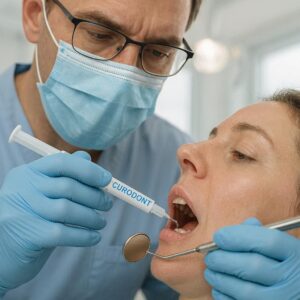
What is Curodont? A Quick Clinical Primer
Before we dive into the billing aspect, it is helpful to step back for a moment and remember exactly what we are dealing with clinically. The code you choose must reflect the service you performed. If the description of the code doesn’t match the clinical reality of the procedure, you are opening the door for audits and claim denials.
Curodont, manufactured by Curodont (formerly known as Curodont Repair and Protect), is part of a new wave of biomimetic and minimally invasive dentistry. It is not a traditional filling, and it is not a fluoride varnish in the conventional sense.
There are two primary products in the Curodont family that you are likely billing for:
-
Curodont Repair: This is a peptide-based technology designed to reverse early caries (non-cavitated lesions). It uses a self-assembling peptide (P11-4) that penetrates the enamel subsurface and acts as a scaffold, guiding natural remineralization. It essentially rebuilds the enamel structure from the inside out. It is indicated for initial proximal and smooth surface caries.
-
Curodont Protect: This is a fluoride varnish with a unique composition (CPP-ACP and fluoride) designed to create a protective barrier and support the remineralization of enamel and exposed dentin. It is often used for hypersensitivity management and as a preventive agent for high-risk patients.
Because these products are therapies rather than traditional restorations, the coding landscape requires a bit of finesse. You are not “drilling and filling,” nor are you simply applying a generic fluoride tray.
The Core Question: Which ADA Code for Curodont?
Let’s get straight to the point. When you search for the ADA code for Curodont, you will find that the American Dental Association (ADA) does not maintain a proprietary code for specific brand names. Instead, they provide CDT codes for procedures.
Based on the clinical actions described above, there are three main codes that are generally accepted as appropriate for Curodont applications. However, the “correct” one depends entirely on what you are treating and why.
H2: D1354 – Interim Caries Arresting Medicament Application
This is arguably the most common code associated with Curodont Repair, and it is the one most practices reach for first.
What the code describes: D1354 is defined as the “interim caries arresting medicament application.” This involves the application of a medicament to arrest or reverse non-cavitated carious lesions. The key phrase here is “interim,” but in practice, it is used for definitive treatment of incipient lesions.
Why it fits Curodont Repair:
Curodont Repair is explicitly designed to arrest and reverse non-cavitated lesions. The peptide scaffold technology fits the definition of a “medicament” perfectly. You are applying a substance to a lesion site (proximal or occlusal) to halt the progression of decay and encourage remineralization.
Important Note:
Insurance companies often view D1354 as a “silver diamine fluoride” (SDF) code. Because SDF is the most common application for this code, many insurers have specific limitations. They may:
-
Deny D1354 on posterior teeth.
-
Deny D1354 if the patient has already had a fluoride varnish (D1206) on the same day.
-
Require radiographic evidence of the non-cavitated lesion.
If you are using Curodont Repair for proximal lesions (which is its primary indication), D1354 is your strongest starting point.
H2: D1206 – Topical Application of Fluoride Varnish
This is the code most associated with Curodont Protect.
What the code describes: D1206 covers the topical application of fluoride varnish. This is a standard preventive service typically performed by a hygienist during a prophylaxis visit.
Why it fits Curodont Protect:
Curodont Protect is a fluoride varnish. While it contains unique ingredients (CPP-ACP) that enhance its efficacy, its method of delivery and primary preventive function align with the definition of D1206. It is applied to all teeth to prevent demineralization and manage hypersensitivity.
The Reality Check:
While D1206 is a common and well-reimbursed code, using it for Curodont Protect may be met with a question from insurance adjusters: Why are you using a premium varnish when a standard 5% NaF varnish is available?
-
Most insurances pay a flat fee for D1206 regardless of the brand used.
-
If you are using Curodont Protect specifically for hypersensitivity rather than general prevention, you might consider alternative codes like D9910 (see below).
H2: D9910 – Application of Desensitizing Medicament
This is a great alternative code, particularly for Curodont Protect when used for sensitivity, or for Curodont Repair in specific isolated cases.
What the code describes: D9910 covers the application of a desensitizing medicament, typically per tooth or per visit. It is often used for patients with cervical sensitivity or post-operative sensitivity.
Why it fits:
Both Curodont products have desensitizing properties. Curodont Protect is specifically marketed for managing hypersensitivity. If your primary reason for applying Curodont Protect is to address root sensitivity (often due to recession), D9910 is actually a more accurate clinical descriptor than D1206.
-
Note: This code is often reimbursed at a lower rate than D1354 or D1206, but it may be more likely to be accepted by insurance if the patient already met their fluoride frequency limits for the year.
Comparative Table: Choosing the Right Code
To help you make the best decision for your practice and your patients, here is a comparative breakdown of how these codes stack up against the Curodont products.
| ADA Code | Procedure Description | Best Use for Curodont | Typical Reimbursement Expectation | Common Denial Reasons |
|---|---|---|---|---|
| D1354 | Interim Caries Arresting Medicament | Curodont Repair for incipient proximal lesions (bitewing proof required). | Moderate. Often reimbursed similar to a complex sealant or SDF application. | Frequency limits; “non-covered benefit” if payer views it only as SDF for pediatric patients. |
| D1206 | Topical Fluoride Varnish | Curodont Protect for general prevention, high-caries risk patients, or post-ortho. | Varies. Usually covered 100% under preventive benefits, but limited to 1-2x per year. | “Procedure not covered” if patient already maxed out fluoride frequency for the year. |
| D9910 | Desensitizing Medicament | Curodont Protect for localized hypersensitivity (root exposure). Curodont Repair for isolated sensitive lesions. | Low to Moderate. Often limited to a specific number of teeth or a flat fee per visit. | “Included in comprehensive exam/prophy” – insurers often bundle this with periodic exams. |
Realistic Reimbursement: What to Expect
Let’s be honest with each other. The dream scenario where you bill a code and the insurance company sends a check for the full fee of the material plus your chair time is rare—especially for new technology like Curodont.
The Reality of D1354 for Curodont Repair
If you are using Curodont Repair on an adult patient for a proximal lesion seen on a bitewing, you will likely face one of three scenarios:
-
The Payer Accepts It: Some PPO plans have begun to recognize D1354 as a legitimate code for caries arrest. In this scenario, the claim goes through, and you are reimbursed. However, even in this best-case scenario, reimbursement is often significantly lower than the cost of the material (the Curodont kit is expensive).
-
The Payer Denies It as “Experimental/Investigational”: This is the most common pushback. Because Curodont uses peptide technology, some insurance medical directors classify it as “new technology” not yet listed in their standard guidelines. When this happens, you either write off the material cost or bill the patient directly (with a signed waiver).
-
The Payer Bundles It: The insurance may state that D1354 is “included in the comprehensive exam” or “bundled with the prophylaxis.” This is frustrating, but it happens frequently.
Quote from a Practice Management Consultant: “If you are using Curodont Repair, you must manage patient expectations before you start. Explain that this is a state-of-the-art, minimally invasive treatment that insurance may view as a ‘well-kept secret.’ Have a financial policy in place for advanced technologies. If insurance pays, it’s a bonus. If not, the patient understands the value of avoiding a filling.”
The Reality of D1206 for Curodont Protect
For Curodont Protect, the landscape is a bit smoother. Since D1206 is a standard code, claims generally process without issue. However, there is a catch regarding frequency.
Most insurance plans cover fluoride varnish (D1206) twice per year for patients under 21, but only once per year for adults, or sometimes not at all for adults. If you are using Curodont Protect on an adult for desensitization, and they already had a fluoride varnish three months ago, D1206 will be denied.
This is where D9910 becomes your safety net. You can bill D9910 for the desensitizing application without running into the fluoride frequency limits.
Documentation: Your Best Defense
Regardless of which ADA code you choose for Curodont, your documentation is the single most important factor in determining whether you get paid. If the chart notes do not support the code, you are essentially asking for a denial or a clawback.
Here is a checklist of what your notes should include when applying Curodont:
-
Specific Diagnosis: Do not just write “caries.” Specify the location and severity. For D1354, you need to note that the lesion is “non-cavitated” and provide evidence (e.g., “BW shows radiolucency confined to enamel at the distal of tooth #3, non-cavitated”).
-
Medical Necessity: Why are you doing this? For D9910, state the chief complaint: “Patient reports severe cold sensitivity on #23-26 due to gingival recession.” For D1354: “High-risk patient; lesion progression noted on prior radiographs; minimally invasive intervention indicated.”
-
Material Documentation: Always note the specific product used. “Curodont Repair” or “Curodont Protect” should be listed in the medical record. This supports the medical necessity if the payer questions why a specific material was used.
-
Before and After: For proximal lesions treated with Curodont Repair, consider taking intraoral photos or marking the radiograph. While you cannot bill for this, it serves as excellent documentation if the claim is audited.
A Note on CDT 2025 and Beyond
The CDT code set is updated annually by the ADA. As of the current coding cycle, there has not been a new code introduced specifically for “self-assembling peptide” technology or “biomimetic remineralization.”
However, there is a growing movement within the coding community to establish clearer guidelines for minimally invasive non-restorative cavity treatment (NIRT). It is possible that in future editions of the CDT manual, we will see revisions to D1354 or potentially new codes that better reflect the mechanism of action for products like Curodont Repair.
For now, the responsibility falls on the dental provider to use existing codes in a way that is both clinically accurate and compliant with payer contracts.
Frequently Asked Questions (FAQ)
Q1: Can I bill both D1354 and D1206 on the same day?
Generally, yes, but it depends on the insurance. D1354 is for a specific site (a lesion), while D1206 is for full-mouth prevention. However, many insurance carriers will deny one of them, claiming “bundled services.” It is safer to use D1354 for specific lesions and D1206 for full-mouth varnish, but be prepared to appeal or write off the lesser of the two if denied.
Q2: Does insurance cover Curodont Repair for occlusal (chewing surface) lesions?
Technically, Curodont Repair is indicated for proximal and smooth surface lesions. While it can be used on occlusal surfaces, insurance companies are more likely to deny D1354 for occlusal surfaces because they often expect a sealant (D1351 or D1352) to be placed there. If the occlusal surface is non-cavitated but a sealant is not appropriate (e.g., wet field issues), you will need strong documentation to support the D1354 claim.
Q3: What if the patient has a PPO plan that doesn’t cover D1354?
In this case, you have two ethical options. First, you can provide the treatment as a non-covered service and bill the patient directly. To do this, you must have the patient sign a “Notice of Non-Coverage” (often called a “waiver”) before treatment, acknowledging that they understand insurance will not pay and they are responsible for the fee. Alternatively, you can choose not to offer Curodont to patients with that specific plan unless they are willing to self-pay.
Q4: Is there a specific code for Curodont Protect for in-office whitening sensitivity?
While there is no specific code for “pre-whitening desensitizer,” D9910 is the appropriate code. If you are applying Curodont Protect immediately before or after a whitening procedure to manage expected sensitivity, D9910 is your best bet, though it is often not reimbursed by medical or dental insurance as it is considered part of the cosmetic procedure.
Conclusion
Finding the right ADA code for Curodont is less about finding a single magic number and more about understanding the clinical story you are telling the insurance company. For Curodont Repair, D1354 tells the story of arresting a non-cavitated lesion. For Curodont Protect, D1206 tells the story of prevention, while D9910 tells the story of treating sensitivity.
As a dental professional, your goal is to provide the best standard of care. Curodont represents a shift toward preserving tooth structure rather than cutting it away. While the insurance coding world has not yet fully caught up to this shift, by using the appropriate codes, documenting meticulously, and managing patient expectations, you can successfully integrate this technology into your practice.
Stay informed about CDT updates, and never be afraid to appeal a denial with a strong narrative letter explaining the clinical benefits of peptide-guided remineralization. Your patients’ oral health—and their preserved enamel—will thank you.