ADA Codes for Cement Crowns: Billing, Materials, and Best Practices
If you have ever sat in front of a computer screen staring at a dental claim form, you know that the difference between getting paid and getting a denial often comes down to a single five-character code.
When it comes to crowns, things get particularly tricky. There is a common misconception that a crown is just a crown. But in the world of the American Dental Association (ADA) coding system, the material matters just as much as the procedure itself.
One of the most frequent sources of confusion—and rejected claims—revolves around cement crowns. Are we talking about a crown that is cemented after fabrication? Or a specific type of restoration made from cement-based materials?
This guide is designed to clear up that confusion once and for all. We will walk through the specific ADA codes associated with indirect crowns, the nuances of cement-retained restorations, and how to ensure your claims are as solid as the prosthetics you place.
Understanding the ADA Code Structure for Crowns
Before we dive into the specifics of cementation and materials, it is important to understand how the ADA’s Current Dental Terminology (CDT) organizes codes. The codes are grouped by category.
For crowns, we are primarily looking at the D2700 to D2799 range. These codes are designed to describe the material of the crown and the method of fabrication.
When we talk about a “cement crown” in the context of billing, we are usually referring to one of two things:
-
The retention method: An indirect crown that is permanently luted to the prepared tooth with dental cement.
-
The material: Historically, a “cement crown” sometimes referred to a restoration made from reinforced glass ionomer or resin cement, though modern coding distinguishes this clearly.
In current dental practice, the term most often applies to the type of crown that requires a cement lute. The key is to select the code that matches the material of the crown itself.
The Primary ADA Codes for Indirect Cemented Crowns
When you are seating a permanent crown and luting it with cement, you will use one of the following codes depending on what the laboratory fabricated. Here are the most common codes you will use for cement-retained restorations.
D2740 – Crown – Porcelain/Ceramic Substrate
This is the workhorse code for modern aesthetic dentistry. D2740 is used for crowns fabricated entirely from porcelain or ceramic materials (such as lithium disilicate or zirconia).
-
When to use it: You are cementing a full-contour zirconia crown or a pressed ceramic (e.g., e.max) crown.
-
Retention: These are almost always cement-retained.
-
Billing note: Payers often expect to see a radiograph (X-ray) showing the margins and the cement line with this code.
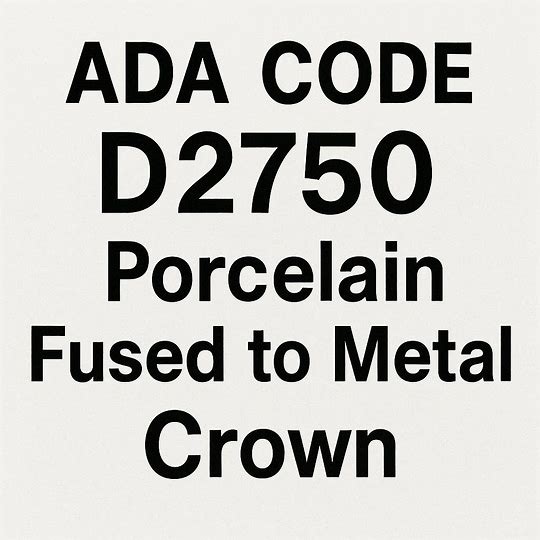
D2750 – Crown – Porcelain Fused to High Noble Metal
This code represents the classic PFM (Porcelain Fused to Metal) crown where the metal substructure contains a high noble metal content (gold, platinum, or palladium—at least 60% of the total metal content, with gold being at least 40%).
-
When to use it: You are cementing a PFM crown with a precious metal base.
-
Retention: These are always cemented.
-
Billing note: Laboratories usually provide a breakdown of metal content. You must keep this documentation in case of an audit.
D2751 – Crown – Porcelain Fused to Predominantly Base Metal
This is the same aesthetic result as D2750, but the substructure is composed of non-noble metals like nickel or chromium.
-
When to use it: You are cementing a PFM crown using a base metal alloy.
-
Retention: Cemented.
-
Billing note: Many insurance plans downgrade coverage to this code if a patient chooses a high noble metal crown but the policy only covers base metal. It is crucial to check the patient’s benefits before seating.
D2752 – Crown – Porcelain Fused to Noble Metal
This falls in the middle. The metal content is noble (including gold, platinum, or palladium), but the percentage is less than 60%, or the gold content is less than 40%.
-
When to use it: A middle-tier PFM crown.
-
Retention: Cemented.
D2790 – Crown – Full Cast High Noble Metal
For the gold crown lovers out there. This code is for a full metal crown (no porcelain) made from high noble metal.
-
When to use it: Posterior teeth where aesthetics are not the primary concern, or for patients with heavy bruxism.
-
Retention: Cemented using conventional luting agents.
D2791 – Crown – Full Cast Predominantly Base Metal
D2792 – Crown – Full Cast Noble Metal
These are the metal-only counterparts to the PFM codes above. They are also cement-retained restorations.
The “Other” Cement Crown: D2940 and D2971
Sometimes, when people search for “ADA code for cement crown,” they are not looking for a permanent prosthetic. Instead, they are looking for a temporary fix or a specific type of restoration that is made of cement.
If you are placing a restoration that is directly formed in the mouth using glass ionomer or resin-modified glass ionomer, you are in a different section of the CDT manual.
D2940 – Protective Restoration
This is a commonly misunderstood code. D2940 is used for a sedative filling or a temporary crown made of reinforced cement (like glass ionomer or IRM) that is placed to protect the tooth.
-
When to use it: You have a fractured cusp, and you are placing a cement-based material to hold the tooth until a definitive crown (D2740, etc.) is fabricated.
-
Key distinction: This is not a permanent crown. It is an interim restoration.
D2971 – Additional Procedures to Facilitate Crown Placement
This code is sometimes used when a cement crown is fabricated, but there are complications. However, the code that is strictly for a definitive cement-based material crown is less common in modern practices because most payers consider reinforced glass ionomer crowns (like Artglass or similar) as a less durable alternative.
Important Note: If a dentist fabricates a permanent crown in-office using a cement-based material (like a direct resin composite crown), the appropriate code is usually D2920 (or the specific direct composite code) or one of the indirect codes if it is fabricated by a lab. For a direct resin crown cemented immediately, you would likely use a code like D2930 for a stainless steel crown, or D2999 for unspecified restorative if it is a unique material—though this is rare.
A Comparative Table: Cemented vs. Screw-Retained
For general dentists, the concept of “cementation” is simple. However, for those placing implants, there is a significant distinction between cement-retained and screw-retained crowns. While the material codes remain similar, the implant-specific codes change the context.
| Type | ADA Code | Retention Method | Primary Use |
|---|---|---|---|
| Cemented Crown (Natural Tooth) | D2740, D2750, D2790 | Dental Cement (e.g., RelyX, glass ionomer) | Traditional crown on natural tooth structure. |
| Cemented Crown (Implant) | D6059 / D6060 | Abutment + Cement | Crown cemented onto a custom or pre-fabricated abutment. |
| Screw-Retained Crown (Implant) | D6059 (if cemented) / D6060 (if screw-retained) | Screw passes through crown | Crown screws directly into the implant; no cement used. |
If you are coding for an implant-supported crown that is cemented, you will typically use:
-
D6059: Abutment supported crown (cemented) – prefabricated abutment.
-
D6060: Abutment supported crown (cemented) – custom fabricated abutment.
This is where confusion often arises. If you place an implant and then cement a D2740 porcelain crown onto an abutment, you must bill the implant crown code (D6059/6060) rather than the natural tooth code (D2740).
Step-by-Step: How to Bill a Cement Crown Correctly
Submitting a claim for a cement-retained crown requires accuracy. Insurance companies are trained to look for gaps in the narrative. Here is a checklist to ensure your claim is watertight.
1. Verify the Tooth Number
This seems obvious, but ensure the tooth number corresponds to the quadrant. If the tooth is missing from the radiograph, the claim will be denied immediately.
2. Select the Material Code
Use the table above. If it is a PFM, ask yourself: Is it High Noble, Noble, or Base? If it is all-ceramic, use D2740. Do not default to D2740 for a PFM just because it is aesthetic; the payer will recoup the money later if the metal content doesn’t match.
3. Address the Cement
The cement itself is rarely a billable line item in a permanent crown delivery. The fee for the crown (D2740, etc.) includes the cost of cementation. However, if you are placing a temporary crown using cement (D2940), that is a separate line item.
4. Submit Radiographs
Most payers require a pre-operative (pre-op) radiograph showing decay or fracture justifying the crown, and a post-operative (post-op) radiograph showing the crown seated with visible cement margins.
-
Tip: If the post-op shows excess cement that is not removed, you risk the claim being flagged for “poor quality.”
5. The Narrative
If there is a specific reason you used a particular cement (e.g., “glass ionomer used due to subgingival margin for fluoride release”), include it in the narrative. While this is not required for every claim, it helps with complex cases or appeals.
Why Cement Choice Matters for Billing
Believe it or not, the type of cement you use can occasionally affect whether a code is accepted, particularly in implant cases.
There is a growing movement in dentistry away from permanent cement on implants because residual cement left in the sulcus can cause peri-implantitis. As a result, some insurance auditors are looking closely at implant crown claims.
If you are billing a cement-retained implant crown (D6059/D6060), you must document:
-
That a radiopaque cement was used (so it is visible on X-rays).
-
That the excess cement was removed.
For natural tooth crowns, the cement type matters less to the insurance company, but it matters significantly to the longevity of the restoration.
“The most expensive crown is the one that has to be redone because of a cement failure. Billing the correct code ensures that if the restoration fails due to material defect (as opposed to cement breakdown), the lab warranty and insurance liability are clear.”
— Dr. Sarah J., Clinical Dentist and Coding Consultant
Common Billing Mistakes with Cement Crowns
Even experienced billers make mistakes. Here are the top three errors seen in dental offices regarding cement crown codes.
Mistake 1: Using D2740 for a Zirconia Crown (Wrongly)
This is a gray area. While D2740 is technically “Porcelain/Ceramic,” many insurers define zirconia as a “ceramic.” However, some auditors argue that zirconia is a different class of material. In 99% of cases, D2740 is accepted. However, if you are consistently getting denials, check if the payer wants D2799 (Provisional crown) or a specific implant code if applicable.
Mistake 2: Upcoding the Metal
If the lab slip says “Base Metal” and you bill “High Noble Metal” (D2750 instead of D2751), you are committing insurance fraud. If the insurance company pays the higher rate and audits you six months later, they will demand a refund plus penalties. Always attach the lab slip to the patient’s record.
Mistake 3: Billing a Temporary Crown as a Permanent One
D2940 (protective restoration) is often denied if billed with a permanent crown on the same day. If you place a glass ionomer “temp” crown while you wait for the permanent crown to come back from the lab, you must wait to bill the permanent crown (D2740, etc.) until the seat date.
-
Correct Process: Day 1: Bill D2940 (temp). Day 14 (seat date): Bill D2740 (permanent). Do not bill them on the same date of service unless the temp was placed on a different tooth.
ADA Codes and Dental Insurance: Frequency Limitations
One of the hardest realities to explain to patients is that insurance does not cover everything. Most dental plans have a “crown frequency” clause.
Typically, insurance companies will only pay for a crown on the same tooth once every 5 to 7 years.
-
If you are cementing a new crown to replace a failed crown that is only 3 years old, you must indicate the “replacement reason” (e.g., fracture, decay).
-
If you fail to note that the old crown was fractured and bill a standard crown, the insurance will reject it as “frequency limitation.”
The cement itself does not dictate the frequency, but the reason for the new crown does. Always include a narrative like: “Replacing existing crown D2740 due to recurrent decay under old restoration.”
The Future of Cement Crown Coding
The CDT codes are updated every year, usually with minor revisions. As materials science evolves, we may see a split between “milled ceramic” and “pressed ceramic,” or a specific code for “hybrid ceramic” crowns.
Currently, the codes remain stable. However, with the rise of same-day dentistry (CAD/CAM) where crowns are milled and cemented in a single visit, the coding does not change. Whether you mill it in the office or get it from a lab, if it is porcelain/ceramic, it is D2740.
The “cement” aspect remains a procedural step rather than a separate code for permanent crowns.
Important Notes for Readers
-
Never guess the metal content. If you do not have the lab slip specifying the alloy, do not submit the claim. Guessing can lead to serious legal and financial consequences.
-
Radiographs are your best friend. For a cement crown, the post-op radiograph is the only way to prove the restoration exists and is properly seated. Without it, many payers will automatically deny.
-
Know the difference between “cemented” and “bonded.” Some dentists use adhesive resin cement (bonding) for ceramic crowns. While the procedure is different clinically, the ADA code remains the same (D2740). You do not bill an extra “bonding” code unless it is a direct composite restoration.
-
Patient responsibility. If insurance downgrades a D2750 (high noble) to a D2751 (base metal) because the patient’s plan only covers base metal, the patient is responsible for the difference. Make sure they sign a waiver before cementation.
FAQ
1. What is the ADA code for a permanent cement crown?
There is no single “cement crown” code. The code depends on the crown material. The most common permanent codes are D2740 (ceramic), D2750 (PFM high noble), and D2790 (full cast gold).
2. Can I use D2740 for a zirconia crown?
Yes. Zirconia is classified as a ceramic/porcelain substrate. D2740 is the standard code for full-contour zirconia crowns.
3. What code do I use for a temporary crown made of cement?
Use D2940 (protective restoration). This covers sedative fillings and temporary crowns made with reinforced cement materials like glass ionomer.
4. Is cementation included in the crown code?
Yes. The ADA code for the crown (e.g., D2740) includes the delivery and cementation of the crown. You cannot bill separately for the cement used.
5. What is the difference between D2750 and D2752?
D2750 is for PFM crowns with a high noble metal content (precious). D2752 is for PFM crowns with a noble metal content (less precious, but still containing gold, platinum, or palladium).
6. How do I code a cement-retained implant crown?
Use D6059 (abutment supported crown – cemented) for prefabricated abutments, or D6060 for custom abutments. Do not use the natural tooth codes (D2700 series) for implants.
Additional Resource
For the most up-to-date information on coding standards, annual updates, and official ADA guidelines, visit the official website of the American Dental Association (ADA) CDT Code.
-
Resource: https://www.ada.org/en/publications/cdt
Additionally, for insurance claim appeals and template letters, the American Association of Dental Office Management (AADOM) offers excellent resources for dental billers to navigate complex cement crown claim denials.
Conclusion
In summary, successfully coding for cement crowns requires a clear understanding of the material classification (ceramic, metal, PFM) and the distinction between natural teeth and implant-supported restorations. There is no single “cement crown” code; instead, the CDT codes D2740, D2750, D2751, and D2790 cover the majority of permanent, cement-retained crowns. By verifying metal content, using the correct radiographs, and adhering to frequency limitations, dental professionals can ensure accurate reimbursement and minimize claim denials.