ADA Codes for Dentures: Understanding Your Dental Claim
If you have ever sat in a dentist’s chair and heard a string of numbers muttered to the assistant, or if you have looked at a dental insurance explanation of benefits (EOB) and felt like you were reading a foreign language, you are not alone.
Dentistry, like all medical fields, runs on codes. For dentures, these codes are part of the ADA Code on Dental Procedures and Nomenclature—more commonly known as the CDT (Current Dental Terminology) codes. These five-digit alphanumeric codes (starting with D) are the language used by dentists, insurance companies, and billing specialists to communicate exactly what work is being done and how much it should cost.
If you are about to receive dentures, understanding these codes is not just about satisfying curiosity. It is about financial protection. Knowing the difference between a “D5110” and a “D5120” can mean the difference between your insurance covering a procedure or leaving you with a surprise bill.
This guide will walk you through every relevant ADA code for dentures, explain what they actually mean for your mouth, and give you the tools to ask the right questions before you commit to treatment.
Why Knowing Your Denture Codes Matters
Before we dive into the specific numbers, let’s talk about why you, the patient, should care.
Dental insurance is rarely straightforward. Most plans have annual maximums, waiting periods, and specific coverage percentages for “major services”—which is where dentures fall. Typically, insurance covers 50% of the cost of dentures, but that percentage is applied to the “negotiated fee” based on these codes.
If a dentist bills a code incorrectly, or if you don’t understand what is being billed, you might end up paying for parts of the denture process that you thought were included. For example, a “immediate denture” (placed right after teeth are extracted) uses a different code than a “conventional denture” (placed months after healing). Insurance companies treat these very differently.
By understanding these codes, you become an informed consumer. You can verify your treatment plan, ensure your insurance is being billed correctly, and avoid disputes down the road.
The Structure of ADA Codes for Prosthodontics
The ADA codes are grouped into categories. For dentures, we are looking at Category D5000 – Prosthodontics, Removable. This section covers everything from complete dentures to partials, and even the adjustments that keep them fitting well.
Here is the breakdown of the main code families you will encounter:
-
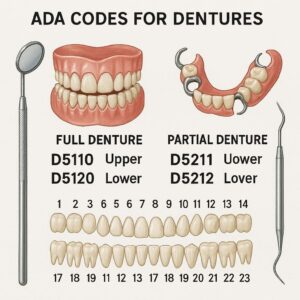
D5110 – D5120: Complete Dentures (Full sets)
-
D5211 – D5214: Partial Dentures (Replacing some missing teeth)
-
D5410 – D5422: Adjustments and Repairs
-
D5850 – D5851: Relines (Refitting the denture base)
-
D5510 – D5520: Rebases (Replacing the entire pink base)
Let’s explore each of these categories in detail.
Complete Denture ADA Codes (Full Arch)
If you are missing all your teeth in one arch (upper or lower) or both, you will be looking at complete denture codes. There are two primary scenarios here: conventional and immediate.
| ADA Code | Procedure Description | What It Actually Means |
|---|---|---|
| D5110 | Complete Denture – Maxillary | A full set of upper teeth (maxillary arch). This is fabricated after the teeth have been extracted and the tissue has fully healed (usually 6-8 weeks or more). |
| D5120 | Complete Denture – Mandibular | A full set of lower teeth (mandibular arch). Same as above, but for the bottom jaw. |
| D5111 | Immediate Denture – Maxillary | An upper denture placed immediately after the teeth are extracted. You do not go without teeth during the healing phase. |
| D5121 | Immediate Denture – Mandibular | A lower denture placed immediately after extraction. |
Conventional Dentures (D5110 & D5120)
A conventional denture is the standard route for patients who have already healed from extractions. The process usually involves two to five appointments over a few weeks.
The dentist takes impressions, bites are recorded to ensure the teeth line up correctly, and a “try-in” appointment allows you to see the teeth in wax before the final acrylic is processed. Because the gums are healed and stable, the fit is often more accurate from the start compared to an immediate denture.
Immediate Dentures (D5111 & D5121)
Immediate dentures are a marvel of modern dentistry, but they come with a caveat. The code D5111 (or D5121) covers a denture that is fabricated before your teeth are extracted. On the day of the extractions, the dentist places the denture immediately.
The benefit: You never have to leave the office without teeth.
The drawback: Because the bone and gums shrink significantly over the next six months following extraction, an immediate denture will require a reline (D5850) or eventually a rebase to maintain a proper fit. It is common for patients to receive an immediate denture and then later pay for a conventional permanent denture once healing is complete.
Partial Denture ADA Codes
If you still have some healthy natural teeth remaining, you likely need a partial denture. These codes are split based on whether the partial is made of acrylic (flexible or rigid) or cast metal (which is the gold standard for durability).
| ADA Code | Procedure Description | What It Actually Means |
|---|---|---|
| D5211 | Mandibular Partial Denture – Resin Base (Including Clasps, rests, and teeth) | A lower partial made of acrylic. Often used as a temporary or “transitional” partial. |
| D5212 | Mandibular Partial Denture – Cast Metal Framework | A lower partial with a strong metal skeleton. This is the standard for long-term durability and fit. |
| D5213 | Maxillary Partial Denture – Resin Base | An upper partial made of acrylic. |
| D5214 | Maxillary Partial Denture – Cast Metal Framework | An upper partial with a metal skeleton. |
Cast Metal vs. Acrylic Partials
When looking at your treatment plan, pay close attention to whether the code is for a cast metal framework (D5212 or D5214) versus a resin base (D5211 or D5213).
-
Cast Metal (D5212/D5214): This is a premium procedure. The metal framework is thin, strong, and distributes chewing forces without covering the roof of the mouth (palate) excessively. It is the preferred choice for longevity.
-
Resin/Acrylic (D5211/D5213): Often referred to as a “flipper” or temporary partial. It is bulkier and can break more easily. While it is a valid code, if your insurance pays for a “partial,” you should verify if they are paying for the acrylic version or the metal version. The price difference is significant.
Denture Adjustment Codes
Getting a new denture usually requires a “breaking-in” period. It is normal to have sore spots. The codes below cover the adjustments needed to make your dentures comfortable.
| ADA Code | Procedure Description |
|---|---|
| D5410 | Adjust Complete Denture – Maxillary |
| D5411 | Adjust Complete Denture – Mandibular |
| D5421 | Adjust Partial Denture – Maxillary |
| D5422 | Adjust Partial Denture – Mandibular |
Many dentists include a “courtesy adjustment period” (often 6 months) where they do not bill insurance for these adjustments. However, if you go in for adjustments after that period, or if you see a new dentist for a repair, these codes will appear on your bill. Adjustments are usually low-cost compared to the denture itself, but they are essential for maintaining oral health. A poorly fitting denture can lead to bone loss and mouth sores.
Denture Reline and Rebase Codes
Over time—sometimes as quickly as a year—your jawbone changes shape. When your denture starts feeling loose or wobbly, you have two main options: a reline or a rebase. These are distinct procedures with different codes and costs.
| ADA Code | Procedure Description | Key Difference |
|---|---|---|
| D5850 | Tissue Conditioning (Per Arch) | A soft material placed inside the denture to soothe irritated tissue. Often a temporary fix before a reline. |
| D5851 | Reline Complete/Partial Denture (Chairside) | Done in one appointment in the office. The dentist removes some acrylic and adds a new lining. |
| D5730 | Reline Complete/Partial Denture (Laboratory) – Maxillary | The denture is sent to a lab. The lab replaces the entire tissue side surface for a better fit. This is more expensive and more accurate than chairside. |
| D5731 | Reline Complete/Partial Denture (Laboratory) – Mandibular | Same as above, but for the bottom. |
| D5510 | Repair Broken Complete Denture – Maxillary | Fixing a cracked or broken base. |
| D5520 | Repair Broken Complete Denture – Mandibular | Fixing a cracked or broken base. |
| D5610 | Repair Resin Partial Denture | Fixing a crack or adding a tooth to an acrylic partial. |
| D5620 | Repair Cast Partial Denture | Fixing a broken metal framework or adding a tooth to a metal partial. |
| D5710 | Rebase Complete Denture – Maxillary | Replacing the entire pink acrylic base of the denture while keeping the existing teeth. |
| D5711 | Rebase Complete Denture – Mandibular | Replacing the entire pink acrylic base of the denture while keeping the existing teeth. |
Reline vs. Rebase: What is the difference?
This is one of the most confusing aspects of denture codes.
-
A Reline (D5730/D5731): Think of this as reupholstering a chair. The dentist or lab adds a new layer of material to the inside of the denture to fill the gap created by bone loss. The outside of the denture (the teeth and the visible pink acrylic) remains the same.
-
A Rebase (D5710/D5711): Think of this as replacing the entire frame of the chair but keeping the seat cushions (teeth). The lab replaces the entire pink base of the denture. This is usually done when the denture is structurally worn out but the existing teeth are still in good shape.
Navigating Insurance Coverage with ADA Codes
Understanding the codes is step one. Step two is understanding how insurance uses them. Most dental plans categorize dentures as “Major Restorative” procedures.
Frequency Limitations
Insurance companies strictly enforce time limits. You will rarely see an insurance plan that allows a new complete denture (D5110) more than once every 5 to 8 years. Similarly, for relines (D5730), insurance often covers them only once every 3 years.
If your dentist recommends a new denture but you had one done 4 years ago, you need to check your plan. If the insurance company deems it “too early,” you will be responsible for the full cost unless your dentist can provide documentation (photos, notes) showing the denture is broken beyond repair.
The “Missing Tooth” Clause
For partial dentures, many insurance companies have a “missing tooth clause.” If you were missing a tooth before the insurance policy became active, they may deny coverage for replacing that tooth with a partial. Always review your policy’s pre-existing condition limitations.
In-Network vs. Out-of-Network
The numbers on your treatment plan will change dramatically depending on whether your dentist is “in-network” (contracted with your insurance carrier). In-network dentists agree to a contracted fee for each ADA code. Out-of-network dentists can charge their usual fee; insurance will pay a percentage of their allowed amount, often leaving you with a significant balance.
A Typical Denture Billing Scenario
To bring this all together, let’s look at a common scenario.
The Patient: John is missing all his upper teeth. He has existing insurance that covers 50% of major services after a 12-month waiting period (which he has satisfied).
The Treatment Plan:
-
D5110 – Complete Denture – Maxillary (Conventional)
-
D5850 – Tissue Conditioning (If needed after extractions)
-
D5410 – Adjust Complete Denture (Post-insertion follow-ups)
The Billing:
If the dentist’s fee for D5110 is $2,000, the insurance’s negotiated rate might be $1,600. The insurance pays 50% of $1,600 = $800. John is responsible for the remaining $800, plus any copays for adjustments if they are not included in the original contract.
If the dentist had mistakenly billed D5111 (Immediate) instead of D5110, but John had no teeth to extract, the claim would be denied for being “not medically necessary” or a coding error.
Questions to Ask Your Dentist Before Treatment
To ensure you are getting exactly what you expect, here is a list of questions to ask while reviewing your treatment plan and the ADA codes listed.
-
“Is this code for a conventional or immediate denture?”
-
This ensures you aren’t paying for an immediate denture procedure if your gums are already healed.
-
-
“If this is a partial, is it cast metal or acrylic?”
-
If you see D5211 or D5213 (acrylic), but you were expecting a metal partial (D5212 or D5214), clarify this. The durability and cost are vastly different.
-
-
“Does the price include the ‘try-in’ appointment, or is that a separate code?”
-
Sometimes the “try-in” (D5820 or D5821) is billed separately if the case is complex.
-
-
“How many adjustments are included in the fee?”
-
Knowing if adjustments (D5410) are free for the first 6 months prevents surprise bills.
-
-
“When will I need a reline? Will my insurance cover it?”
-
Since bone loss is inevitable, knowing when to budget for a reline (D5730) is crucial for long-term comfort.
-
Common Mistakes in Denture Coding
Even professionals make mistakes. Being aware of common coding errors can help you catch them before they become insurance denials.
-
Using D5110 for an Immediate Denture: As mentioned, this is a frequent error. If the dentist extracted teeth and placed a denture the same day, the code must be D5111. If the dentist uses D5110, the insurance may deny it, claiming the denture was fabricated after healing—which isn’t true—and may also deny coverage for the extractions because they were done “after” the denture was made.
-
Unbundling: Sometimes, a dentist might try to bill for “teeth” separately when they are already included in the denture code. The complete denture code (D5110) implies all parts of the denture: base, teeth, processing. If you see an extra charge for “porcelain teeth” on top of a denture code, question it.
-
Adjustments vs. Repairs: If a denture breaks, it is a repair (D5510). If it just feels loose, it is an adjustment (D5410). Using the wrong code can lead to the wrong insurance benefit being applied.
The Future of Denture Codes: Implant Overdentures
While traditional dentures rely on suction or adhesive, modern dentistry often combines dentures with implants. This falls under a different category of codes: D6000 – Implant Supported Prosthetics.
If you are getting a denture that snaps onto implants (locator attachments), you will see codes like:
-
D6110: Implant Supported Complete Denture (Maxillary)
-
D6111: Implant Supported Complete Denture (Mandibular)
These codes are significantly more expensive because they involve surgical placement of implants and specialized bars or attachments. However, they are also vastly superior in stability and bone preservation. If your treatment plan includes these codes, you are looking at a premium restoration that is functionally closer to natural teeth than a traditional removable denture.
How to Read Your Explanation of Benefits (EOB)
Once the claims are sent, you will receive an EOB from your insurance company. This is not a bill (though it often looks like one). It is an explanation.
Here is how to decode it using the ADA codes:
-
Procedure Code: This is the ADA code (e.g., D5110).
-
Billed Amount: What the dentist charges.
-
Allowed Amount: The contracted rate between the insurance and the dentist. You usually cannot be charged above this if the dentist is in-network.
-
Plan Pays: The percentage of the allowed amount the insurance covers (e.g., 50%).
-
Patient Responsibility: The remaining balance. Cross-reference this with your treatment plan to ensure it matches what you agreed to pay.
If a code shows as “Denied,” look at the remark code. It might say “frequency limitation” (you had one too recently) or “not a covered benefit” (your plan doesn’t cover partials, for example).
Conclusion
Understanding ADA codes for dentures transforms you from a passive patient into an active partner in your dental care. Whether you are looking at a conventional complete denture (D5110), a cast metal partial (D5214), or planning for future relines (D5730), these codes dictate your clinical journey and your financial responsibility. By reviewing your treatment plan carefully, asking the right questions about the specific code being used, and verifying insurance allowances before work begins, you can ensure that your path to a new smile is as smooth and predictable as possible.
Frequently Asked Questions (FAQ)
1. What is the difference between D5110 and D5111?
D5110 is a conventional complete denture, made after the gums have healed from extractions. D5111 is an immediate denture, made before extractions and placed on the same day the teeth are removed. The immediate denture allows you to avoid being without teeth, but it usually requires a reline later due to bone shrinkage.
2. Does dental insurance cover the full cost of dentures?
Typically, no. Most dental insurance plans categorize dentures as a “major service.” The standard coverage is usually 50% of the cost after you meet your deductible. You are responsible for the remaining 50%, along with any costs if you choose a premium material that exceeds the insurance allowance.
3. How often will insurance pay for a new denture (D5110)?
Most insurance companies enforce a frequency limitation. They will only pay for a new complete denture once every 5 to 8 years. If you need a new denture sooner due to breakage or poor fit, your dentist must submit a pre-authorization with documentation (like photos) to prove medical necessity.
4. What does a “reline” (D5730) mean?
A reline is a procedure where the tissue-bearing surface (the inside) of your denture is resurfaced to ensure a snug fit. As your jawbone changes shape over time, the denture becomes loose. A laboratory reline (D5730) is the most accurate way to refit the denture without having to make an entirely new one.
5. Why is my partial denture code D5213 instead of D5214?
D5213 indicates an acrylic (resin) base partial denture, while D5214 indicates a cast metal framework partial. Acrylic partials are often used as temporary solutions and are less durable. If you believe you are paying for a metal partial, ensure the code on your treatment plan matches D5214.
Additional Resource
To verify current CDT codes, look up your specific insurance plan’s fee schedule, or find a dentist in your area, visit the official American Dental Association (ADA) website.
-
Resource Link: https://www.ada.org/en/publications/cdt
-
Note: The ADA publishes the Current Dental Terminology (CDT) guide annually. Checking their website ensures you have the most up-to-date code definitions and coding guidelines for your dental claims.