ADA Codes for EMAX Crowns: Billing, Coding, and Clinical Accuracy
If you work in a dental practice, you know that the clinical work is only half the battle. The other half happens in the administrative office, where a simple three-to-five-digit code can determine whether your practice gets paid accurately—or spends months fighting a denied claim.
When it comes to modern restorative dentistry, EMAX crowns (lithium disilicate) have become the gold standard for anterior and posterior restorations. They offer unparalleled aesthetics, strength, and biocompatibility. But here is where things get tricky: how do you code for them?
Is an EMAX crown simply a “porcelain crown”? Is it a “ceramic crown”? Or does it fall under a specific category that insurance companies love to scrutinize?
In this guide, we are going to walk through everything you need to know about the ADA (American Dental Association) Code on Dental Procedures and Nomenclature—specifically focusing on the codes used for EMAX restorations. We will cover the nuances of D2740, D2790, and even D2783, along with practical tips on how to write narratives that actually get claims paid.
Whether you are a dentist trying to understand why your insurance reimbursements are lower than expected, or a front-office coordinator looking to streamline your billing process, this guide is for you.
What Exactly is an EMAX Crown?
Before we dive into the codes, it helps to understand what we are billing for. EMAX is a brand name by Ivoclar Vivadent for a specific type of lithium disilicate ceramic.
The Material Matters
Lithium disilicate is not your grandmother’s dental porcelain. It is a high-strength ceramic that allows for:
-
Monolithic restorations: No metal framework needed.
-
Bonding: Unlike traditional PFMs (Porcelain Fused to Metal), EMAX is adhesively bonded to the tooth structure, which actually reinforces the remaining tooth.
-
Translucency: It mimics the natural enamel’s light properties.
Because of these characteristics, the way the crown is fabricated and the way it is cemented impacts the coding. Insurance companies don’t usually care about the brand name “EMAX,” but they care deeply about the material classification.
The Primary ADA Codes for EMAX Crowns
When you are sitting at your computer entering a treatment plan for an EMAX crown, you will typically choose between two main ADA codes. Choosing the wrong one is the number one reason for claim denials or downgrades.
D2740: Porcelain/Ceramic Crown
This is the most common code used for EMAX crowns.
What it means:
D2740 describes a crown that is fabricated from porcelain or ceramic material. Since lithium disilicate (EMAX) is a ceramic, this code is technically accurate for a full-contour EMAX crown.
When to use it:
-
For anterior crowns (incisors and canines) where aesthetics are the priority.
-
For posterior crowns when the restoration is full-contour zirconia or layered ceramic.
-
When the restoration does not contain any metal substructure.
D2790: Crown – Full Cast High Noble Metal
Wait—why would we use a metal code for a ceramic crown? Usually, we don’t. However, confusion arises because some practices mistakenly use this for PFMs. Do not use D2790 for EMAX. EMAX contains zero metal.
However, it is important to note that if an insurance company sees D2790, they expect a gold or high-noble metal crown. If they receive a claim with that code and an EMAX lab slip, they will deny it for “materials not matching code.”
D2783: Crown – Porcelain/Ceramic – ¾
Occasionally, dentists use EMAX for partial coverage restorations (like onlays or ¾ crowns). If the restoration covers less than the entire anatomical crown, D2783 might be appropriate, though this is less common than the full-coverage D2740.
The Great Debate: D2740 vs. D2790 (PFM)
To understand why coding EMAX is sometimes a headache, you need to understand how insurance companies think.
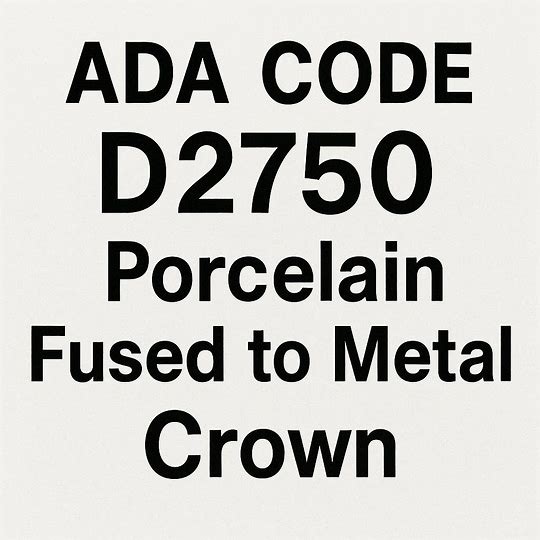
Historically, the standard for posterior crowns was the PFM (Porcelain Fused to Metal), which uses code D2750 (Porcelain Fused to High Noble Metal) or D2751 (Porcelain Fused to Base Metal).
Many insurance plans are still built around this 20th-century model. They have a higher fee schedule for metal-based crowns (D2750) because they consider them “stronger” for back teeth, and a lower fee schedule for all-ceramic crowns (D2740) because they consider them “aesthetic-only” and historically weaker.
However, clinical research over the last decade has shown that bonded lithium disilicate (EMAX) is actually stronger than PFM in many clinical scenarios because it allows for a more conservative preparation and bonded retention.
The Reimbursement Gap
Here is the reality:
-
D2740 (All Ceramic): Often reimbursed at the “aesthetic” rate. If a patient has an old plan, the insurance might pay significantly less for this code, assuming it is a “cosmetic” procedure.
-
D2750 (PFM): Often reimbursed at a higher rate.
Because EMAX is technically ceramic, you should use D2740. However, if you use D2740, you might get paid $200 less than if you had placed a PFM and billed D2750.
Important Note: Upcoding (using a code that does not reflect the service provided) is insurance fraud. You cannot bill a D2750 (PFM) if you placed an all-ceramic EMAX crown. You must bill for what you placed.
How to Prevent Denials for EMAX Crowns
Since D2740 is the correct code, how do you ensure you get paid fairly? The answer lies in the narrative and the radiographs.
Insurance companies are increasingly requiring a “reason for the restoration.” If they see D2740 on a lower molar, they might automatically downgrade it to D2750 (PFM) or D2790 (metal) because they assume a metal crown would have sufficed.
The Narrative is Your Best Friend
Never submit a bare claim. Always attach a detailed narrative. For an EMAX crown, your narrative should include:
-
Material Justification: “Due to the patient’s high occlusal forces and the need for a conservative preparation, a bonded lithium disilicate (EMAX) crown was selected. This material allows for maximum enamel preservation and provides superior fracture resistance compared to PFM alternatives.”
-
Medical Necessity: “Tooth #19 exhibits a cracked cusp extending subgingivally. A full-coverage restoration is required to prevent cuspal fracture and maintain occlusal stability.”
-
Bonding Necessity: “The restoration requires adhesive bonding to achieve retention due to the loss of coronal tooth structure.”
X-Rays Are Mandatory
Always send preoperative and postoperative radiographs with the claim. If the insurance company sees a tooth that had a large failing amalgam with a crack extending into the root (on the X-ray), they are far less likely to downgrade the ceramic code.
Comparative Table: ADA Codes for Crown Materials
To help visualize where EMAX fits in the coding hierarchy, here is a comparative table of the most common crown codes.
| ADA Code | Description | Material Type | Typical Use Case | EMAX Compatibility |
|---|---|---|---|---|
| D2740 | Porcelain/Ceramic | Full ceramic (Lithium disilicate, Zirconia, Feldspathic) | Anterior & Posterior aesthetics; Conservative prep | Standard Code |
| D2750 | PFM – High Noble Metal | Metal substructure (Gold/Platinum) with porcelain overlay | Posterior crowns needing strength and aesthetics | Not Compatible |
| D2751 | PFM – Base Metal | Metal substructure (Nickel/Chromium) with porcelain overlay | Posterior crowns (cost-effective) | Not Compatible |
| D2790 | Full Cast – High Noble Metal | Solid gold or high noble metal | Posterior crowns for patients with heavy bruxism | Not Compatible |
| D2783 | ¾ Porcelain/Ceramic | Partial coverage ceramic | Inlay/Onlay alternatives; conservative prep | Compatible (Partial coverage) |
Specific Scenarios: Coding EMAX in Different Situations
The context in which you place the crown often dictates how you should present the claim.
Scenario 1: The Cracked Tooth Syndrome (Posterior Molar)
A patient presents with pain on biting, no decay, and a visible crack on tooth #30. You recommend a full-coverage EMAX crown.
-
Code: D2740
-
Narrative Highlight: “Tooth #30 exhibits cracked tooth syndrome with a visible fracture line extending mesially. A full-coverage bonded ceramic restoration is necessary to prevent cuspal separation and irreparable fracture. Metal-free restoration is required to allow for optimal bonded retention given the limited remaining coronal structure.”
-
Why this works: You are justifying bonding (which you cannot do with metal) and addressing the structural failure.
Scenario 2: The Anterior Aesthetic Case
A patient wants to replace an old, discolored PFM crown on tooth #8 with an EMAX crown.
-
Code: D2740
-
Narrative Highlight: “Replacement of failing PFM crown. Patient exhibits gingival recession exposing the metal margin, leading to an unesthetic gray line. Lithium disilicate (EMAX) is required for optimal translucency, gingival health, and superior marginal fit to match adjacent natural dentition.”
-
Why this works: Aesthetics are a valid medical reason when the existing restoration causes soft tissue inflammation or a visible defect.
Scenario 3: The High-Risk Decay Patient
A patient has recurrent decay under an old amalgam. You need to save tooth structure.
-
Code: D2740
-
Narrative Highlight: “Minimal remaining coronal tooth structure. Lithium disilicate allows for a supragingival, minimally invasive preparation and adhesive bonding, maximizing preservation of healthy enamel and reducing the risk of root fracture compared to conventional full-coverage metal alternatives.”
-
Why this works: You are highlighting the conservative nature of the EMAX preparation, which is a clinical advantage over PFM or full metal.
The Role of “Bonding” in Coding
One of the unique aspects of EMAX crowns is that they are typically bonded rather than cemented with traditional luting cement.
Traditional crowns (PFM, Gold) rely on mechanical retention. You cut the tooth with a specific taper, and the cement fills the gap. If you cut a tooth for a PFM too short, the crown falls off.
EMAX crowns can be adhesively bonded using resin cement. This is a chemical bond to the tooth. It allows dentists to be significantly more conservative with the tooth preparation.
Why this matters for coding:
If you are using a conservative preparation (like a partial coverage EMAX or a minimally invasive full coverage), you must justify why you didn’t do a standard PFM. In your narrative, you should explicitly state:
“Traditional full-coverage preparation was not indicated due to the extent of the caries/fracture. The use of bonded lithium disilicate allows for a conservative tooth preparation preserving vital tooth structure.”
Insurance Frequency Limitations
Regardless of the code you use, insurance companies have frequency limitations. Most plans allow one crown per tooth every 5 to 7 years.
If you are replacing an existing crown with an EMAX crown, ensure that the previous crown’s placement date meets the insurance company’s replacement frequency. If it doesn’t, and the crown is “failing,” you need to document why it is failing early.
Reasons for early replacement (that insurance will accept):
-
Caries under the existing crown.
-
Fracture of the porcelain or metal substructure.
-
Open margins leading to periodontal disease.
-
Sensitivity due to exposed metal or poor fit.
If you are replacing a crown because the patient simply wants a “whiter smile” (elective), the insurance will likely deny the claim entirely.
Practical Tips for Dental Coders
If you are a dental biller or front desk coordinator, here are some actionable tips to ensure your EMAX claims go through smoothly.
1. Verify Patient Benefits Before Treatment
Before you schedule the prep appointment, call the insurance company. Ask specifically:
-
“Does the patient have coverage for code D2740 (porcelain/ceramic crown)?”
-
“Is D2740 subject to downgrade to D2750 or D2790 on posterior teeth?”
-
“What is the patient’s remaining annual maximum?”
If the plan downgrades D2740, you can inform the patient of the potential balance before starting treatment.
2. Always Use the “Correct” Tooth Number
It sounds obvious, but errors here are common. If the patient is missing tooth #14, and you are crowning #15, but you accidentally type #14 on the claim, it will be denied because the insurance will show #14 was already extracted.
3. Use the “Replacement” Box Correctly
If you are replacing an existing crown, check the “replacement” box on the ADA claim form. If the old crown was placed within the insurance’s frequency limit, attach a narrative explaining why it failed clinically.
4. Keep Your Lab Slips
If an insurance company audits your claim and wants to know why you billed D2740 instead of a PFM, you need to show them the lab slip. The lab slip clearly states “EMAX” or “Lithium Disilicate.” Never send the lab slip with the initial claim unless requested, but have it ready for appeals.
A Note on “Splitting” Crown Codes
Some practices try to “split” the code by billing the buildup (D2950) separately from the crown (D2740). This is standard practice. However, ensure that the buildup is actually necessary.
If the tooth has adequate structure, a buildup is not required. Insurance companies are flagging claims where a buildup is billed on every single crown. If you place a buildup, the X-ray must show that there was insufficient tooth structure to retain the crown without it.
For EMAX crowns, because the preparation is conservative, you might actually need fewer buildups than you would for a PFM. Do not artificially inflate the claim by adding codes that aren’t clinically necessary.
Real-World Example: The Appeal Letter
Let’s say you submitted D2740 for a mandibular molar. The insurance company denied it, stating “D2740 is not a benefit for posterior teeth. Downgraded to D2750.”
You need to appeal. Here is a sample of what that appeal letter should look like.
Date: [Insert Date]
Re: Patient: [Name], ID: [Number]
Claim #: [Number]
Tooth #: 19Dear Claims Adjudicator,
*We are writing to appeal the downgrade of code D2740 (Porcelain/Ceramic Crown) to code D2750 (Porcelain Fused to Metal) on the above-referenced claim.*
*The patient presented with a fractured cusp on tooth #19. Due to the extent of the fracture, a traditional full-coverage PFM preparation would have required additional reduction of healthy tooth structure, compromising the long-term prognosis of the tooth. To preserve the maximum amount of natural tooth structure, a bonded lithium disilicate (EMAX) crown was selected.*
*Lithium disilicate (EMAX) is a high-strength ceramic that is indicated for posterior restorations. Unlike PFM crowns, it allows for adhesive bonding to the remaining tooth structure, which reinforces the tooth and prevents further fracture—a clinical requirement in this case. The use of D2740 accurately reflects the material placed, as no metal was used in this restoration.*
Attached please find preoperative radiographs showing the extent of the fracture, postoperative radiographs confirming fit, and the laboratory invoice specifying the fabrication of a full-contour lithium disilicate crown.
We respectfully request that you honor the submitted code D2740 and reprocess the claim accordingly.
Sincerely,
[Practice Name]
List: Essential Documentation for EMAX Crown Claims
To ensure a smooth reimbursement process, here is a checklist of items to have in the patient’s chart before submitting the claim.
-
Preoperative X-ray: Showing the existing decay, fracture, or failing restoration.
-
Postoperative X-ray: Showing the final crown seated with proper margins and no cement voids.
-
Periodontal Chart: To show that the tooth is periodontally sound enough to restore.
-
Narrative: A typed or clearly written explanation of medical necessity (specifically mentioning “bonded lithium disilicate” if it is an EMAX).
-
Lab Prescription: A copy of the lab slip detailing the material.
-
Intraoral Photos (Optional but Powerful): Photos showing the fractured tooth pre-op and the final crown post-op can often override automatic downgrades during manual review.
EMAX vs. Zirconia: Does the Code Change?
Both EMAX (lithium disilicate) and Zirconia are coded under D2740 (Porcelain/Ceramic).
Even though the materials are very different—Zirconia is opaque and incredibly strong, while EMAX is translucent and bondable—the ADA code does not differentiate between them.
However, clinical justification matters:
If you place a Zirconia crown on an anterior tooth, you might face scrutiny because Zirconia lacks the translucency of EMAX for aesthetic zones. Conversely, if you place EMAX on a patient with severe bruxism, you might face scrutiny regarding material strength.
In your narrative, you should explain why you chose that specific ceramic.
-
For EMAX: “Lithium disilicate was selected to maximize aesthetics and allow for adhesive bonding to preserve tooth structure.”
-
For Zirconia: “High-strength zirconia was selected to withstand the patient’s diagnosed bruxism while maintaining a metal-free restoration.”
The Cost Factor and Patient Billing
When discussing fees with patients, transparency is key. EMAX crowns typically have a higher lab fee than PFM crowns or gold crowns. The lab fee for an EMAX crown is often $150 to $300, whereas a PFM might be $100 to $150.
Because of this, your office fee for D2740 (when placing EMAX) is likely higher than your fee for D2750 (PFM). However, if the insurance reimburses D2740 at a lower rate, the patient’s out-of-pocket expense might be significantly higher.
How to handle this conversation:
“Mrs. Jones, the crown we are recommending for your front tooth is a high-aesthetic ceramic crown, which is code D2740. While your insurance does cover this procedure, they typically cover 50% of this specific code. Because this material has a higher lab cost to achieve the natural look you want, there will be a portion not covered by insurance. Let me go over the estimate with you.”
Common Coding Mistakes and How to Avoid Them
Even experienced offices make mistakes. Here are the top three errors when coding for EMAX crowns.
1. Using D2790 for EMAX
As mentioned, D2790 is for cast metal. If you accidentally use this code for a ceramic crown, the insurance will either deny it (because the X-ray doesn’t show a radiopaque metal crown) or they will pay it, and you will be at risk for an audit later for “upcoding” (though technically this is “incorrect coding”).
2. Forgetting the “Core Buildup” Exclusion
If you bill a buildup (D2950) on the same day as a crown, some insurance plans consider that “inclusive” to the crown procedure. They will deny the buildup. Always check if the patient’s plan includes buildup coverage. If they don’t, you must inform the patient that the buildup is a separate fee.
3. Lack of Documentation for Root Canal Teeth
If a tooth has had a root canal (D3330), placing a crown is almost always medically necessary to prevent fracture. However, if you are placing an EMAX crown on an endodontically treated molar, you should mention in the narrative that the crown is required for “cusp coverage to prevent catastrophic fracture of the endodontically treated tooth.”
The Future of Dental Coding and EMAX
The ADA updates the Code on Dental Procedures and Nomenclature annually. While there is currently no specific code for “lithium disilicate” or “bonded ceramic,” there has been industry talk about the need for greater specificity.
As restorative materials evolve, we may see a future where codes differentiate between:
-
Pressed ceramic (EMAX)
-
Milled zirconia
-
3D printed resins
Until then, D2740 remains the home for all full-coverage ceramic restorations.
Conclusion
Navigating the world of dental insurance codes for EMAX crowns boils down to three key principles: accuracy, documentation, and justification. Always use D2740 for full-coverage lithium disilicate restorations, as it is the only honest and appropriate code. To secure fair reimbursement, pair that code with a strong narrative that explains the clinical necessity of a bonded, metal-free restoration. By mastering these documentation strategies, you protect your practice from audits and ensure your patients receive the high-quality care they deserve without financial surprises.
Frequently Asked Questions (FAQ)
Q1: Can I use D2750 (PFM) for an EMAX crown if the insurance pays more for it?
A: No. This is considered insurance fraud. You must bill the code that matches the material placed. Placing a ceramic crown and billing for a metal-based crown is a misrepresentation of services.
Q2: Why does my insurance downgrade D2740 on molars?
A: Many insurance plans were written decades ago when all-ceramic crowns were weak and only used for front teeth. They often have a clause that pays the “alternative benefit,” meaning they will pay what they would have paid for a metal crown. You can appeal this with a strong narrative and X-rays showing the clinical advantages of EMAX in the posterior.
Q3: Is there a specific ADA code for “EMAX” itself?
A: No. The ADA does not use brand names in its coding system. EMAX falls under the umbrella code D2740 (Porcelain/Ceramic Crown).
Q4: My dentist wants to do a “stainless steel crown” on a permanent tooth. Is that the same code?
A: No. Stainless steel crowns for permanent teeth use a different code: D2930 (prefabricated stainless steel crown). EMAX is a custom-fabricated laboratory crown using D2740.
Q5: How do I code a “splinted” EMAX crown?
A: If you are splinting two EMAX crowns together (e.g., replacing teeth #7, #8, #9, #10 with a fixed bridge), you would use the bridge codes (D6740 for ceramic pontic, D6240 for ceramic retainers). A single splinted crown is rare; typically, splinting implies a fixed partial denture.
Additional Resources
For further reading and to stay updated on the latest changes in dental coding, we recommend the following trusted resource:
-
American Dental Association (ADA) – Current Dental Terminology (CDT): The official manual for dental codes. Always ensure you are using the most recent version to stay compliant.
-
Link: https://www.ada.org/en/publications/cdt (External Link)
-
Disclaimer: This article is intended for informational and educational purposes only. Dental coding and insurance reimbursement policies vary by carrier and region. Always verify benefits and coding requirements directly with the patient’s insurance plan and consult with a certified dental billing specialist for complex cases.