ADA Dental Code for Exam: A Patient’s Guide to Understanding Your Visit
Walking into a dental office can sometimes feel like stepping into a foreign country. You sit in the chair, the dentist does their work, and then you head to the front desk. That’s when the paperwork begins. You glance at the treatment plan or the insurance claim form, and you see a string of alphanumeric codes. One of the most common codes you will encounter is the ADA dental code for exam. But what does it actually mean? And why does it matter to you?
Understanding these codes is one of the easiest ways to take control of your dental health and your budget. When you know what the numbers represent, you can have better conversations with your dentist, avoid surprise bills, and make sure you are using your insurance benefits wisely.
This guide is designed to be your friendly roadmap through the world of dental procedure codes. We will focus specifically on the examination codes—the foundation of every dental visit. By the end of this article, you will be able to look at a dental claim form and know exactly what happened during your appointment and why.
What Are ADA Dental Codes?
Before we dive into the specifics of the exam codes, it helps to understand what these codes are and where they come from. ADA dental codes, officially known as the Current Dental Terminology (CDT) codes, are a set of standardized codes maintained by the American Dental Association (ADA).
Think of them as a universal language for dental procedures. Every time a dentist performs a service—whether it is a simple cleaning, filling a cavity, or taking an X-ray—there is a specific code that describes exactly what was done. This system was created to bring consistency to dental records and billing.
The beauty of this system is that it allows a dentist in New York to communicate with an insurance company in California using the same language. There is no confusion about what “a check-up” entails. Is it a quick look? Is it a full head and neck evaluation? The code tells the story.
Why These Codes Matter to You
For the patient, these codes are the key to your dental insurance. When your dentist submits a claim to your insurance provider, they are not sending a paragraph describing the work. They are sending a list of these codes. The insurance company then looks at your policy to see how much they will pay for that specific code.
If you have ever received an “Explanation of Benefits” (EOB) statement from your insurer, you have seen these codes in action. They dictate the cost of your visit.
“Understanding dental codes is not just for the dentist or the insurance adjuster. It is a tool for the patient. When you understand the codes, you are no longer a passive recipient of care; you become an active participant in your treatment plan.”
The Main ADA Dental Codes for Exams
Now, let us get to the heart of the matter. Not all dental exams are the same. Depending on why you are visiting the dentist and what kind of evaluation you need, your dentist will use a different code.
Here are the most common ADA dental codes you will see on your paperwork for exams.
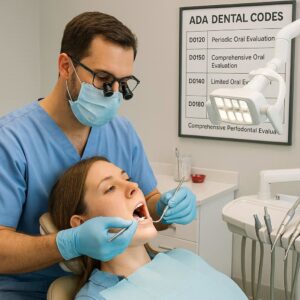
D0120: Periodic Oral Evaluation
This is the code you will likely see most often. D0120 refers to a periodic oral evaluation. This is what most people think of when they imagine a “routine check-up.”
This exam is performed on a patient of record. That means you have already been to this dental office before, and they have your history on file. The purpose of this exam is to check the stability of your oral health since your last visit.
What does it include?
-
An evaluation of the existing clinical conditions.
-
A check for changes in your dental health.
-
A review of the patient’s medical and dental history.
-
An assessment of the gums and soft tissues.
-
An oral cancer screening.
This code is typically used when you come in for your regular six-month cleaning and check-up. It is a “snapshot” to ensure everything is on track. Most insurance plans cover this code twice per calendar year, usually with no copay if you are in-network, because it is considered preventive care.
D0150: Comprehensive Oral Evaluation
If D0120 is the snapshot, D0150 is the full documentary. A comprehensive oral evaluation is performed when a patient is new to a practice, or when a patient has not been seen in a long time (often three years or more), or when there has been a significant change in their health status.
This is a much more in-depth evaluation than a periodic exam. The dentist is essentially establishing a baseline for your oral health. This exam involves a thorough assessment of the entire oral cavity, including the head and neck.
What does it include?
-
Evaluation of the teeth, gums, and oral soft tissues.
-
Comprehensive intraoral and extraoral hard and soft tissue exams.
-
Assessment of the patient’s medical and dental history.
-
Evaluation of the temporomandibular joint (TMJ) if necessary.
-
Oral cancer screening.
-
Often, this exam is accompanied by diagnostic images (X-rays) to get a full view of what is happening beneath the surface.
You should expect this code to appear on your first visit to a new dentist. It is a crucial step. Without this baseline, a dentist cannot reliably tell if a small cavity is new or old, or if gum disease is progressing or stable.
D0140: Limited Oral Evaluation
Life happens. Sometimes you need to see the dentist for a specific problem. Maybe you chipped a tooth on a popcorn kernel, or you have a sudden toothache that keeps you up at night. In these cases, the dentist will use D0140, the limited oral evaluation.
This is a problem-focused examination. The dentist is not there to check all your teeth; they are there to evaluate the specific area of concern. It is often referred to as an “emergency exam” or a “focused exam.”
What does it include?
-
An evaluation of the chief complaint.
-
Examination of the specific tooth or area in question.
-
Diagnostic procedures to determine the cause of the pain or issue.
This code is frequently used to get a patient out of pain. It is important to note that if you go to a dentist for an emergency and you are not a patient of record, they may use a combination of D0140 and D0150 to establish care and address the problem.
D0180: Comprehensive Periodontal Evaluation
Your gums are the foundation of your teeth. The D0180 code is used for a comprehensive periodontal evaluation. While a general exam looks at the teeth, this exam focuses specifically on the health of the periodontium—the tissues and bone that support the teeth.
This is not a routine check-up for everyone. It is typically performed when a patient shows signs of gum disease (periodontitis) or when they are undergoing periodontal treatment.
What does it include?
-
A full assessment of the periodontal tissues.
-
Probing and charting of the gum pockets around each tooth.
-
Evaluation of bleeding points, recession, and furcation involvement (where the bone has receded between the roots of multi-rooted teeth).
-
Assessment of the patient’s risk factors.
If your dentist mentions that you need “periodontal charting” or that your gums are bleeding, they are likely performing the procedures associated with code D0180.
D0190: Screening of a Patient
This is a newer code in the CDT manual. Screening of a patient (D0190) is used for a very brief assessment to determine if a full exam is necessary. This is often used in public health settings, nursing homes, or schools. It is not typically used for a standard appointment in a private dental practice.
D0191: Assessment of a Patient
Similar to D0190, assessment of a patient is used to determine the need for a definitive diagnostic examination. It is a preliminary look to see what kind of care is required next.
A Comparative Look: Periodic vs. Comprehensive vs. Limited
To help you visualize the differences between the main exam codes, here is a simple comparison table. This is a handy reference to keep in mind when you look at your next treatment plan.
| ADA Code | Procedure Name | Best For | Typical Insurance Coverage | Key Characteristics |
|---|---|---|---|---|
| D0120 | Periodic Oral Evaluation | Routine check-ups (every 6 months) | Usually covered at 100% (preventive) | Patient of record; checks stability; “maintenance” visit. |
| D0150 | Comprehensive Oral Evaluation | New patients or patients with a long absence | Often covered, but may have a frequency limit (e.g., once every 3-5 years) | Full baseline; head and neck exam; establishes full health picture. |
| D0140 | Limited Oral Evaluation | Emergency visits; specific pain or problem | Subject to deductible; may have copay | Problem-focused; only evaluates the area of chief complaint. |
| D0180 | Comprehensive Periodontal Evaluation | Patients with gum disease | Often covered under basic services, not preventive | Focused specifically on gums and supporting bone structures. |
How Dental Exams Fit Into Your Treatment Plan
An exam is rarely the only service performed during a dental visit. It is usually the starting point. Understanding how the exam code interacts with other codes can help you decipher the entire treatment plan.
The Standard Visit: Exam, Cleaning, and X-rays
The most common combination of codes for a typical six-month visit is a triad:
-
D0120 (Periodic Oral Evaluation)
-
D1110 (Adult Prophylaxis – the cleaning)
-
D0210 or D0270 (Intraoral X-rays – bitewings)
When you see these three together, you are looking at a standard preventive care appointment. Insurance companies usually look favorably on this combination because it is cheaper to prevent disease than to treat it later.
The New Patient Visit
If you are seeing a dentist for the first time, your treatment plan might look different. It will likely include:
-
D0150 (Comprehensive Oral Evaluation)
-
D0210 (Full Mouth X-rays – a series of 14-20 images to get a complete picture)
-
D1110 or D4341 (Cleaning or deeper cleaning depending on gum health)
Because the comprehensive exam and full-mouth X-rays are more involved, the cost is usually higher than a routine visit. However, this is a critical investment in your long-term health.
The Emergency Visit
If you break a tooth and need it fixed, your treatment plan might look like this:
-
D0140 (Limited Oral Evaluation)
-
D0220 (Intraoral Periapical X-ray – an X-ray of just the specific tooth)
-
D2391 (Resin-based composite filling, one surface – to fix the tooth)
In this scenario, the focus is on the immediate problem. The exam code reflects that the dentist only looked at the affected area, not the whole mouth.
Common Questions and Confusions About Exam Codes
Even with the codes laid out clearly, patients often have questions. It is completely normal to feel a little lost when you first start looking at dental billing. Let us clear up some of the most common sources of confusion.
“Why am I being charged for an exam when I just came for a cleaning?”
This is perhaps the most common question. The confusion arises because patients often bundle “the cleaning” and “the check-up” into one event in their minds. In dental coding, these are two separate services.
The cleaning (prophylaxis) removes plaque and tartar. The exam (D0120) is the dentist’s time and expertise spent evaluating your health. You are paying for the dentist’s professional judgment, diagnosis, and the creation of a treatment plan. You cannot have one without the other in a standard preventive visit, but they are billed separately.
“My insurance denied my D0150 because it’s too soon. What does that mean?”
Insurance companies often put frequency limits on specific codes. For a comprehensive exam (D0150), many insurance policies will only cover it once every three to five years, or sometimes only once per lifetime per practice.
If you try to bill a comprehensive exam again within that time frame, the insurance company will likely deny the claim, leaving the balance to the patient. If your dentist feels you truly need a new comprehensive exam (perhaps due to a major health change), they can submit a narrative and X-rays to the insurance company asking for an exception, but it is not guaranteed.
“Can I get a periodic exam (D0120) instead of a comprehensive one (D0150) to save money?”
This is a common thought, but it is not usually advisable. If you are a new patient, a periodic exam is not appropriate. The dentist does not have a baseline to compare against. Performing a D0120 on a new patient could lead to missed diagnoses because the dentist does not know what is new versus what has been there for years.
Think of it like buying a used car. A periodic exam is like checking the oil and tire pressure. A comprehensive exam is like having a mechanic put the car on a lift and inspect the engine, transmission, and frame. You want the full inspection first to ensure there are no hidden problems.
Beyond the Basics: Navigating Dental Insurance with Knowledge
Now that you understand the codes, you can use this knowledge to navigate the financial side of dentistry with more confidence. Dental insurance is a contract. By knowing the language of that contract (the codes), you can advocate for yourself more effectively.
How to Read Your Explanation of Benefits (EOB)
Your EOB is a document sent by your insurance company after a claim is filed. It is not a bill, but it tells you how much they are paying and what you might owe.
Here is what to look for regarding exam codes:
-
Code: Look for the code (D0120, D0150, etc.).
-
Billed Amount: What the dentist charged.
-
Allowed Amount: The negotiated rate your insurance has with the dentist.
-
Covered Amount: What the insurance paid.
-
Patient Responsibility: The difference you owe.
If your EOB shows a code you do not recognize, call your dentist’s billing coordinator. They can explain why that specific code was used. Most billing errors are simple misunderstandings that can be cleared up with a quick phone call.
Questions to Ask Your Dentist’s Office
To avoid surprises, it is always a good idea to ask questions before your appointment. Here are a few helpful questions to keep in your back pocket:
-
“Since I am a new patient here, will I be billed for a D0150 comprehensive exam?”
-
“For my six-month cleaning next week, will you be using code D0120 for the exam?”
-
“I have a toothache. If I come in, will this be considered a D0140 limited exam?”
-
“Does my insurance plan have a frequency limit on comprehensive exams (D0150)?”
By asking these questions upfront, you align expectations with reality. The dental team appreciates when patients are engaged and informed because it leads to smoother appointments and fewer billing headaches later.
The Value of the Exam: More Than Just a Number
While this guide focuses heavily on the financial and coding aspects of dental exams, it is crucial to remember the real value behind these codes. An exam is not just a prerequisite for a cleaning or a means to an insurance claim.
A dental exam is a diagnostic tool. It is a preventive measure.
During a D0120 or D0150, your dentist is doing more than just “counting teeth.” They are screening for:
-
Oral Cancer: Early detection saves lives.
-
Systemic Diseases: Conditions like diabetes, osteoporosis, and even heart disease can show symptoms in the mouth first.
-
Sleep Apnea: Dentists often identify signs of airway issues.
-
Bruxism (Teeth Grinding): Wear patterns can indicate stress or alignment issues.
When you look at your treatment plan and see an exam code, remember that it represents a professional medical assessment that contributes to your overall well-being. It is the cornerstone of your dental care.
A Note on Tele-dentistry and Virtual Exams
The world of dentistry has evolved, and with it, the way exams are performed. In recent years, telehealth codes have emerged, allowing for virtual consultations. While a physical examination is always the gold standard, there are codes like D9995 (Telehealth – synchronous) and D9996 (Telehealth – asynchronous) that may be used in conjunction with an exam code.
These are typically used for consultations, follow-ups, or triage to determine if an in-person visit is necessary. They are an exciting development in increasing access to care, especially for patients in rural areas or those with mobility issues.
Conclusion: Empowering Your Dental Journey
Understanding the ADA dental code for exam is about more than just saving money on a dental bill. It is about empowerment. When you know the difference between a periodic evaluation (D0120) and a comprehensive one (D0150), you move from being a passive patient to an active participant in your oral health care.
You now have the tools to ask the right questions, interpret your insurance statements, and work collaboratively with your dental team. Remember, these codes are designed to create clarity and consistency. By learning their language, you ensure that you receive the appropriate care for your needs without unnecessary confusion.
Your oral health is a vital part of your overall health, and the exam is where it all begins. The next time you see that code on a form, you will know exactly what it means and why it matters.
Frequently Asked Questions (FAQ)
1. How often can I have a D0120 periodic exam?
Most dental insurance plans cover D0120 twice per calendar year (every six months). Some plans may allow three times per year if there is a medical necessity, such as active periodontal disease.
2. Is a comprehensive exam (D0150) covered by insurance?
Yes, most dental insurance plans cover a comprehensive exam, but it is usually limited to once every 3 to 5 years, or only when you first join a new practice. It is considered a diagnostic service, so it may be subject to your deductible if you haven’t met it yet.
3. What is the difference between D0120 and D0150?
D0120 (Periodic Oral Evaluation) is a routine check-up for existing patients to monitor stability. D0150 (Comprehensive Oral Evaluation) is a full, in-depth assessment performed for new patients or after a long absence to establish a complete baseline of oral health.
4. Why did my dentist use D0140 for my toothache?
D0140 is a limited, problem-focused exam. If you come in with a specific complaint like a toothache or a broken tooth, this code is used because the dentist’s evaluation is focused on the area of concern rather than examining the entire mouth.
5. Can a dentist change an exam code after the appointment?
Codes are chosen based on the service provided. If a dentist performed a comprehensive exam, they must bill D0150. Billing a different code to get a better insurance benefit is considered insurance fraud. However, if there was a clerical error, the office can correct it.
6. What happens if my insurance denies my exam code?
If your insurance denies an exam code, you are responsible for the cost. However, you should first ask your dental office to verify the denial reason. If it was a coding error, they can resubmit. If it was a frequency limitation, you may be able to appeal with the help of your dentist.
Additional Resources
For further reading and to verify the most current information directly from the source, the American Dental Association (ADA) provides the official manual for dental codes.
-
American Dental Association (ADA) – CDT Codes: https://www.ada.org/en/publications/cdt (Link to the official ADA page for the Current Dental Terminology)