The Complete Guide to the ADA Code for Nitrous Oxide Anesthesia
- On
- InDENTAL CODE
If you have ever spent time deciphering a dental insurance claim, you know it can feel like learning a new language. Among the most common questions we hear from dental professionals and even curious patients is about the specific code for one of dentistry’s oldest and most reliable tools: nitrous oxide.
You might know it as “laughing gas.” In the clinical world, it is a vital tool for managing anxiety and ensuring patient comfort. But when it comes to billing and documentation, precision is everything.
In this guide, we are going to explore everything you need to know about the ADA code for nitrous oxide anesthesia. Whether you are a dentist looking to tighten up your coding practices, a dental office manager handling claims, or a patient wanting to understand your bill, this article is for you. We will keep things simple, clear, and practical.
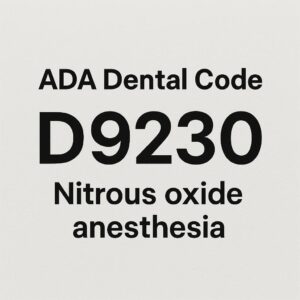
Table of Contents
ToggleUnderstanding the Current Dental Terminology (CDT)
Before we dive into the specific code, it helps to understand where these codes come from. The American Dental Association (ADA) maintains the Current Dental Terminology (CDT) code set. This is the standard in the United States for reporting dental procedures and services to payers.
Think of the CDT as the dictionary of dentistry. Every year, the ADA reviews and updates these codes to reflect changes in technology, techniques, and clinical best practices. Using the correct code is not just about getting paid. It is about maintaining accurate patient records and ensuring that the treatment provided is clearly understood by insurance companies and other healthcare providers.
Why Accurate Coding Matters
Using the wrong code can lead to a cascade of problems. A claim might be denied, delayed, or underpaid. In some cases, using an incorrect code could even raise red flags during an audit.
For nitrous oxide specifically, accuracy is crucial because it is often a separate, billable service. It is not always considered a routine part of every procedure. It stands on its own as an anxiety control service. This means that your documentation and coding need to clearly justify its use.
The Primary ADA Code for Nitrous Oxide
So, let us get straight to the point. The specific ADA code for nitrous oxide anesthesia is D9230.
This code is officially described in the CDT manual as: “Inhalation of nitrous oxide/analgesia, anxiolysis.”
When you see D9230 on a claim form or an explanation of benefits (EOB), it signifies that the patient received nitrous oxide for the purpose of relaxation and pain control during a dental procedure.
It is important to note that this code is typically billed in addition to the primary restorative or surgical procedure. For example, if a patient receives a filling (D2391) and also requests nitrous oxide to help with anxiety, the claim would include both codes: the filling code and D9230.
What D9230 Includes
When you bill D9230, you are billing for more than just the gas itself. The fee generally covers:
-
The administration of the gas by the dental team.
-
The monitoring of the patient’s vital signs and responsiveness.
-
The use of the nasal mask and scavenging system.
-
The clinical expertise required to titrate the gas to the appropriate level of sedation.
It is a service fee, not a material cost. This is an important distinction when discussing fees with patients or negotiating with insurance networks.
When to Use D9230
D9230 is specifically designed for minimal sedation using nitrous oxide. The goal is anxiolysis, which is a fancy way of saying “anxiety relief.”
Common Clinical Scenarios
You will typically see this code used in situations where a patient experiences dental anxiety. However, it is also used for practical clinical reasons.
| Scenario | Reason for D9230 |
|---|---|
| High Anxiety Patients | Patients who have a fear of needles, drills, or the dental environment often require nitrous oxide to tolerate treatment. |
| Long Appointments | For procedures lasting over an hour, nitrous oxide helps the patient remain comfortable and relaxed in the chair. |
| Gag Reflex | A strong gag reflex can make impressions or work on posterior teeth nearly impossible. Nitrous oxide helps suppress the gag reflex. |
| Special Needs Patients | For individuals with certain cognitive or physical challenges, nitrous oxide can facilitate a safe and effective appointment. |
| Pediatric Patients | Children often benefit from nitrous oxide to help them sit still for restorative work or extractions. |
Important Distinction: Not for Surgical Anesthesia
It is crucial to understand that D9230 is not for deep sedation or general anesthesia. If a patient requires a higher level of sedation—such as IV sedation (D9241, D9242) or general anesthesia (D9222, D9223)—those have their own distinct codes. Using D9230 for a case that requires deeper sedation would be incorrect and potentially dangerous from a documentation standpoint.
Documentation Requirements for D9230
Insurance companies are increasingly scrutinizing claims for nitrous oxide. To ensure reimbursement and maintain compliance, your documentation must be thorough.
Simply writing “N2O” on a routing slip is not enough. The patient’s chart should tell a story.
What Your Notes Should Include
To support the use of D9230, your clinical notes should cover the following elements:
-
Indication for use: Why was nitrous oxide necessary? Was it for anxiety, a strong gag reflex, or a lengthy procedure? Be specific. A note like “Patient requested nitrous oxide due to moderate dental anxiety” is acceptable.
-
Informed consent: You should have a signed consent form specifically for the administration of nitrous oxide. This form should outline the risks, benefits, and alternatives.
-
Monitoring: Record the patient’s response to the medication. Did they tolerate it well? Were there any adverse reactions? Note the start and stop times.
-
Post-administration recovery: Document that the patient was discharged to the care of a responsible adult. Since nitrous oxide has a rapid recovery time, this note is often simple, but it should exist.
-
Procedure linkage: Clearly link the D9230 to the primary procedure. The chart should show that the nitrous oxide was administered to facilitate the successful completion of the dental treatment.
Important Note for Readers:
If you are a patient reviewing your chart, you have the right to see these notes. They should clearly explain why the service was provided. If something is unclear, do not hesitate to ask your dental office for clarification.
Reimbursement and Insurance Considerations
One of the most common frustrations for both dental practices and patients is the unpredictability of insurance reimbursement for D9230.
Is Nitrous Oxide Covered?
The short answer is: sometimes. It varies widely from plan to plan.
-
Medical Necessity: Many insurance carriers will only cover D9230 if it is deemed “medically necessary.” This usually means the patient has a documented condition (like severe anxiety or a physical disability) that prevents them from receiving necessary dental care without it.
-
Patient Age: Some plans automatically cover nitrous oxide for pediatric patients (often under the age of 12) but deny it for adults, considering it a “convenience” rather than a necessity.
-
Frequency Limitations: Even when covered, there may be limitations. Some plans only allow D9230 to be billed once per day, regardless of how many procedures are completed. Others may limit the number of units per year.
-
Coordination with Other Sedation: If a patient receives IV sedation, most plans will not also pay for nitrous oxide on the same day, as the IV sedation is considered to cover the anxiety control.
A Note on Patient Responsibility
Because insurance coverage for D9230 is so inconsistent, many dental practices collect payment for nitrous oxide at the time of service. They may then file the claim as a courtesy to the patient, but the expectation is that the patient is responsible for the fee if the insurance denies it.
This is a best practice for transparency. It avoids the unpleasant situation of sending a bill months later for a service the patient assumed was fully covered.
Billing Strategies for the Dental Team
If you work in dental administration, you know that the battle is often won or lost in the details. Here are some practical tips to improve your success rate with D9230 claims.
-
Verify Benefits Before the Appointment: When a patient schedules an appointment that will likely require nitrous oxide, call the insurance carrier to verify coverage. Ask specifically: “Does the plan cover D9230 for an adult patient with dental anxiety?” and “Are there any frequency limitations?”
-
Use the Correct Modifiers: While D9230 usually stands alone, sometimes attaching a modifier can help. For example, if the primary procedure is denied, you may need to append a modifier to indicate the nitrous oxide was for a distinct service. However, always check payer guidelines, as not all accept modifiers for this code.
-
Write for the Reviewer: When submitting a claim with D9230, consider including a brief narrative. If your documentation shows “moderate anxiety” and “patient unable to tolerate restorative work without sedation,” you are giving the reviewer a reason to approve the claim.
-
Understand Your Fee Structure: Have a clear internal policy. Is your D9230 fee the same for all patients? Do you offer a discounted fee for uninsured patients? Consistency in your fee structure helps avoid confusion and potential compliance issues.
The Patient Experience: What to Expect
For patients, seeing D9230 on a treatment plan can be confusing. They might wonder, “Why am I being charged extra for air?”
If you are a patient reading this, understanding what this code represents can help you feel more confident in your treatment plan. When you pay for D9230, you are paying for a controlled, safe, and professional service.
How the Process Works
Your dental team will place a small, comfortable nasal mask over your nose. You will be asked to breathe normally. The gas mixture is titrated to your specific needs. The goal is not to put you to sleep but to create a state of profound relaxation.
-
The Onset: You will feel a sense of calm. Your limbs might feel heavy or tingly. This usually happens within a few minutes.
-
During Treatment: You remain awake, aware, and able to communicate with the dentist. If you feel any discomfort, you can raise your hand.
-
Recovery: At the end of the procedure, the nitrous oxide is turned off, and you breathe 100% oxygen for about five minutes. The effects wear off rapidly, and you can usually drive yourself home, unless other medications were used.
This is why D9230 is so popular. It offers a high level of safety with a quick recovery time.
Comparing Nitrous Oxide to Other Sedation Options
To fully appreciate the role of D9230, it helps to see how it stacks up against other sedation modalities. This comparison is also useful for patients trying to decide which option is right for them.
| Feature | Nitrous Oxide (D9230) | Oral Sedation (D9241) | IV Sedation (D9242) |
|---|---|---|---|
| Level of Sedation | Minimal (anxiolysis) | Minimal to Moderate | Moderate to Deep |
| Administration | Inhalation via nasal mask | Pill taken by mouth | Intravenous (IV) line |
| Consciousness | Awake and responsive | Drowsy but responsive | Very drowsy; may sleep |
| Recovery Time | Very fast (5-10 minutes) | Slow (hours) | Moderate (30-60 min) |
| Need for Escort | Usually not required | Required | Required |
| Best For | Mild to moderate anxiety, gag reflex | Moderate to severe anxiety | Severe anxiety, complex surgery |
As the table shows, D9230 is the entry point for sedation. It is the least invasive, has the fastest recovery, and generally carries the lowest risk. This is why it remains a cornerstone of modern dental practices.
Legal and Ethical Considerations
From a legal standpoint, using the correct ADA code for nitrous oxide anesthesia is not just about reimbursement. It is about adhering to the standard of care.
State Regulations
In many states, the administration of nitrous oxide requires specific certification. Dentists and hygienists may need to complete a board-approved course to legally administer it. When you see D9230 on a claim, it implies that the provider is licensed and trained to deliver that service.
Ethical Billing
There is a temptation in some practices to “bundle” the cost of nitrous oxide into the primary procedure code to simplify billing for uninsured patients. While this might seem harmless, it is a form of unbundling that can cause issues.
If a patient is insured, bundling the cost is not allowed. The service should be billed separately. For uninsured patients, it is best practice to maintain a transparent fee structure. If you choose to offer a discount, it should be clearly documented, and the services should still be itemized on the ledger.
The Future of D9230 and Dental Coding
The CDT codes are dynamic. While D9230 has been a stable code for many years, the conversation around sedation and anesthesia is evolving.
There is a growing emphasis on the medical necessity of anxiety control. As the connection between oral health and systemic health becomes clearer, we may see more medical plans covering dental sedation for patients with specific health conditions.
Additionally, teledentistry and remote monitoring are changing how we think about patient care. While it is unlikely that D9230 will change soon, the documentation requirements around it may become more stringent. Practices that adopt robust digital charting systems and narrative templates will be better positioned for the future.
Common Coding Mistakes to Avoid
Even experienced teams can make mistakes. Here is a quick list of pitfalls to watch out for.
-
Billing D9230 for the wrong procedure: Some primary procedure codes (like certain surgical extractions) have a “global period” that might include basic anxiety control. Check if the primary code is bundled.
-
Failing to document the indication: As mentioned earlier, a claim with D9230 and no narrative is an easy target for denial.
-
Using D9230 for general anesthesia: If the patient was unconscious, you need the general anesthesia codes (D9222 or D9223). Using D9230 in this scenario is incorrect.
-
Not obtaining consent: Always get written consent. Verbal consent is difficult to prove in a dispute.
-
Inconsistent fees: Charging one insurance plan a certain fee and another plan a vastly different fee for the same service can lead to accusations of fee discrimination.
A Checklist for Dental Practices
To help streamline your process, here is a simple checklist to use whenever D9230 is part of a treatment plan.
-
Pre-Appointment: Verified insurance coverage for D9230.
-
Consultation: Explained the benefits, risks, and cost to the patient.
-
Consent: Signed nitrous oxide consent form is in the chart.
-
Medical History: Reviewed to ensure no contraindications (e.g., certain respiratory conditions or pregnancy in the first trimester).
-
Documentation: Chart notes include the reason for use, start/stop times, and patient response.
-
Post-Op: Note of recovery and discharge instructions (if applicable).
-
Claim Submission: D9230 is submitted with the primary procedure codes, and a narrative is attached if the reason for use is not obvious.
Frequently Asked Questions (FAQ)
Q: Does dental insurance always cover D9230?
A: No. Coverage varies significantly. Many plans consider it a separate service and may only cover it for children or cases with documented medical necessity. It is always best to verify benefits before treatment.
Q: Can I drive myself home after receiving nitrous oxide?
A: In most cases, yes. Because nitrous oxide is eliminated from the body so quickly (especially with the post-procedure oxygen flush), patients can typically drive themselves home. However, if you received any other medications (like oral sedatives), you will need a driver.
Q: Is D9230 the same as “laughing gas”?
A: Yes. D9230 is the ADA code for the administration of nitrous oxide, which is commonly known as laughing gas. It is used for relaxation and anxiety control.
Q: Why was I charged for D9230 if I didn’t ask for it?
A: In some cases, a dentist may recommend nitrous oxide to ensure a procedure can be completed safely, especially if you have a strong gag reflex or are showing signs of anxiety. You should always be informed of any additional fees before treatment begins.
Q: How is D9230 different from D9241?
A: D9230 is for nitrous oxide inhalation (minimal sedation). D9241 is for oral conscious sedation, where a patient takes a medication (like Valium or Halcion) by mouth to achieve a deeper state of relaxation.
Additional Resources
For those looking to dive deeper into dental coding, sedation protocols, or patient management, the following resource is an excellent starting point:
-
American Dental Association (ADA) Center for Professional Success: This is the official source for CDT codes, coding guides, and practice management resources. You can find the latest manual and webinars on proper documentation.
You can access their resources at: https://www.ada.org/en/publications/cdt
Conclusion
Navigating the world of dental codes does not have to be a headache. Understanding the ADA code for nitrous oxide anesthesia—D9230—is essential for accurate billing, clear patient communication, and smooth clinical operations. This code represents a valuable service that helps millions of patients receive the dental care they need in a comfortable, safe environment.
By using the code correctly, documenting thoroughly, and communicating transparently with patients about costs and insurance coverage, dental teams can reduce denials and build trust. Whether you are a provider, a team member, or a patient, knowing the ins and outs of D9230 empowers you to make informed decisions about dental sedation and anxiety management.

dentalecostsmile
Newsletter Updates
Enter your email address below and subscribe to our newsletter