ADA Code for Implant Supported Denture
If you have been told you need an implant supported denture, you might feel a little overwhelmed. There are many terms, steps, and numbers to keep track of. One of those numbers is the ADA code.
Do not worry. You do not need to be a dental billing expert to understand this.
This guide walks you through everything you need to know. We will look at what an implant supported denture really is. Then we will explain the specific ADA codes used for different parts of the procedure.
By the end, you will feel more confident talking to your dentist and your insurance company. Let us begin.
What Is an Implant Supported Denture? A Simple Explanation
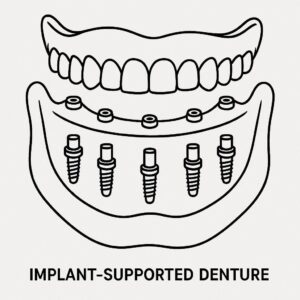
An implant supported denture is a type of overdenture. It attaches to dental implants that are placed in your jawbone. Unlike a traditional denture, which sits directly on your gums, this one clicks into place.
Think of it like this. A traditional denture is like a hat sitting on your head. An implant supported denture is like a hat snapped onto a few牢固 posts. It stays put.
This design gives you more stability. You can chew better. You do not have to worry about your denture slipping when you laugh or talk.
Who benefits from this type of denture?
-
People with no teeth in one or both jaws.
-
Those who have struggled with loose traditional dentures.
-
Patients with enough bone density to support implants.
-
Individuals looking for a more permanent but removable option.
Fixed vs. removable implant dentures
There are two main styles.
-
Removable implant supported denture: You take it out for cleaning at night.
-
Fixed implant denture: Only your dentist can remove it.
Most people use the removable type with a bar or ball attachments. The ADA coding changes slightly depending on which type you choose.
Important note: Not every patient is a good candidate for implants. Your dentist will take X-rays or a CT scan to check your bone level before starting.
Why Do ADA Codes Matter for You?
ADA codes are part of the Current Dental Terminology (CDT). The American Dental Association updates these codes every year.
You might wonder why a patient should care about codes.
Here is the honest truth. Your insurance company uses these codes to decide what they will pay for. If your dentist uses the wrong code, your claim could be denied. You could end up paying more out of pocket.
Understanding the basic codes helps you double-check your treatment plan. It also helps you ask better questions.
How codes appear on your dental bill
| Code Type | Example | What It Means |
|---|---|---|
| Diagnostic | D0150 | Comprehensive oral exam |
| Surgical | D6010 | Surgical placement of implant |
| Prosthetic | D6058 | Implant supported denture (partial) |
| Adjustment | D6080 | Implant maintenance |
Each code has a specific fee. Your dentist combines several codes to build your complete treatment plan.
The Main ADA Code for Implant Supported Denture
Let us answer the big question directly.
There is not one single ADA code for “implant supported denture.” Instead, the procedure uses a combination of codes. The most common primary code for the denture itself is D6110 or D6111 depending on the jaw.
Complete implant supported denture codes
-
D6110: Implant supported maxillary overdenture (upper jaw)
-
D6111: Implant supported mandibular overdenture (lower jaw)
These codes cover the denture that attaches to implants already placed. They include the framework, the denture teeth, and the attachments that snap onto the implants.
What these codes include
-
Laboratory fabrication of the denture
-
Metal reinforcement if needed
-
The housing for attachments (the female part that snaps onto the implant abutment)
-
Placement of the denture in your mouth
What they do not include
-
The implants themselves
-
The abutments (connector pieces)
-
Surgical guides
-
Bone grafting
-
CT scans
Remember: You will see multiple codes on your treatment plan. D6110 or D6111 is for the denture only, not the surgery.
Complete List of ADA Codes for Each Treatment Step
To give you a full picture, here are all the codes you might see during an implant supported denture journey. We have organized them by phase.
Phase 1: Diagnosis and planning
| ADA Code | Description |
|---|---|
| D0150 | Comprehensive oral evaluation |
| D0210 | Intraoral complete series of X-rays |
| D0367 | CT scan for implant planning |
| D6190 | Radiographic implant survey |
Phase 2: Surgical implant placement
| ADA Code | Description |
|---|---|
| D6010 | Surgical placement of implant body (endosteal implant) |
| D6011 | Second stage implant surgery (uncovering implant) |
| D6100 | Implant removal (if needed) |
| D7953 | Bone graft to sinus (sinus lift) |
Phase 3: Abutment and attachment codes
| ADA Code | Description |
|---|---|
| D6057 | Custom abutment (fabricated by lab) |
| D6058 | Abutment supported porcelain/ceramic crown |
| D6059 | Abutment supported retainer for FPD |
| D6062 | Abutment supported cast metal crown |
| D6080 | Implant maintenance (cleaning) |
Phase 4: The denture itself
| ADA Code | Description |
|---|---|
| D6110 | Implant supported maxillary overdenture |
| D6111 | Implant supported mandibular overdenture |
| D6112 | Replacement implant supported maxillary overdenture |
| D6113 | Replacement implant supported mandibular overdenture |
| D6114 | Implant supported maxillary overdenture (bar retained) |
| D6115 | Implant supported mandibular overdenture (bar retained) |
| D6116 | Implant supported maxillary overdenture (hybrid) |
| D6117 | Implant supported mandibular overdenture (hybrid) |
Phase 5: Repairs and adjustments
| ADA Code | Description |
|---|---|
| D6118 | Repair implant supported overdenture |
| D6119 | Replace implant supported overdenture attachments |
| D6920 | Reline implant overdenture (chairside) |
| D6930 | Reline implant overdenture (lab) |
Pro tip: Ask your dentist for a printed treatment plan with codes before you start. This helps you compare costs and check insurance coverage.
How Many Implants Do You Need for Each Code?
The ADA code does not specify the number of implants. However, the number of implants affects the type of denture and sometimes the specific code within the D6110 series.
Typical implant numbers by jaw
| Jaw | Number of Implants | Best Code Option |
|---|---|---|
| Lower (mandible) | 2 | D6111 (overdenture) |
| Lower | 4 | D6115 (bar retained) |
| Lower | 6+ | D6117 (hybrid) |
| Upper (maxilla) | 4 | D6110 (overdenture) |
| Upper | 6 | D6114 (bar retained) |
Two implants in the lower jaw work very well. Many patients choose this because it costs less and still gives great stability.
For the upper jaw, you often need at least four implants. The bone is softer up there. More implants help distribute chewing forces.
What your dentist will consider
-
Your bone density
-
Your budget
-
Whether you smoke
-
Any medical conditions like diabetes
-
How much the denture will cost long-term
Insurance Coverage for ADA Code D6110 and D6111
This is where things get tricky. Many dental insurance plans do not cover implant services fully. Some do not cover them at all.
Typical coverage breakdown
-
Diagnostic codes (D0150, D0210): Often covered at 80–100%
-
Surgical codes (D6010): Sometimes covered at 50% with a yearly max limit
-
Prosthetic codes (D6110, D6111): Often covered at 50% or not covered
-
Maintenance (D6080): Sometimes covered once per year
Why insurance may deny implant denture coverage
Some insurance companies call implants “experimental” or “cosmetic.” This is outdated, but it still happens. Other plans have a missing tooth clause. This means they will not pay to replace a tooth that was missing before you joined the plan.
What you can do
-
Ask your dentist’s office to submit a pre-treatment estimate.
-
Review your plan’s implant exclusion in writing.
-
Look into medical insurance. Some medical plans cover implants if tooth loss was due to an accident or tumor.
-
Ask about payment plans or dental discount programs.
Realistic advice: Budget to pay at least half the cost out of pocket. If insurance covers more, that is a nice surprise.
The Step-by-Step Clinical Process (With Codes)
Let us walk through a real patient example.
Meet Linda. She needs a lower implant supported denture (D6111). She has two implants placed.
Appointment 1: Consultation (D0150)
Linda’s dentist does a full exam. They take X-rays (D0210). They discuss options.
Estimated cost: $150–$250
Appointment 2: CT scan (D0367)
A 3D image helps the dentist see bone shape and nerve locations.
Estimated cost: $300–$500
Appointment 3: Implant surgery (D6010 x2)
The dentist places two implants into Linda’s lower jaw. Local anesthesia is used.
Estimated cost: $1,800–$3,000 per implant
Appointment 4: Healing period (3 to 6 months)
No code here. The bone grows around the implants. Linda wears her old denture with a soft liner.
Appointment 5: Second stage surgery (D6011)
The dentist uncovers each implant. Healing caps are placed.
Estimated cost: $300–$600
Appointment 6: Impressions and records (D6190)
The dentist takes special impressions to send to the lab.
Estimated cost: $200–$400
Appointment 7: Abutment placement (D6057)
Custom abutments are screwed into the implants.
Estimated cost: $500–$900 each
Appointment 8: Denture delivery (D6111)
The new implant supported denture is inserted. It snaps onto the abutments.
Estimated cost: $2,500–$5,000
Appointment 9: Follow-up and adjustment (D6080)
Linda returns after one week. The dentist checks pressure points and makes small adjustments.
Estimated cost: $100–$200
Total estimated cost for Linda: $8,000–$15,000 per arch
These are average US fees. Your actual costs will vary by region and dentist.
Comparative Table: ADA Codes for Different Implant Denture Types
| Type of Prosthesis | ADA Code(s) | Implants Needed | Removable? | Approximate Lab Cost |
|---|---|---|---|---|
| Traditional denture | D5110 (upper), D5120 (lower) | 0 | Yes | $500–$1,500 |
| Two-implant overdenture | D6111 (lower) | 2 | Yes | $2,500–$4,000 |
| Four-implant bar overdenture | D6115 (lower) | 4 | Yes (but very stable) | $4,000–$7,000 |
| Fixed hybrid denture | D6117 | 4–6 | No (screw retained) | $6,000–$12,000 |
| All-on-4 (proprietary) | D6114 or D6116 | 4 | No | $10,000–$20,000 |
The All-on-4 technique is a specific treatment concept. Many dentists use the standard ADA codes above to bill for it.
Attachments and Their Role in Coding
The attachment system matters for billing. Different attachments sometimes use different codes or modifiers.
Common attachment types
Locator attachments
These are very popular. They have a female nylon insert inside the denture. The male part sits on the implant abutment. You feel a click when the denture seats.
Bar attachments
A metal bar connects two or more implants. The denture has a metal housing that clips onto the bar. This uses code D6114 or D6115.
Ball attachments
The oldest type. A metal ball on the implant and a rubber O-ring in the denture. Less common now but still reliable.
What the attachment code covers
When you see D6110 or D6111, the basic attachment housing is included. However, if you need replacement O-rings or nylon inserts later, that uses a different code: D6119.
Maintenance reminder: The nylon inserts in Locator attachments wear out every 6 to 12 months. Replacing them is quick and inexpensive. Do not ignore this. Loose attachments can damage your implants.
Common Billing Mistakes and How to Avoid Them
Even good dental offices make coding errors. Here are the most frequent problems with implant supported denture codes.
Mistake #1: Using a crown code for a denture
Some offices mistakenly bill D6058 (implant crown) instead of D6110. This is wrong because a crown replaces one tooth. An overdenture replaces a full arch.
Consequence: Insurance denial or partial payment of a much lower fee.
Mistake #2: Forgetting the second stage code
D6011 is often omitted. The office rolls the uncovering fee into the original surgery. That makes tracking actual costs harder for you.
Mistake #3: Not separating the abutment
Abutments (D6057) are billed separately from the denture. Some offices include them. Others do not. Ask for clarity.
How to protect yourself
-
Request an itemized treatment plan before any work begins.
-
Match each code to a description you understand.
-
Ask: “Is there any other code I will see later for the same tooth?”
Medically Necessary vs. Cosmetic: A Note on Coding
Sometimes dentists use different codes to help with medical insurance claims. Medical insurance does not recognize ADA codes. They use CPT codes (Current Procedural Terminology).
When medical insurance might pay
-
Tooth loss due to trauma (car accident, fall)
-
Congenital conditions (cleft palate)
-
Tumor removal that included teeth
-
Radiation damage to jawbone
What your dentist may need to do
Write a letter of medical necessity. This letter explains why implants and an implant supported denture are not cosmetic. It must include:
-
Diagnosis (ICD-10 code)
-
How the condition affects eating or speaking
-
Why a traditional denture is not adequate
Be honest: Medical insurance is not easy to convince. But it is worth trying if your situation qualifies.
Implant Supported Denture Codes for Replacement and Repair
What happens if your denture breaks five years later? There are codes for that too.
Replacement codes
-
D6112: Replacement maxillary implant supported overdenture
-
D6113: Replacement mandibular implant supported overdenture
These are used when the original denture is beyond repair. You keep the same implants. Only the denture is remade.
Repair codes
-
D6118: Repair of implant supported overdenture
(for a cracked base or broken tooth) -
D6119: Replacement of attachments
(new O-rings, nylon inserts, or clips)
Reline codes
Over time, your gums change shape. A reline refits the inside of your denture to your gums.
-
D6920: Chairside reline (done in one visit)
-
D6930: Laboratory reline (denture sent to lab)
A reline does not require changing the implant attachments. It only adjusts the denture base.
What the ADA Codes Do NOT Tell You
Codes are useful, but they do not tell the whole story. Here are important things codes leave out.
Quality of materials
D6110 does not say whether your denture teeth are premium acrylic or standard. It does not specify the type of metal framework. Always ask your dentist about material grades.
Dentist experience
A code does not reflect how many implant dentures your dentist has done. Experience matters a lot. An experienced prosthodontist may charge more, but the fit is often better.
Laboratory quality
Two dentures with the same ADA code can look very different. One lab uses high-end zirconia teeth. Another uses basic plastic teeth. Ask which lab your dentist uses.
Warranty information
Some dentists offer a 1-year or 2-year warranty on the denture. Others do not. This is not part of any code. Get it in writing.
Patient story: Mark paid $12,000 for an implant denture. The denture cracked after 14 months. His dentist had no warranty. Mark paid $1,200 for a repair. Ask about warranties before you start.
How to Read Your Dental Claim Form
Understanding your dental claim form (ADA 2012 form) helps you catch errors. Here is what to look for.
Box 32 – Procedure Code
This is where D6110 or D6111 appears. Make sure the code matches what you agreed to.
Box 34 – Tooth Number or Area
For an implant supported denture covering the whole arch, you will see “00” for upper arch or “01” for lower arch. If you see individual tooth numbers (like 18–31), that may be wrong.
Box 35 – Description
A short text description of the code. It should say “implant supported overdenture” or something similar.
Box 36 – Fee
The amount charged for that procedure.
Box 37 – Other Insurance?
If you have medical insurance that might cover part of the surgery, this box should be marked yes.
What to do if something looks wrong
Call your dentist’s billing coordinator. Ask them to explain each line. Do not assume it is correct. Mistakes happen.
Frequently Asked Questions (FAQ)
1. Is D6110 the same as All-on-4?
Not exactly. D6110 is a general code for an implant supported overdenture. All-on-4 is a specific technique. Many dentists use D6110 or D6116 to bill for All-on-4. Ask your dentist which code they use.
2. Does insurance cover D6111 for the lower jaw?
Some PPO plans cover 50% after a deductible. Many DHMO plans cover nothing for implants. Medicare generally does not cover implant dentures.
3. How often can I bill D6080 for maintenance?
Most plans allow once or twice per year. D6080 covers implant cleaning and checking the attachments.
4. Can I use D6110 if I already have implants?
Yes. D6110 and D6111 are specifically for the denture itself. You would have had implants placed earlier using D6010.
5. What code is used if my implant denture needs a new tooth?
D6118 covers repair of the denture. If a single tooth fractures, this is the correct code.
6. Why did my dentist use D6115 instead of D6111?
D6115 indicates a bar-retained overdenture. D6111 is for an overdenture with individual attachments (like Locators). Your dentist chose based on your clinical needs.
7. Are these codes the same in Canada or the UK?
No. Canada uses Canadian Dental Association codes. The UK uses NHS or BDA codes. This article focuses on US ADA codes.
8. What is the difference between D6116 and D6117?
D6116 is a hybrid prosthesis for the upper jaw. D6117 is for the lower jaw. Both are fixed (non-removable) dentures.
9. Can I get a discount for paying cash?
Many dentists offer 5–10% off if you pay in full before treatment starts. This does not affect which code they use. Just ask.
10. What if my implant denture code is denied by insurance?
File an appeal. Ask your dentist to write a letter of medical necessity. Provide X-rays and photos showing why a traditional denture will not work for you.
Additional Resources
For more reliable information on ADA codes and implant dentures, visit the American College of Prosthodontists patient resource page. They offer free guides on treatment options and insurance advocacy.
🔗 Recommended link:
Gotoapro.org – Find a prosthodontist and learn about implant denture codes
Copy and paste this link into your browser for verified, patient-friendly information.
Final Thoughts: Putting It All Together
You do not need to memorize every ADA code. But knowing the main ones — D6110 for upper and D6111 for lower — gives you a solid starting point. These codes represent the denture that will change your daily life for the better.
Talk openly with your dentist. Ask for a written treatment plan with codes. Check with your insurance before committing. And remember: a well-coded claim is the first step to a well-made denture.
You have taken an important step by educating yourself. Now go forward with confidence.
Conclusion
The ADA code for an implant supported denture is not a single number but a combination, with D6110 (upper) and D6111 (lower) being the primary prosthetic codes. Understanding these codes helps you navigate insurance claims, avoid billing errors, and make informed decisions about your dental care. Always request an itemized treatment plan and discuss costs, materials, and warranties with your dentist before starting treatment.