ADA Dental Code for Core Build Up: A Complete Guide for Patients & Professionals
If you have ever been told you need a dental crown, you might have heard the phrase “core buildup” mentioned in the discussion. Suddenly, your simple filling turned into something that sounds a little more like construction work.
But here is the truth: a core buildup is exactly that—construction work. It is the foundation that saves a tooth when there isn’t enough structure left to hold a crown.
And every construction job in dentistry needs a specific code to bill it properly.
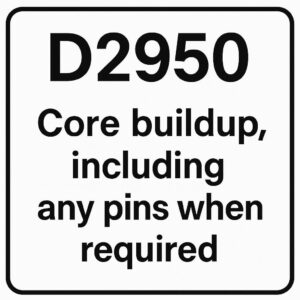
That code is D2950.
In this guide, we will walk you through everything you need to know about the ADA dental code for core buildup. We will explain what it means, when a dentist uses it, how it differs from similar procedures, and what you should expect to see on your dental bill.
Let us start from the beginning.
What Is a Core Buildup? (A Simple Explanation)
Imagine an old house that has been damaged by a storm. The outer walls are cracked, and some rooms are missing. You want to put a new roof on that house, but there is nothing strong enough to attach the roof to.
You cannot just place the roof on thin air.
First, you need to rebuild the walls. You need to create a solid structure that can support that roof.
A core buildup does the exact same thing for a tooth.
When a tooth has been damaged by decay, a fracture, or an old failing filling, there may not be enough healthy tooth structure left above the gum line. A dental crown (the “roof”) needs something to hold onto. The core buildup rebuilds the missing parts of the tooth so the crown has a strong and stable foundation.
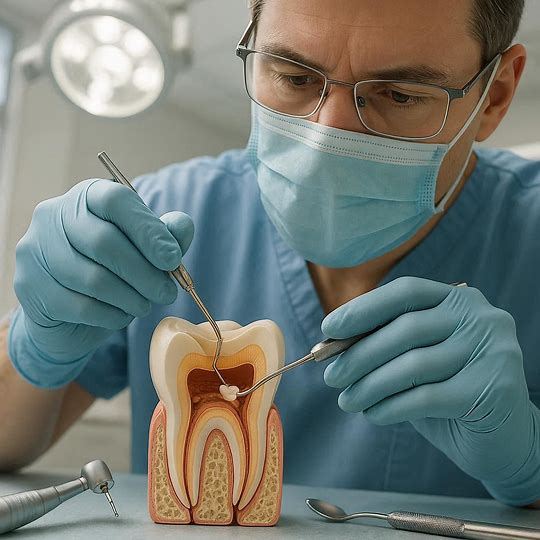
The dentist uses special dental materials—often a composite resin or a glass ionomer—to rebuild the core of the tooth. Once this material hardens, it becomes a solid base. Then, the dentist can prepare the tooth for a crown.
Why Is a Core Buildup Different From a Filling?
This is a very common question, and it deserves a clear answer.
A regular filling restores a small hole in a tooth. The cavity is removed, and the filling fills the space. The remaining tooth is still mostly intact.
A core buildup, however, is much more extensive. It replaces a large portion of the missing tooth structure—sometimes more than half of the visible part of the tooth. The goal is not just to fill a hole. The goal is to create a completely new internal structure that can support a crown.
Think of it this way:
-
Filling: Patching a hole in a wall.
-
Core Buildup: Rebuilding half of the wall before you hang a heavy cabinet on it.
Important note: A core buildup is not a crown. It is the step before the crown. You will typically see both procedures on the same treatment plan.
The Official ADA Dental Code for Core Buildup
Let us get straight to the point.
The official Current Dental Terminology (CDT) code for a core buildup, as published by the American Dental Association (ADA), is:
D2950 – Core Buildup, Including Any Pins When Required
This is the code you will see on your dental claim form and your treatment estimate.
The description is very specific. It says “including any pins when required.” We will talk about pins later in this guide. For now, just know that if your dentist needs to place small metal or fiber pins to help hold the core material in place, those pins are included in this same code. They are not billed separately.
When Is D2950 Used?
Your dentist will use code D2950 when all three of these conditions are met:
-
The tooth has lost a significant amount of its original structure due to decay, fracture, or removal of an old filling.
-
A crown is planned for the tooth.
-
The remaining tooth structure is not enough to support a crown on its own.
If the tooth still has plenty of healthy structure left, a core buildup is not necessary. Your dentist may simply prepare the tooth for a crown without a separate buildup procedure.
What D2950 Does NOT Include
This is equally important to understand.
Code D2950 does not include:
-
The crown itself (that is a different code, such as D2740 for a porcelain crown or D2750 for a porcelain-fused-to-metal crown).
-
A separate post and core (that is code D2952, which we will explain below).
-
A prefabricated post (that is D2954).
-
A pin retention system when no core is needed (that would be a different situation).
Do not worry if these codes sound confusing. We will break them down in a comparison table later in this article.
A Realistic Look at the Core Buildup Procedure
Knowing the code is helpful. But understanding what actually happens in the dental chair is even more valuable.
Let us walk through the procedure step by step.
Step 1: Assessment and Decision
Your dentist will first examine the tooth. They will take X-rays to see how much healthy tooth structure remains below the gum line. They will also check for cracks or decay that extend deep into the tooth.
If the dentist decides that a core buildup is necessary, they will explain why. They should also show you on the X-ray or with an intraoral camera what they are seeing.
Step 2: Removal of Decay and Old Restorations
The dentist removes all decayed tooth structure. They also remove any old, failing fillings or broken pieces of the tooth.
This step is crucial. You cannot build a new core on top of rot or loose material. It would fail quickly.
Step 3: Placement of Pins (If Needed)
Sometimes, after removing decay, there is very little tooth left. The core material needs something to grab onto.
In these cases, the dentist will place tiny pins into the remaining dentin (the inner layer of the tooth). These pins act like rebar in concrete. They stick out slightly from the tooth, and the core material flows around them.
Remember: If pins are used, they are included in code D2950. You will not see a separate charge for the pins.
Step 4: Building the Core
The dentist applies the core buildup material directly onto the prepared tooth. This material is usually a dual-cure or self-cure composite resin. It is applied in layers and shaped to recreate the missing parts of the tooth.
The dentist shapes the core so that it has the right height, width, and taper to eventually receive a crown.
Step 5: Curing and Shaping
If the material is light-cured, the dentist uses a special curing light to harden each layer. If it is self-curing, they wait a few minutes for it to set.
Once the material is hard, the dentist trims and shapes it further. They make sure the core is smooth and properly contoured.
Step 6: Crown Preparation
After the core buildup is complete, the dentist immediately prepares the tooth for the crown. They shave down the outer surface of the core and any remaining natural tooth to create a uniform shape.
Then, they take an impression (digital or physical) and send it to a dental lab. You will receive a temporary crown, and you will come back in a few weeks for your permanent crown.
How Long Does a Core Buildup Take?
The entire core buildup procedure usually takes 15 to 30 minutes. It is typically done in the same appointment as the crown preparation. You will not need a separate visit just for the core buildup.
D2950 vs. Other Common Codes: A Comparison Table
This table will help you understand how the core buildup code differs from other similar codes. Keep this handy if you are reviewing a dental insurance statement.
| ADA Code | Procedure Name | What It Does | How It Differs From D2950 |
|---|---|---|---|
| D2950 | Core Buildup, Including Any Pins | Rebuilds missing tooth structure to support a crown. Pins are included. | This is the standard core buildup code. |
| D2952 | Post and Core in Addition to Crown | Places a post (usually metal or fiber) into the root canal space, then builds a core around it. | This is used only on teeth that have had root canal therapy. The post goes inside the root. |
| D2954 | Prefabricated Post and Core | Similar to D2952, but uses a prefabricated post (not custom-made). | Also requires a root canal. The post is pre-made, not custom cast. |
| D2940 | Protective Restoration | A temporary filling placed to protect a tooth. | This is temporary. D2950 is a permanent foundation for a crown. |
| D2391-D2394 | Various Fillings (Composite Resin) | Restores a small to medium cavity. | Fillings do not prepare a tooth for a crown. They simply fill a hole. |
A Special Note on Posts and Cores
If you see code D2952 or D2954 on your treatment plan, do not confuse it with a standard core buildup.
A post and core is a different procedure. It is only possible after a root canal. The dentist drills a small channel into the root canal space and places a post. Then, they build the core around that post.
The post provides retention for the core when there is almost no natural tooth left above the gum line.
Here is the key difference:
-
D2950 (core buildup): The tooth has NOT had a root canal, or it has had one but still has enough natural structure to hold the core without a post.
-
D2952 or D2954 (post and core): The tooth HAS had a root canal, and there is so little structure left that a post is required to hold the core.
Do not let anyone tell you that a post and core is the same as a standard core buildup. They are different codes, different procedures, and often different costs.
When Does a Tooth Actually Need a Core Buildup?
Not every crowned tooth needs a core buildup. In fact, many teeth have enough natural structure to support a crown on their own.
So, how does your dentist decide?
Here are the most common scenarios where a core buildup becomes necessary.
Scenario 1: Large Decay or Old Fillings
A tooth that has had multiple fillings over the years may look like a patchwork of silver and tooth. When the dentist removes all those old fillings and the decay underneath them, there may be very little original tooth left.
Without a core buildup, the crown would have nothing to attach to. The remaining tooth would be too weak and could fracture under the crown.
Scenario 2: Cracked Tooth Syndrome
Some teeth develop cracks that do not go all the way to the root, but they weaken the tooth significantly. A crown alone cannot hold the cracked pieces together if the internal structure is compromised.
A core buildup acts like an internal splint. It bonds the remaining pieces together and creates a solid mass that the crown can protect.
Scenario 3: Fractured Cusp
A dental cusp is the pointed part of the chewing surface of a tooth. These can fracture off, leaving a large missing section.
If the fracture is too large for a simple filling, a core buildup can replace the missing cusp and restore the tooth’s shape before the crown is placed.
Scenario 4: Amalgam (Silver Filling) Replacement
Amalgam fillings do not bond to the tooth. They sit inside a prepared cavity like a puzzle piece. Over time, the tooth around the amalgam can weaken and crack.
When the dentist removes a large amalgam filling, they often find that the underlying tooth is thin or fractured. A core buildup is almost always needed in this situation.
When Is a Core Buildup NOT Needed?
Your dentist will not use code D2950 if:
-
The tooth has a small cavity that a regular filling can fix.
-
The tooth has enough healthy structure after decay removal to directly receive a crown.
-
A root canal has been performed, and the tooth has ample remaining structure (no post or core needed).
Some dentists may try to bill a core buildup when it is not truly necessary. This is why understanding the code is so valuable. If your dentist says you need a core buildup, ask them to show you why on the X-ray. A good dentist will be happy to explain.
What About Pins? Are They Always Required?
We have mentioned pins several times. Let us clarify exactly what they are and when they are used.
Dental pins are tiny, threaded metal or fiber posts. They are usually made of stainless steel, titanium, or a fiber-reinforced composite. They are very small—typically 0.5 to 0.8 millimeters in diameter.
The dentist drills a small hole into the remaining dentin of the tooth. Then, they screw or cement the pin into that hole. The pin sticks out about 1 to 2 millimeters above the tooth surface.
When the dentist applies the core material, it flows around the pins. Once hardened, the pins are locked inside the core. They provide extra retention and resistance.
Do You Always Need Pins With a Core Buildup?
No. Absolutely not.
In fact, many modern core buildups do not use any pins at all. Dental adhesives and bonding agents have become so strong that pins are often unnecessary.
Your dentist will only use pins if:
-
The remaining tooth structure is very minimal.
-
The tooth has a specific shape that does not allow the core material to stay in place on its own.
-
The tooth is a molar that will receive heavy chewing forces.
If pins are used, remember that they are included in code D2950. You should not see a separate line item for “pins” on your dental bill.
The Risk of Pins
It is only fair to mention that pins are not risk-free. Placing a pin creates a small crack in the dentin. In rare cases, that crack can propagate and split the tooth.
For this reason, many experienced dentists avoid pins unless absolutely necessary. They prefer to use modern bonding techniques that do not require drilling additional holes into the tooth.
If your dentist recommends pins, you can ask: “Is there a way to do this core buildup without pins?” A confident dentist will give you a clear answer.
Dental Insurance and Code D2950: What Gets Paid?
Let us talk about money. This is where things can get confusing, but we will keep it simple.
Dental insurance plans typically cover core buildup procedures, but the coverage varies widely.
How Insurance Views a Core Buildup
Most insurance companies classify D2950 as a major restorative service. That means it falls into the same category as crowns, bridges, and dentures.
Major services usually have lower coverage than basic services (like fillings) or preventive services (like cleanings and exams).
Here is a typical breakdown:
-
Preventive: 80% to 100% coverage
-
Basic (fillings, extractions): 70% to 80% coverage
-
Major (crowns, core buildups, dentures): 50% to 60% coverage
So, if your plan covers 50% of major services, and your dentist charges $300 for a core buildup, your insurance would pay $150. You would be responsible for the remaining $150 plus any deductible.
Important Insurance Exclusions
Some insurance plans will not pay for a core buildup at all. Here are the most common reasons for denial:
-
The tooth has a poor long-term prognosis. If the tooth is unlikely to survive more than a few years, the insurance company may deny the core buildup as “not a covered benefit.”
-
The core buildup was done on a tooth that already had a crown within the last 5 years. Many plans have a “crown replacement” limitation.
-
The dentist did not send X-rays showing the need for the core buildup. Insurance companies almost always require proof.
-
The plan explicitly excludes buildups. Some low-cost plans simply do not cover this procedure.
Typical Costs Without Insurance
If you do not have dental insurance, or if your plan denies the claim, you will pay the full fee. What can you expect?
In the United States, the typical fee for a core buildup (D2950) ranges from:
-
Low end: $150 to $200 (usually in smaller towns or dental schools)
-
Average: $250 to $400 (typical for private practices)
-
High end: $450 to $600+ (major metropolitan areas or specialist offices)
Remember: This fee does not include the crown. The crown is a separate charge, typically between $800 and $1,500 depending on the material and the laboratory used.
Important note: Some dental offices will waive or reduce the core buildup fee if you are paying for the crown out of pocket. It never hurts to ask about package pricing.
Common Billing Mistakes and How to Spot Them
Even good dental offices make billing errors. Here are the most common mistakes involving code D2950.
Mistake 1: Billing a Core Buildup With a Post (D2952) When No Post Was Used
This is a serious error. If your dentist did not place a post into a root canal space, they cannot bill D2952. The correct code is D2950.
How to spot it: Look at your treatment plan. If you see D2952 but you never had a root canal on that tooth, ask for a correction immediately.
Mistake 2: Billing a Core Buildup and a Filling on the Same Tooth on the Same Day
A dentist cannot perform a core buildup and a separate filling on the same surface of the same tooth on the same day. The core buildup replaces the need for a filling.
If you see both codes, one of them is likely incorrect.
Mistake 3: Billing a Core Buildup When Only a Pin Was Placed
Sometimes, a dentist places a pin without a full core buildup. This is rare, but it happens. The correct code in that situation is D2951 (Pin Retention – Per Pin). Code D2950 should not be used.
Mistake 4: Billing a Core Buildup on a Tooth That Will Not Receive a Crown
Code D2950 specifically states that the core buildup is for a tooth that will receive a crown. If no crown is planned, the procedure is not a core buildup. It is just a large filling (D2394 for composite resin).
If you see D2950 without a crown code on the same treatment plan, ask why.
A Note for Dental Professionals: Documentation Is Everything
If you are a dentist or a dental biller reading this article, you know that insurance companies scrutinize code D2950 more than almost any other restorative code.
Why? Because core buildups are frequently overbilled.
To avoid denials and audits, follow these documentation guidelines:
-
Always attach preoperative X-rays. The insurance company needs to see the decay, fracture, or missing structure.
-
Write a clear narrative. State exactly how much tooth structure was lost. Use phrases like “less than 50% of coronal tooth structure remains” or “the mesial cusp is completely fractured to the gum line.”
-
Document the number of surfaces. A core buildup is not a one-surface filling. It typically involves three or more surfaces.
-
Take a postoperative X-ray if pins were placed. This proves that pins were actually used and that they are properly positioned.
-
Do not bill D2950 and D2952 on the same tooth. It is one or the other.
Frequently Asked Questions (FAQ)
Let us answer the most common questions patients ask about the ADA code for core buildup.
1. Is a core buildup the same as a post and core?
No. A standard core buildup (D2950) does not involve a post inside the root canal. A post and core (D2952 or D2954) is only used on teeth that have had a root canal and need additional retention.
2. Does insurance always cover D2950?
No. Coverage depends on your specific plan. Many plans cover it as a major service at 50% to 60%. Some plans exclude it entirely. Always check your benefit booklet or call your insurance company.
3. How long does a core buildup last?
A well-done core buildup can last for many years—often a decade or more—as long as it is protected by a properly fitted crown. Without a crown, a core buildup will fail quickly because it is not designed to withstand chewing forces on its own.
4. Can a core buildup be done in the same appointment as a crown?
Yes. In fact, this is the standard approach. The dentist builds the core, then immediately prepares the tooth for the crown, takes an impression, and places a temporary crown. Everything happens in one visit.
5. Is a core buildup painful?
The procedure itself is not painful because the tooth is numbed with local anesthesia. After the anesthesia wears off, you may feel some soreness in the gum tissue around the tooth. This usually resolves within a few days.
6. Can a core buildup fail?
Yes. A core buildup can fail if:
-
The underlying tooth fractures.
-
New decay forms around the margins.
-
The bonding between the core material and the tooth breaks down.
-
The crown above it fails, exposing the core to excessive forces.
If a core buildup fails, the tooth may not be restorable. You could lose the tooth entirely. This is why it is critical to maintain good oral hygiene and see your dentist regularly.
7. Do I need a core buildup for a root canal tooth?
Not always. Many root canal-treated teeth have enough remaining structure to support a crown without a core buildup or a post. Your dentist will make this decision based on X-rays and clinical examination.
8. Can I see code D2950 on my dental claim if I have a bridge?
Yes. If a tooth that serves as an abutment (support) for a bridge needs a core buildup, the dentist will bill D2950 for that tooth. The bridge itself has its own code (D6750 for a porcelain-fused-to-metal bridge, for example).
9. Why did my dentist charge for D2950 when I only had a small filling?
That would be incorrect billing. If you truly had a small filling and no crown was planned, code D2950 is not appropriate. You should discuss this with your dentist and, if necessary, with your insurance company.
10. Is there a difference between a core buildup and a “foundation restoration”?
No. These terms are often used interchangeably. A foundation restoration is another name for a core buildup. Both refer to code D2950.
Additional Resources
For more reliable information on dental codes and procedures, we recommend the following trusted sources:
-
American Dental Association (ADA) CDT Code Book – The official guide to all dental procedure codes. You can purchase the latest edition directly from the ADA.
-
Your State Dental Board – If you suspect billing fraud or have a complaint about a dental procedure, your state dental board can help.
-
National Association of Dental Plans (NADP) – Provides consumer guides to understanding dental insurance.
Recommended external link:
Visit the American Dental Association’s patient education page for more articles on crowns, fillings, and restorative dentistry.
➡️ ADA MouthHealthy – Crowns
Note: Always consult with your own dentist or insurance provider for advice specific to your situation. This article is for educational purposes only and does not constitute medical or billing advice.
Conclusion
Understanding dental codes can feel overwhelming, but the ADA code for core buildup—D2950—is one of the most important ones to know if you are facing a crown.
Here are the three key takeaways from this article:
-
D2950 is used when a tooth lacks enough natural structure to support a crown, and it includes any pins that may be needed.
-
A core buildup is not a filling, not a crown, and not a post and core. It is a separate, specific procedure with its own insurance rules.
-
Always review your treatment plan, ask questions, and request X-rays if your dentist recommends a core buildup. An informed patient is an empowered patient.
You now have the knowledge to read your dental bill with confidence, ask the right questions, and understand exactly what your dentist is doing to save your tooth.
Disclaimer: This article is for informational purposes only and does not replace professional dental or legal advice. Dental codes, insurance policies, and fees vary by location and provider. Always consult a licensed dentist and your insurance carrier for decisions about your specific treatment and coverage.