ADA Code for Removal of Ortho Bracket: A Complete, Practical Guide
If you work in an orthodontic practice, you know that brackets come off. It happens. Maybe a patient ate something they should not have. Maybe a bracket simply lost its bond. Whatever the reason, you need to remove the leftover adhesive and sometimes the bracket itself. But here is where many offices get stuck: what is the correct ADA code for removal of ortho bracket?
You are not alone if you find this confusing. Many dental coders and orthodontic assistants ask the same question. The good news is that the answer is straightforward once you understand how the American Dental Association (ADA) coding system treats orthodontic emergencies.
In this guide, we will walk through everything you need to know. We will look at the correct codes, when to use them, when not to use them, and how to document the procedure properly. No fluff. No fake information. Just realistic, reliable guidance you can use tomorrow morning.
Let us start with the most important question first.
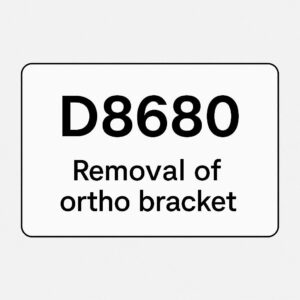
What Is the Correct ADA Code for Removing an Orthodontic Bracket?
The short answer is that there is no single ADA code specifically named “removal of orthodontic bracket.” That surprises many people. However, the ADA Current Dental Terminology (CDT) code set handles bracket removal under existing codes for orthodontic adjustments and repairs.
The most commonly used code for removing a loose or broken bracket and recementing or replacing it is:
D8695 – Removal of fixed orthodontic appliance for reasons other than completion of treatment (e.g., for patient referral or to convert to clear aligner therapy)
Wait. That code says “removal of fixed orthodontic appliance.” That sounds like removing full braces, not just one bracket. You are right to pause. Let me explain.
In practice, many orthodontists and coders use D8695 when they need to remove one or more brackets without completing full treatment. However, some payers prefer a different approach. Others use D8999 – Unspecified orthodontic procedure with a clear narrative.
Let me be honest with you: coding for a single bracket removal is a gray area. The ADA has no perfect match. That is why documentation is your best friend.
Here is a quick reference table to help you choose.
| Clinical Situation | Recommended ADA Code | Notes |
|---|---|---|
| Remove loose bracket, clean tooth, recement same bracket | D8680 (ortho adjustment) or D8999 | Many include in global fee |
| Remove broken bracket, replace with new bracket | D8695 or D8999 | Bill if outside global period |
| Remove bracket and do not replace (patient going to aligners) | D8695 | Best fit per ADA |
| Remove multiple brackets for patient referral | D8695 | Document reason clearly |
| Emergency visit only – no bracket replacement | D8999 + narrative | Check payer policy |
Important note: Always check the patient’s orthodontic benefit plan. Many plans include bracket repair and replacement in the global treatment fee. If that is the case, you cannot bill separately.
Understanding How Orthodontic Coding Works
Before we go deeper, let us take one step back. Orthodontic coding is different from restorative dentistry. When a patient starts braces, the orthodontist usually bills a global fee. That fee covers all adjustments, emergency visits, and minor repairs for the entire treatment duration.
The global fee is typically billed using:
-
D8090 – Comprehensive orthodontic treatment (child)
-
D8091 – Limited orthodontic treatment (child)
-
D8092 – Comprehensive orthodontic treatment (adult)
Under these codes, replacing a lost bracket is normally included. You do not bill extra. However, there are exceptions.
When Can You Bill Separately for Bracket Removal?
You can consider billing separately when:
-
The patient is outside the global treatment period (e.g., retention phase)
-
The patient is being referred to another orthodontist
-
The patient is switching to clear aligners before treatment completion
-
The original orthodontist is no longer available
-
The insurance plan specifically covers emergency orthodontic repairs outside global fees
In these situations, you need a specific ADA code for removal of ortho bracket or a similar procedure. Let us look at your best options.
Detailed Breakdown of Relevant ADA Codes
Now let us examine each code that could apply to removing an orthodontic bracket. I will give you the exact code, the official ADA description, and how it fits your needs.
D8695 – Removal of Fixed Orthodontic Appliance for Reasons Other Than Completion of Treatment
This is the closest code available. The ADA created it for situations where you remove braces before the planned end date. That includes removing one bracket, several brackets, or full arch wires.
Official description:
Removal of fixed orthodontic appliance(s) for reasons other than completion of treatment (e.g., for patient referral or to convert to clear aligner therapy).
When to use D8695 for bracket removal:
-
A single bracket is damaged beyond repair, and you remove it without replacing it immediately
-
You remove one bracket because the patient is moving to another provider
-
You remove several brackets to convert the patient to Invisalign or another aligner system
Documentation required:
-
Note which tooth or teeth
-
State the reason for removal (not completion of treatment)
-
Describe what you did after removal (e.g., polished enamel, left bracket off)
Payer tip: Some medical-dental plans reject D8695 for a single bracket. If that happens, appeal with a clear narrative. Explain that no other code accurately describes the service.
D8680 – Orthodontic Adjustment (Not Including Repair)
This code is often misunderstood. D8680 covers routine adjustments like changing wires, adding elastics, or checking progress. It does not include bonding or rebonding brackets. However, if you simply remove a loose bracket and do not replace it, some offices bill D8680.
Official description:
Orthodontic adjustment (not including repair of appliances).
When to use for bracket removal:
-
A bracket is already completely detached from the tooth (patient brings it in a bag)
-
You remove the residual adhesive and clean the tooth
-
You do not place a new bracket
Important: Most payers consider this part of the global fee. Only use D8680 if you are billing fee-for-service outside a global contract.
D8999 – Unspecified Orthodontic Procedure
When no other code fits, D8999 is your safety net. You must attach a written narrative explaining exactly what you did and why.
Official description:
Unspecified orthodontic procedure, by report.
When to use D8999 for bracket removal:
-
You removed a bonded bracket that was partially detached but still on the wire
-
You removed adhesive remnants from multiple teeth after debonding
-
You removed a bracket for a patient whose original orthodontist retired, and you are not continuing treatment
Example narrative:
*”Removed loose orthodontic bracket from tooth #11. Bracket was fractured and non-restorable. Cleaned residual adhesive from enamel surface using a high-speed handpiece with a white stone. Polished enamel to smooth finish. Did not replace bracket. Patient is in retention phase and outside global treatment period.”*
That level of detail helps payers understand the service.
Step-by-Step Clinical Workflow for Bracket Removal
Knowing the code is only half the battle. You also need to document the clinical steps properly. Let me walk you through a realistic bracket removal procedure. This is what you would actually do in a clinic.
Step 1: Assess the Bracket
Before you remove anything, look closely. Is the bracket completely loose? Is it still attached to the archwire? Is the adhesive partially bonded? These details matter for coding.
Ask yourself:
-
Can the bracket be recemented, or is it broken?
-
Is the tooth healthy underneath?
-
Is the patient still in active treatment?
Step 2: Explain to the Patient
Tell the patient what you are doing and why. If you are billing separately, mention that upfront. No surprises. Patients appreciate honesty.
Example: “Your bracket came loose. Because you finished your active treatment six months ago, this visit is not covered under your original fee. We will bill a small fee for removing the bracket and cleaning the tooth.”
Step 3: Remove the Bracket
Use orthodontic bracket removal pliers. Apply gentle, firm pressure to peel the bracket off the enamel. Do not use excessive force. You can damage enamel.
If the bracket is already off, skip to removing the adhesive.
Step 4: Remove Residual Adhesive
This step is critical. Leftover composite can trap plaque and cause white spot lesions.
Use one of these methods:
-
High-speed handpiece with a white stone – most common
-
Ultrasonic scaler with a adhesive-removal tip – gentle on enamel
-
Hand scaler – for small remnants only
Work carefully. Stop when the enamel feels smooth. You do not need to remove every microscopic trace. Just remove bulk adhesive.
Step 5: Polish the Enamel
Use a fine polishing cup with pumice or prophylaxis paste. This removes minor roughness and leaves a clean surface.
Step 6: Document Everything
Write a detailed note. Include:
-
Tooth number
-
Reason for removal (e.g., bracket fracture, patient request, referral)
-
Method used for adhesive removal
-
Final condition of enamel
-
Whether you replaced the bracket or left it off
This note protects you and justifies your chosen ADA code.
Common Scenarios and Correct Coding Choices
Let me give you real-world examples. These are situations I have seen in actual orthodontic practices.
Scenario 1: Active Treatment, Bracket Loose, Recemented Same Day
What happened: Patient in month 14 of 24-month treatment. Bracket on tooth #22 is loose but intact. You remove it, clean the tooth, etch, bond, and recement the same bracket.
Correct coding: No separate charge. Included in global fee (D8090 or D8080).
Documentation: “Loose bracket #22. Removed, cleaned enamel, rebonded same bracket. No additional fee.”
Scenario 2: Retention Phase, Bracket Left Over from Braces
What happened: Patient finished active treatment 8 months ago. Wears retainers at night. A bonded bracket was left on tooth #28 for elastic wear but is no longer needed. The bracket is loose. You remove it and polish the tooth.
Correct coding: D8695 or D8999. Global period is over. You can bill.
Documentation: “Patient in retention phase. Removed non-functional bonded bracket from #28 per patient request. Polished enamel. No replacement.”
Scenario 3: Broken Bracket, Patient Moving Out of State
What happened: Patient is relocating in one week. Bracket on tooth #11 is fractured. You remove the bracket and adhesive but do not replace it because the patient will see a new orthodontist.
Correct coding: D8695 – Removal of fixed orthodontic appliance for referral.
Documentation: “Patient moving to Ohio. Removed fractured bracket #11. Smoothed enamel. Referred to Dr. Smith for continuation of treatment. Provided records.”
Scenario 4: Emergency Visit Only – No Bracket Replacement
What happened: Patient calls with a bracket hanging on the wire. You see them same day. You remove the bracket and adhesive. The patient decides not to continue treatment at your office.
Correct coding: D8999 with narrative. Some offices use D8695.
Documentation: “Emergency visit. Removed loose bracket #6. Bracket was non-restorable. Cleaned and polished enamel. Patient declined further treatment at this office. No global fee applies.”
Documentation Best Practices for Bracket Removal
Good documentation is your shield. If an auditor questions your ADA code for removal of ortho bracket, your notes will save you.
Here is a checklist for every bracket removal note:
-
Date of service
-
Tooth number(s) using universal numbering system
-
Reason for removal (loose, fractured, patient request, referral, end of treatment)
-
Method of adhesive removal (white stone, ultrasonic, hand instrument)
-
Final enamel condition (smooth, intact, no visible damage)
-
Whether bracket was replaced or not
-
If replaced, type of cement or bonding agent used
-
Global period status (active, retention, completed)
-
Separate fee billed or included in global
-
Patient acknowledgment of financial responsibility (if billing separately)
Do not skip any of these. A two-line note like “removed loose bracket” will not hold up in an audit.
How Payers View Bracket Removal Codes
Insurance companies vary widely. Some are reasonable. Others reject anything that is not crystal clear. Let me give you a realistic picture.
Dental PPO Plans
Most dental PPOs include orthodontic emergency care in the global fee. They will reject D8695 or D8999 if the patient is in active treatment. You can appeal, but you will rarely win.
Exception: Some plans allow a separate “emergency visit” copay. Check the patient’s benefit summary for code D0140 (limited oral evaluation) plus D8695. Some offices bill both.
Medicaid
Medicaid orthodontic coverage is different in every state. Some states explicitly allow billing for bracket repair. Others do not. You must check your state’s Medicaid provider manual.
In my experience, most state Medicaid programs consider bracket removal part of the global orthodontic fee. They will deny separate payment.
Medical Plans
Orthodontic brackets are rarely covered by medical insurance unless the treatment is for a medical condition (e.g., cleft palate or trauma reconstruction). Do not bill a medical plan for routine bracket removal.
Patient-Pay (Fee-for-Service)
This is the cleanest scenario. You set your fee. You explain it upfront. The patient pays. Use D8695 or D8999. Provide a superbill with a clear description.
Sample fee range for bracket removal (patient-pay):
-
$35 – $75 for one bracket removal and adhesive cleanup
-
$100 – $150 for multiple brackets
Be reasonable. This is a quick procedure. Do not overcharge.
Frequently Asked Questions (FAQ)
Let me answer the questions I hear most often from orthodontic teams.
1. Is there an ADA code specifically for removing one bracket?
No. The ADA does not have a code that says “removal of single orthodontic bracket.” D8695 is the closest option. For global treatment patients, you do not bill separately.
2. Can I use D8695 for a bracket that fell off on its own?
Yes, if you remove residual adhesive and do not replace the bracket. Document that the bracket was already detached.
3. What code do I use if I remove a bracket and replace it with a new one?
If the patient is in active treatment, do not bill separately. It is included. If outside global, use D8695 or D8999. Some offices use D8680 plus a bonding code, but that is not standard.
4. How do I bill if I only remove adhesive and no bracket?
This is adhesive remnant removal. Use D8999 with a narrative. Describe the service as “removal of residual orthodontic adhesive from enamel surface.” Many offices charge a small fee of $25–$50.
5. What if the patient refuses to pay for bracket removal?
Always discuss fees before the procedure. If the patient refuses, you have two choices: do the work at no charge as a goodwill gesture, or decline to provide the service. Never perform a paid service without financial agreement first.
6. Does Medicare cover orthodontic bracket removal?
No. Medicare does not cover routine orthodontic services for adults. Only medically necessary jaw surgeries or trauma cases may qualify, and those are rare.
7. Can an assistant remove a bracket without the orthodontist present?
Scope of practice varies by state. In most states, a certified orthodontic assistant can remove loose brackets under general supervision. However, adhesive removal with a handpiece may require a dentist or orthodontist. Check your state dental board rules.
Comparative Table: ADA Codes for Orthodontic Emergencies
Here is a broader comparison to help you see where bracket removal fits.
| Procedure | ADA Code | Global or Separate? | Common Reimbursement |
|---|---|---|---|
| Routine adjustment (wire change) | D8680 | Global | $0 if global active |
| Loose bracket – recement | No separate code | Global | $0 |
| Remove bracket – do not replace | D8695 or D8999 | Separate if global complete | $30–$70 |
| Replace broken bracket (new) | D8695 | Separate if global complete | $50–$100 |
| Remove adhesive only | D8999 | Separate | $25–$50 |
| Remove entire fixed appliance (full debond) | D8695 | Separate (not completion) | $150–$300 |
| Emergency exam + bracket removal | D0140 + D8999 | Separate | $75–$150 |
Note: Reimbursement amounts are estimates for patient-pay or out-of-network fees. In-network fees are lower.
Realistic Advice for Orthodontic Coders
I want to be honest with you. You will not get rich billing for bracket removal. Most of the time, you will not bill at all because the global fee covers it. That is okay. Your goal is not to maximize every visit. Your goal is to code correctly and ethically.
Here is my practical advice:
Do not bill separately for patients in active treatment.
It will be denied. You will waste time on appeals. You may frustrate the patient. Just absorb the five minutes of chair time.
Do bill separately for patients in retention or after treatment completion.
That is fair. The global fee no longer applies. The patient should expect a small charge.
Do bill separately for referral situations.
If you remove brackets to send a patient to another orthodontist, you deserve payment for your time. Use D8695.
Do document thoroughly every single time.
Even when you do not bill. Good records protect you if a patient later claims you damaged their tooth.
Do not use D8695 for routine loose bracket rebonding.
That is not what the code means. Using it that way is incorrect coding and could be considered fraud.
How to Handle Denials for Bracket Removal Codes
Denials happen. Do not panic. Here is how to respond.
Denial Reason: “Procedure not covered under benefit plan”
Response: Check if the patient is in global period. If yes, the denial is correct. Write off the charge. If no, submit an appeal with documentation showing treatment completion date.
Denial Reason: “Code invalid for this service”
Response: Submit a reconsideration request. Attach a detailed narrative. Explain that no specific code exists for single bracket removal. Cite ADA guidance that D8695 is appropriate for removal of fixed appliances before treatment completion.
Denial Reason: “Missing prior authorization”
Response: For orthodontic emergency codes, most plans do not require prior authorization. But some do. Call the payer to verify. If required, you cannot appeal successfully without it. Learn for next time.
Denial Reason: “Service included in global fee”
Response: This is often correct. If the patient is in active treatment, accept the denial. Do not fight it. You will lose.
Legal and Ethical Considerations
Coding for bracket removal is not just about getting paid. It is about doing the right thing.
Upcoding Warning
Never use a more complex code to get higher reimbursement. For example, do not bill D8695 (full appliance removal) when you only removed one bracket. That is upcoding. It is illegal.
Unbundling Warning
Do not break a global service into separate codes. If the patient is in active treatment, do not bill separately for bracket removal. That is unbundling. Payers consider it fraud.
Patient Communication
Always tell the patient if you are billing separately. Get verbal consent. For larger fees (over $100), get written consent. Transparency prevents complaints.
State Dental Board Rules
Some state dental boards have specific rules about who can remove brackets and adhesive. In many states, only the orthodontist or a licensed dentist can use a high-speed handpiece on enamel. Check your state rules before delegating.
Alternative Approaches When No Code Fits
Sometimes you will find yourself in a situation where no ADA code works well. Here are three honest options.
Option 1: Use D8999 and Write an Excellent Narrative
This is the most common solution. Payers accept unspecified codes when you justify them. Write clearly. Use plain language. Include all the details from the documentation checklist above.
Option 2: Bill No Code (Include in Office Visit Fee)
If the patient is paying out of pocket and does not need insurance, you can skip the ADA code entirely. Bill a simple line item: “Orthodontic bracket removal – $45.” No code needed for cash patients.
Option 3: Appeal to Your Regional ADA Coding Advisor
Every ADA district has coding advisors. They volunteer to help dentists with tricky coding questions. You can email them for guidance. They may give you an official opinion you can share with payers.
Tools and Supplies for Safe Bracket Removal
Having the right tools makes the procedure faster and safer. Here is what you need.
Removal Pliers
-
Ligature cutter – for cutting wires around the bracket
-
Bracket removal pliers – specifically designed to peel brackets off enamel
-
Weingart pliers – for grasping and stabilizing
Adhesive Removal Instruments
-
White stone (medium grit) – for bulk adhesive removal
-
Fine polishing bur – for final smoothing
-
Ultrasonic scaler with plastic tip – gentle on enamel
-
Hand scaler – for small remnants only
Polishing Materials
-
Prophy cup and pumice – low-cost and effective
-
Rubber polishing points – for interproximal areas
-
Enamel polishing paste – final shine
Safety Equipment
-
High-volume suction – to capture adhesive dust
-
Magnification loupes – to see residual adhesive clearly
-
Rubber dam – optional but helpful for isolated teeth
Pro tip: Always use magnification when removing adhesive. You will see leftover composite that you would miss with the naked eye. Leaving adhesive behind is a common cause of white spot lesions.
Sample Documentation Templates
Use these templates to save time and ensure completeness.
Template 1: Bracket Removal – No Replacement (Global Period Over)
Date: [DATE]
Patient: [NAME]
Tooth: #[NUMBER]

Reason for removal: [LOOSE/FRACTURED/PATIENT REQUEST/REFERRAL]
Method: Removed bracket using [PLIERS TYPE]. Removed residual adhesive using [WHITE STONE/ULTRASONIC/HAND SCALER]. Polished enamel with [PUMICE/PROPHY PASTE].
Final condition: Enamel smooth, intact, no visible damage.
Global status: Patient completed active treatment on [DATE]. Currently in retention.
Billing: D8695 – Removal of fixed orthodontic appliance. Patient notified of separate fee.
Provider signature: [NAME/CREDENTIALS]
Template 2: Bracket Removal – Recemented (Global Active)
Date: [DATE]
Patient: [NAME]
Tooth: #[NUMBER]

Reason for removal: Loose bracket – patient reported "bracket spinning on wire."
Method: Removed bracket. Cleaned enamel with pumice. Etched 30 seconds. Rinsed and dried. Applied primer. Bonded bracket with [ADHESIVE NAME]. Cured 10 seconds per side.
Global status: Patient in active treatment. No separate fee.
Provider signature: [NAME/CREDENTIALS]
Template 3: Adhesive Only – No Bracket
Date: [DATE]
Patient: [NAME]
Tooth: #[NUMBER]

Reason: Patient had bracket removed elsewhere. Residual adhesive remaining on enamel.
Method: Removed adhesive using [WHITE STONE at low speed]. Polished enamel.
Final condition: Smooth, glossy enamel. No visible adhesive.
Global status: Not applicable. Bracket removed by previous provider.
Billing: D8999 – Unspecified orthodontic procedure. Narrative attached.
Provider signature: [NAME/CREDENTIALS]
What to Do When a Patient Complains About Bracket Removal Fees
Sometimes patients get upset. They think bracket removal should be free. Here is how to handle that conversation.
Listen first. Let the patient explain why they are upset. Do not interrupt.
Acknowledge their feeling. Say: “I understand why you would think that. Many patients assume all orthodontic visits are covered.”
Explain the global fee concept. Say: “Your original fee covered two years of active treatment. Now that treatment is complete, we charge separately for any additional visits.”
Offer a small goodwill discount if appropriate. Say: “I can reduce the fee by 20% as a courtesy. Would that work for you?”
Never argue. If the patient refuses to pay, you have two choices: waive the fee and keep the patient happy, or stand firm and risk losing them. Choose wisely based on the relationship.
Future Changes to Orthodontic Coding
The ADA updates CDT codes every year. New codes are added. Old codes are revised. As of now, there is no specific code for single bracket removal on the horizon. However, the ADA Coding Committee has received requests for better orthodontic emergency codes.
You can submit a code change request yourself. Go to the ADA website. Look for the “CDT Code Maintenance” section. Describe the need for a specific code for “removal of single orthodontic bracket and adhesive.” Include examples. The committee reviews all requests.
Do not expect a new code soon. The process takes years. In the meantime, use D8695 and D8999 with excellent documentation.
Summary of Key Takeaways
Let me pull everything together into a short list.
-
No single ADA code exists specifically for removing one orthodontic bracket.
-
D8695 is your best option for removal before treatment completion (referral, aligner conversion).
-
D8999 with a narrative works for most other situations.
-
Patients in active global treatment should not be billed separately.
-
Patients in retention or after treatment completion can be billed fairly.
-
Documentation is critical – always record tooth number, reason, method, and enamel condition.
-
Do not upcode or unbundle. It is illegal and unethical.
-
Communicate fees clearly before starting the procedure.
Conclusion
The ADA code for removal of ortho bracket is not a single perfect code. It is a thoughtful choice between D8695, D8999, and sometimes no code at all. Your job is to pick the most accurate option, document thoroughly, and bill fairly. Most bracket removals will be included in your global treatment fee. That is normal and expected. For the remaining cases – retention patients, referrals, and fee-for-service visits – use D8695 or D8999 with a clear narrative. Keep your notes detailed. Keep your fees reasonable. And always put the patient’s understanding first.
Additional Resource
For the most current ADA CDT codes and official coding guidance, visit the American Dental Association’s Coding and Reimbursement page:
🔗 www.ada.org/en/publications/cdt
This is the authoritative source for all dental procedure codes. Bookmark it and check for annual updates.
FAQ (Quick Reference)
Q: What is the best ADA code for removing one loose bracket?
A: D8695 if you are not replacing it and the patient is not in active global treatment.
Q: Can I bill a patient for bracket removal during active treatment?
A: No. That is included in the global fee.
Q: What code do I use for removing only adhesive (no bracket)?
A: D8999 with a detailed narrative.
Q: Is D8680 correct for bracket removal?
A: Not really. D8680 is for adjustments, not bracket or adhesive removal.
Q: Does Medicaid cover orthodontic bracket removal?
A: Rarely. Most states include it in the global fee. Check your state manual.
Q: How much should I charge for bracket removal (patient-pay)?
A: $35–$75 for one bracket. $100–$150 for multiple.
Q: Can a dental assistant remove a bracket?
A: Depends on your state. Most allow it under supervision. Adhesive removal with a handpiece often requires a dentist.
Q: What if the payer denies D8695 for a single bracket?
A: Submit an appeal with a narrative explaining that no specific code exists.
Q: Is there a new ADA code coming for bracket removal?
A: Not at this time. You can submit a request to the ADA.
Q: Where can I find official ADA coding guidelines?
A: Visit www.ada.org/en/publications/cdt for the official CDT manual.