ADA Dental Code for Flipper 1 Tooth: A Complete Guide for Patients
If you have recently lost a tooth, you have probably heard the word “flipper” from your dentist. It sounds casual, even playful. But when you look at your dental insurance form or treatment plan, you see a confusing mix of letters and numbers: ADA codes.
You are not alone in feeling lost.
Finding the correct ADA code for a flipper for one tooth can feel like searching for a needle in a haystack. Many patients ask their dentist’s front desk for a code, only to receive a long list of terms like “interim partial denture” or “acrylic removable partial.”
This guide is here to help.
We will walk through everything you need to know about the ADA code for a flipper for one tooth. You will learn what the code means, how much you might pay, whether insurance helps, and what other options exist. No confusing dental school language. No hidden tricks. Just clear, honest information.
Let us begin.
What Is a Dental Flipper for One Tooth?
Before we talk about codes, we need to understand the device itself.
A dental flipper is a type of removable partial denture. It is usually made of pink acrylic (gum-colored material) with one false tooth attached. The name “flipper” comes from the way it flips into place. You take it out when you sleep or clean it.
Dentists often use flippers as temporary or interim solutions. They are not meant to last forever. But they serve a very important purpose.
Why Do People Get a One-Tooth Flipper?
There are several common reasons:
-
You are waiting for a dental implant to heal.
-
You need a bridge but cannot afford it right away.
-
You lost a tooth in a visible area (front of the mouth) and want an immediate cosmetic fix.
-
Your jawbone or gums need time to heal after an extraction.
-
You want a low-cost, non-invasive option while saving for a permanent solution.
A flipper for one tooth is lightweight. It stays in place using small wire clasps that grab onto your neighboring teeth. For many people, it provides confidence while eating and smiling.
How Long Does a One-Tooth Flipper Last?
This is an honest question, and here is the honest answer.
Most one-tooth flippers last between six months and two years. After that, the acrylic can stain or break. The fit may become loose because your gums and bone naturally change shape over time.
Some patients use a flipper for three years or more with excellent care. But do not expect it to function like a permanent tooth. It is a temporary solution, and that is perfectly fine.
What Is the ADA Dental Code System?
The American Dental Association (ADA) created the Current Dental Terminology (CDT) code set. These codes are used by every dentist and insurance company in the United States. Think of them as a universal language for dental procedures.
Each code has five characters. The first character is always a letter (usually D for dental). The next four are numbers.
For example:
-
D1110 – Adult prophylaxis (regular cleaning)
-
D2740 – Crown – porcelain/ceramic
-
D7210 – Extraction of an erupted tooth
When your dentist submits a claim to your insurance, they use these codes. The insurance company then knows exactly what procedure was done and how much to pay.
So, what is the ADA code for a flipper for one tooth?
Let us get straight to the answer.
The Exact ADA Code for a Flipper 1 Tooth
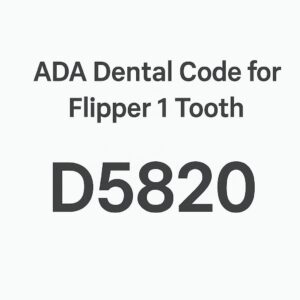
The ADA code for a flipper for one tooth is D5820.
Here is the official description from the ADA CDT code book:
D5820 – Interim partial denture (including retentive clasps, rest seats, and teeth), maxillary
And for the lower jaw:
D5821 – Interim partial denture (including retentive clasps, rest seats, and teeth), mandibular
Important Note for Readers
Many people search for “flipper dental code” and expect a single code. But dentists choose between D5820 (upper) and D5821 (lower) based on which jaw needs the tooth.
If your missing tooth is in the upper jaw, your dentist will use D5820.
If your missing tooth is in the lower jaw, your dentist will use D5821.
Both codes are for an interim partial denture replacing one tooth. Some dentists may use these codes for two or three teeth, but for a single-tooth flipper, D5820 and D5821 are the correct choices.
✅ Key takeaway: The ADA code for a flipper 1 tooth is D5820 (upper) or D5821 (lower).
What Does D5820 and D5821 Include?
When you see D5820 or D5821 on your treatment plan, what exactly are you paying for?
The code covers the complete fabrication and placement of the interim partial denture. This includes:
-
Taking impressions of your mouth
-
Creating a model of your teeth
-
Selecting the right shade for the false tooth
-
Making the acrylic base with retentive clasps (wire hooks)
-
Adjusting the flipper for a comfortable fit
-
Delivering the flipper and teaching you how to use it
It does not include extractions, X-rays, or follow-up adjustments after the first month. Those are separate codes and separate costs.
What Does “Interim” Mean?
The word “interim” means “temporary” or “in the meantime.” Your dentist is not promising a permanent solution. That is why the code says “interim partial denture” instead of “complete denture” or “permanent bridge.”
This distinction matters for insurance. Many plans cover interim devices differently than permanent ones.
Cost of a One-Tooth Flipper Using D5820 or D5821
Let us talk about money. This is where things get real for most patients.
The cost of a one-tooth flipper varies widely across the United States. Here is a realistic breakdown.
Without Insurance (Cash Price)
If you pay out of pocket, expect to pay between $300 and $800 for a single-tooth flipper using D5820 or D5821.
-
Low-cost dental schools: $150 – $300
-
Small private practice (rural area): $350 – $550
-
Large city dental clinic (urban area): $500 – $800
-
High-end cosmetic practice: $700 – $1,200
The price depends on your location, the dentist’s experience, and the materials used. Some dentists include adjustments in the price. Others charge separately.
With Dental Insurance
Most dental insurance plans cover D5820 and D5821 as “basic” services. Basic services are usually covered at 50% to 80% after you meet your deductible.
Here is an example:
-
Total fee for D5820: $600
-
Your plan covers basic services at 70%
-
Insurance pays: $420
-
You pay: $180 (plus any deductible)
Some plans have a waiting period for partial dentures. Others may limit coverage to one interim partial per lifetime. Always call your insurance company before scheduling the work.
Comparison Table: Cost vs. Other Tooth Replacement Options
| Procedure | ADA Code | Average Cost (No Insurance) | Is It Permanent? |
|---|---|---|---|
| One-tooth flipper (interim partial) | D5820 / D5821 | $300 – $800 | No (temporary) |
| Traditional fixed bridge (3 units) | D6240 | $2,000 – $5,000 | Yes (10-15 years) |
| Single dental implant + crown | D6010 + D2740 | $3,500 – $6,000 | Yes (20+ years) |
| Resin-bonded bridge (Maryland bridge) | D6545 | $1,000 – $2,500 | Semi-permanent |
| Removable partial denture (metal framework) | D5211 | $1,200 – $2,500 | Yes (5-10 years) |
As you can see, the one-tooth flipper is by far the most affordable option. That is why it remains so popular.
Does Insurance Cover D5820 for a One-Tooth Flipper?
This is a common question, and the answer is: it depends on your plan.
Most PPO dental plans cover D5820 and D5821. However, they may classify the procedure differently.
Three Common Insurance Scenarios
Scenario 1: Coverage as a Basic Service
Your plan pays 50% to 80% after deductible. You pay the rest. This is the most common outcome.
Scenario 2: Coverage as a Major Service
Some plans consider any partial denture (even interim) as a “major” service. Major services are often covered at 50% with a separate waiting period (usually 12 months).
Scenario 3: No Coverage
Discount plans or basic HMO plans may not cover interim partials at all. You pay 100% out of pocket.
How to Check Your Coverage
Call your insurance company and ask these exact questions:
-
“What is my coverage for ADA code D5820 (interim partial denture)?”
-
“Is this considered a basic or major service?”
-
“Is there a waiting period for this code?”
-
“Do I have an annual maximum that applies?”
-
“Is a pre-authorization required?”
Write down the answers. Get the representative’s name and ID number. Insurance companies change policies often, so having a record protects you.
📞 Pro tip: Ask your dentist’s front desk to run a “predetermination” of benefits. This is a free estimate from your insurance company before any work is done. It takes two to four weeks but saves you from surprise bills.
Step-by-Step: What Happens When You Get Code D5820?
If your dentist recommends a one-tooth flipper and uses D5820 or D5821, here is exactly what you can expect.
Step 1: Consultation and Examination
Your dentist examines the missing tooth area. They check your neighboring teeth and gums. X-rays are taken (separate code, separate fee).
Step 2: Impressions
The dentist takes a mold of your upper and lower teeth using a soft putty-like material. This takes about five minutes. You may gag slightly, but it passes quickly.
Step 3: Shade Selection
You choose the color of the false tooth. The dentist uses a shade guide to match your natural teeth. Try to do this in natural daylight if possible.
Step 4: Laboratory Fabrication
The impressions are sent to a dental lab. A technician pours stone into the mold, creates a model, and builds the acrylic flipper with the false tooth. This takes one to two weeks.
Step 5: Try-In Appointment
You return to the dentist. They place the flipper in your mouth. They check for pressure points, fit, and appearance. Adjustments are made with a small burr.
Step 6: Delivery and Instructions
The dentist gives you the final flipper. They show you how to insert and remove it. You receive cleaning instructions and a storage case.
Step 7: Follow-Up (Usually 1-2 weeks later)
You return for a quick check. The dentist makes any final adjustments. After this, future adjustments are usually charged separately.
Pros and Cons of a One-Tooth Flipper (D5820/D5821)
Let us be honest. A flipper is not perfect. But for many people, it is the right choice.
Pros
-
Low cost compared to implants or bridges
-
Non-invasive – no drilling of healthy teeth
-
Fast – often completed in two weeks
-
Reversible – you can stop wearing it anytime
-
Cosmetic improvement – fills the gap immediately
-
No surgery – unlike implants
Cons
-
Not permanent – lasts 6 to 24 months on average
-
Can break – acrylic is fragile
-
May feel bulky – especially on the upper palate
-
Affects speech – temporary lisp for a few days
-
Can trap food – requires diligent cleaning
-
Wire clasps show – visible when you smile wide
What Patients Say
“I lost my front tooth in a bike accident. The flipper gave me my smile back while I saved for an implant. It was not perfect, but it cost me $450 and lasted 14 months.” – Sarah, Ohio
“My insurance would not cover a bridge yet. My dentist made me a lower flipper for one tooth. It took about a week to stop lisping. I am happy with it as a temporary fix.” – James, Florida
How to Care for Your Flipper (D5820/D5821)
Proper care extends the life of your one-tooth flipper. Follow these simple rules.
Daily Cleaning Routine
-
Remove the flipper over a sink filled with water or a soft towel. This prevents breakage if you drop it.
-
Rinse with cool water after eating.
-
Brush the flipper with a soft toothbrush and non-abrasive denture cleaner. Do not use regular toothpaste – it scratches the acrylic.
-
Brush your natural teeth and gums thoroughly.
-
Soak the flipper in water or denture solution when not wearing it. Never let it dry out – acrylic warps.
What to Avoid
-
Hot water – warps the flipper
-
Bleach – damages acrylic and metal clasps
-
Sleeping with it in – increases risk of decay and breakage
-
Chewing sticky foods – caramel, taffy, gum
-
Biting into hard foods – apples, corn on the cob
When to Call Your Dentist
-
The flipper feels loose or rocks when you bite
-
A wire clasp breaks or bends
-
The false tooth chips
-
You develop a sore spot on your gums
-
The flipper no longer stays in place
Do not try to fix a broken flipper yourself. Superglue is toxic and will ruin the fit.
Alternatives to D5820/D5821 for One Missing Tooth
A flipper is not your only option. Depending on your budget, timeline, and oral health, one of these alternatives may work better.
1. Resin-Bonded Bridge (Maryland Bridge)
This is a false tooth with small metal wings bonded to the back of adjacent teeth. No drilling is required.
-
ADA Code: D6545 (retainer for Maryland bridge)
-
Cost: $1,000 – $2,500
-
Lifespan: 5 to 8 years
-
Pros: No drilling, more stable than flipper
-
Cons: Metal wings can show, may debond
2. Traditional Fixed Bridge (Three Units)
Your dentist crowns the two teeth next to the gap and attaches a false tooth in between.
-
ADA Code: D6240 (porcelain fused to metal bridge)
-
Cost: $2,000 – $5,000
-
Lifespan: 10 to 15 years
-
Pros: Permanent feeling, strong for chewing
-
Cons: Requires drilling healthy teeth, expensive
3. Single Dental Implant
A titanium post is surgically placed in your jawbone. After healing, a crown is attached.
-
ADA Codes: D6010 (implant placement) + D2740 (crown)
-
Cost: $3,500 – $6,000
-
Lifespan: 20+ years (often lifetime)
-
Pros: Best long-term solution, no damage to adjacent teeth
-
Cons: Expensive, requires surgery, takes 4-9 months
4. Do Nothing
You can leave the gap empty.
-
Cost: $0
-
Lifespan: N/A
-
Pros: No cost, no procedures
-
Cons: Teeth may shift, bone loss, chewing problems, cosmetic concerns
Comparison of Alternatives Table
| Option | ADA Code(s) | Cost | Time to Complete | Surgery Required | Drills Healthy Teeth |
|---|---|---|---|---|---|
| Flipper (interim) | D5820/D5821 | $300-800 | 2 weeks | No | No |
| Maryland bridge | D6545 | $1,000-2,500 | 2-3 weeks | No | Minimal |
| Traditional bridge | D6240 | $2,000-5,000 | 2-3 weeks | No | Yes |
| Dental implant | D6010 + D2740 | $3,500-6,000 | 4-9 months | Yes | No |
| Do nothing | None | $0 | Immediate | No | No |
Frequently Asked Questions (FAQ)
1. Is D5820 the same as a flipper?
Yes. D5820 is the official ADA code for an interim partial denture, which is commonly called a flipper.
2. Can I get a flipper for one tooth on Medicaid?
Medicaid coverage varies by state. Some states cover D5820 and D5821 for adults, but many only cover extractions and fillings. Call your state Medicaid office to confirm.
3. How long does it take to get a flipper after extraction?
Many dentists can take impressions immediately after extraction. The lab then takes one to two weeks. Some offices offer same-day flippers using in-house milling, but that is less common.
4. Will a flipper change my speech?
For the first few days, you may have a slight lisp or feel like you have extra plastic in your mouth. Your tongue adapts quickly. Most people speak normally within one week.
5. Can I eat with a one-tooth flipper?
Yes, but stick to soft foods for the first week. Avoid sticky, hard, or crunchy foods. Remove the flipper if you eat something chewy like steak or bread.
6. Does D5820 include adjustments?
Most dentists include one or two adjustments within the first 30 days. After that, adjustments are billed separately using code D5410 (adjust partial denture).
7. Can I sleep with my flipper in?
No. You should remove your flipper every night to give your gums a rest and prevent decay. Soak it in water or denture solution while you sleep.
8. What happens if I lose my flipper?
You will need a new one. The lab cannot duplicate a lost flipper without new impressions. Expect to pay the full fee for D5820 or D5821 again.
9. Is a flipper painful?
Most patients feel mild pressure or soreness for the first 24 to 48 hours. True pain is not normal. Call your dentist if you have sharp pain or ulcers.
10. Can I use Polident or Efferdent on a flipper?
Yes. Effervescent denture cleaners are safe for acrylic flippers. Follow the package instructions. Do not use bleach or hot water.
Additional Resources
For more reliable information about dental codes, tooth replacement options, and insurance help, visit the American Dental Association’s patient education page.
🔗 Resource Link: MouthHealthy.org – Partial Dentures
This website is run by the ADA. It offers free, unbiased information written for patients. You will find videos, illustrations, and cost guides.
Important Notes for Readers
-
Codes change. The ADA updates CDT codes every year. D5820 and D5821 have been stable for many years, but always confirm with your dentist.
-
Your dentist may use a different code if your flipper has special features (like a flexible material or precision attachment). Ask if you see a code other than D5820 or D5821.
-
Do not assume coverage. Always verify with your insurance company before treatment. A verbal promise over the phone is not a guarantee of payment.
-
Keep your receipt and treatment plan. You may need them for taxes (medical expense deduction) or insurance disputes.
-
A flipper is not a long-term solution. If you plan to keep the gap filled for years, start saving for an implant or bridge now.
Conclusion
The correct ADA code for a flipper for one tooth is D5820 for the upper jaw and D5821 for the lower jaw. Both codes describe an interim partial denture designed to replace a single missing tooth temporarily. A one-tooth flipper costs between $300 and $800 out of pocket, with partial insurance coverage available under most PPO plans. While not a permanent fix, it remains the most affordable, non-invasive, and fastest option for filling a visible gap while you plan for a long-term solution like an implant or bridge.