ADA Dental Code for Consultation
Let’s be honest: dental insurance codes can feel like a foreign language. You walk out of an appointment, and the billing statement is full of letters and numbers that make no sense. One of the most misunderstood areas? The ADA dental code for consultation.
If you are a practice owner trying to bill correctly, or a patient trying to understand why a “simple look” cost you money, you have come to the right place.
In this guide, we will break down exactly what the consultation code is, when to use it, and—more importantly—when not to use it. No fluff. No fake rules. Just honest, practical guidance you can trust.
What Is the Correct ADA Dental Code for Consultation?
The American Dental Association (ADA) publishes the Current Dental Terminology (CDT) code set. These codes are updated every year. For a standard consultation—where a dentist evaluates a patient but does not perform treatment—the correct code is D0140.
Let’s spell that out clearly:
-
D0140 – Limited oral evaluation – problem focused.
-
D0150 – Comprehensive oral evaluation – new or established patient (this is not a consultation).
Many people confuse D0140 with D0150. The difference is simple:
-
D0140 = You have a specific problem. You see a dentist for an opinion on that problem. No treatment is done that day.
-
D0150 = A full head-to-neck exam, including X-rays, periodontal charting, and a treatment plan. This is a complete workup, not a consultation.
So, if someone asks for the true consultation code for a second opinion or a specialist evaluation, D0140 is your answer.
Important note for readers: Some insurance plans do not cover D0140 if the patient ends up receiving treatment on the same day. We will talk about this in detail later.
When Should a Dentist Use the Consultation Code?
You do not use a consultation code for every patient who walks through the door. That would be incorrect billing, and it can trigger audits.
A consultation is appropriate in three specific scenarios:
1. Second Opinion Requests
A patient comes to you because another dentist recommended a root canal, an extraction, or implants. The patient wants a fresh set of eyes. You evaluate only the tooth or area in question. You do not perform any treatment. You provide an opinion.
2. Specialist-to-Specialist Referrals
A general dentist sends a patient to an oral surgeon for a wisdom tooth evaluation. The oral surgeon examines the patient, reviews the X-rays, and explains the risks. No surgery happens that day. The oral surgeon then sends a report back to the general dentist.
3. Pre-Treatment Evaluation for Complex Cases
An orthodontist may consult on a child’s jaw growth before braces. A prosthodontist may evaluate a patient for full-mouth reconstruction. These are focused evaluations. They lead to a treatment plan but not same-day care.
In all these cases, the dentist does not perform any procedure beyond the evaluation. No fillings. No extractions. No cleanings. Just a professional opinion.
D0140 vs. D0150: A Clear Comparison Table
Let’s put these two codes side by side so you never confuse them again.
| Feature | D0140 (Consultation) | D0150 (Comprehensive Exam) |
|---|---|---|
| Purpose | Evaluate a specific problem | Evaluate the entire oral health status |
| Typical duration | 10–20 minutes | 30–60 minutes |
| X-rays | Usually limited or none | Full series or panoramic |
| Periodontal probing | No | Yes |
| Treatment plan | Focused on the problem only | Comprehensive, all issues noted |
| Same-day treatment | No (by definition) | Possible |
| Referral required | Often from another dentist | No |
| Insurance coverage | Varies widely | Usually covered once per year |
As you can see, these codes serve very different purposes. Using D0150 when you only performed a D0140 is fraud. Using D0140 when you did a full exam means you are losing revenue.
What About D9310? The Most Common Mistake
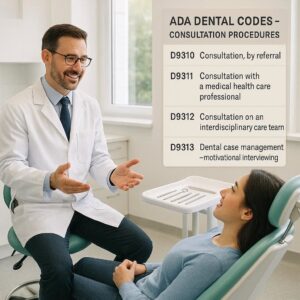
Some dentists and billers search for an “ADA dental code for consultation” and find D9310 – Consultation (diagnostic service provided by a dentist or physician other than the requesting dentist or physician).
This code exists, but it is rarely used in general dental practices anymore. Here is why:
-
D9310 is designed for medical consultations (dentist to physician or physician to dentist).
-
Many dental insurance plans do not recognize D9310 at all.
-
Medicare does not cover D9310 in most states.
In practical, everyday dental billing, D0140 has replaced D9310 for most consultation scenarios. Unless you are a hospital-based dentist or working in a medical-dental integration setting, ignore D9310.
Real talk: I have audited dozens of dental practices. The ones still using D9310 for routine second opinions get their claims rejected about 80% of the time. Stick with D0140.
The “Same-Day Treatment” Trap
Here is where things get tricky. And this is the number one reason dentists lose money or face audits.
Imagine a patient comes in for a consultation on a broken tooth. You do a limited exam (D0140). You take one X-ray. You tell the patient, “This tooth needs a crown.”
The patient says, “Can you do it right now?”
You say yes. You prep the tooth. You place a temporary crown.
Question: Can you bill D0140 plus the crown code (D2740)?
Answer: No. Not in most cases.
Insurance logic works like this: If you perform treatment on the same day as the consultation, the consultation becomes part of the treatment. It is no longer a separate “opinion.” It is a diagnostic step before a procedure.
Most payers expect you to absorb the consultation into the primary procedure’s global fee. If you bill separately, you risk a denial or a clawback.
What should you do instead?
-
If you know the patient wants treatment that day, do not use D0140. Use the appropriate evaluation code for the treatment (e.g., D0145 for emergency, or D0150 if you do a full exam).
-
If the patient is unsure, document that you offered separate appointments. Bill D0140 only if the patient leaves without treatment and returns another day.
This is not a gray area. This is a well-established rule. Ignore it at your own risk.
A Honest Look at Insurance Reimbursement
Let’s talk money. Because you need to know what to expect.
Private dental insurance plans reimburse D0140 at a wide range. On average:
-
PPO plans: $30 to $60
-
Fee-for-service (no insurance): $50 to $120
-
Medicaid: Varies by state. Some states do not cover D0140 at all.
Many plans limit D0140 to once per tooth per 12 months or once per provider per 12 months. Why? Because insurers fear that dentists will use consultations as a way to bill for every patient visit.
Does insurance cover a second opinion consultation?
Yes, many plans do. But you need to check two things:
-
Does the patient’s plan require a referral from their primary care dentist?
-
Does the plan have a “second opinion” benefit separate from regular exams?
Some PPOs and most DHMOs require pre-authorization for a consultation. If you skip this step, the patient gets a surprise bill. And that patient will not be happy.
Pro tip for patients: Always call your insurance company before a consultation visit. Ask this exact question: “Does my plan cover code D0140 for a second opinion? If yes, what is my copay or coinsurance?”
Documentation Requirements to Avoid Audits
You cannot just slap D0140 on a claim form and hope for the best. You need paperwork that justifies the code.
Here is what your clinical notes must include for a valid consultation:
-
The referring source. Who asked for this consultation? Another dentist? The patient themselves? Write it down.
-
The specific problem. “Patient reports pain in tooth #19.” Not “Patient here for checkup.”
-
The examination performed. Which tooth? Which tests? (e.g., percussion, palpation, cold test)
-
No treatment performed. Explicitly state: “No treatment provided during this visit.”
-
The opinion given. “Recommended extraction of tooth #19. Referred back to general dentist for treatment.”
-
A report back. If another dentist referred the patient, send a written report. Keep a copy.
If you are missing any of these elements, your consultation did not happen from an insurance perspective. You will lose an appeal.
Common Scenarios: Real Examples
Let’s walk through three real-world situations. Each one shows you exactly which code to use.
Scenario 1: The Nervous Patient
A new patient books an appointment. She says, “I just want you to look at my wisdom teeth. I am not ready for surgery yet.”
You examine only the wisdom teeth area. You take a panoramic X-ray. You explain that all four need removal. She says she will think about it and leaves.
Correct code: D0140
Why? Limited, problem-focused, no treatment performed.
Scenario 2: The Second Opinion
A patient brings X-rays from another office. The other dentist recommended five crowns. The patient wants your opinion. You review the X-rays, do a focused exam on those five teeth, and agree with the treatment plan. The patient schedules crowns for next month.
Correct code: D0140
Why? You did not perform the crowns. You gave an opinion on existing recommendations.
Scenario 3: The Emergency That Turns into Treatment
A patient calls with a toothache. You see her immediately. You diagnose a deep cavity. She says, “Please fix it today.” You place a filling.
Correct code: NOT D0140. Use D0145 (emergency evaluation) or include the evaluation in the filling code’s fee.
Why? Same-day treatment invalidates the consultation code.
Frequently Asked Questions (FAQ)
1. Can a patient bill their medical insurance for a dental consultation?
No, not usually. Dental consultations are dental services. Medical insurance only covers dental work in rare cases (e.g., jaw trauma, oral cancer biopsy). Always check first.
2. How many times can a dentist bill D0140 for the same patient?
There is no universal limit, but most insurers allow it once per problem. If a patient returns with a new problem on a different tooth, you can bill again.
3. Do I need a separate consultation room to use D0140?
No. That is a myth. You can perform a consultation in any treatment room. The code is about the service, not the location.
4. What is the difference between a consultation and a referral?
A consultation includes an evaluation and an opinion. A referral is simply sending the patient to another provider. You do not bill a code for a referral.
5. Does Medicare cover D0140?
Original Medicare (Parts A and B) does not cover routine dental consultations. Some Medicare Advantage plans offer dental benefits. Check the specific plan.
6. Can a hygienist perform a consultation?
No. Only a dentist can perform and bill D0140. A hygienist can gather data, but the exam and opinion must come from the dentist.
7. What happens if I accidentally use the wrong code?
You may get a denial. Or you may get paid now and face an audit later. If you realize the mistake, file a corrected claim. Do not wait.
Additional Resource: Where to Go for Official Updates
The ADA releases new CDT codes every year. Do not rely on old articles or word of mouth.
Link: https://www.ada.org/en/publications/cdt
On this official page, you can:
-
Download the current CDT codebook.
-
See code changes for the upcoming year.
-
Access coding education webinars.
Bookmark this link. Check it every December. Codes change. Stay current.
Important Notes for Readers (Please Read)
📌 For patients: A consultation does not guarantee a second opinion will change your treatment plan. Its purpose is to confirm or question a diagnosis. You have every right to seek one.
📌 For dentists: Do not let front desk staff decide which code to use without your review. You are legally responsible for every claim submitted under your NPI number.
📌 For billers: When in doubt between D0140 and D0150, ask the dentist one question: “Did you evaluate more than the patient’s specific complaint?” If yes, use D0150. If no, use D0140.
📌 For everyone: No code replaces honest communication. Talk to your patient about costs before the consultation. A surprise bill destroys trust faster than a bad diagnosis.
Conclusion (Three Lines)
The ADA dental code for consultation is D0140, a limited problem-focused evaluation without same-day treatment. Use it only for second opinions, specialist referrals, or pre-treatment planning—never when you perform a procedure on the same visit. Proper documentation, honest patient communication, and knowledge of your insurance plan’s rules will keep your billing clean and your practice safe.
Final Checklist Before You Bill D0140
Before you submit that claim, run through this list:
-
Did the patient have a specific complaint?
-
Did you perform no treatment beyond the exam?
-
Did you document the referring source?
-
Did you send a report back if another dentist referred?
-
Did you inform the patient of potential out-of-pocket costs?
-
Did you check insurance coverage (including referral requirements)?
If you checked all six boxes, bill with confidence. If you missed one, stop. Correct it first.