Tri Dental Implants: Honest Guide to Three-Point Tooth Replacement
Losing a tooth is never fun. Losing several teeth can feel overwhelming. You might have heard about dental implants, but then someone mentioned “tri dental implants,” and now you are confused.
Let’s clear that up right away.
The term “tri dental implants” is not a special brand or a new type of implant material. Instead, it usually refers to a treatment concept where three individual dental implants are used to support a fixed bridge or a removable denture. Sometimes, it also describes a specific implant system with a triangular internal connection, but in everyday dental practice, patients use this phrase to ask about getting three implants in a row.
This guide will walk you through everything you need to know. We will look at why you might need three implants, how the procedure works, what it costs, and how to take care of your new smile.
No fluff. No fake promises. Just honest, helpful information.
What Exactly Are Tri Dental Implants?
Let’s break this down with a simple comparison.
Think of a single dental implant like a screw that replaces one tooth root. Now, imagine you are missing three teeth in a row. You have two main options. The first option is to place three separate implants, one for each missing tooth. That is a three-implant solution. The second option is to place two implants and use a bridge between them. That is different.
When people search for “tri dental implants,” they usually mean the first option: three independent implant posts placed into the jawbone to hold three individual crowns or a three-unit bridge.
A Quick Visual Comparison
| Feature | Single Implant | Tri Implants (Three Individual) |
|---|---|---|
| Number of posts | 1 | 3 |
| Number of crowns | 1 | 3 |
| Bone density needed | Moderate | High (for each site) |
| Cost range | Lower per tooth | Higher upfront |
| Cleaning difficulty | Easy | Moderate |
| Lifespan | 20+ years | 20+ years (if maintained) |
Important note: You cannot always place three implants in a row. Your jawbone might not have enough width or height. Sometimes, a dentist will recommend two implants supporting a three-tooth bridge instead of three separate implants. That is perfectly normal and often a better choice.
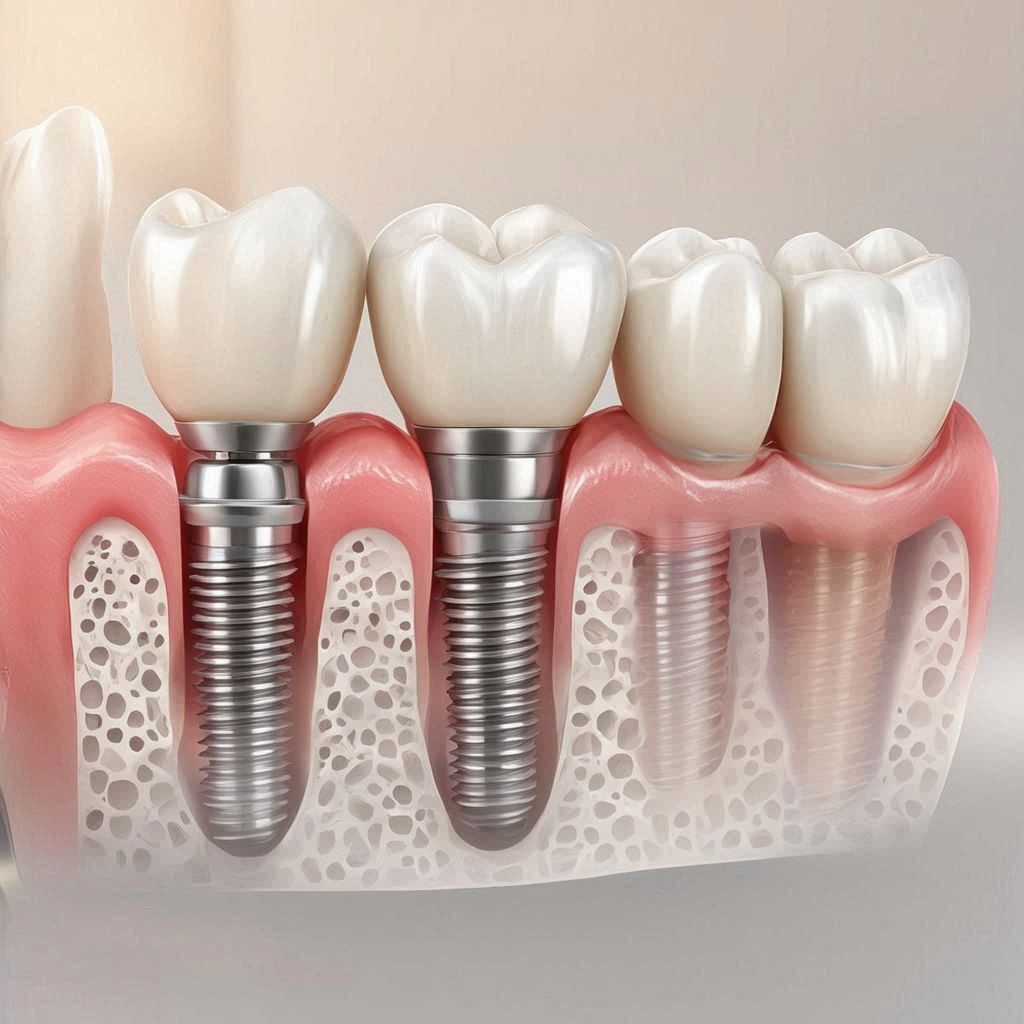
The Anatomy of a Tri Implant Setup
Each of the three implants follows the same basic structure. Understanding these parts helps you talk to your dentist with confidence.
- The implant post (fixture): This is the screw made of titanium or zirconia. It goes directly into your jawbone. Over time, your bone grows around it. This process is called osseointegration.
- The abutment: This is a small connector piece. It screws onto the top of the implant post. It sticks out just above your gum line.
- The restoration: This is the part you see. It can be a single crown, a bridge, or a denture that clips onto the abutments.
When you have three implants, you have three of each of these components working together.
Who Is a Good Candidate for Three Implants?
Not everyone needs three implants. Not everyone can get them either. Let’s look at the real-world criteria.
Good Candidates Often Have:
- Three missing teeth in a row. This is the most common scenario. The teeth on either side of the gap are healthy, but the middle ones are gone.
- A free-standing gap. If you are missing teeth 19, 20, and 21 (lower left molars and premolar), three implants work very well.
- Good general health. Conditions like uncontrolled diabetes, heavy smoking, or active gum disease can cause implant failure.
- Enough bone volume. Each implant needs about 1.5 to 2 mm of bone around it. For three 4 mm wide implants, you need at least 18 to 20 mm of horizontal bone space.
- Realistic expectations. Implants are not natural teeth. They do not move. They do not have ligaments. You will feel the difference when you bite.
When Three Implants Are NOT a Good Idea
- If you clench or grind your teeth heavily. Bruxism puts extreme pressure on implants. They do not absorb shock like natural teeth. You would need a night guard.
- If you have uncontrolled gum disease. Active periodontitis will attack the bone around your implants just like it attacks natural teeth.
- If you smoke more than 10 cigarettes a day. Smoking reduces blood flow to the gums. Healing takes longer, and failure rates go up significantly.
- If the gap is too small. Sometimes, three missing teeth spaces are actually less than 30 mm wide. That is too tight for three standard implants.
A quote from an oral surgeon: “I tell my patients that more implants are not always better. Two well-placed implants with a bridge can be stronger than three poorly placed ones. Quality over quantity, every time.”
The Step-by-Step Procedure for Tri Dental Implants
Getting three implants is a journey. It does not happen in one visit. Here is what a realistic timeline looks like.
Phase 1: Consultation and Planning (1–2 visits)
Your dentist will take a 3D CBCT scan. This is a special x-ray that shows your bone in three dimensions. They will measure:
- Bone height
- Bone width
- Bone density
- Location of nerves and sinuses
They will also take impressions or a digital scan of your teeth. This helps them plan exactly where each implant should go.
Phase 2: The Surgical Placement (1 day)
This is the main event. Most people get local anesthesia. You are awake but feel no pain. For anxious patients, sedation options are available.
What happens during surgery:
- The dentist makes small incisions in your gum where each implant will go.
- They drill a pilot hole, then gradually widen it to the exact size of the implant.
- Each implant post is screwed into place.
- A healing cap or cover screw is placed on top.
- The gum is stitched closed, or left open around the healing cap.
The whole procedure for three implants usually takes 60 to 90 minutes.
Phase 3: Osseointegration (3 to 6 months of waiting)
This is the most critical phase. Your jawbone needs to grow around each implant. This creates a strong, permanent anchor.
During this time, you will wear a temporary partial denture or a bridge. You cannot put full chewing pressure on the healing implants.
Phase 4: Abutment Placement (1 short visit)
Once the implants are fully integrated, your dentist uncovers them (if they were buried) and attaches the abutments. This is a minor procedure. It takes about 30 minutes.
Phase 5: Final Restorations (2–3 weeks later)
Your dentist takes final impressions. A dental lab fabricates your three crowns or your bridge. You come back for a final visit to have them screwed or cemented onto the abutments.
Total timeline from start to finish: 4 to 8 months, sometimes longer if you need bone grafting.
Tri Dental Implants vs. Other Options: An Honest Comparison
You have choices. Let’s compare the three-implant solution against the most common alternatives. This table is based on real clinical outcomes, not marketing claims.
| Solution | Pros | Cons | Average Lifespan | Typical Cost (USA, per arch) |
|---|---|---|---|---|
| Three individual implants | No damage to adjacent teeth; easy to clean between; bone preservation | Expensive; requires surgery; long healing time | 20+ years | $9,000 – $15,000 |
| Two implants + three-unit bridge | Less surgery; lower cost; good stability | Harder to clean under the bridge; adjacent teeth untouched (good) | 15–20 years | $6,000 – $10,000 |
| Traditional fixed bridge (on natural teeth) | Faster (3 weeks); no surgery; lower upfront cost | Requires grinding down healthy teeth; bone loss under pontic | 10–15 years | $3,000 – $5,000 |
| Removable partial denture | Cheapest option; no surgery; easy to repair | Uncomfortable; moves when eating; bone loss over time; can break | 5–8 years | $1,000 – $2,500 |
| Single implant + cantilever bridge | Only one surgery; moderate cost | Puts extra leverage on one implant; not for molars | 10–15 years | $4,000 – $7,000 |
Important note: The “cheapest” option is not always the least expensive in the long run. A removable partial denture might cost $1,500 today, but you may need a new one every five years. Over 20 years, that adds up to $6,000 or more. Implants cost more now but rarely need replacement.
The Real Costs of Tri Dental Implants
Money is a real concern. Let’s be specific. Prices vary widely by location, dentist experience, and materials. These are realistic estimates for the United States in 2025.
Breaking Down the Bill
| Service | Low Estimate | High Estimate |
|---|---|---|
| Consultation and CBCT scan | $300 | $600 |
| Implant posts (3 x $1,200 to $2,000) | $3,600 | $6,000 |
| Abutments (3 x $300 to $600) | $900 | $1,800 |
| Crowns (3 x $1,000 to $2,500) | $3,000 | $7,500 |
| Surgical placement fee | $1,500 | $3,000 |
| Temporary partial during healing | $300 | $800 |
| Total (without insurance) | $9,600 | $19,700 |
Ways to Reduce the Cost
- Dental schools. Teaching clinics offer implant procedures at 40–60% less. Supervised students do the work. Wait times are longer.
- Dental tourism. Mexico, Costa Rica, Colombia, and Turkey offer tri implant packages for $4,000 to $7,000 total. This includes travel and lodging. Do your research on the clinic first.
- Payment plans. Many offices work with CareCredit, Alphaeon, or in-house financing. Monthly payments of $200–$400 are common.
- Insurance coverage. Most dental insurance does not cover implants. Some plans cover the crown portion. A few cover the abutment. Very few cover the implant post itself.
A honest tip: If a deal sounds too good to be true, it probably is. $2,000 for three implants including crowns is not realistic. You will likely get poor materials, rushed work, or no follow-up care.
Recovery and Healing: What Actually Happens
Let’s talk about the real experience. Not the perfect, pain-free fantasy. Not the horror story. The normal, middle-of-the-road reality.
Days 1–3: The Swelling Phase
You will have swelling. Your face might look puffy, like you have a mild allergic reaction. This is normal. Ice packs help. So does keeping your head elevated when you sleep.
You will eat soft foods. Mashed potatoes, yogurt, smoothies (no straw), scrambled eggs, soup.
Pain is usually manageable with over-the-counter ibuprofen or the prescription medication your dentist gives you.
Days 4–10: The Improvement Phase
Swelling goes down. Bruising might appear on your neck or chin. Do not panic. Gravity pulls blood downward. It looks worse than it feels.
You can start eating slightly firmer soft foods. Pasta, soft bread, cooked vegetables.
You will use a special mouth rinse or warm salt water. No spitting. No vigorous rinsing. Let the water fall out of your mouth.
Weeks 2–6: The Boring Phase
This is the longest part. You feel mostly normal. Your gums have healed over or around the implants. But you cannot chew on that side. You have to wait for osseointegration.
This is when people make mistakes. They get impatient. They chew something hard. Do not do that. Follow your dentist’s instructions exactly.
Months 3–6: The Final Stretch
Your dentist will test each implant. They tap on it. They wiggle it. They take an x-ray. If everything looks good, you move to the abutment and crown phase.
List of foods to avoid during full healing:
- Nuts and seeds
- Popcorn
- Hard candy
- Ice cubes
- Beef jerky
- Crusty bread
- Corn on the cob
You can eat these things after your final crowns are placed. Until then, be gentle.
Risks and Complications: No Sugarcoating
Dental implants have a success rate of 95–98% for single teeth. For three implants, the success rate per implant is similar, but the chance that at least one implant fails is higher. It is simple math.
Common Complications (5–10% of cases)
- Peri-implantitis. This is gum disease around an implant. It causes bone loss. It is treatable if caught early. If not, the implant may fail.
- Screw loosening. The tiny screw holding your crown can come loose over time. Your dentist can tighten it. It takes five minutes.
- Chipping of the crown material. Porcelain can chip. Zirconia is stronger but can still crack under extreme force.
- Nerve disturbance. If implants are placed too close to the inferior alveolar nerve (lower jaw), you may feel numbness or tingling in your lip or chin. This is often temporary but can be permanent.
Rare but Serious (Less than 1% of cases)
- Implant fracture. The titanium post breaks. This is extremely rare with modern implants. It requires surgical removal.
- Sinus perforation. Upper jaw implants can poke into the sinus cavity. This often heals on its own but sometimes requires additional surgery.
- Bone graft failure. If you needed bone grafting before implants, the graft might not take. That means starting over.
A realistic perspective: Every medical procedure has risks. Driving to the dentist is riskier than the implant surgery itself for most healthy people. But you deserve to know the truth. Ask your dentist about their specific complication rate.
Long-Term Maintenance for Tri Dental Implants
Implants do not get cavities. That is wonderful. But they do get gum disease and tartar buildup. You must clean them just like natural teeth.
Daily Cleaning Routine
- Brush twice a day. Use a soft or extra-soft brush. Hard bristles can scratch the crown surface.
- Floss every day. Use superfloss or implant-specific floss with a stiff end to thread under the bridge or between crowns.
- Use a water flosser. This is not optional. A Waterpik set to medium pressure removes food debris from around abutments. Many implant dentists call this the single best tool for implant longevity.
- Interdental brushes. These tiny brushes fit between implants. They clean the curved surfaces that floss misses.
Professional Maintenance Schedule
| Time after placement | What the dentist does |
|---|---|
| 2 weeks after final crowns | Check bite alignment; tighten any loose screws |
| 6 months | X-rays; probing around each implant; professional cleaning with plastic scalers (metal ones scratch implants) |
| Every 12 months | Full exam; bite check; radiograph comparison to baseline |
| Every 3–5 years | Replace any worn or chipped crowns; check abutment screws |
Signs Something Is Wrong
- Bleeding when you brush or floss around an implant
- A bad taste or smell coming from one area
- The crown feels loose or moves slightly
- You see gum recession around the implant (metal thread becoming visible)
- Pain when biting down
If you notice any of these, call your dentist. Do not wait. Early treatment is simple. Late treatment can mean losing the implant.
Tri Dental Implants for Full Arch Reconstruction
Sometimes, “tri dental implants” refers to a different concept entirely. Some implant systems use a tri-lobe or triangular internal connection to lock the abutment into the implant. This is a design feature, not a number of implants.
But there is another use case: using three implants to support a full lower denture. This is called an overdenture on three implants.
How It Works
Instead of placing 4, 6, or 8 implants for a full set of teeth, some dentists place only three in the front of the lower jaw. The denture snaps onto these three implants with special attachments called locators or balls.
Pros of Three-Implant Overdentures
- Much lower cost than a full fixed bridge on 6 implants
- Easier to clean (you remove the denture)
- Less surgery
- Good stability for eating and speaking
Cons of Three-Implant Overdentures
- The denture still covers your palate (upper) or has a horseshoe shape (lower)
- You must remove it every night to clean
- The attachments wear out and need replacement every 1–2 years
- Less stable than a fixed bridge on more implants
When This Is a Good Choice
- You have low bone volume in the back of your jaw
- You want a less expensive way to stabilize a loose denture
- You are okay with a removable appliance
- You have health conditions that make longer surgeries risky
Important: A three-implant overdenture is not the same as three individual crowns. Make sure you and your dentist are talking about the same thing. The words matter.
Common Questions Patients Ask (Before and After Surgery)
These are real questions from real people. I have heard them all in dental offices.
“Will people be able to see my implants?”
No. The metal post is inside your bone and gum. The crown looks like a tooth. Unless you smile very wide and pull your lip up, no one will see anything unusual.
“Do implants feel like real teeth?”
No. They feel different. Natural teeth have a ligament that gives them slight movement. Implants are rigid. Biting feels more direct, almost like tapping on a countertop. Most people get used to this within a few weeks.
“Can I get all three implants in one day?”
Yes, the surgical placement happens in one day. But you will not have your final teeth that day. Some offices offer “teeth in a day” with temporary crowns on the same day. These are for show and soft eating only. You still need months of healing.
“What if one of the three implants fails?”
This happens. If one implant fails to integrate, your dentist will remove it. You have two options:
- Let the area heal, then place a new implant (adds 4–6 months)
- Change the plan to a two-implant bridge that spans all three spaces
Option 2 is common and works very well. Do not panic. One failure does not mean the others will fail.
“Is 70 years old too old for tri dental implants?”
No. Age alone is not a problem. Many 80 and 90-year-olds get implants successfully. Your overall health matters more than your birthday. If you can tolerate a tooth extraction, you can likely tolerate implant surgery.
How to Choose Your Dentist for Tri Dental Implants
Not all dentists place implants. Not all implant dentists are equally skilled. Here is how to find a good one.
Credentials to Look For
- Diplomate of the American Board of Oral Implantology (ABOI) – This is the highest certification.
- Fellow or Master of the International Congress of Oral Implantologists (ICOI) – A strong credential.
- Periodontist or oral surgeon – These specialists place implants every day.
- Prosthodontist – These specialists restore implants (make the crowns). A good team includes both a surgeon and a prosthodontist.
Questions to Ask Before Committing
- “How many three-implant cases have you done in the last year?”
- “What is your personal implant success rate?”
- “Do you use a CT scan for all implant placements?”
- “What happens if an implant fails? Do you replace it for free?”
- “Can I speak to a previous patient who had a similar procedure?”
Red Flags to Avoid
- The dentist does not take a CT scan before surgery.
- The price is less than half of the local average without explanation.
- They promise permanent teeth in one visit without discussing healing time.
- They refuse to give you a written treatment plan with costs.
- They do not have a backup plan for complications.
A friendly warning: The cheapest dentist is rarely the best. The most expensive dentist is not always the best either. Look for someone who communicates clearly, answers your questions patiently, and shows you before-and-after photos of their own work.
Preparing for Your Tri Implant Surgery: A Practical Checklist
Being prepared reduces anxiety. Here is a simple checklist.
One Week Before
- Fill all prescriptions (antibiotics, pain medication, mouth rinse)
- Buy soft foods: yogurt, applesauce, pudding, protein shakes, mashed potato mix
- Buy ice packs (gel packs or bags of frozen peas work)
- Arrange time off work (2–3 days minimum, 1 week if your job involves talking all day)
- Stop blood thinners if your doctor approves (aspirin, ibuprofen, fish oil, vitamin E)
The Night Before
- Eat a normal dinner
- Brush and floss carefully
- Do not drink alcohol
- Get a full night of sleep
The Morning of Surgery
- Eat a light breakfast if you are not having sedation (if sedation, do not eat after midnight)
- Take prescribed pre-medication with a small sip of water
- Brush your teeth but do not floss
- Wear comfortable, loose clothing with short sleeves
- Bring a list of all medications and allergies
- Bring headphones and a podcast or music
- Arrange for someone to drive you home (required for sedation)
What to Buy Before Your Surgery Day
Having these items ready makes recovery much easier.
Kitchen supplies:
- Blender or immersion blender for smooth soups
- Small spoons (easier to fit in a tender mouth)
- Paper towels (less laundry than cloth napkins)
Oral care supplies:
- Extra-soft toothbrush (children’s size works well)
- Non-alcohol mouthwash (alcohol stings fresh incisions)
- Water flosser (if you do not already own one)
- Salt for warm salt water rinses
Comfort items:
- Two gel ice packs (rotate them so one is always frozen)
- Extra pillows for sleeping upright
- Favorite movies or TV shows queued up
- Lip balm (your lips will get dry from mouth breathing)
The Emotional Side of Getting Three Implants
We talk a lot about bone and titanium. We do not talk enough about how this feels emotionally.
Getting three implants is a commitment. You will spend thousands of dollars. You will spend months in treatment. You will have days when you regret starting.
That is normal.
Almost everyone goes through a phase of doubt. Usually it happens around week three of soft foods. You just want a crispy apple. You are tired of soup. You wonder if this was a mistake.
It was not a mistake.
Thousands of people have gone before you. They felt the same frustration. And almost all of them say the same thing six months later: “I am so glad I did it.”
The ability to bite into an apple again. To smile without worrying about a denture clicking. To taste food without a plastic plate covering your palate. That is the reward.
Be patient with yourself. Be patient with the process. Your future self will thank you.
Tri Dental Implants Around the World: A Quick Comparison
If you are considering traveling for dental work, here is a realistic look at costs and quality.
| Country | Typical cost for 3 implants + crowns | Quality level | Risks to consider |
|---|---|---|---|
| United States | $9,000 – $20,000 | Very high (regulated) | High cost |
| Canada | $8,000 – $18,000 CAD | Very high | Long wait times for specialists |
| Mexico (border cities) | $3,500 – $6,000 | Moderate to high (varies widely) | Follow-up care; travel costs if problem arises |
| Costa Rica | $4,000 – $7,000 | High (many US-trained dentists) | Language barrier; logistics |
| Colombia | $3,000 – $5,500 | Moderate to high | Political stability; travel distance |
| Turkey | $2,500 – $5,000 (including flights sometimes) | Moderate (excellent in top clinics, poor in others) | Very far for Americans; difficult legal recourse |
| Thailand | $4,000 – $7,000 | High (excellent hospitals) | Travel time; jet lag; culture shock |
| Hungary | $3,500 – $6,000 | High (European standards) | Travel from US is long and expensive |
Crucial advice for dental tourists: If you go abroad, budget for a local dentist at home to manage complications. Ask the foreign clinic if they have a warranty that covers treatment at a partner clinic in your country. Get everything in writing. And never pay the full amount upfront.
New Technologies and the Future of Tri Dental Implants
Dental implant technology improves every year. Here is what is new or coming soon.
3D Printed Implants
Some companies now offer custom 3D printed titanium implants. They match your bone exactly. This is most useful for large defects, not routine three-implant cases. The cost is higher. The benefit for standard cases is minimal.
Robotic Implant Placement
Systems like Yomi and Navident guide the dentist’s hand with robotic precision. This improves accuracy, especially for multiple implants in a row. The technology adds $1,000–$2,000 to the case. It is not necessary for most people but can help in tricky bone situations.
Zirconia Implants
Metal-free implants exist. They are made of zirconia, a white ceramic. They look more natural if your gum is very thin. They also appeal to people with metal allergies. However, zirconia implants are more brittle than titanium. They are not recommended for three-implant bridges that will take heavy biting force.
Immediate Loading
“Immediate loading” means placing a temporary crown on the same day as the implant. This is becoming more common for single teeth. For three implants in a row, it is still risky. Most dentists prefer to wait for healing. Do not let a clinic talk you into immediate loading for three molars unless they show you strong evidence from their own cases.
Conclusion
Tri dental implants are a reliable, long-term solution for replacing three missing teeth in a row. The procedure requires surgery, months of healing, and a significant financial investment. Success rates are high when patients have good bone density, maintain excellent oral hygiene, and choose an experienced dentist. Alternatives like two implants with a bridge or a traditional fixed bridge may work better for some people. Always discuss all options with your dentist, get a second opinion if you are unsure, and remember that the cheapest choice upfront is rarely the best choice over a lifetime.
Frequently Asked Questions (FAQ)
1. Are tri dental implants painful?
The surgery itself is not painful because of local anesthesia. Afterward, most people describe discomfort as a dull ache, similar to a tooth extraction. Over-the-counter pain medication usually controls it well.
2. How long do tri dental implants last?
With proper care, 20 years or more is realistic. Many patients keep their implants for life. The crowns may need replacement after 10–15 years due to normal wear.
3. Can I get tri dental implants if I have bone loss?
Yes, but you may need a bone graft first. This adds 4–9 months to the treatment time and increases the cost by $1,000–$3,000 per graft site.
4. Does insurance cover tri dental implants?
Most dental insurance plans do not cover implants. Some cover the crown portion. A few cover the abutment. Very few cover the implant post itself. Check your specific policy.
5. Can I smoke with dental implants?
Smoking significantly increases the risk of implant failure. If you smoke more than 10 cigarettes per day, many dentists will not place implants unless you commit to quitting or switching to nicotine patches.
6. What is the success rate for three implants?
Per implant, success is 95–98%. For three implants, the chance that all three succeed is roughly 90–95% (0.95 x 0.95 x 0.95 = 0.857, or 86%, but real-world outcomes are better due to patient selection).
7. How do I clean between three implants?
Use superfloss, interdental brushes, or a water flosser daily. Your dentist will show you the technique. It takes practice but becomes routine.
8. Can I have an MRI with dental implants?
Yes. Titanium implants are non-ferromagnetic. They are safe for MRI. Zirconia implants are also safe. Always tell the MRI technician you have implants.
9. What is the difference between tri implants and All-on-4?
All-on-4 uses four implants to support a full arch of teeth (all upper or all lower teeth). Tri implants refer to three implants replacing three specific teeth or supporting a smaller denture.
10. How soon after extraction can I get an implant?
Sometimes immediately (immediate implant). Sometimes after 4–8 weeks of healing (early implant). Sometimes after 4–6 months (delayed implant). Your dentist will decide based on infection and bone quality.
Additional Resource
For a deeper look into implant-supported restorations, patient testimonials, and a searchable directory of board-certified implant dentists, visit the International Congress of Oral Implantologists (ICOI) patient education page.
Link: https://www.icoi.org/patients/ (Open in a new tab. Not an affiliate link. Provided for educational purposes.)