Dental Implants Turlock: Honest Guide to Restoring Your Smile
Losing a tooth can feel like a big deal. And honestly, it is. Beyond the way it looks, a missing tooth can affect how you eat, speak, and even how you feel about yourself.
If you live in Turlock or the surrounding Central Valley, you have options. One of the most popular and long-lasting solutions is the dental implant. But what does getting a dental implant in Turlock actually involve? How much does it cost? And is it right for you?
This guide walks you through everything you need to know. No fluff. No false promises. Just real, practical information to help you make a confident choice.
What Exactly Is a Dental Implant?
A dental implant is not a fake tooth you pop in and out. It is a permanent, surgical-grade replacement for the root of a missing tooth.
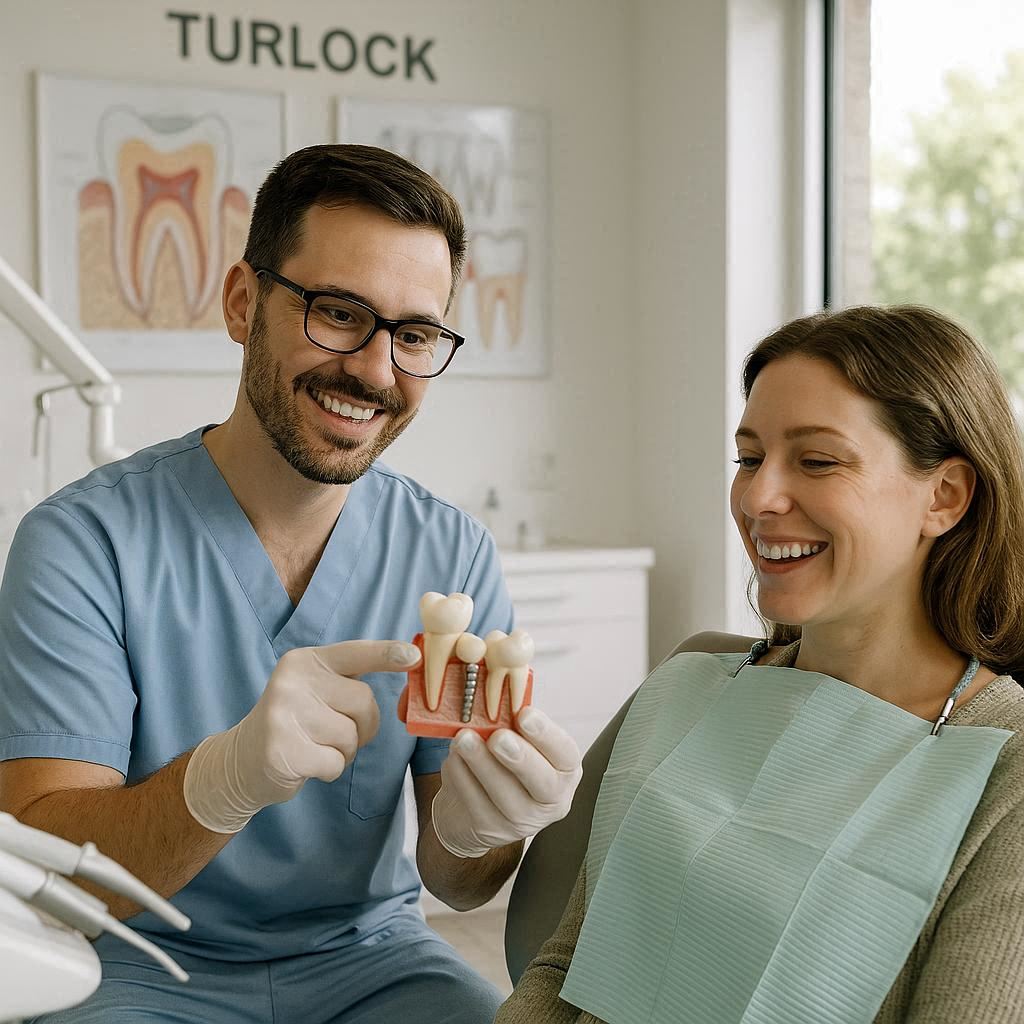
Think of it as a tiny titanium post. A dentist surgically places this post into your jawbone. Over time, your bone grows around it (a process called osseointegration). That gives you a rock-solid foundation. Once healed, a custom-made crown is attached to the post. The result looks, feels, and functions like a natural tooth.
The three main parts of a dental implant
- The implant post: The titanium screw placed into the jawbone.
- The abutment: A small connector that attaches to the post and holds the crown.
- The crown: The visible, tooth-colored part that sits above the gum line.
A well-placed implant can last 20 years, 30 years, or even a lifetime with proper care.
Why Turlock Residents Choose Dental Implants Over Other Options
You might wonder: Why not just get a bridge or a partial denture? That is a fair question.
Here is a simple comparison table to help you see the difference.
| Feature | Dental Implant | Dental Bridge | Removable Denture |
|---|---|---|---|
| Looks like a natural tooth | Yes | Usually | Sometimes |
| Stops bone loss | Yes | No | No |
| Affects nearby teeth | No | Yes (shaves down healthy teeth) | No |
| Comfort | Feels like your own tooth | Can feel bulky | Often moves or clicks |
| Longevity | 20+ years | 5–15 years | 3–10 years |
| Requires special cleaning | No (brush normally) | Yes (floss threaders) | Yes (soaking, adhesives) |
For most Turlock patients, the biggest win is bone preservation. When a tooth is missing, the jawbone starts to shrink. Implants stop that process. Bridges and dentures do not.
“I had a bridge fail after eight years. My dentist in Turlock recommended an implant, and I wish I had done it from the start. It feels like my own tooth.” — Maria R., Turlock resident
The Step-by-Step Process of Getting Dental Implants in Turlock
Knowing what happens during treatment removes a lot of the fear. Most implant procedures follow the same general timeline.
Initial consultation and imaging
Your journey starts with a visit to a Turlock implant dentist. They will:
- Examine your mouth
- Take X-rays or a 3D CBCT scan
- Review your medical history
- Discuss your goals and budget
This is also when they check if you have enough jawbone. Some patients need a bone graft before implants.
Treatment planning
Every mouth is different. Your dentist creates a custom plan. This includes:
- Number of implants needed
- Type of restoration (single crown, implant bridge, or full arch)
- Timeline and cost estimate
Implant placement surgery
The surgery itself is usually done under local anesthesia. You are awake but feel no pain. Many patients describe it as less uncomfortable than a tooth extraction.
The dentist makes a small cut in the gum, drills a precise hole in the bone, and places the titanium post. Then they stitch the gum closed over it.
The entire surgery for a single implant often takes 45 to 90 minutes.
Healing and osseointegration
This is the waiting period. It takes about three to six months for the bone to fuse with the implant. During this time, you wear a temporary tooth or go without one depending on the location.
Abutment placement
Once the implant is solidly fused, a second minor procedure exposes the implant and attaches a small metal abutment. This step is quick. Healing takes another two weeks or so.
Final crown placement
Your dentist takes impressions and sends them to a lab. A custom crown is made to match your surrounding teeth. Two to three weeks later, you come back, and the crown is screwed or cemented onto the abutment.
Congratulations. Your new tooth is complete.
Are You a Good Candidate for Dental Implants?
Not everyone is an ideal candidate right away. But many people can become one with preparation.
Good candidates generally have:
- One or more missing teeth
- A fully grown jawbone (typically age 18+ for women, 20+ for men)
- Enough bone density to support the implant
- Healthy gums (no active gum disease)
- Commitment to good oral hygiene
- No uncontrolled chronic conditions (like severe diabetes or autoimmune disorders)
What if you lack bone?
That is common, especially if the tooth has been missing for years. The solution is a bone graft. A small amount of bone material is added to your jaw. It heals for several months, then you can get the implant.
Many Turlock dental offices offer bone grafting. Do not let that scare you. It is a routine procedure.
Lifestyle factors
Smoking significantly reduces implant success. If you smoke, your dentist may ask you to quit before surgery. Heavy alcohol use and teeth grinding (bruxism) can also affect results. Be honest with your dentist. They have seen it all.
Dental Implant Costs in Turlock: What to Expect
Let’s talk money. This is often the biggest concern for patients.
A single dental implant in Turlock typically costs between $3,500 and $6,500. That includes:
- The surgical placement
- The abutment
- The crown
But the total depends on several factors.
What influences the price?
- Number of implants: One implant is cheaper than four.
- Need for bone grafting: Adds $300 to $1,200 per site.
- Tooth extraction: If the damaged tooth is still present, extraction adds $150 to $400.
- Type of crown material: Porcelain-fused-to-metal is less expensive than all-ceramic (zirconia).
- Dentist’s experience: A prosthodontist or oral surgeon may charge more than a general dentist.
- Location: Turlock prices are generally lower than the Bay Area or Los Angeles.
Does insurance cover dental implants?
Sometimes, partially. Many dental insurance plans do not cover the implant post itself. But they often cover portions of the crown and abutment. Some plans also cover the extraction and bone graft.
Call your insurance provider and ask:
- What is my annual maximum?
- Does my plan have a missing tooth clause? (Some exclude missing teeth before the policy started.)
- What percentage is covered for major services?
Payment options in Turlock
Most local dental offices offer:
- In-house payment plans
- Third-party financing (CareCredit, LendingClub, Proceed Finance)
- Cash pay discounts
Do not let cost stop you from at least having a consultation. Many Turlock dentists offer free or low-cost exams.
Finding the Best Dental Implant Provider in Turlock
You have choices. Turlock has general dentists, periodontists, and oral surgeons who place implants. Who should you trust?
Types of implant providers
| Provider Type | Best for | Typical cost |
|---|---|---|
| General dentist with implant training | Single implants, straightforward cases | $$ |
| Periodontist | Gum issues, multiple implants, bone grafts | $$$ |
| Oral surgeon | Complex cases, full arch, sinus lifts | $$$ |
| Prosthodontist | Full mouth reconstruction, cosmetic perfection | $$$$ |
Questions to ask before choosing
- How many implants have you placed?
- What is your success rate?
- Do you perform the entire procedure or refer out the crown?
- Can you show me before-and-after photos of Turlock patients?
- What happens if the implant fails?
A note from a Turlock dental assistant: “Patients who research and ask questions almost always have better outcomes. Don’t be shy. A good dentist will welcome your curiosity.”
Red flags to watch for
- Prices that seem too low (e.g., $1,500 for a full implant)
- No X-rays or CT scan before treatment planning
- Pressure to decide immediately
- No written treatment plan or cost breakdown
Recovery and Aftercare: What You Need to Know
Recovery from dental implant surgery is usually easier than people expect. But you still need to follow instructions.
First 24 to 48 hours
- Expect mild swelling and bruising
- Use ice packs on your cheek
- Eat soft foods (yogurt, soup, smoothies, mashed potatoes)
- Do not spit, use a straw, or smoke
- Take prescribed or over-the-counter pain medication as needed
Most people return to work the next day. Physical jobs may need two days off.
One week after surgery
- Swelling should be gone
- Stitches may dissolve or require removal
- You can return to normal brushing (gently around the site)
- Still avoid crunchy or sticky foods
Long-term care for your implant
Here is the best part: implants do not get cavities. But they can fail if you neglect your gums.
- Brush twice a day with a soft toothbrush
- Floss daily – use implant-specific floss or a water flosser
- Visit your Turlock dentist every six months for checkups
- Avoid chewing ice or hard candy (this can crack the crown)
With proper care, your implant can outlive you. That is not an exaggeration.
Risks and Complications: Being Honest
No surgery is 100% risk-free. But dental implants have a success rate of 95% to 98% in healthy people.
Possible complications include:
- Infection: Rare if you follow aftercare instructions
- Implant failure: The bone does not fuse (more common in smokers)
- Nerve damage: Temporary numbness in the lip or chin (very rare with modern imaging)
- Sinus issues: Upper back implants can protrude into the sinus cavity (prevented with CT scans)
If an implant fails, it is usually within the first six months. Most dentists will replace it at a reduced cost or free of charge. Ask about warranty policies upfront.
Alternatives to Dental Implants
Implants are not for everyone. Maybe your budget is tight, or your health makes surgery risky. Here are alternatives.
Removable partial denture
A plastic or metal framework with fake teeth. It clips onto your natural teeth.
- Pros: Low cost ($500–$1,500), no surgery
- Cons: Can move, affects taste, accelerates bone loss
Fixed dental bridge
The teeth on either side of the gap are shaved down. A three-unit bridge is cemented over them.
- Pros: Non-removable, quicker (2–3 weeks)
- Cons: Destroys healthy teeth, lasts 5–15 years
Resin-bonded bridge (Maryland bridge)
A bridge with wings that bond to the back of adjacent teeth.
- Pros: Minimal tooth alteration, lower cost ($1,500–$2,500)
- Cons: Not for back teeth, can come loose
Do nothing
Some people choose to live with the gap. That is a valid choice. But over time, adjacent teeth tilt, the opposing tooth may erupt, and bone loss continues.
Turlock-Specific Considerations
Living in Turlock offers some unique advantages for dental implant patients.
Access to specialists
Turlock is large enough to have periodontists and oral surgeons. You do not have to drive to Modesto or Stockton unless you want a second opinion.
Cost comparison
Central Valley dental fees are generally 15% to 30% lower than coastal California. That means you can save thousands staying local rather than traveling to San Francisco or Sacramento.
Seasonal considerations
If you work in agriculture or have seasonal income, ask about flexible payment schedules. Many Turlock dental offices understand local economic patterns and offer deferred payment plans.
Frequently Asked Questions (FAQ)
1. Are dental implants painful?
No. The surgery is done with anesthesia. Most patients report less discomfort than a tooth extraction. Post-op pain is usually managed with ibuprofen.
2. How long do dental implants last?
With good care, 20 years to a lifetime. The crown may need replacement after 10–15 years due to normal wear.
3. Can I get a dental implant if I have gum disease?
Not until the gum disease is treated. Active infection must be resolved first, or the implant will fail.
4. Does insurance cover dental implants in Turlock?
Some plans cover parts of the procedure. Call your provider. Many Turlock dentists also offer payment plans.
5. How many appointments does it take?
Typically 4 to 6 appointments over 4 to 9 months. This includes consultation, surgery, abutment, and crown placement.
6. Can I get all my teeth replaced with implants?
Yes. Options include implant-supported dentures or full-arch fixed bridges (like All-on-4). That requires 4 to 8 implants per arch.
7. What is the success rate for dental implants?
About 95% to 98% in healthy non-smokers. Lower in smokers or those with uncontrolled diabetes.
8. How much does a full mouth of implants cost in Turlock?
Between $20,000 and $60,000 per arch depending on complexity. That is significantly less than coastal California.
9. Can I eat normally with implants?
Yes. After full healing, you can eat steak, apples, corn on the cob — anything natural teeth can handle.
10. Do dental implants look fake?
No. Modern crowns are custom-shaded and shaped to match your natural teeth. Only your dentist and you will know which one is the implant.
Additional Resource
For an unbiased, dentist-reviewed explanation of the different types of dental implants (endosteal, subperiosteal, zygomatic), visit the American Academy of Implant Dentistry’s patient education page:
👉 https://www.aaid.com/patients/index.html
This resource is free, non-commercial, and written for real people — not dental professionals.
Conclusion
Dental implants in Turlock offer a permanent, natural-looking solution for missing teeth. The process takes several months and requires an upfront investment, but the long-term benefits — preserved bone, normal eating, and restored confidence — are unmatched. Find an experienced local provider, ask the right questions, and you can enjoy a lifetime of smiles.