Dental Implants for Missing Lateral Incisors
Losing a tooth is never fun. But losing a lateral incisor? That one feels personal.
Your lateral incisors are the teeth right next to your two front teeth (the central incisors). They frame your smile. When one is missing, even the most confident person starts to feel self-conscious. You might find yourself hiding your mouth when you laugh or turning your head slightly in photos.
But here is the good news: modern dentistry has solved this problem beautifully.
Dental implants for missing lateral incisors offer a solution that looks, feels, and functions like a natural tooth. Not just a fake tooth stuck in place—a real, permanent restoration rooted in your jawbone.
This guide walks you through everything you need to know. No confusing dental jargon. No exaggerated promises. Just honest, practical information to help you decide if an implant is right for you.
Why the Lateral Incisor Is So Important
Most people do not think about their lateral incisors until one goes missing. Then, suddenly, it is all you can see in the mirror.
These teeth are small but mighty. They sit between your prominent central incisors and your canine teeth (the pointed ones). Anatomically, they have a slightly rounded, chisel-like shape that helps guide your jaw during chewing.
But their real job? Aesthetics.
When you smile, your lateral incisors create harmony. They balance the two front teeth. Without one, your smile looks asymmetrical. The gap draws the eye immediately.
Functionally, losing a lateral incisor creates problems too. Adjacent teeth start to tilt into the empty space. The tooth above (or below) the gap may drift downward or upward because it has nothing to bite against. Over time, this can lead to bite issues, jaw pain, and even gum disease.
So replacing a missing lateral incisor is not vanity. It is dental health.
What Exactly Is a Dental Implant?
Before we go deeper, let us make sure we understand the device itself.
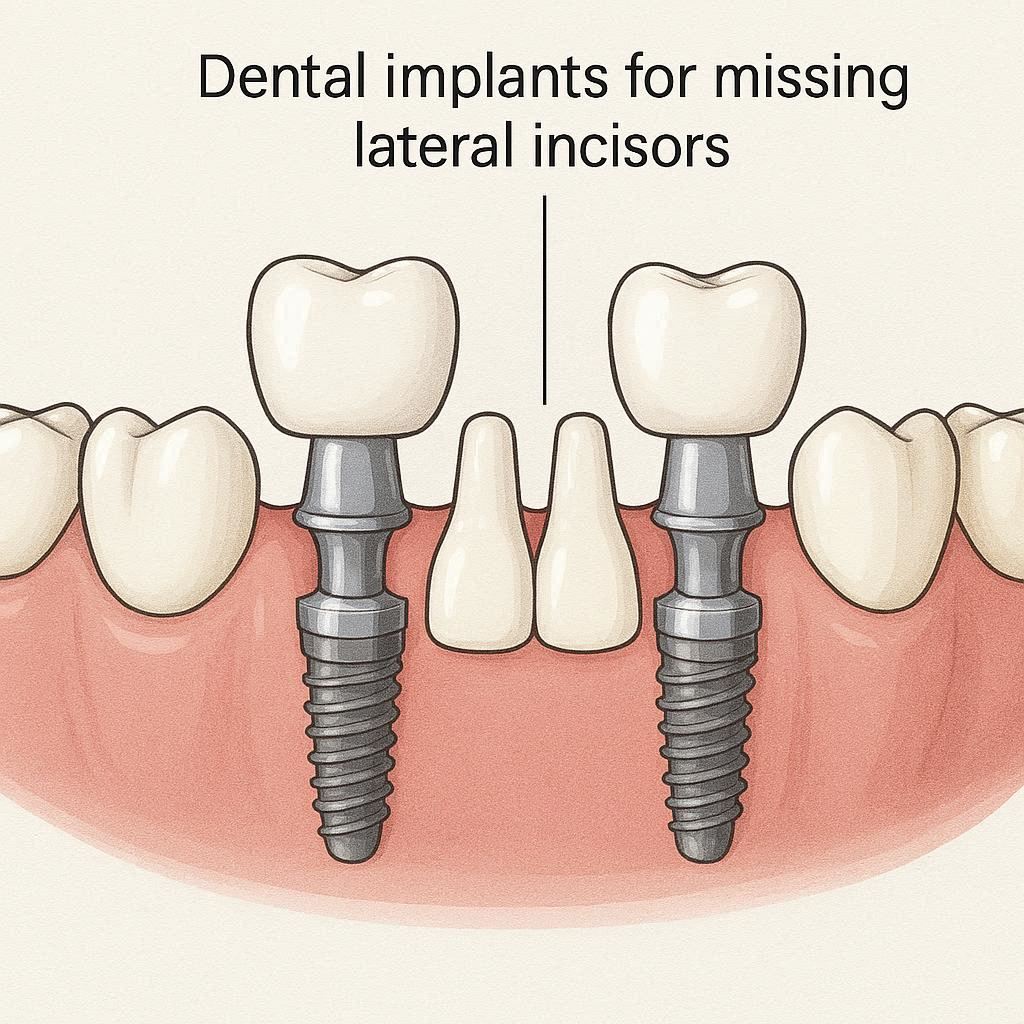
A dental implant is not the crown you see in your mouth. It is the artificial root that goes into your jawbone.
The implant is a small post made of medical-grade titanium or zirconia. Your dentist surgically places this post into the bone where your natural tooth root used to be. Over several months, your bone fuses with the implant surface. This process is called osseointegration. Once that bond is solid, the implant becomes a permanent anchor.
On top of that anchor, your dentist attaches an abutment (a small connector piece). And on top of the abutment goes the crown—the visible part that looks like your natural tooth.
So when we talk about dental implants for missing lateral incisors, we are talking about replacing the entire tooth structure: root and crown.
| Component | Function | Material |
|---|---|---|
| Implant Fixture | Acts as artificial tooth root | Titanium or Zirconia |
| Abutment | Connects implant to crown | Titanium or Zirconia |
| Crown | Visible tooth surface | Porcelain or Ceramic |
Who Is a Good Candidate for This Procedure?
Not everyone qualifies for an implant right away. But do not let that discourage you. Many people who initially get told “no” can become candidates with some preparation.
Ideal Candidate Profile
You likely qualify for a dental implant if you:
- Have one or both lateral incisors missing
- Possess adequate jawbone density to support the implant
- Maintain healthy gums with no active periodontal disease
- Do not smoke heavily (smoking impairs bone healing)
- Are committed to good oral hygiene
- Have completed facial growth (typically age 18 or older for women, 20 or older for men)
Challenging Situations That Can Be Fixed
Some conditions make implant placement harder, but not impossible.
Low bone density: The lateral incisor area often has thin bone. If you have been missing the tooth for years, that bone may have resorbed (melted away). A bone graft can rebuild it.
Gum disease: Active infection must be treated first. Once your gums are healthy, you can proceed.
Smoking: Quitting for at least two weeks before and after surgery dramatically improves success rates.
Narrow space: Lateral incisors are naturally small. Sometimes the space between your central incisor and canine is too narrow for a standard implant. Mini implants or orthodontic treatment to create space can solve this.
Important Note: Never let a dentist rush you into an implant without a cone beam CT scan. This 3D X-ray shows exactly how much bone you have and where your nerves and sinuses are. It is non-negotiable for safety.
The Complete Procedure: Step by Step
Knowing what happens during implant surgery reduces anxiety. Let us walk through the entire journey, from your first consultation to biting into an apple.
Step 1: Initial Consultation and Planning
Your dentist will examine your mouth, take X-rays, and discuss your medical history. Expect honest questions about medications, chronic conditions (like diabetes or osteoporosis), and habits like teeth grinding.
If you are a candidate, the dentist creates a surgical guide. This 3D-printed template ensures the implant goes into the exact right position—critical for lateral incisors because even a millimeter off can ruin the smile.
Step 2: Preparatory Procedures (If Needed)
Some people need bone grafting or a sinus lift (less common for lateral incisors but possible if the missing tooth is an upper lateral incisor near the sinus cavity).
A bone graft adds artificial or donated bone material to the deficient area. Then you wait four to nine months for that graft to mature before placing the implant.
Step 3: Implant Placement Surgery
This is the main event. And it is far less scary than it sounds.
Your dentist numbs the area completely. You feel pressure but no pain. A small incision opens the gum tissue to expose the bone underneath. Using a series of drills, the dentist creates a precise hole exactly the size of the implant. The implant post screws into that hole. Then the gum tissue is stitched closed over or around the implant.
The whole thing takes about 30 to 60 minutes for a single tooth.
Most people drive themselves home afterward. You will be awake (unless you chose sedation), alert, and ready to rest.
Step 4: Osseointegration Period
Now the waiting begins.
For the next three to six months, your jawbone grows tightly around the implant surface. During this time, you wear a temporary partial denture or a bonded “flipper” tooth to fill the gap. You must avoid putting heavy chewing pressure on the healing implant.
Step 5: Abutment Placement
Once osseointegration is confirmed (another X-ray), a second minor procedure uncovers the implant and attaches the abutment. This is much quicker than the first surgery—about 15 minutes. Your gums need another two to four weeks to heal around the abutment.
Step 6: Crown Fabrication and Placement
Your dentist takes impressions of the abutment and surrounding teeth. A dental lab crafts your custom crown, matching the color, shape, and translucency of your natural lateral incisor.
When the crown is ready, your dentist screws or cements it onto the abutment. You look in the mirror. And just like that, your smile is complete.
Single vs. Multiple Implants for Lateral Incisors
Sometimes both lateral incisors are missing. Or one lateral incisor and the central incisor. The approach changes based on the situation.
| Situation | Recommended Solution |
|---|---|
| One missing lateral incisor | Single implant + single crown |
| Both lateral incisors missing (healthy adjacent teeth) | Two separate implants + two crowns |
| Missing lateral incisor and central incisor | Two implants, possibly with a bridge connecting them |
| Missing lateral incisor with insufficient bone | Bone graft + single implant |
Never let a dentist convince you to get a three-unit bridge (cutting down healthy adjacent teeth) if you are a candidate for an implant. That advice belongs in the 1990s.
Success Rates and Longevity
Dental implants work. The numbers prove it.
- Ten-year success rate for lower lateral incisors: approximately 97%
- Ten-year success rate for upper lateral incisors: approximately 95%
Those are better success rates than dental bridges and root canals.
Once healed and restored, a well-maintained implant can last 30 years, 40 years, or even a lifetime. The crown may need replacement after 10 to 15 years due to normal wear, but the implant itself keeps going.
What affects longevity? Three things: your oral hygiene, your smoking status, and whether you grind your teeth. Grinders need a nightguard to protect the crown from fracturing.
Cost Breakdown: What You Will Actually Pay
Let us talk money openly. Dental implants are an investment. But understanding the costs helps you plan.
The total cost for a single lateral incisor implant typically ranges from $3,000 to $6,000 in the United States. That includes surgery, abutment, and crown but not the initial consultation or bone grafting if needed.
Here is a realistic breakdown:
| Service | Typical Cost Range |
|---|---|
| Consultation and CT scan | $200 – $500 |
| Bone graft (if needed) | $300 – $1,200 |
| Implant placement surgery | $1,500 – $2,500 |
| Abutment | $300 – $600 |
| Custom crown | $1,000 – $2,000 |
| Total (without graft) | $3,000 – $5,600 |
Dental insurance rarely covers the implant itself, calling it “cosmetic” for lateral incisors (unfair, but true). However, many plans cover parts of the crown or the abutment. Some cover bone grafting if deemed medically necessary.
Payment plans through CareCredit or in-house dental financing can spread the cost over 12 to 24 months.
Dental Implants vs. Alternatives: An Honest Comparison
You have options. Let us compare them directly so you can make an informed choice.
| Feature | Dental Implant | Resin-Bonded Bridge (Maryland Bridge) | Traditional Bridge | Removable Partial Denture |
|---|---|---|---|---|
| Preserves adjacent teeth | Yes (no alteration) | Minimal (small etchings) | No (crowns on healthy teeth) | Yes |
| Bone loss prevention | Yes | No | No | No |
| Lifespan | 30+ years | 5-10 years | 10-15 years | 3-8 years |
| Initial cost | Higher | Lower | Medium | Lowest |
| Long-term cost | Lowest | Higher (replacement) | Higher (replacement) | Highest (constant replacement) |
| Feels like natural tooth | Yes | No (slight movement) | Yes | No |
| Requires healthy adjacent teeth | No | Yes | Yes | No |
Our take: If you can afford the upfront cost and have adequate bone, an implant is the best choice. If you have severe bone loss and cannot undergo grafting, a resin-bonded bridge is a reasonable second option. Removable partials should be temporary only.
Common Risks and How to Avoid Them
No medical procedure is risk-free. Being honest about complications helps you spot problems early.
Short-Term Risks (First 2 weeks)
- Pain and swelling: Normal. Controlled with ice packs and over-the-counter medication.
- Bleeding: Minor oozing for 24 hours. Bite on gauze.
- Infection: Rare (under 2%). Antibiotics before surgery reduce this risk.
- Nerve injury: Extremely rare for lateral incisors because nerves are not nearby. More common for lower molars.
Long-Term Risks
- Implant failure (lack of osseointegration): Happens in 3-5% of cases. More likely in smokers and people with uncontrolled diabetes.
- Peri-implantitis: This is gum disease around the implant. It is preventable with excellent hygiene but difficult to treat once established.
- Crown fracture: Porcelain can chip if you bite hard objects (ice, pens, fingernails).
Quote from Dr. Sarah Chen, Prosthodontist: “The biggest reason lateral incisor implants fail is not surgical error. It is patients neglecting to floss around the implant. Treat it like a natural tooth, and it will last decades. Ignore it, and you will lose it.”
What to Expect During Recovery
Everyone heals differently. But here is a realistic timeline for a typical patient.
Day 1 (surgery day): Numbness wears off after a few hours. You feel throbbing but not sharp pain. Eat soft, cool foods. No rinsing, spitting, or drinking through straws (this dislodges the blood clot).
Days 2-3: Swelling peaks. Your face may look puffy near the implant site. Use ice packs 20 minutes on, 20 minutes off. Stick to yogurt, smoothies, mashed potatoes, and scrambled eggs.
Days 4-7: Swelling subsides. You can introduce warm soups and soft bread. Begin gentle salt water rinses (don’t swish vigorously—just tilt your head).
Week 2: Stitches dissolve or get removed. You feel nearly normal. Return to work and light exercise. Still avoid chewing directly on the implant site.
Months 1-3: The implant heals quietly under your gums. You wear your temporary tooth. No restrictions other than avoiding nuts, chips, and sticky candies on that side.
Month 4-6: Abutment placement and crown delivery. You walk out with a permanent tooth. You can eat anything you want within 24 hours.
Caring for Your Lateral Incisor Implant
Here is the truth: an implant cannot get a cavity. But it can get peri-implantitis, which is just as destructive as gum disease.
Your daily hygiene routine needs small adjustments.
What to Do
- Brush twice daily with a soft-bristled toothbrush
- Floss daily using implant-specific floss or superfloss (it has a stiff end to thread under the crown)
- Use a water flosser on low pressure to clean around the abutment
- Visit your dentist every six months for professional cleanings
- Wear a nightguard if you grind your teeth
What to Avoid
- Metal picks or hard floss threaders that scratch the implant surface
- Tobacco products (they triple your failure risk)
- Chewing ice, hard candy, or pens
- Skipping dental cleanings (plaque buildup around implants progresses faster than natural teeth)
Think of it like this: you invested money and time into this tooth. Protecting it takes two extra minutes per day.
Psychological Benefits: More Than Just a Tooth
We have talked about bone and gums and crowns. But let us address the emotional side.
People who replace missing lateral incisors often report feeling more confident in just a few weeks. They smile in photos again. They stop covering their mouths when they laugh. They speak more clearly because their tongue no longer hits a gap.
One patient told us: “I didn’t realize how much I was hiding until I got my implant. I spent five years angling my face away from people in conversations. Now I just smile. It sounds silly, but it changed my life.”
That is not an exaggeration. Your smile is your social passport. Restoring it restores something deeper.
Frequently Asked Questions (FAQ)
1. Is the surgery painful?
Most patients rate the discomfort as 2-3 out of 10 during recovery. The procedure itself is painless due to local anesthesia.
2. How long must I wait after extraction to get an implant?
If the extraction site is healthy and infection-free, immediate placement (same day) is possible. Otherwise, wait 8-12 weeks for the socket to heal.
3. Can I get an implant if I have gum disease?
Not until the gum disease is treated and under control. Active infection will cause implant failure.
4. Do dental implants for lateral incisors look natural?
When done by an experienced dentist, yes. The crown is custom-shaded and shaped to match your natural lateral incisor. Most people cannot tell it is not a real tooth.
5. What happens if the implant fails?
Your dentist removes it (a simple procedure). After the bone heals for several months, you can try again, often with a wider or longer implant.
6. Can I get an MRI with a dental implant?
Yes. Titanium implants are not magnetic and do not interfere with MRI machines.
7. Are mini implants an option for lateral incisors?
Sometimes. Mini implants (narrow diameter) work well for small spaces or low bone volume. However, they are less strong than standard implants and not ideal for heavy chewers.
8. How do I choose a good implant dentist?
Look for a prosthodontist (specialist in tooth replacement) or an oral surgeon. Ask how many lateral incisor implants they place per year. Request before-and-after photos of similar cases.
Additional Resources
For more detailed information on implant safety, clinical studies, and finding a qualified specialist, visit the American Academy of Implant Dentistry (AAID) patient education page:
👉 https://www.aaid.com/patients
This resource offers a searchable directory of accredited implant dentists and free downloadable guides on treatment planning and cost estimates.
Conclusion
Missing a lateral incisor affects your smile, your confidence, and your dental health. Dental implants for missing lateral incisors provide the closest thing to a natural tooth: permanent, functional, and virtually indistinguishable from the real one. While the upfront cost and healing time are higher than alternatives, the long-term benefits—bone preservation, adjacent tooth safety, and decades of worry-free smiling—make it the gold standard for a reason.