Dental Implant Pain After 2 Weeks
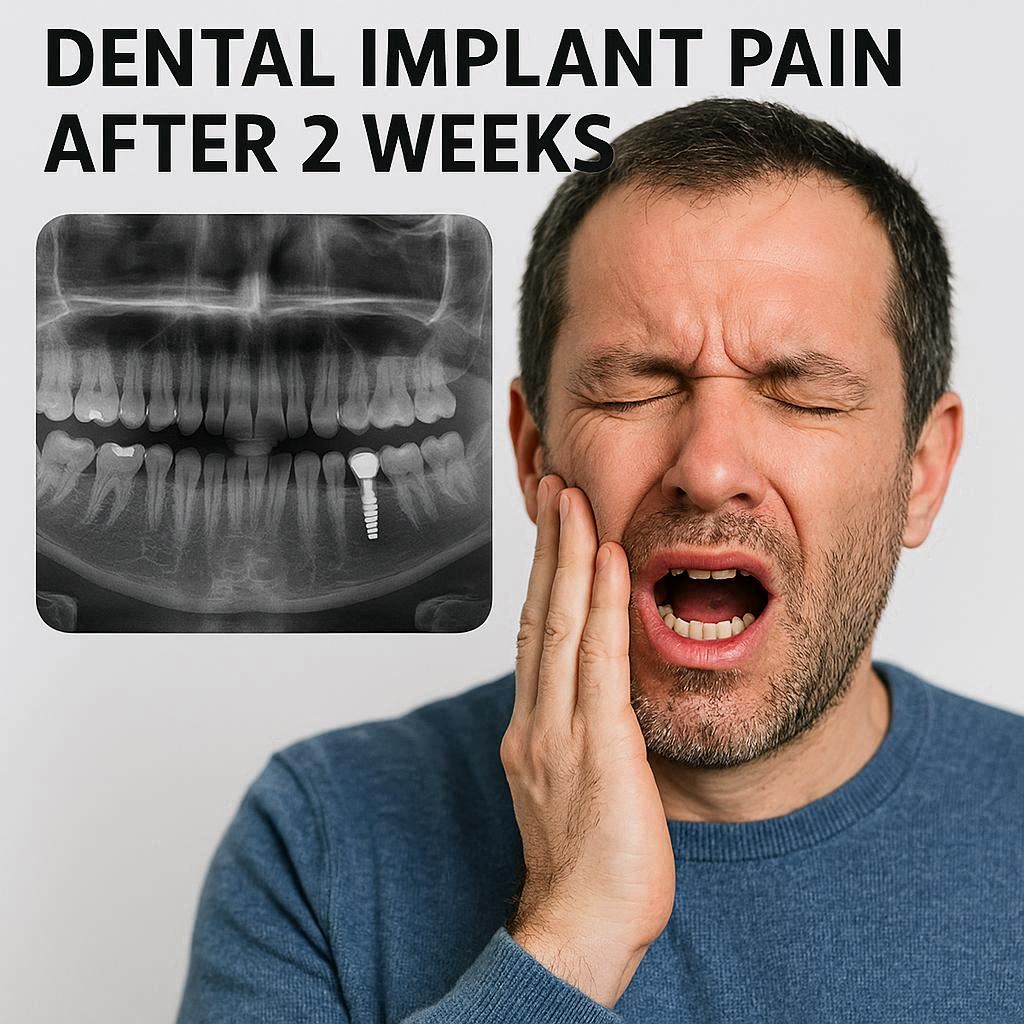
You made it through the surgery. You survived the first few days of swelling, soft foods, and gentle rinsing. But now, two weeks later, you still feel pain. Maybe it’s a dull ache. Maybe it’s a sharp pinch when you chew. And a small voice in your head keeps asking: Should this still hurt?
Here is the honest truth: some discomfort at the two-week mark can be completely normal, but certain types of pain are a clear signal to call your dentist.
This guide walks you through exactly what happens inside your mouth during weeks two and three after implant placement. You will learn how to tell the difference between normal healing pain and early signs of complications like infection or implant failure. No fluff. No scare tactics. Just practical, realistic information to help you make good decisions.
Important note: This article is for educational purposes only. It does not replace professional medical advice. If you are concerned about your dental implant, always contact your oral surgeon or dentist.
Part 1: The Normal Healing Timeline – Where Should You Be at 2 Weeks?
Before deciding if your pain is abnormal, you need to understand what typical healing looks like. Dental implant surgery is a minor surgical procedure that involves placing a titanium post into your jawbone. Your body needs time to build new bone around that post—a process called osseointegration.
Here is a realistic week-by-week breakdown.
Days 1–3: The Intense Phase
- Moderate to significant pain (3–6 out of 10)
- Visible swelling of the cheek or gum
- Possible minor bruising
- Bleeding that stops within 24 hours
- Pain medication (prescription or OTC) usually needed
Days 4–7: The Turning Point
- Pain drops to mild or moderate (2–4 out of 10)
- Swelling begins to go down
- You can eat soft foods more comfortably
- Many people stop strong painkillers and switch to ibuprofen or acetaminophen
Days 8–14: The “Almost Normal” Phase
- Mild occasional soreness (0–2 out of 10)
- No visible swelling in most cases
- Gum tissue looks pink and healthy
- You may forget you had surgery for hours at a time
- Some sensitivity when pressing on the area or chewing firmer foods
Day 14 and Beyond
- Most patients report zero to very mild discomfort
- You might feel a strange “pressure” sensation but not sharp pain
- Normal eating (with some chewing precautions) resumes for many
So if you are at day 14 and still feeling constant, moderate, or sharp pain—something may be off. But mild twinges or soreness when you press directly on the implant site? That can still fall within the range of normal.
Part 2: Types of Dental Implant Pain After 2 Weeks (And What They Mean)
Pain is not all the same. The quality of the pain tells you more than the intensity. Let us break down the most common pain profiles at the two-week mark.
Type 1: Dull, Achy Pressure When Chewing
What it feels like:
You bite down on the implant side, and instead of feeling normal, you feel a deep, dull pressure. Almost like the implant is “too tall” or pushing into your sinus (for upper implants).
Is it normal?
Yes, in many cases. Your bite is still adjusting. The crown is not yet attached (unless you had a same-day implant), so you are biting directly or indirectly on the healing cap or gum tissue.
What to do:
- Chew on the opposite side for a few more days.
- Stick to softer foods (pasta, eggs, mashed potatoes).
- If the pressure persists into week 3, mention it at your follow-up.
Type 2: Sharp, Electric-Shot Pain When Touching the Area
What it feels like:
You accidentally brush the implant site, or you touch it with your tongue, and BAM—a sudden, sharp, shooting pain that lasts only a second or two.
Is it normal?
Yes, surprisingly. This often indicates exposed nerve endings in the healing gum tissue. The nerves are regenerating, and they can be hypersensitive.
What to do:
- Use a soft-bristled toothbrush and avoid direct contact.
- Switch to an alcohol-free, non-irritating mouth rinse.
- This usually fades within another 7–10 days.
Type 3: Constant, Throbbing Pain That Wakes You Up
What it feels like:
A deep, pulsating ache that does not go away with over-the-counter pain relievers. It may throb in rhythm with your heartbeat. It might keep you awake at night.
Is it normal?
No. At two weeks, constant throbbing pain is a red flag.
Possible causes:
- Infection (peri-implantitis or a localized abscess)
- Bone overheating during surgery (less common with modern techniques)
- Nerve irritation or injury
What to do:
Call your dentist within 24 hours. Do not wait for your scheduled follow-up.
Type 4: Pain That Gets Worse Instead of Better
What it feels like:
Week one was bad, week two started okay, but now—suddenly—the pain is increasing. You might notice new swelling or a bad taste.
Is it normal?
Absolutely not. Healing pain follows a downward trend. If your pain graph is going up, something is wrong.
What to do:
Contact your oral surgeon immediately. You may need an X-ray and a clinical exam.
Type 5: Referred Pain (Jaw, Ear, or Temple)
What it feels like:
Your implant site itself feels okay, but your ear aches, your jaw joint clicks, or your temple throbs.
Is it normal?
Sometimes. Referred pain can happen because the trigeminal nerve supplies sensation to all these areas. However, persistent referred pain at two weeks can also indicate:
- Muscle splinting (you are clenching due to surgery)
- A developing infection
- Sinus involvement (upper implants)
What to do:
Monitor for 48 hours. If the referred pain does not fade or worsens, see your dentist.
Part 3: Common Reasons for Lingering Pain at 2 Weeks (Not Failure)
Let us be clear: most lingering pain at two weeks is NOT implant failure. It is usually one of these five manageable issues.
1. You Are a Slow Healer
Healing speed varies dramatically by age, overall health, and habits.
| Factor | Slows Healing | Speeds Healing |
|---|---|---|
| Age | Over 60 | Under 40 |
| Smoking | Yes (significantly) | Non-smoker |
| Diabetes | Uncontrolled diabetes | Well-controlled diabetes |
| Medications | Steroids, immunosuppressants | None |
| Oral hygiene | Poor | Excellent |
If you have two or more slowing factors, expect to feel mild pain longer than the average patient.
2. Bone Quality Was Poor
If your jawbone was thin or soft, the surgeon may have needed to:
- Add bone graft material
- Place a narrower implant
- Drill more aggressively
All of these extend the healing timeline. Bone grafting, in particular, often causes lingering soreness for 3–4 weeks.
3. Adjacent Teeth Are Protesting
Sometimes the pain is not from the implant at all. The neighboring teeth may be:
- Developing temporary sensitivity from being manipulated during surgery
- Shifting slightly as the implant settles
- Showing signs of existing decay or cracks that were asymptomatic before surgery
Your dentist can test adjacent teeth with a percussive tap or cold test to rule this out.
4. You Have a Sinus Communication (Upper Implants Only)
Upper molars and premolars sit close to your maxillary sinus. If the implant protrudes slightly into the sinus cavity, you may experience:
- Dull aching in the cheek
- Pressure when bending over
- Occasional nosebleeds or clear fluid from the nose
This often resolves on its own but requires monitoring. Your dentist may prescribe a decongestant or sinus precautions (no blowing your nose for a week).
5. Your Temporary Crown Is Ill-Fitting
If you received a same-day temporary crown, it might be:
- Too high (causing premature contact when you bite)
- Too wide (irritating the gum tissue)
- Rough (collecting plaque and inflaming the gum)
A simple adjustment by your dentist (a few seconds with a bur) often eliminates the pain immediately.
Part 4: Warning Signs – When Pain After 2 Weeks Is an Emergency
Some symptoms, when paired with pain, require urgent attention. Memorize this list.
The Red Flag Checklist
- Fever (100.4°F / 38°C or higher)
- Pus or foul drainage from the implant site
- Swelling that returns after having gone down (especially under the chin or eye)
- Difficulty swallowing or breathing (very rare but serious)
- Numbness of the lip, chin, or tongue that is new or worsening
- The implant feels loose (this is never normal at any stage)
If you have any of the above, do not wait for a routine appointment. Call your surgeon’s emergency line or go to an urgent care center.
The “Probably Fine But Call Anyway” List
- Pain that limits you to liquids only at week 2
- Pain that requires prescription opioids at week 2
- Bad taste in your mouth that will not go away
- The area feels hot to the touch
These are not emergencies, but they warrant a phone call within 24–48 hours.
Part 5: Step-by-Step – What to Do If You Still Have Pain at 2 Weeks
Do not panic. Follow this logical action plan.
Step 1: Self-Assessment (5 minutes)
Grab a mirror, a bright light, and a piece of paper. Answer these questions:
- On a scale of 0–10 (0 = no pain, 10 = worst imaginable), what is your average pain?
- Is the pain constant or only when you chew/touch it?
- Do you see any redness, swelling, or white patches around the implant?
- Does the area bleed easily when you gently dab it with gauze?
- Have you taken any antibiotics or painkillers in the last 48 hours?
Write down your answers. They will help your dentist.
Step 2: Try Conservative Home Care (For Mild Pain Only)
If your pain is mild (1–3 out of 10) and you have no red flags:
- Warm salt water rinses (1 tsp salt in 8 oz warm water) 3–4 times daily
- Switch to extra-soft foods (smoothies, yogurt, soup, scrambled eggs)
- Over-the-counter anti-inflammatory (ibuprofen 400–600 mg every 6–8 hours with food)
- Ice the outside of your cheek for 10 minutes on / 20 minutes off (yes, even at 2 weeks—it helps deep inflammation)
- Sleep with your head elevated on two pillows
Try this for 48 hours. If no improvement, move to Step 3.
Step 3: Call Your Dental Office (Do Not Email)
Explain clearly: “I had an implant placed [X date]. I am at two weeks, and I still have [describe pain]. I have no fever or pus. Can I speak to a nurse or doctor?”
Most offices will either:
- Reassure you that this is normal and give you a later follow-up date, or
- Bring you in for a quick check (often no charge if it is a post-op concern)
Step 4: What to Expect at the Appointment
Your dentist will likely:
- Probe gently around the implant to check for bleeding or pocket depth
- Take a periapical X-ray to see the bone level around the implant
- Test your bite with articulating paper
- Irrigate the site with chlorhexidine if there is trapped debris
- Adjust or remove any temporary crown if needed
In 90% of cases, the solution is simple: a bite adjustment, a prescription for a stronger mouth rinse, or reassurance to wait one more week.
Part 6: Real Patient Scenarios (What Actually Happens)
Let us walk through three realistic cases. These are composites of real patients (names and details changed for privacy).
Case A: Maria, Age 52 – Dull Pain at 2 Weeks
History: Maria had a lower left first molar extracted and an implant placed with bone graft. She stopped smoking two months before surgery.
Pain at 2 weeks: A dull, annoying ache when she chews on that side. No swelling. No fever.
What her dentist found: The healing cap was slightly loose. Food debris had collected underneath it, causing localized gum inflammation.
Solution: Tightened the healing cap and flushed the area with saline. Prescribed a medicated rinse for 5 days.
Outcome: Pain resolved in 3 days.
Case B: James, Age 34 – Sharp Pain When Brushing
History: James had an upper right premolar implant. No bone graft needed. Healthy non-smoker.
Pain at 2 weeks: A shocking, sharp zap whenever his toothbrush touched the gum around the implant.
What his dentist found: Exposed nerve endings in the healing gum. The tissue looked healthy but was hypersensitive.
Solution: Switched James to an ultra-soft “post-surgical” toothbrush and a desensitizing gel.
Outcome: Pain faded over 10 days. At week 4, he felt nothing.
Case C: Linda, Age 68 – Increasing Pain and Swelling at 2 Weeks
History: Linda had two adjacent implants placed in the lower right. She has well-controlled type 2 diabetes.
Pain at 2 weeks: Week one was fine. Week two, the pain began increasing. She noticed swelling returning and a bad taste.
What her dentist found: Peri-implant mucositis (early infection) due to a small piece of food lodged deep under the gum.
Solution: Professional debridement (cleaning) and a 7-day course of amoxicillin.
Outcome: Pain dropped dramatically within 48 hours. She healed completely.
Key takeaway: Linda caught it early. She did not wait. That saved her implant.
Part 7: How to Prevent Prolonged Pain After Dental Implant Surgery
You are already at week two. But these tips can still help you—and they will definitely help if you ever need another implant.
The 7-Day Post-Op Checklist (For Next Time)
| Day | Action | Why It Helps |
|---|---|---|
| 1–3 | Ice 20 min on / off | Reduces deep bone inflammation |
| 1–7 | No spitting, no straws | Protects the blood clot |
| 1–14 | Sleep elevated | Reduces fluid pooling in the face |
| 3–14 | Salt water rinses (not swishing) | Keeps site clean without pressure |
| 7–14 | Introduce soft chewing gradually | Stimulates bone healing gently |
| 14+ | Gentle brushing with post-surgical brush | Removes plaque without trauma |
Long-Term Habits for Pain-Free Implants
- Do not smoke. Smoking at two weeks post-op significantly increases pain and failure risk.
- Control your blood sugar. Every 1% rise in HbA1c doubles infection risk.
- Wear a night guard if you grind your teeth. Clenching creates micro-motion that causes chronic dull pain.
- Keep your follow-up appointments. The 2–4 week check is when most problems are caught early.
Part 8: Comparing Implant Pain to Other Dental Procedures (Context Helps)
Sometimes it helps to know how implant pain stacks up against other common treatments.
| Procedure | Typical Pain at Day 14 (0–10) | Notes |
|---|---|---|
| Simple tooth extraction | 0–1 | Fully healed for most |
| Wisdom teeth removal (impacted) | 1–3 | Some residual soreness |
| Root canal | 0 | Usually pain-free by day 3 |
| Single dental implant (no graft) | 0–2 | Most are comfortable |
| Single implant + bone graft | 1–3 | Graft extends healing |
| Multiple implants | 2–4 | More trauma = more time |
| Sinus lift + implant | 2–5 | Sinus healing is slower |
If you had a bone graft or sinus lift, your pain at two weeks is automatically expected to be higher. Do not compare yourself to a friend who had a simple implant with no graft.
Part 9: Medications and Pain Management – What Works at 2 Weeks
By week two, you should be transitioning away from prescription painkillers. Here is what dentists actually recommend.
Best Over-the-Counter Options
- Ibuprofen (Advil, Motrin): Best for bone and gum inflammation. 400–600 mg every 6–8 hours with food. Do not exceed 2400 mg/day.
- Acetaminophen (Tylenol): Best for generalized aching. 500–1000 mg every 6 hours. Do not exceed 3000 mg/day (lower if you drink alcohol).
- Combination: Taking ibuprofen and acetaminophen together (staggered) works better than either alone for moderate pain.
What to Avoid
- Aspirin: Increases bleeding risk (unlikely at week 2, but still not ideal).
- Opioids (tramadol, hydrocodone): You should not need these at week 2. If you do, call your dentist.
- Topical benzocaine gels (Orajel): They can irritate the healing gum and mask important symptoms.
Non-Medication Pain Relief That Works
- Clove oil (diluted): One drop on a cotton swab applied to the gum (not the implant itself) has natural numbing properties.
- Cold foods: Ice cream, smoothies, and cold yogurt provide temporary relief through vasoconstriction.
- Stress reduction: Clenching from anxiety multiplies pain. Try 5 minutes of deep breathing before bed.
Part 10: Frequently Asked Questions (FAQ)
Q1: Is it normal for my dental implant to hurt when I press on it after 2 weeks?
Yes, in many cases. Direct pressure on the healing cap or the gum over the implant can still cause mild discomfort at two weeks. The bone-implant interface is still strengthening. If the pain is sharp or severe, see your dentist.
Q2: Can an infected dental implant be saved at 2 weeks?
Absolutely. Early infection (peri-implant mucositis) is highly treatable with professional cleaning and antibiotics. The key is catching it before it spreads to the bone (peri-implantitis). Two weeks is very early, so prognosis is excellent.
Q3: Why does my implant hurt more at night after 2 weeks?
Nighttime pain often means:
- You are clenching or grinding in your sleep
- Inflammation peaks when you lie flat (gravity changes fluid dynamics)
- You have no daytime distractions, so you notice the pain more
Try sleeping with an extra pillow and a warm compress before bed.
Q4: How long does bone graft pain last after an implant?
Bone graft pain typically lasts 3–4 weeks. The graft material (often cadaver, bovine, or synthetic) needs to integrate with your natural bone. This causes prolonged low-grade soreness. It is rarely severe, but it can be persistent.
Q5: When should I go to the emergency room for dental implant pain?
Go to the ER if you have:
- Swelling that spreads to your eye or neck
- Difficulty breathing or swallowing
- A fever over 101°F (38.3°C) that does not respond to medication
- Uncontrollable bleeding
These are signs of a deep space infection. They are rare with dental implants, but they require hospital care.
Q6: Can I take antibiotics left over from a previous prescription?
No. Never take leftover antibiotics. You need the correct type (usually amoxicillin or clindamycin for dental infections) and the correct duration. Taking the wrong antibiotic can make the infection worse or create resistant bacteria.
Q7: Will salt water rinses help my pain at 2 weeks?
Yes, but only for certain types of pain. Salt water reduces inflammation and flushes out food debris. If your pain is caused by trapped particles or mild gum irritation, rinses help significantly. If your pain is deep bone pain, salt water will not reach it.
Q8: My dentist said “no pain at 2 weeks” but I have some. Did my implant fail?
Almost certainly not. Implant failure (lack of osseointegration) is usually painless in the early stages. The implant simply remains mobile. Pain is actually a good sign in many ways—it means your nerves are alive and your body is responding. Do not assume failure.
Part 11: The Emotional Side – Anxiety and Pain Perception
We cannot talk about dental implant pain without addressing the elephant in the room: anxiety makes pain worse.
Studies show that patients who worry excessively about implant pain rate their discomfort 40–60% higher than calm patients with identical clinical findings.
The Anxiety-Pain Loop
- You feel a small twinge
- You think, “Is this normal? What if it fails?”
- Anxiety raises your heart rate and tenses your jaw muscles
- Muscle tension creates more pain
- You feel more pain → more anxiety
How to Break the Loop
- Stop checking the site every hour. Look at it once in the morning and once at night.
- Do not Google symptoms at 2 AM. Use this article as your only reference for 48 hours.
- Distract yourself intentionally. Watch a movie, call a friend, go for a walk (gentle pace).
- Use a pain journal. Write down your pain level three times a day. You will likely see a slow decline that reassures you.
“I was convinced my implant had failed at two weeks because of a dull ache. My dentist took an X-ray and showed me beautiful bone growth. The ache was just my jaw muscles healing. I wish I had saved myself the worry.”
— Sarah, actual dental implant patient
Part 12: What Your Dentist Wishes You Knew (But Won’t Say)
Let me translate dental-office-speak into plain English.
“That’s within normal limits” means:
I see this every day. You are fine. Go home and eat some ice cream.
“Let’s keep an eye on it” means:
I am not worried, but I want to be thorough. Come back if it changes.
“You have a high pain threshold” means:
You are tolerating this better than most patients.
“Some people just heal slower” means:
You did nothing wrong. Your body has its own timeline.
The vast majority of dental implant pain at two weeks is benign. Dentists see hundreds of implants per year. Only a small fraction (less than 5%) have true complications at this stage.
Conclusion (Three-Line Summary)
Dental implant pain after 2 weeks is often normal if it is mild, dull, or only occurs when chewing or touching the site. However, constant throbbing pain, worsening symptoms, or signs of infection (fever, pus, swelling) require an immediate call to your dentist. Most lingering pain resolves with simple adjustments, home care, or a short course of antibiotics—implant failure at this stage is very rare.
Additional Resource
For a complete, dentist-reviewed guide on the entire dental implant healing timeline (days 1 through 90), including printable aftercare checklists and a symptom tracker, visit:
🔗 www.colgate.com/en-us/oral-health/implants/dental-implant-healing-stages
(Note: This link leads to a reputable, clinically reviewed oral health resource. Always verify any medical information with your own healthcare provider.)