Why Are Dental Implants So Expensive in the UK? A Honest Breakdown for 2026
If you have recently looked into replacing a missing tooth, you have probably experienced a bit of sticker shock. You sit down for a consultation, the dentist smiles warmly, and then they mention a number that sounds closer to a used car than a single tooth.
You are not alone in asking: why are dental implants so expensive in the UK?
It is a fair question. On the surface, an implant looks like a small metal screw and a porcelain tooth. But comparing an implant to a simple filling is like comparing a bicycle to a car. Both get you from A to B, but the engineering, materials, and safety features are worlds apart.
Let’s walk through the real reasons behind the cost. No confusing dental jargon. No hidden sales pitch. Just an honest, friendly guide to help you understand where your money actually goes.
The Big Picture: An Investment, Not Just a Purchase
Before we dive into the numbers, we need to change how we think about the price.
A dental implant is not a product you buy off a shelf. It is a surgical procedure combined with custom engineering. You are paying for:
- Highly trained professionals (surgeon, restorative dentist, nurse, anaesthetist).
- Advanced technology (CBCT scanners, 3D printers, digital design software).
- Medical-grade materials (titanium or zirconia that must be biocompatible).
- A skilled dental lab (a human artist crafting your new tooth by hand).
- Aftercare and warranties (many clinics include free repairs for 1–5 years).
When you look at it that way, the price starts to make more sense. You are not buying a screw. You are buying a permanent solution that can last 30 years or more.
*“Patients often focus on the upfront cost, but they forget that a cheap bridge might need replacing every 7–10 years. Over a lifetime, a well-done implant is usually the more economical choice.”* – Dr. Sarah Manning, UK restorative dentist.
Let us break down the actual components.
The Anatomy of an Implant Price: Where Does the Money Go?
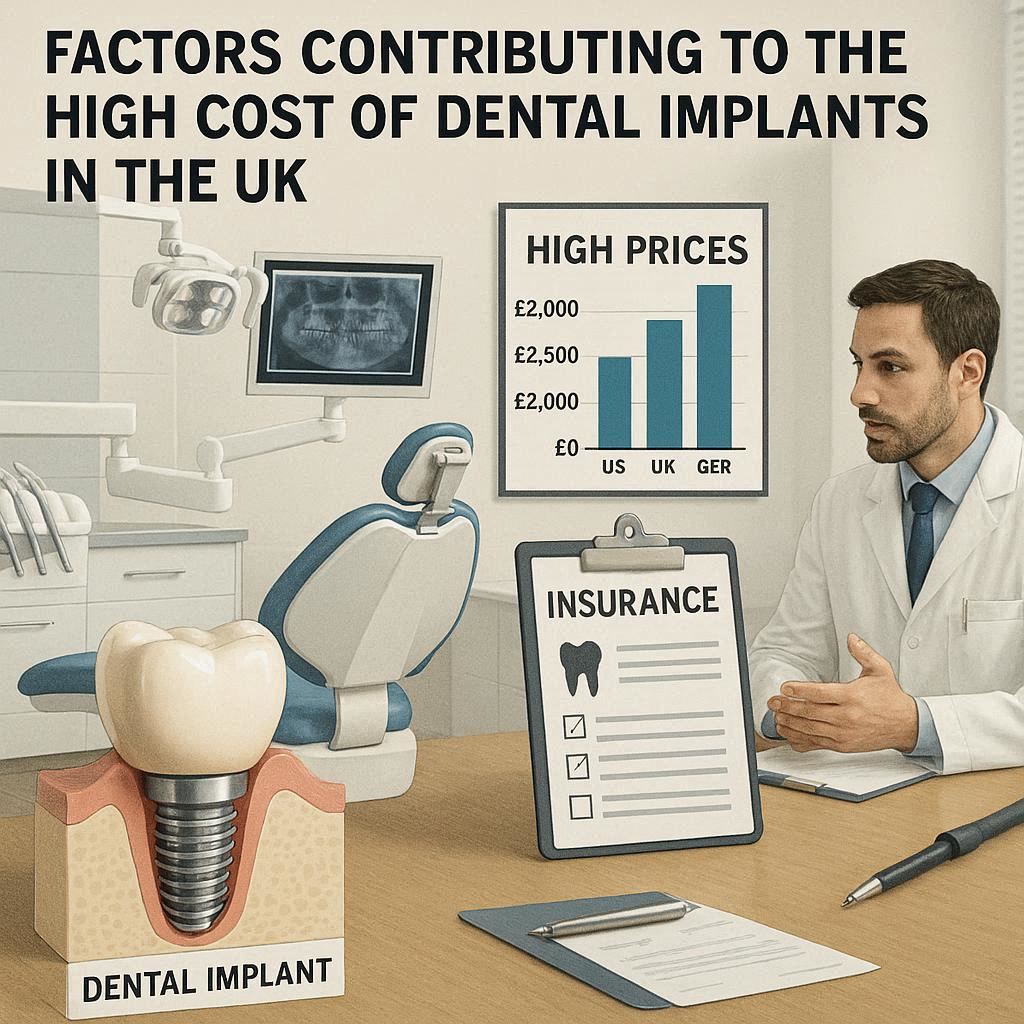
To understand the final bill, you have to see the individual parts. A typical single tooth implant in the UK costs between £2,500 and £4,500. Here is a realistic split:
| Component | What it is | Percentage of cost | Typical range (GBP) |
|---|---|---|---|
| Consultation & Diagnostics | CBCT scan, X-rays, medical history, treatment planning | 10% | £250 – £450 |
| The Implant Fixture (Screw) | The titanium post placed into your jawbone | 15% | £375 – £675 |
| Surgical Placement | The surgeon’s time, theatre fees, sterilisation, nursing staff | 25% | £625 – £1,125 |
| Abutment | The connector piece that joins the screw to the crown | 10% | £250 – £450 |
| The Crown (Tooth) | Porcelain or zirconia custom-made by a lab | 25% | £625 – £1,125 |
| Clinical & Lab Time | Impressions, fitting, adjustments, dentist’s restorative time | 15% | £375 – £675 |
Important note for readers: These figures are averages for private clinics in cities like London, Manchester, or Birmingham. Prices in rural Scotland or Northern Ireland may be 15–20% lower. Prices in central London may be 30% higher.
Reason 1: The Cost of Clinical Expertise and Team Training
This is the number one reason for the high price, and it is also the most justified.
Placing an implant is not like pulling a tooth. The surgeon must avoid nerves (like the inferior alveolar nerve), blood vessels, and the sinus cavity. A mistake of 1mm can cause permanent lip numbness or sinus infections.
To do this safely, your dentist needs:
- A degree in dentistry (5 years).
- Postgraduate training in implantology (2–4 additional years).
- Mentorship under experienced surgeons (hundreds of hours).
- Continual education (implants evolve every 3–4 years).
In the UK, the General Dental Council (GDC) does not require a specific implant license, but responsible clinics only hire surgeons with a Diploma in Implant Dentistry (e.g., from the Royal College of Surgeons).
A quick comparison:
| Professional | Years of training after A-Levels | Typical hourly cost (private) |
|---|---|---|
| Dental implant surgeon | 10 – 12 years | £300 – £600+ |
| General dentist (fillings) | 5 – 6 years | £150 – £250 |
| Dental hygienist | 3 – 4 years | £60 – £100 |
You are paying for a decade of education. That expertise keeps you safe.
Reason 2: High-Tech Diagnostic Equipment (CBCT Scanners)
A regular dental X-ray (OPG or panoramic) is flat. It shows your teeth like a shadow. An implant surgeon needs a 3D map of your bone.
That requires a CBCT scan (Cone Beam Computed Tomography).
- Cost of the machine: £60,000 – £150,000.
- Annual maintenance: £5,000 – £10,000.
- Per scan cost to the clinic: £50 – £80 (software licensing, radiation safety officer, storage).
- Price charged to you: £150 – £300.
The scan allows the surgeon to measure your bone height and width down to 0.1mm. It shows exactly where to place the implant for maximum stability.
Without a CBCT, the surgeon would be guessing. Guessing leads to failed implants. Failed implants lead to bone loss and more surgery. The scan is expensive, but it is also the best insurance policy you can buy.
Reason 3: Premium Materials Made in Germany, Switzerland, and Sweden
You may see cheap implants online for £30 each. You will never find a UK clinic using them.
Why? Because reputable clinics use brands like Straumann (Switzerland), Nobel Biocare (Sweden), Dentsply Sirona (Germany/USA), or Neoss (UK/Sweden).
These companies spend millions on research. They test their titanium for:
- Osseointegration (how well bone bonds to the metal).
- Corrosion resistance (metal particles must not leak into your body).
- Surface technology (special etching or roughening to help bone grow faster).
A cheap implant might feel the same to touch, but over 5–10 years, it is more likely to fail. Once a cheap implant fails, the bone around it is often destroyed. Replacing it is harder and more expensive than the first surgery.
| Material origin | Typical clinic cost (implant + abutment) | Failure rate after 10 years |
|---|---|---|
| Swiss/German/Swedish | £600 – £900 | 2 – 5% |
| Korean (high quality) | £400 – £600 | 5 – 8% |
| Unbranded/Chinese | Not used in UK clinics | 15 – 30%+ |
UK clinics stick to premium brands because they do not want to see you back with a failed implant. Reputation matters.
Reason 4: The Dental Laboratory – Handcrafted Art, Not Mass Production
A dental crown is not 3D printed in five minutes (well, sometimes it is, but the finishing is still manual).
Here is what happens after your dentist takes a digital scan of your mouth:
- The file is sent to a dental technician – a skilled professional with 3–5 years of training.
- The technician designs the crown in software, matching the shape, colour, and translucency of your natural teeth.
- A milling machine or 3D printer creates the framework (zirconia or layered ceramic).
- The technician hand-paints the crown using up to 15 different coloured porcelains.
- The crown is fired in a furnace at 800–900°C to harden the layers.
- Final adjustments, polishing, and quality control.
A good lab technician spends 1.5 to 3 hours on a single crown.
Lab fees in the UK:
- Basic crown: £150 – £250
- High-aesthetic crown (front tooth): £300 – £600
- Premium zirconia multi-layer: £400 – £800
When you pay £2,500 for an implant, the lab is getting roughly £250–£400 of that. The rest covers the surgery, materials, and clinic overheads.
Reason 5: UK Overheads – Rent, Insurance, and Regulation
Running a dental clinic in the UK is brutally expensive. Compare these annual costs:
| Expense | Typical annual cost (single surgery clinic) |
|---|---|
| Commercial rent (London/south east) | £30,000 – £80,000 |
| Dental indemnity insurance (surgeon) | £5,000 – £15,000 |
| GDC registration fees (per dentist) | £945 |
| CQC registration and compliance | £2,500 – £5,000 |
| Sterilisation equipment (autoclaves) | £8,000 – £20,000 (one-time) |
| Waste disposal (clinical + amalgam) | £2,000 – £4,000 |
These costs exist whether the dentist places one implant today or ten. So the price per implant must cover the days when the surgery is empty, the nurse is still being paid, and the rent is still due.
Clinics in premium postcodes (Harley Street, Manchester city centre, Birmingham Colmore Row) pay double the rent of a suburban clinic. That difference passes to you.
Hidden Factors That Increase Your Final Bill
Not every patient pays the same price. Your specific situation can add significant costs.
Bone Grafting
If you lost your tooth years ago, your jawbone has likely shrunk (atrophied). Without enough bone, the implant has nothing to hold onto.
A bone graft involves taking synthetic bone particles or bone from another area (like your chin or hip) and packing it into the empty socket. Then you wait 4–9 months for new bone to grow.
Extra cost: £400 – £1,500 per site.
Sinus Lift
For upper back teeth (molars), the maxillary sinus sits right above your jawbone. If the bone is too thin, the surgeon must lift the sinus membrane and place bone graft material underneath.
Extra cost: £800 – £2,000.
CT Scan (already mentioned) and Surgical Guides
Some surgeons use a 3D-printed surgical guide. This is a plastic template that fits over your teeth and tells the drill exactly where to go.
Extra cost: £200 – £500.
Immediate vs. Delayed Loading
Placing the crown on the same day as the implant (immediate loading) requires extra planning, special components, and a temporary crown. It is faster for you but more complex for the surgeon.
Extra cost: £300 – £800.
A Realistic Price Comparison: UK vs Other Countries
You may have heard of “dental tourism” – going to Turkey, Poland, Hungary, or Thailand for cheaper implants.
Let us be honest. You can get a single implant in Turkey for £800 – £1,500, including the crown. That is about a third of the UK price.
But here is what that lower price often means:
| Factor | UK clinic (typical) | Budget clinic abroad |
|---|---|---|
| Surgeon qualification | GDC-registered, postgraduate diploma | Variable (some are excellent, some are weekend-course trained) |
| Implant brand | Straumann, Nobel Biocare, Dentsply | Local or Korean budget brands |
| Warranty | 1–5 years, often transferable | Often none or only if you return |
| Follow-up care | Included | You pay to fly back |
| Language | No barriers | May require translator |
| Legal recourse | GDC complaints, CQC, UK courts | Very difficult |
Important note for readers: There are excellent dentists in Turkey, Poland, and Hungary. There are also dangerous ones. The same is true in the UK. However, if something goes wrong abroad, you have almost no protection. A failed implant that needs removal and bone grafting in the UK will cost you £3,000+ to fix.
For complex cases (multiple missing teeth, heavy bone loss, medical conditions like diabetes), staying in the UK is almost always safer.
How to Save Money Without Sacrificing Safety
You do not have to accept the first quote you receive. Here are five legitimate ways to reduce the cost.
1. Dental Schools and Teaching Hospitals
UK universities with dental schools offer implant treatment at 40–60% off the private price.
Examples:
- King’s College London Dental Institute
- University of Manchester Dental School
- University of Birmingham School of Dentistry
- Leeds Dental Institute
- Glasgow Dental Hospital and School
The catch: treatment is slower (students are learning), and a consultant supervises every step. But the materials and safety standards are identical to private clinics.
Typical cost: £1,200 – £2,000 per implant (including crown).
2. Dental Plan Memberships (Denplan, Practice Plan)
Some clinics offer membership plans that give you 10–20% off major treatments like implants. You pay a monthly fee (£15–£30) for routine care, then get discounted rates on surgery.
3. Paying via Finance (0% or Low Interest)
Many UK clinics partner with finance companies like Chrysalis Finance, Tabeo, or Dental Finance. You can spread the cost over 12–48 months.
- 0% interest for 12 months is common.
- 9.9% APR for longer terms (24–48 months).
Example: A £3,500 implant costs £292/month for 12 months at 0%.
4. Combining Implants (All-on-4 or multiple units)
The biggest fixed cost is the surgery setup (sterilisation, nurse, anaesthetic). If you need one implant, you pay all of that. If you need four implants for a full arch, the per-implant cost drops significantly.
| Number of implants | Typical total cost | Cost per implant |
|---|---|---|
| 1 | £3,000 | £3,000 |
| 2 | £5,200 | £2,600 |
| 4 (All-on-4 lower arch) | £9,000 – £12,000 | £2,250 – £3,000 |
5. Negotiate with the Clinic
This sounds strange for medical care, but private dentistry is a business. If you need multiple implants, ask for a package discount.
What to say: “I have been quoted £X by another clinic. Can you offer a better price if I pay in full upfront?”
Some clinics will offer 5–10% off for immediate full payment. Others will match a competitor’s written quote.
Long-Term Value: Why Cheap Can Be Expensive
Let us do a 30-year cost comparison.
Scenario A: UK premium implant (£3,500) – lasts 30+ years with normal hygiene.
Total cost over 30 years: £3,500 (plus routine checkups).
Scenario B: Cheap bridge (£1,200) – lasts 10 years, needs replacement twice over 30 years.
Total cost over 30 years: £3,600 (plus more tooth reduction each time).
Scenario C: Budget implant abroad (£1,200) – fails after 5 years. Removal (£800) + bone graft (£1,000) + new UK implant (£3,500) = £5,300.
The premium UK implant is actually the cheapest option in the long run, provided you choose a skilled surgeon and look after your oral health.
FAQ: Your Most Common Questions Answered
1. Are dental implants covered by the NHS?
Almost never for adults. The NHS only provides implants in extreme cases (jaw cancer, severe birth defects, or accidents that destroy the jawbone). For routine tooth loss, you must go private.
2. How long do dental implants last?
With good oral hygiene and regular checkups, 25–30 years is realistic. Some patients keep their implants for 40+ years. The crown may need replacing after 15–20 years, but the titanium screw can last a lifetime.
3. Does insurance cover implants in the UK?
Most standard dental insurance plans (like Bupa or Denplan) do not cover implants. Some premium plans offer partial cover (e.g., 50% up to £1,500) after a 12-month waiting period. Always read the fine print.
4. Why are some clinics cheaper than others?
Possible reasons: less experienced surgeon, budget implant brands, no CBCT scanner (risky), lower lab fees (lower quality crown), or lower overheads (suburban or industrial estate location). Not all cheap clinics are bad, but you should ask questions.
5. Is the pain worth the cost?
Most patients report that the procedure is less painful than a tooth extraction. Local anaesthesia is very effective. Post-surgery pain is usually managed with over-the-counter ibuprofen or paracetamol. The long-term benefit (biting into an apple with confidence) far outweighs the temporary discomfort.
6. Can I get a dental implant years after losing the tooth?
Yes, but you may need a bone graft first. The longer you wait, the more bone you lose. That can increase the total cost. If you lost a tooth recently, do not wait more than 6–12 months to start the implant process.
7. What is the success rate of dental implants in the UK?
For a healthy non-smoker with good bone volume, success rates are 95–98% over 10 years. Smokers have a 10–20% higher failure rate. People with uncontrolled diabetes or gum disease also have higher risks.
Additional Resource (Free and Reliable)
For a completely independent, government-backed guide to dental implants, including how to find a qualified surgeon and what questions to ask before you sign anything, visit:
The Oral Health Foundation (UK) – Dental Implants Guide
[Insert your internal link here or use: https://www.dentalhealth.org/dental-implants ]
This charity provides unbiased, non-commercial information. No ads. No clinic referrals. Just facts.
Final Verdict: Are They Worth the Price?
So, why are dental implants so expensive in the UK? Because you are paying for safety, longevity, and expertise. A good implant is the closest thing we have to a natural tooth. It preserves your jawbone, does not damage neighbouring teeth, and allows you to eat, speak, and smile without thinking about it.
The upfront price is high – there is no denying that. £3,000 for a single tooth feels outrageous when a basic filling costs £150. But you are not comparing like with like.
A filling is a repair. An implant is a replacement organ. It is bioengineering inside your body.
If you are a non-smoker with decent bone levels, a premium UK implant from a qualified surgeon is one of the best long-term investments you can make in your health. It will outlast two or three bridges. It will keep your face shape from collapsing. And it will let you eat steak and toffee again.
If the price is truly out of reach, look at dental schools or save up using 0% finance. Just avoid the temptation of ultra-cheap overseas deals unless you have done deep research and have a clear plan for complications.
Your teeth are not a place to cut corners. Neither is your safety.
Conclusion (Three Lines)
Dental implants in the UK are expensive because they combine surgical expertise, premium Swiss/German materials, handcrafted lab work, and high clinic overheads. The price reflects a 30-year solution, not a quick fix. While cheaper options exist abroad or via dental schools, a properly placed UK implant offers safety, legal protection, and long-term value that often makes it the most economical choice over a lifetime.
FAQ (Consolidated for Quick Reference)
Q: Why is the consultation alone so expensive?
A: Because it includes a CBCT 3D scan (£150–£300 machine cost), treatment planning software, and the surgeon’s time to map your nerves and bone.
Q: Can I get just the implant screw now and the crown later to spread cost?
A: Yes. Many clinics offer staged payments. You pay for the surgery (implant placement) in month 1, then the crown 3–6 months later after healing.
Q: Do dental implants hurt more than extractions?
A: Most patients say less. The area is completely numb. After the anaesthetic wears off, you feel pressure and mild soreness, rarely sharp pain.
Q: Are there any hidden costs I should ask about upfront?
A: Yes. Ask for a written quote including: CBCT scan, bone graft (if needed), temporary crown (if any), anaesthetic fees (IV sedation costs extra), and any warranty terms.
Q: Why does my friend’s implant cost half what I was quoted?
A: Possible differences: location (north vs London), implant brand (Korean vs Swiss), surgeon experience (new vs 20 years), or whether a bone graft was needed.
Q: Is it true that implants can fail years later?
A: Yes, but rarely. Peri-implantitis (inflammation around the implant) is the main cause. It is like gum disease but harder to treat. Daily cleaning and regular hygienist visits prevent this.
Disclaimer: This article is for informational purposes only and does not constitute medical advice. Always consult a GDC-registered dentist for a personal clinical assessment. Prices and availability change over time. This guide reflects typical UK private dental costs for 2026.