Are Dental Implants Covered by Medicare?
If you are missing teeth or struggling with uncomfortable dentures, dental implants can feel like a miracle solution. They are strong, natural-looking, and permanent.
But there is one big question that stops most seniors in their tracks: Are dental implants covered by Medicare?
You are not alone if you feel confused. The rules around Medicare and dental care are tricky. Many people assume that since they have paid into Medicare for years, their dental work should be covered.
Unfortunately, that is rarely the case.
This guide will walk you through everything you need to know. We will look at what Original Medicare says about dental implants, explore Medicare Advantage plans, discuss real costs, and share practical alternatives to help you afford the smile you deserve.
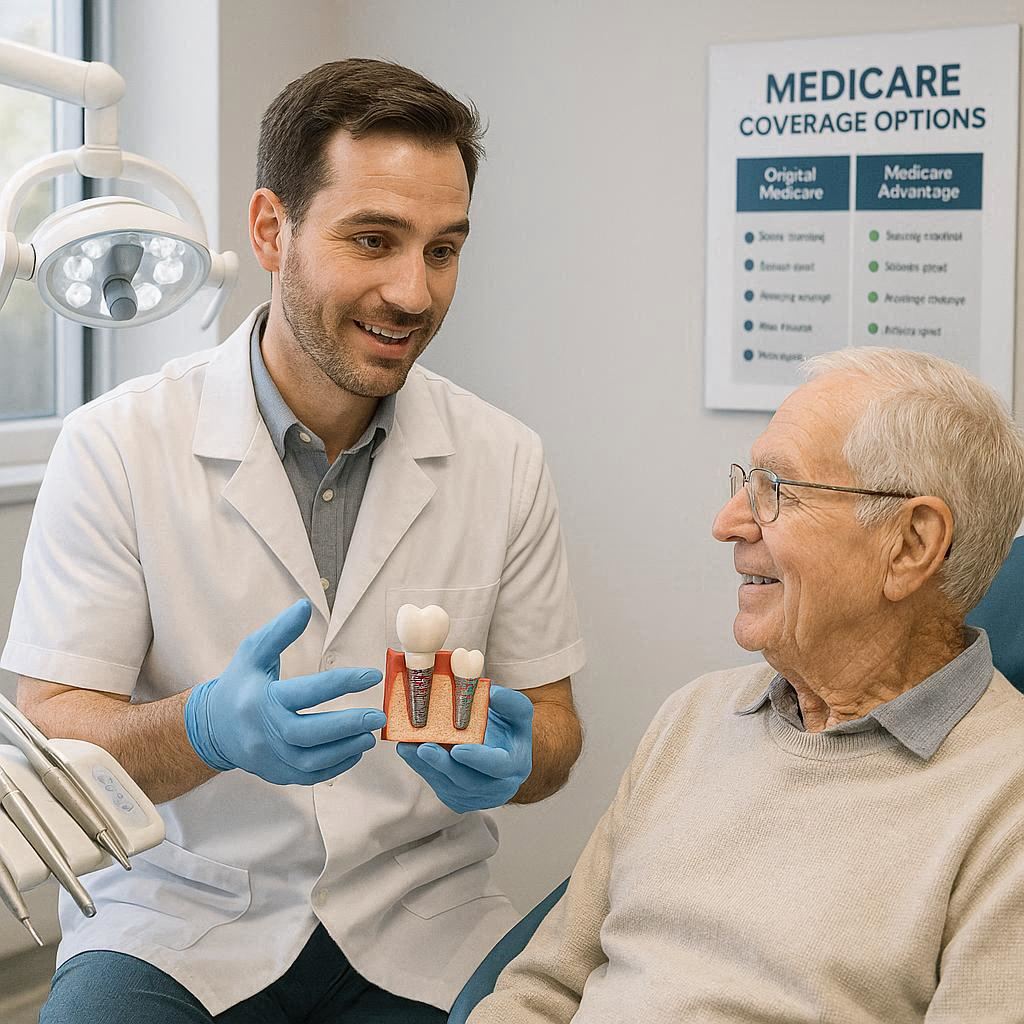
Understanding What Original Medicare (Part A and Part B) Covers
Before we talk about implants specifically, we need to look at the big picture. What does Original Medicare actually cover when it comes to your teeth?
The General Rule: No Routine Dental Care
Here is the honest truth. Original Medicare — which includes Part A (Hospital Insurance) and Part B (Medical Insurance) — does not cover routine dental care.
That means no coverage for:
- Routine cleanings
- Fillings
- Extractions (in most cases)
- Dentures
- Dental implants
- Root canals
- Crowns for dental reasons alone
This rule has been in place since Medicare began in 1965. At that time, routine dental care was seen as a “non-covered service.” That has not changed much since then.
The Rare Exceptions: When Medicare Might Pay for Dental Work
Even though the general rule is “no,” there are a few specific situations where Medicare may step in. These are narrow exceptions, but they are important to understand.
1. Hospital stays for complex dental procedures
If you need a dental extraction or other dental surgery that requires you to be admitted to a hospital because of an underlying medical condition, Medicare Part A might cover the hospital stay.
For example, imagine you need to have several teeth removed before heart surgery or cancer treatment. If a dentist determines that the extraction is too risky to perform in an office and you must be admitted to a hospital, Medicare could cover your inpatient hospital costs.
Important note: Even in this case, Medicare still does not cover the cost of the dental procedure itself (like the extraction or the implant). It only covers the hospital room, nursing care, and any medical complications.
2. Dental exams before a major medical procedure
Medicare Part B may cover a limited dental exam if it is required before a kidney transplant, heart valve replacement, or organ transplant. The goal is to check for hidden infections in the mouth that could spread to the rest of the body.
Again, this is only the exam — not any treatment or implants.
3. Accidental injury or jaw reconstruction
If you are in a serious accident and break your jaw or knock out teeth in a way that requires surgical reconstruction, Medicare may cover the medically necessary reconstruction of your jawbone. However, the actual dental implant attached to that bone is still considered dental, not medical.
This is a very gray area. In practice, most claims for implants after an accident are denied unless there is a clear medical necessity beyond just restoring your ability to chew.
Reader Note: Do not rely on these exceptions. They are rare and difficult to prove. Most people with Original Medicare pay 100% of their dental implant costs out of pocket.
What About Medicare Advantage (Part C)?
If Original Medicare leaves you frustrated, you are not alone. That is why millions of seniors choose Medicare Advantage Plans (also called Part C).
These plans are sold by private insurance companies like Aetna, Humana, UnitedHealthcare, and Blue Cross. They replace your Original Medicare and must cover at least the same benefits as Parts A and B.
But here is the good news: Many Medicare Advantage plans add extra benefits that Original Medicare does not offer.
Dental Coverage in Medicare Advantage Plans
According to a 2023 report from the Kaiser Family Foundation, nearly 94% of Medicare Advantage plans offer some form of dental coverage. That sounds promising, right?
But we need to look closer.
What Most Advantage Plans Cover for Dental
Most Medicare Advantage dental benefits include:
- Routine cleanings (usually two per year)
- Bitewing X-rays once per year
- Fluoride treatments
- Basic fillings
- Simple extractions
What They Rarely Cover
This is where expectations meet reality. Even the best Medicare Advantage plans rarely cover major dental services like:
- Dental implants
- Crowns
- Bridges
- Full or partial dentures (some plans cover basic dentures, but often with long waiting periods)
If a plan does offer implant coverage, it is usually limited to $1,000 to $1,500 per year. That might sound like a lot, but a single dental implant can cost between $3,000 and $6,000. The full cost for a single implant with crown often reaches $4,500 to $7,000.
So even “good” coverage leaves you paying thousands out of pocket.
How to Check if Your Advantage Plan Covers Implants
If you already have a Medicare Advantage plan, follow these steps:
- Look at your Evidence of Coverage booklet. Search for the words “major dental” or “implants.”
- Call the customer service number on your card. Ask directly: “Does my plan cover dental implants? If yes, what is my annual maximum benefit?”
- Ask about waiting periods. Many plans require you to be enrolled for 6 to 12 months before covering major dental work.
Be honest with yourself. Most Advantage plans simply do not cover implants. They are expensive for insurance companies, so they exclude them or offer very low caps.
Real Costs of Dental Implants Without Coverage
Let us talk numbers. If Medicare does not cover your implants, how much will you actually pay?
The cost of dental implants varies widely depending on where you live, the dentist you choose, and how complex your case is.
Average Cost Breakdown for One Dental Implant
| Service | Average Cost |
|---|---|
| Initial consultation and CBCT scan | $150 – $350 |
| Tooth extraction (if needed) | $200 – $600 |
| Bone graft (often required) | $300 – $1,500 |
| Implant post placement (surgery) | $1,500 – $2,500 |
| Abutment (connector piece) | $300 – $600 |
| Custom crown | $1,000 – $2,500 |
| Total for one implant | $3,500 – $7,500 |
If you need a full mouth reconstruction with multiple implants, costs can range from $20,000 to $50,000 or more.
That is real money. For most seniors on a fixed income, those numbers feel impossible.
Why Are Implants So Expensive?
You are paying for:
- A surgeon’s specialized training (oral surgery is a medical specialty)
- A custom titanium post that fuses with your jawbone
- A lab-made ceramic crown matched to your other teeth
- High-tech imaging (3D cone beam CT scans)
- Follow-up visits for up to six months
Implants are not simple fillings. They are surgical procedures. The price reflects the complexity and the materials involved.
Alternative Ways to Pay for Dental Implants if Medicare Says No
Just because Medicare does not cover implants does not mean you have no options. Let us look at realistic paths forward.
1. Standalone Dental Insurance
Medicare does not sell dental insurance, but private companies do. A standalone dental plan can cost between $30 and $80 per month.
The catch: Most dental plans have waiting periods of 6 to 12 months for major services like implants. They also have annual maximums (usually $1,000 to $1,500 per year). That means even with insurance, you will pay thousands out of pocket over time.
Best for: People who can wait a year and need only one or two implants.
2. Dental Schools
Dental schools are one of the best-kept secrets in affordable dental care. Students perform the work under the supervision of experienced faculty.
Cost savings: Typically 50% to 70% less than private practice.
Example: A $5,000 implant at a private dentist might cost $1,500 to $2,500 at a university clinic.
Where to look: Search for “dental school near me” or visit the American Dental Education Association website.
Trade-off: Appointments take longer (sometimes 3 to 4 hours each). You may have more visits overall. But for many people, the savings are worth it.
3. Dental Tourism
Traveling to another country for dental work has become surprisingly common. Popular destinations include Mexico, Costa Rica, Colombia, Thailand, and Turkey.
Typical savings: 50% to 75% off U.S. prices.
Example: A $5,000 implant in the U.S. might cost $1,200 in Mexico or $1,500 in Costa Rica.
Risks to consider:
- Travel costs (flights, hotels, meals)
- Follow-up care is difficult if something goes wrong
- Infection control standards vary by clinic
- Legal recourse is limited if you receive poor care
Safety tip: Research clinics that are accredited by the Joint Commission International (JCI). Read recent reviews from other international patients.
4. Nonprofit Organizations and Charitable Programs
Several organizations offer free or low-cost dental care for seniors, veterans, and low-income adults.
- Dental Lifeline Network – Connects seniors with volunteer dentists.
- Mission of Mercy – Hosts free dental clinics in multiple states.
- Local Area Agency on Aging – Your local AAA can point you to sliding-scale clinics.
Important: Most of these programs focus on extractions and dentures, not implants. But if you cannot afford implants, dentures are a valid and much cheaper alternative ($600 to $2,000 per arch).
5. Payment Plans and Medical Credit Cards
Many dental offices offer in-house financing. You pay a down payment (often 25% to 50%) and then monthly installments.
CareCredit is a popular medical credit card accepted by many dentists. It offers 6, 12, or 18 months of interest-free financing if you pay in full by the deadline.
Warning: If you miss a payment or do not pay off the full balance on time, interest rates can jump to 15% to 27%. Only use this option if you are certain you can meet the payment schedule.
Should You Choose Dentures Instead of Implants?
Let us be honest with each other. If Medicare does not cover implants and you cannot afford $5,000 to $50,000, you might feel hopeless. But dentures are a real, practical alternative.
| Feature | Dental Implants | Traditional Dentures |
|---|---|---|
| Cost for one arch | $15,000 – $30,000 | $600 – $2,000 |
| Medicare coverage | Almost never | Almost never |
| Stability | Very stable (fixed in bone) | Can slip or click |
| Bone preservation | Prevents bone loss | Accelerates bone loss |
| Eating restrictions | None | Avoid sticky/hard foods |
| Maintenance | Brush and floss normally | Remove nightly to soak |
| Lifespan | 20+ years | 5 to 10 years |
If you have significant bone loss or health conditions like uncontrolled diabetes, your dentist may actually recommend dentures over implants anyway.
Dentures are not perfect. But they are affordable, removable, and they give you back a functional smile. For many seniors on Medicare, that is the right answer.
What the Government Says About Medicare and Dental Implants
To be fully transparent, the federal government has considered expanding Medicare to include dental benefits. The Build Back Better Act (2021) included a proposal to add dental coverage to Medicare.
That proposal did not pass.
As of 2026, there is no federal legislation that adds routine dental or implant coverage to Original Medicare. Some members of Congress continue to introduce bills, but none have become law.
If you hear someone say “Medicare now covers dental implants,” verify the source. That claim is false for Original Medicare.
Frequently Asked Questions (FAQ)
1. Does Medicare cover dental implants for seniors?
No. Original Medicare (Part A and Part B) does not cover dental implants under any routine circumstance. The only rare exceptions involve hospital stays for medically necessary surgeries unrelated to the implant itself.
2. Will Medicare Advantage pay for my implants?
Some Medicare Advantage plans offer limited major dental benefits, but implants are rarely included. If they are, expect a low annual maximum (often $1,000 to $1,500) and a long waiting period (6 to 12 months).
3. Can I get free dental implants with Medicare?
No. There is no free dental implant program through Medicare. Some nonprofit charities offer free basic dental care (extractions and dentures), but implants are almost never provided for free.
4. Does Medicaid cover dental implants for seniors?
Medicaid is a state-run program. Most states do not cover dental implants for adults. A few states cover implants only if medically necessary after trauma or cancer surgery. Check your specific state’s Medicaid dental guidelines.
5. Are there any grants for dental implants for seniors?
Grants are extremely rare. Most “dental implant grants” you see online are marketing tactics from dental offices. A better approach is to contact dental schools or local health departments.
6. What is the cheapest way to replace a missing tooth?
A partial denture (also called a “flipper”) costs $300 to $800. A dental bridge costs $2,000 to $5,000. A single implant costs $3,500 to $7,000. The cheapest option is a partial denture, but it is removable and less comfortable.
7. Can I use a Health Savings Account (HSA) or Flexible Spending Account (FSA) for implants?
Yes. If you have an HSA or FSA through your employer or a private plan, you can use those pre-tax dollars to pay for dental implants. Medicare does not contribute to HSAs, but any funds you already have can be used.
8. What happens if I need an implant after jaw surgery covered by Medicare?
If Medicare covers your jaw surgery (for example, after tumor removal), the surgery and hospital stay are covered. The dental implant placed later is still not covered. You would pay for the implant out of pocket.
9. Does AARP offer dental insurance for implants?
AARP does not sell insurance directly. They endorse UnitedHealthcare’s Medicare Advantage and dental plans. Some of those plans include major dental benefits, but again, implants are rarely covered or have very low limits.
10. Is it worth getting a Medicare Advantage plan just for dental?
Only if the plan’s total benefits (medical, prescription drugs, vision, hearing, and dental) outweigh the costs and restrictions. Do not switch to an Advantage plan solely for implants unless you have confirmed implant coverage in writing.
Practical Steps You Can Take Today
You do not have to stay stuck in confusion. Here is a simple action plan.
- Call your current Medicare Advantage plan (if you have one) and ask the exact question: “Does my plan cover dental implants? Please send me written confirmation.”
- Request a treatment plan from a local dentist. Most offices offer free or low-cost consultations. Get a written estimate that breaks down every cost: extraction, bone graft, implant post, abutment, crown.
- Contact the nearest dental school and ask about their implant program. Many have waiting lists, so get on the list now.
- Compare the cost of implants vs. dentures with your dentist. Be honest about your budget. A good dentist will not pressure you into debt.
- Look into a supplemental dental discount plan. These are not insurance. You pay an annual fee ($100 to $150) and get 20% to 40% off dental services at participating dentists. No waiting periods. No annual maximums.
Additional Resource
For a current list of dental schools offering low-cost implant services by state, visit the American Dental Education Association (ADEA) official website:
👉 https://www.adea.org/GoDental/Future_Dentists/What_to_Expect/Cost_of_Dental_School/
You can also search “dental school clinics [your state]” to find university-based care near you.
Final Thoughts: Honest Expectations for Medicare Beneficiaries
Let us wrap this up with complete honesty.
Are dental implants covered by Medicare? For the vast majority of people, the answer is no. Original Medicare treats dental implants as a non-covered service. Medicare Advantage plans rarely offer meaningful implant coverage. And government programs like Medicaid exclude implants in almost every state.
That does not mean you cannot get implants. It just means you will likely pay for them yourself.
But you have options. Dental schools offer high-quality care at half the price. Payment plans spread the cost over time. And dentures remain a reliable, affordable alternative that has helped millions of seniors eat, smile, and live well.
Do not let the lack of Medicare coverage discourage you from seeking help. Talk to a dentist. Explore every option. And remember — a healthy smile is worth investing in, even if Medicare does not agree.
Conclusion
Original Medicare does not cover dental implants except in rare, medically necessary hospital situations. Medicare Advantage plans may offer limited dental benefits, but implants are usually excluded or subject to low annual caps. Affordable alternatives include dental schools, payment plans, dentures, and dental discount programs.