can you really get dental implants with bone loss?
If you have been told that you need dental implants but also that you have “bone loss,” you probably felt your heart sink. It sounds like a dead end. Your jawbone is shrinking, and without enough bone, how can a titanium post hold?
Here is the honest truth: Yes, you can get dental implants with bone loss. In fact, millions of people with moderate to even severe bone loss now wear successful dental implants.
The catch? You cannot just place an implant into weak or missing bone and hope for the best. You need a strategy.
This guide walks you through exactly how modern dentistry solves the “no bone” problem. No fluff. No fake promises. Just real, practical information to help you understand your options.
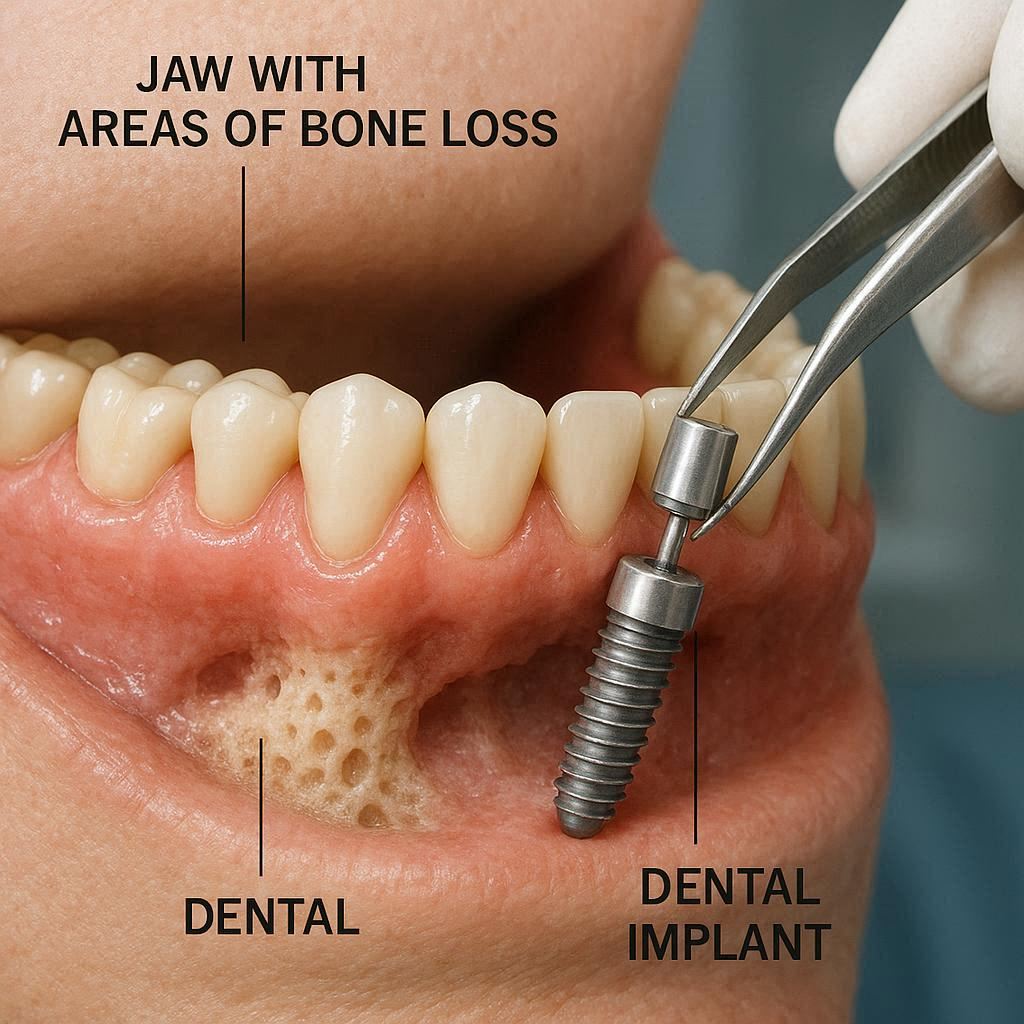
Why Bone Loss Happens in the First Place
Before we talk about solutions, let us quickly understand why your jawbone is disappearing. This is not just technical information—it helps you see that you are not alone.
Your jawbone needs stimulation. Every time your natural teeth touch, they send a small shock through the root into the bone. This signal tells your body: “Keep this bone strong.”
When you lose a tooth, that stimulation stops. The body thinks: “I do not need this bone anymore.” So it starts to resorb the bone—essentially recycling the minerals for other uses.
Common Causes of Jawbone Loss
- Tooth extraction without replacement – Even waiting six months after an extraction can cause noticeable bone shrinkage.
- Periodontal (gum) disease – Chronic infection eats away at both gum tissue and the underlying bone.
- Trauma or injury – A broken jaw or lost tooth from an accident can damage bone structure.
- Dentures – Traditional dentures rest on the gums but do not stimulate the bone. Over years, the bone under dentures melts away.
- Osteoporosis – Systemic bone loss can affect your jaw just like your hips or spine.
- Infection or abscess – Long-term tooth infections can destroy surrounding bone.
The result? You look in the mirror and see a sunken jawline, drifting teeth, or dentures that no longer fit. But here is the good news: bone loss is treatable, not hopeless.
Can You Really Get Dental Implants with Bone Loss? The Short Answer
Let me give you a direct, honest answer.
Yes, you can. But the technique changes depending on how much bone you have lost.
| Level of Bone Loss | Can You Get Implants? | Typical Solution |
|---|---|---|
| Mild (less than 30% loss) | Yes, easily | Standard implants, possibly with a small bone graft at the time of placement |
| Moderate (30% to 60% loss) | Yes | Bone grafting procedure, then wait 4-9 months, then implants |
| Severe (over 60% loss) | Yes, but complex | Zygomatic implants, pterygoid implants, or advanced grafting (block graft, sinus lift) |
| Extreme (almost no bone) | Yes, but rare | Customized subperiosteal implants or zygomatic implants with no grafting |
I want to be clear: No one should tell you that you need dentures just because you have bone loss. That is outdated thinking. Modern implant dentistry has solutions for almost every case.
“I have placed thousands of implants in patients who were told they had ‘no bone.’ The key is matching the right technique to the right patient.” — Dr. Michael Norton, Implant Surgeon
How Much Bone Is Actually Needed for an Implant?
Let us get practical. A standard dental implant is about 3.5 to 4.5 millimeters wide and 10 to 12 millimeters long. To hold this implant safely, you need:
- Height: At least 10 mm of vertical bone (from the top of the ridge down to the nerve canal or sinus)
- Width: At least 5 to 6 mm of horizontal bone (from cheek side to tongue side)
- Quality: Dense enough bone that does not crumble during drilling
If you have less than that, you have two choices:
- Add bone (grafting)
- Use longer or angled implants that anchor in stronger bone elsewhere
Think of it like building a fence. If the soil is shallow, you can either bring in more soil (graft) or use a longer post that reaches deeper, firmer ground (special implants).
Option 1: Bone Grafting – The Most Common Solution
This is the gold standard for most people with moderate bone loss. A bone graft sounds scary, but in reality, it is a routine procedure. Dental surgeons perform hundreds of thousands of these every year.
What Is a Bone Graft?
A bone graft is simply adding bone material to your jaw to create a solid foundation for an implant. The material can come from:
- Your own body (usually from your chin, lower jaw, or shin bone) – This is called an autograft.
- A human donor (processed, safe, and sterile) – Allograft.
- An animal source (usually cow bone) – Xenograft.
- Synthetic material (lab-made bone-like minerals) – Alloplast.
Most dentists today use a mix of synthetic and human donor bone. This avoids a second surgical site on your body.
Types of Bone Grafts for Implants
| Graft Type | What It Does | Healing Time |
|---|---|---|
| Socket graft | Placed immediately after tooth extraction to preserve the socket | 4-6 months |
| Ridge preservation | Maintains the shape and width of the jaw ridge | 4-6 months |
| Block graft | A solid piece of bone screwed onto the jaw to add major volume | 6-9 months |
| Sinus lift | Lifts the sinus membrane and adds bone to the upper back jaw | 6-12 months |
| Particulate graft | Loose bone granules packed into a defect area | 4-6 months |
Does a Bone Graft Hurt?
Here is an honest answer: the day after surgery, you will feel soreness. It is not sharp pain—more like a deep bruise. Most patients compare it to having a tooth extracted. Over-the-counter pain medication (ibuprofen or acetaminophen) controls it well for 90% of people.
The actual procedure is painless because you receive local anesthesia. Some surgeons also offer sedation if you feel anxious.
Success Rates of Bone Grafting
- Small grafts (socket grafts): over 95% success
- Moderate grafts (ridge preservation): 90-95% success
- Large block grafts: 85-90% success
If a graft fails (rare), you simply try again with a different material or technique. Failure usually means the body rejected the material or an infection developed.
The Waiting Period – Be Patient
This is the part most people hate. After a bone graft, you cannot place the implant immediately. You have to wait for the graft to turn into living bone.
- Small graft: 4 months
- Medium graft: 6 months
- Large block graft or sinus lift: 8 to 12 months
Yes, that is a long time. But think of it this way: you are building a foundation for a tooth that could last 30 years or more. A few months of waiting is a small price.
Option 2: Zygomatic Implants – For Severe Upper Jaw Bone Loss
If you have almost no bone in your upper jaw, zygomatic implants change the game entirely.
Instead of anchoring in the jawbone, these implants are much longer (30 to 55 millimeters). They pass through the upper jaw and anchor into the zygomatic bone – your cheekbone. The cheekbone is very dense and almost never affected by bone loss.
Who Needs Zygomatic Implants?
- People who have been told they need a sinus lift with a massive bone graft (often two surgeries over 12-18 months)
- Patients with failed sinus grafts
- Those with defects from tumor removal or trauma
- People who do not want to wait a year for grafting
How Zygomatic Implants Work
A skilled surgeon places between two and four zygomatic implants per side. These implants support a fixed bridge of teeth. The entire procedure is often done in one surgery, and you walk out with temporary teeth that day.
Important note: Not every implant dentist places zygomatic implants. You need a specialist—usually a maxillofacial surgeon or a highly trained periodontist. This is advanced surgery.
Pros and Cons of Zygomatic Implants
| Pros | Cons |
|---|---|
| No bone grafting needed | More expensive (often $5,000-$7,000 per implant) |
| Immediate teeth possible | Requires a very experienced surgeon |
| Very high success rate (95%+) | Recovery can be longer (sinus issues, cheek swelling) |
| Avoids sinus lift surgery | Not available in every dental clinic |
*“Zygomatic implants are the single greatest advancement for severe upper jaw bone loss in the last 20 years. They turn a 12-month grafting ordeal into a 2-hour surgery.”* — Dr. Edmond Bedrossian, Zygomatic Implant Pioneer
Option 3: Pterygoid and Nasal Implants
These are less common but useful for specific situations. They are like shorter cousins of zygomatic implants.
- Pterygoid implants – Anchor into the pterygoid plate (a bone behind your upper jaw). They work well for the very back of the mouth where the sinus is large.
- Nasal implants – Anchor into the floor of the nasal cavity. Used for front teeth when the upper jaw is thin.
Most patients do not need these. But if your bone loss is patchy, your surgeon might combine one pterygoid implant with standard implants.
Option 4: Short Implants (6mm or Less)
Here is a simpler solution for mild to moderate bone loss: use shorter implants.
A standard implant is 10-12mm long. But you can buy implants as short as 4mm or 5mm. These require less vertical bone height.
Advantages of Short Implants
- No sinus lift or nerve repositioning needed
- One surgery (instead of graft + implant)
- Faster healing (2-3 months instead of 6-12)
- Lower cost
Are Short Implants as Strong?
This was debated for years, but recent studies are clear. Short implants (6mm) have the same success rate as standard implants (10mm+) when placed in good quality bone. The key is bone density, not just height.
A 2020 review in the Journal of Clinical Periodontology looked at over 1,500 short implants. The 5-year survival rate was 96.7% – equal to longer implants.
Limitations of Short Implants
They do not solve wide bone loss. If your jaw is also narrow (less than 5mm wide), short implants still need bone grafting for width. They also cannot be used if you have very soft, poor-quality bone.
Option 5: Mini Implants – A Temporary Solution
Mini implants are much thinner (1.8mm to 2.4mm wide) and shorter. They require very little bone. You sometimes see them used for:
- Stabilizing lower dentures
- Replacing small front teeth
- Temporary implants while waiting for grafting
Honest warning: Mini implants are not ideal for permanent, full-function teeth. They break more often than standard implants. Most experienced implant dentists use them only as a temporary or low-budget solution.
If you have bone loss, do not settle for mini implants when grafting or zygomatic implants can give you a real, long-term solution.
Step-by-Step: What Happens When You Get Implants with Bone Loss
Let me walk you through the entire journey. This removes the fear of the unknown.
Step 1: Comprehensive Exam (1-2 hours)
You will get:
- CBCT scan (3D x-ray) – This is essential. A regular x-ray cannot show bone width or quality. The CBCT gives your surgeon a 3D map of your jaw.
- Periodontal evaluation – Checking for active gum disease. Active infection must be treated first.
- Medical history review – Conditions like uncontrolled diabetes or heavy smoking affect bone healing.
Step 2: Treatment Planning
Your surgeon shows you the CBCT images and explains:
- How much bone you actually have (often more than you think)
- Which option fits your case (graft, zygomatic, short implant, etc.)
- Timeline (surgery to final teeth)
- Total cost
Do not skip this step. A proper plan prevents surprises.
Step 3: Preparatory Work (If Needed)
Before grafting or implants, you might need:
- Gum disease treatment – Deep cleaning, antibiotics, or minor gum surgery.
- Tooth extractions – Removing hopeless teeth.
- Sinus or nerve assessment – Especially for lower jaw implants near the inferior alveolar nerve.
Step 4: Bone Grafting or Implant Placement
- Graft first, then implants: You have graft surgery. Wait 4-9 months. Then implant surgery.
- Immediate implants (with small graft): If bone loss is mild, the surgeon places the implant and packs a small graft around it in one visit.
- Zygomatic implants: One surgery, no waiting for graft to heal.
Step 5: Healing and Osseointegration
After implant placement, you wait for osseointegration – the bone growing tightly around the implant surface.
- Standard implants: 3-6 months
- Short implants: 2-3 months
- Zygomatic implants: 3-4 months
During this time, you wear a temporary denture, bridge, or nothing at all (if the implant is hidden under gum).
Step 6: Abutment and Crown
Once the implant is solidly fused to bone:
- A small connector (abutment) is screwed into the implant.
- A custom-made crown (tooth) is cemented or screwed onto the abutment.
From start to finish, the entire process takes:
- Simple case (mild loss): 4 to 6 months
- Moderate loss with grafting: 8 to 12 months
- Severe loss with zygomatic implants: 3 to 5 months (no grafting waiting time)
Realistic Success Rates for Implants with Bone Loss
Let me give you numbers you can trust. These come from peer-reviewed dental literature.
| Situation | 5-Year Success Rate | 10-Year Success Rate |
|---|---|---|
| Standard implant in healthy bone | 97-98% | 94-96% |
| Implant with small bone graft | 95-97% | 92-94% |
| Implant with large block graft | 90-93% | 85-90% |
| Short implant (6mm) | 95-97% | 90-93% |
| Zygomatic implant | 95-96% | 93-95% |
| Mini implant | 80-85% | 70-75% |
What does “failure” mean? It usually means the implant becomes loose or infected and must be removed. Most failures happen in the first year. After year one, successful implants tend to stay successful.
Factors That Increase Your Risk of Failure
I will be honest with you. Even with the best surgeon, some people have higher risks.
Smoking
Nicotine constricts blood vessels. Less blood flow means less oxygen for healing bone. Smokers have twice the failure rate of non-smokers for bone grafts and implants.
- Light smoker (under 10/day): Moderate risk
- Heavy smoker (20+/day): High risk
What you can do: Stop smoking 2 weeks before surgery and 2 months after. Even cutting down helps.
Uncontrolled Diabetes
High blood sugar impairs healing and increases infection risk. If your HbA1c is above 8%, most ethical surgeons will postpone implants until you achieve better control.
Gum Disease (Peri-implantitis)
This is the #1 cause of late implant failure. The same bacteria that destroyed your natural bone can attack the bone around an implant. You must commit to excellent home care and regular cleanings (every 3-6 months).
Medications (Bisphosphonates)
Drugs like Fosamax, Actonel, or Boniva (for osteoporosis) can cause a rare but serious complication called medication-related osteonecrosis of the jaw (MRONJ) – where the jawbone fails to heal and dies.
- Oral bisphosphonates (pills): Low risk if taken less than 4 years
- IV bisphosphonates (cancer treatment): High risk – implants are usually avoided
Always tell your dentist about every medication you take.
Poor Oral Hygiene
Implants do not decay, but they can get infected. The gum attachment around an implant is weaker than around a natural tooth. Plaque buildup leads to inflammation, then bone loss. This is 100% preventable with good brushing and flossing.
Cost Breakdown: What Will You Pay?
Let us talk money. This varies widely by location and dentist, but here are realistic US ranges (without insurance).
| Procedure | Typical Cost (USD) |
|---|---|
| Single implant (crown + abutment + implant) | $3,000 – $6,000 |
| Bone graft (small, one site) | $500 – $1,500 |
| Bone graft (large block graft) | $2,000 – $4,000 |
| Sinus lift | $1,500 – $3,000 |
| Zygomatic implant (per implant) | $5,000 – $7,500 |
| Full upper arch with zygomatic implants (4 implants + fixed bridge) | $25,000 – $35,000 |
| Full upper arch with grafting + standard implants | $20,000 – $30,000 |
Does dental insurance help? Usually very little. Most plans cap implant coverage at $1,000-$1,500 per year. However, some cover the bone graft if coded as “medically necessary.” Always ask for a pre-treatment estimate.
Financing options:
- CareCredit (medical credit card)
- Lending Club or Prosper Healthcare
- In-house payment plans (some dental offices)
- Dental schools (30-50% lower cost)
Frequently Asked Questions (FAQ)
1. Can bone loss grow back on its own?
No. Once jawbone is lost, it never regenerates without a surgical bone graft. No pill, supplement, or laser can grow back significant bone. Do not waste money on unproven “bone regeneration” gadgets.
2. How long after tooth extraction can I still get an implant?
You have a window. Within 6 months of extraction, bone loss is usually mild, and you may not need a graft. After 1-2 years, moderate grafting is often required. After 5+ years, you are looking at advanced grafting or zygomatic implants. But even 20 years later, you can still get implants – it just takes more work.
3. Are dental implants painful with bone loss?
The pain level is the same as for people with healthy bone. You receive anesthesia. The only difference is that grafting adds a second surgery (and second recovery). Most patients rate the discomfort as 3-5 out of 10 for a few days.
4. Can I get all-on-4 implants with bone loss?
Yes. The All-on-4 technique was specifically designed for bone loss. It uses two straight implants in the front (where bone is usually good) and two angled implants in the back to avoid sinus or nerve areas. Many patients with moderate bone loss qualify for All-on-4 without separate grafting.
5. What happens if an implant fails because of bone loss?
The surgeon removes the loose implant (a quick, numbed procedure). You let the area heal for 2-3 months. Then you try again with a different approach – often a larger graft, a different implant type, or zygomatic implants. Failure is not the end. It is just a detour.
6. Is there an age limit for implants with bone loss?
No. Healthy 80 and 90-year-olds get implants successfully. Age is not a factor. Your general health and bone healing ability matter more. As long as you are well enough for a simple oral surgery, you can have implants.
7. Can I use my own bone from my hip for grafting?
Yes, but it is rarely done today. Hip bone grafting requires a second surgical team, general anesthesia, and a painful recovery (often worse than the jaw surgery). Most surgeons prefer donor bone or synthetic materials because they work just as well without the extra pain.
8. Do I need to see a specialist or can a general dentist do this?
For simple cases with mild bone loss, a skilled general dentist who does implants regularly is fine. But for moderate to severe bone loss, you want a specialist:
- Oral and maxillofacial surgeon (best for zygomatic and large block grafts)
- Periodontist (gum and bone specialist)
- Prosthodontist (advanced restorative dentist)
Ask: “How many grafting or zygomatic implant cases do you do per year?” You want someone who does at least 50-100 per year.
Additional Resource: Where to Learn More
For the most current, unbiased information on dental implants and bone loss, visit the American Academy of Implant Dentistry (AAID) :
👉 www.aaid.com/patient-resources
This site offers:
- A “Find an Implant Dentist” search tool
- Patient education videos showing grafting procedures
- Cost comparison guides by region
- Questions to ask your surgeon
Final Checklist: Are You a Candidate?
Before you book a consultation, ask yourself these questions:
- ✅ Do I have any uncontrolled medical conditions (diabetes, autoimmune disease)?
- ✅ Do I smoke? (If yes, are you willing to stop temporarily?)
- ✅ Do I have active gum disease with bleeding gums?
- ✅ Am I willing to wait 4-12 months for the complete process?
- ✅ Can I afford the treatment ($4,000 to $35,000 depending on complexity)?
- ✅ Do I have a support person to drive me home after sedation?
If you answered “yes” to the first three, fix those issues first. If you answered “yes” to the last three, you are ready to move forward.
Conclusion
Yes, you can get dental implants with bone loss. Modern solutions like bone grafting, short implants, and zygomatic implants make implant placement possible for almost everyone—even those with severe jawbone loss. The key is an honest evaluation, the right specialist, and realistic expectations about healing time and cost.