What Does DX Mean in Dentistry?
You are sitting in the dental chair. The hygienist points to a screen full of letters and numbers. Suddenly, you hear the dentist say something like, “We need to look at the DX before we proceed.”
You nod politely, but inside you are thinking: What does DX mean in dentistry?
Do not worry. You are not alone.
Dentists, like all medical professionals, use shorthand. They write fast. They talk fast. And sometimes, they forget that patients do not speak “chart language.”
This guide is here to fix that.
We will break down the meaning of DX in a simple, friendly way. No complicated textbooks. No boring lectures. Just clear answers.
By the end of this article, you will understand exactly what your dentist is saying. You will feel more confident. And you might even impress your dentist with your knowledge.
The Simple Answer: DX Stands for “Diagnosis”
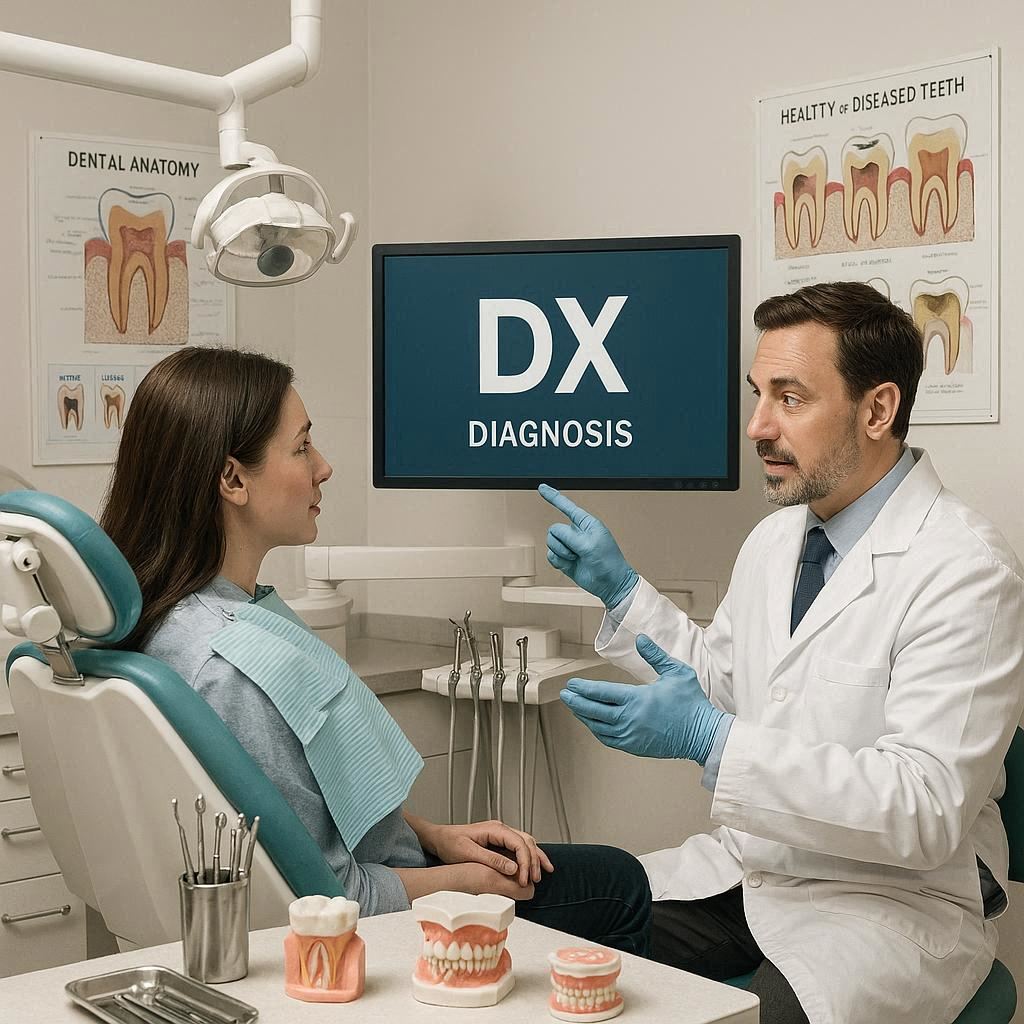
In dentistry, DX is the standard abbreviation for diagnosis.
It comes from medical shorthand. Doctors and dentists use it to save time when writing notes, prescriptions, and treatment plans.
So, when a dentist writes “DX” next to a tooth number, they mean: This is the diagnosis for that tooth.
For example:
- Tooth #19 – DX: Dental caries (cavity)
- Tooth #7 – DX: Fracture
- Tooth #30 – DX: Periapical abscess
The diagnosis is the conclusion. It is the answer to the question: What is wrong here?
Without a diagnosis, there is no treatment. The DX is the starting point for everything your dentist does next.
Why Dentists Use DX Instead of Writing “Diagnosis”
You might wonder: Why not just write the full word?
There are three main reasons.
1. Speed
Dentists write dozens of patient notes every day. Abbreviations like DX save seconds per entry. Over a week, that adds up to hours of saved time.
2. Space
Dental charts are small. There is limited room for writing. A short “DX” fits neatly next to a tooth diagram. The full word “diagnosis” takes up too much space.
3. Medical Tradition
The abbreviation DX has been used in medicine for over a century. It is part of a larger system that includes:
- RX (prescription)
- HX (history)
- SX (symptoms)
- FX (fracture)
Dentists learn this system in school. It becomes second nature.
Important note for readers: Do not feel bad if you did not know this. Medical abbreviations are not taught in regular schools. Dentists learn them as a separate language.
How DX Fits Into Your Dental Visit
To understand DX fully, you need to see where it appears in your dental journey.
Here is a simple breakdown of the typical patient workflow:
| Step | What Happens | Where DX Appears |
|---|---|---|
| 1 | You arrive with a complaint (tooth pain, broken tooth, etc.) | Not yet |
| 2 | Dentist asks questions (history / HX) | No |
| 3 | Dentist examines you (looks, probes, taps) | No |
| 4 | Dentist takes X-rays | No |
| 5 | Dentist reviews all information | DX is made here |
| 6 | Dentist explains the problem to you | You hear the diagnosis |
| 7 | Dentist writes DX in your chart | Yes |
| 8 | Treatment plan is created based on DX | Yes |
The DX is the turning point. It changes the visit from “we are looking” to “we know.”
Common Dental Diagnoses (DX) You Might See
Dentists use specific terms for their diagnoses. Some are simple. Others sound scary.
Here are the most common DX entries you will find in a dental chart.
Cavities (Dental Caries)
- DX: Dental caries
- What it means: Decay has damaged the tooth structure.
- Common locations: Pits, fissures, between teeth, or under old fillings.
Cracked Tooth Syndrome
- DX: Incomplete fracture
- What it means: A crack in the tooth that does not yet separate it into pieces.
- Symptom: Pain when biting down and releasing.
Abscess
- DX: Periapical abscess
- What it means: An infection at the tip of the tooth root.
- Symptom: Swelling, throbbing pain, possible fever.
Gum Disease
- DX: Periodontitis or gingivitis
- What it means: Inflammation and infection of the gums and bone.
- Stages: Mild, moderate, severe.
Bruxism
- DX: Bruxism
- What it means: Grinding or clenching teeth, usually at night.
- Signs: Worn teeth, jaw pain, headaches.
Dry Mouth
- DX: Xerostomia
- What it means: Reduced saliva production.
- Causes: Medications, aging, or medical conditions.
Here is a quick reference list of other common DX abbreviations you might see:
- DX caries – cavity
- DX Fx – fracture
- DX perio – gum disease
- DX mal – malocclusion (bad bite)
- DX abcess – infection
- DX sens – dentin hypersensitivity
- DX erup – eruption problem (tooth not coming in correctly)
The Difference Between DX and Other Dental Abbreviations
Patients often confuse DX with other short forms. Let us clear that up.
| Abbreviation | Meaning | Used For |
|---|---|---|
| DX | Diagnosis | Identifying the problem |
| RX | Prescription | Medications or treatment orders |
| HX | History | Past illnesses, surgeries, allergies |
| TX | Treatment | The procedure plan (filling, crown, etc.) |
| FX | Fracture | A cracked or broken tooth |
| SX | Symptoms | What the patient feels (pain, swelling) |
Think of it like a story:
- HX = What happened before
- SX = What you feel now
- DX = What the dentist finds
- TX = What the dentist does
- RX = What medicine you take
Each abbreviation has a job. None of them work alone.
Important note for readers: If you see “TX plan” on your paperwork, that means “treatment plan.” It is based entirely on the DX.
How Dentists Arrive at a DX (Step by Step)
A good diagnosis is not a guess. It is a conclusion based on evidence.
Dentists follow a process. It is similar to a detective solving a case.
Step 1: Listen to the Patient (Subjective Information)
You tell the dentist what you feel.
- Where does it hurt?
- When did it start?
- Does hot or cold make it worse?
Step 2: Perform a Clinical Exam (Objective Information)
The dentist looks, feels, and tests.
- Visual inspection (looking for cracks, decay, swelling)
- Periodontal probing (measuring gum pockets)
- Percussion (tapping on teeth)
- Cold test (applying a cold stimulus to check nerve health)
Step 3: Take X-rays (Radiographic Information)
X-rays show what the eyes cannot see.
- Cavities between teeth
- Infections at the root tip
- Bone loss from gum disease
- Impacted teeth
Step 4: Compare Findings
The dentist puts everything together.
- Symptom + Exam + X-ray = DX
Step 5: Write the DX in the Chart
The dentist records the diagnosis using standard terminology.
Step 6: Explain the DX to You
You hear the diagnosis in plain language. This is your chance to ask questions.
Real-Life Examples of DX in Action
Let us walk through three common scenarios. Each one shows how DX guides the treatment.
Example 1: The Tooth That Hurts When You Bite
Your complaint: Pain when chewing on the left side.
Exam: Dentist taps tooth #19. You feel a sharp pain.
X-ray: Shows a dark shadow around the root tip.
DX: Periapical abscess (tooth #19)
Treatment based on DX: Root canal therapy or extraction.
Example 2: The Sensitive Tooth
Your complaint: Cold drinks make tooth #8 ache for a few seconds.
Exam: No visible crack or cavity.
X-ray: Normal, no decay.
Cold test: Pain goes away within 5 seconds.
DX: Reversible pulpitis (early nerve irritation)
Treatment based on DX: Desensitizing toothpaste, fluoride varnish, monitor.
Example 3: Bleeding Gums
Your complaint: Gums bleed when you brush.
Exam: Gums are red, swollen, and bleed easily on probing. Pocket depths are 4-5mm.
X-ray: Mild bone loss visible.
DX: Moderate chronic periodontitis
Treatment based on DX: Deep cleaning (scaling and root planing), improved home care, follow-up visits.
Notice how the DX changes everything. Without it, the dentist would not know whether to do a filling, a root canal, or a cleaning.
Why an Accurate DX Matters for Your Health
A wrong diagnosis leads to wrong treatment.
That sounds obvious, but it happens more often than you think.
If a dentist misdiagnoses a cracked tooth as a cavity, they might place a filling. The crack remains. The pain continues. You waste time and money.
If a dentist misdiagnoses gum disease as sensitive teeth, you might use special toothpaste while the bone loss gets worse.
An accurate DX protects you from:
- Unnecessary procedures
- Delayed treatment
- Worsening conditions
- Higher costs down the road
That is why good dentists take their time with the diagnosis. They do not rush. They test, re-test, and confirm before writing anything down.
Quote from a practicing dentist: “I tell my patients all the time: I would rather spend 20 minutes getting the DX right than 2 minutes guessing and causing problems later. The diagnosis is the most important thing I do all day.”
How You Can Help Your Dentist Make a Better DX
You are not a dentist. But you play a big role in the diagnosis.
The more accurate information you give, the better the DX will be.
Here is a simple checklist for your next visit:
Before the appointment, write down:
- When did the problem start? (Date or approximate time)
- What makes it worse? (Hot, cold, sweet, biting, pressure)
- What makes it better? (Painkillers, cold compress, nothing)
- Does the pain wake you up at night?
- Have you had treatment on this tooth before? (Filling, crown, root canal)
- Are you taking any medications? (List them)
During the appointment:
- Be honest about your pain level (use a scale of 1 to 10)
- Point exactly to the tooth if you can
- Tell the dentist if something changes during the exam (like a new sharp pain)
After the DX is explained:
- Repeat it back in your own words to confirm understanding
- Ask: “What happens if we do nothing?”
- Ask: “Are there other possible diagnoses?”
The last question is powerful. It reminds the dentist to consider alternatives.
What If You See a DX You Do Not Understand?
Sometimes patients look at their dental records and see a diagnosis written in complex language.
For example: “Generalized moderate chronic periodontitis with localized vertical bone loss on tooth #3.”
That sounds overwhelming. But it is just a very specific description.
Here is how to decode any dental DX:
- Find the tooth number (or area)
- Look for the main condition (caries, fracture, abscess, periodontitis)
- Look for descriptive words (mild, moderate, severe, chronic, acute, localized, generalized)
If you still do not understand, do this:
Ask your dentist directly. Say: “Can you explain my DX in plain English, please?”
A good dentist will be happy to do this. They want you to understand your own health.
Important note for readers: You have a legal right to understand your medical records. Never feel embarrassed about asking for clarification.
Digital Dentistry and the Future of DX
Technology is changing how dentists make diagnoses.
Today, many offices use digital tools that make DX faster and more accurate.
Digital X-rays
- Instant images
- Lower radiation
- Zoom and contrast enhancement for better visibility
Intraoral Cameras
- Tiny video cameras on a wand
- You see exactly what the dentist sees on a screen
- Great for showing you the cavity or crack
Caries Detection Devices
- DIAGNOdent (laser fluorescence)
- Detects early decay that X-rays might miss
- Helps confirm a DX of early caries
CBCT (Cone Beam CT)
- 3D X-ray imaging
- Used for complex DX like root fractures, impacted teeth, and jaw infections
- Much more detailed than regular X-rays
AI-Assisted Diagnosis
- Artificial intelligence software analyzes X-rays
- Flags suspicious areas for the dentist to review
- Still a tool, not a replacement for human judgment
These tools do not replace the dentist. They support the dentist. The final DX is always made by a human professional.
The Difference Between a Provisional DX and a Final DX
Dentists sometimes use two types of diagnosis.
Provisional DX (Working Diagnosis)
- Made early in the appointment
- Based on limited information
- May change after more tests or X-rays
- Example: “Provisional DX of cracked tooth – need X-ray to confirm”
Final DX (Definitive Diagnosis)
- Made after all tests are complete
- Confirmed with evidence
- Used to create the final treatment plan
- Example: “Final DX – vertical root fracture, tooth #19. Not restorable. Extraction recommended.”
Do not be alarmed if a dentist gives you a provisional DX that changes later. That is normal. It means they are being thorough.
Common Mistakes Patients Make About DX
Let us clear up a few misunderstandings.
Mistake #1: Thinking DX is a treatment.
No. DX is the problem. TX is the solution. They are different steps.
Mistake #2: Assuming one symptom equals one DX.
Tooth pain can come from a cavity, a crack, gum disease, a sinus infection, or a clenching habit. The same symptom can have many possible DX.
Mistake #3: Googling a DX and panicking.
Online information is often worst-case. A DX of “periodontitis” sounds scary, but most cases are mild and treatable. Trust your dentist, not Dr. Google.
Mistake #4: Hiding information from the dentist.
If you lie about your symptoms or history, the DX will be wrong. That leads to wrong treatment. Always be honest.
Frequently Asked Questions (FAQ)
1. Is DX only used for problems, not healthy teeth?
Yes, typically. If a tooth is healthy, the dentist might write “WNL” (within normal limits) or leave it blank. DX is reserved for conditions that need attention.
2. Can I see my DX in my patient portal?
Yes. In most modern dental offices, your diagnosis is recorded in your electronic health record. You can request a copy or view it online if your office offers a patient portal.
3. Does my insurance require a DX?
Absolutely. Dental insurance companies will not pay for treatment without a diagnosis code. Every procedure claim must include a corresponding DX code (often using the ICD-10 system).
4. What is an ICD-10 code?
ICD-10 is the international classification of diseases. Dentists convert their DX into a standard code for insurance billing. For example: K02.51 = dental caries on smooth surface of tooth.
5. Can two dentists give different DX for the same tooth?
Yes. Dentistry involves clinical judgment. One dentist might diagnose a deep cavity. Another might diagnose a crack. That is why second opinions are valuable.
6. How do I get a second opinion on a DX?
Request your X-rays and records from the first dentist. Take them to another dentist for a fresh exam. Do not tell the second dentist the first diagnosis until after they give their own opinion.
7. What if I disagree with my dentist’s DX?
Ask questions. Request additional tests. Seek a second opinion. You are the boss of your own body. A good dentist will respect your questions.
8. Is DX used in pediatric dentistry the same way?
Yes. Pediatric dentists use the same abbreviation. Common pediatric DX include early childhood caries, eruption cysts, and tooth trauma.
9. Does a DX expire?
Some do. A diagnosis of a small cavity might change if you get fluoride treatment and the cavity reverses. A diagnosis of a cracked tooth is permanent. Your dentist will update your DX at each visit.
10. What should I do if my dentist does not explain my DX?
Speak up. Say: “I would like to understand my diagnosis better. Can you walk me through it?” If they refuse or seem annoyed, consider finding a new dentist.
A Handy Cheat Sheet for Your Next Visit
Print this section or save it on your phone. Use it when you go to the dentist.
When the dentist says “DX,” think: “What is the problem?”
| If you hear… | It means… |
|---|---|
| DX caries | Cavity |
| DX Fx | Cracked or broken tooth |
| DX perio | Gum disease |
| DX abscess | Infection |
| DX bruxism | Grinding |
| DX xerostomia | Dry mouth |
| DX malocclusion | Bad bite |
| DX pulpitis | Nerve inflammation |
Questions to ask after receiving a DX:
- What caused this?
- What happens if we wait?
- What are my treatment options?
- What is the cost of each option?
- How can I prevent this from happening again?
Why Understanding DX Makes You a Better Patient
Knowledge changes behavior.
When you understand what DX means, you stop being a passive passenger. You become an active partner in your dental care.
You will:
- Ask better questions
- Remember your dentist’s advice
- Follow through with treatment
- Feel less anxious about dental visits
Dentistry is not magic. It is science. And science works best when everyone understands the facts.
The next time your dentist says “DX,” you will smile. Not because the news is good. But because you finally understand what they are saying.
Additional Resources
For readers who want to go deeper, here is a trusted external resource:
🔗 American Dental Association (ADA) – Glossary of Dental Terms
Visit the ADA’s official website and search for “Glossary of Dental Clinical Terms.” This free resource defines hundreds of dental terms, including all common diagnoses.
Note: The ADA updates their glossary regularly. It is one of the most reliable sources for dental terminology online.
Conclusion
DX in dentistry simply means diagnosis. It is the step where your dentist identifies what is wrong with your tooth or gum. Without a clear DX, there is no safe or effective treatment plan. Understanding this abbreviation helps you communicate better with your dentist and take control of your oral health.