Dental Diagnosis Code for Bruxism
If you are a dental professional, you already know that grinding your teeth is one thing—but getting paid for treating it is another. The difference often comes down to a single, correct code.
Bruxism is a common condition. Patients clench or grind their teeth, often while sleeping. But when you sit down to submit a claim, the question always appears: What is the correct dental diagnosis code for bruxism?
The answer is not always as straightforward as you might hope. You have medical codes, dental codes, and a gray area in between.
This guide walks you through everything you need to know. We will cover the specific alphanumeric codes, when to use each one, and how to avoid claim denials. You will also learn how to document bruxism properly so your diagnosis holds up under scrutiny.
Let us start with the most important question first.
What Is the Main Dental Diagnosis Code for Bruxism?
In the dental world, most practices use the Current Dental Terminology (CDT) codes for procedures. However, for diagnosis, dentists often rely on the International Classification of Diseases, Tenth Revision (ICD-10) codes.
There is no standalone “CDT diagnosis code” for bruxism. Instead, you report the condition using the appropriate ICD-10-CM code on the claim form (typically the ADA 2022 or 2023 claim form).
The primary ICD-10 code for bruxism is:
G47.63 – Sleep related bruxism
This code falls under the category of sleep-related movement disorders. It is the most specific and widely accepted code for nocturnal teeth grinding.
If your patient grinds or clenches during waking hours, you use a different code:
F45.8 – Other somatoform disorders (often used for awake bruxism, though some providers use R45.89 for other psychological symptoms associated with clenching).
Wait—why is a dental issue using a “G” code (neurology) and an “F” code (psychiatry)? That is a great question. Let us clarify.
Understanding the Difference: Dental vs. Medical Coding for Bruxism
Many dentists feel frustrated here. You treat the teeth, but the diagnosis code for bruxism lives in the medical classification system.
| Code Type | Example Code | Used For |
|---|---|---|
| CDT (Dental) | D9940 (occlusal guard) | Procedure (the nightguard) |
| ICD-10 (Medical) | G47.63 (sleep bruxism) | Diagnosis (why you made the guard) |
You pair a dental procedure code (like D9940) with a medical diagnosis code (like G47.63) on the same claim form, especially when billing medical insurance for bruxism-related appliances.
Key point: Most dental insurances do not require a specific diagnosis code for basic procedures. But medical insurance always does. If you want to bill a patient’s health plan for a nightguard (often covered under medical policies for sleep bruxism), you must use G47.63 or F45.8.
Important Note for Readers: Do not assume your medical insurance covers bruxism treatment. Many policies exclude “dental conditions” or “TMJ disorders.” Always verify benefits before beginning treatment. We cover this more later.
Complete List of ICD-10 Codes Related to Bruxism
You may need different codes depending on the clinical situation. Here is the full table of relevant codes.
| ICD-10 Code | Description | Clinical Context |
|---|---|---|
| G47.63 | Sleep related bruxism | Nocturnal grinding, confirmed by partner or sleep study |
| F45.8 | Other somatoform disorders | Awake bruxism with psychological component |
| G47.8 | Other sleep disorders | Bruxism not clearly meeting G47.63 criteria |
| R45.89 | Other psychological symptoms | Stress-related clenching without full disorder |
| K08.50 | Unspecified disorder of teeth | Attrition without a confirmed bruxism diagnosis |
| M26.69 | Other specified disorders of temporomandibular joint | Bruxism contributing to TMD |
Which one should you use most often?
For 90% of dental practices, the answer is G47.63 for nighttime grinding. Use F45.8 only when the patient is consciously clenching during the day without sleep involvement.
When to Avoid K08.50 (Unspecified tooth disorder)
Some dentists use K08.50 to describe “wear on teeth.” This is a mistake for two reasons:
- It does not specify the cause of the wear.
- Medical insurers will deny coverage for a nightguard because K08.50 sounds like routine dental wear, not a medical condition.
Always link the tooth damage to the underlying condition: bruxism.
How to Document Bruxism for Coding Purposes
Your diagnosis code is only as strong as your clinical notes. Insurance auditors look for three things.
1. Objective Evidence of Bruxism
Do not just write “patient grinds teeth.” Show it.
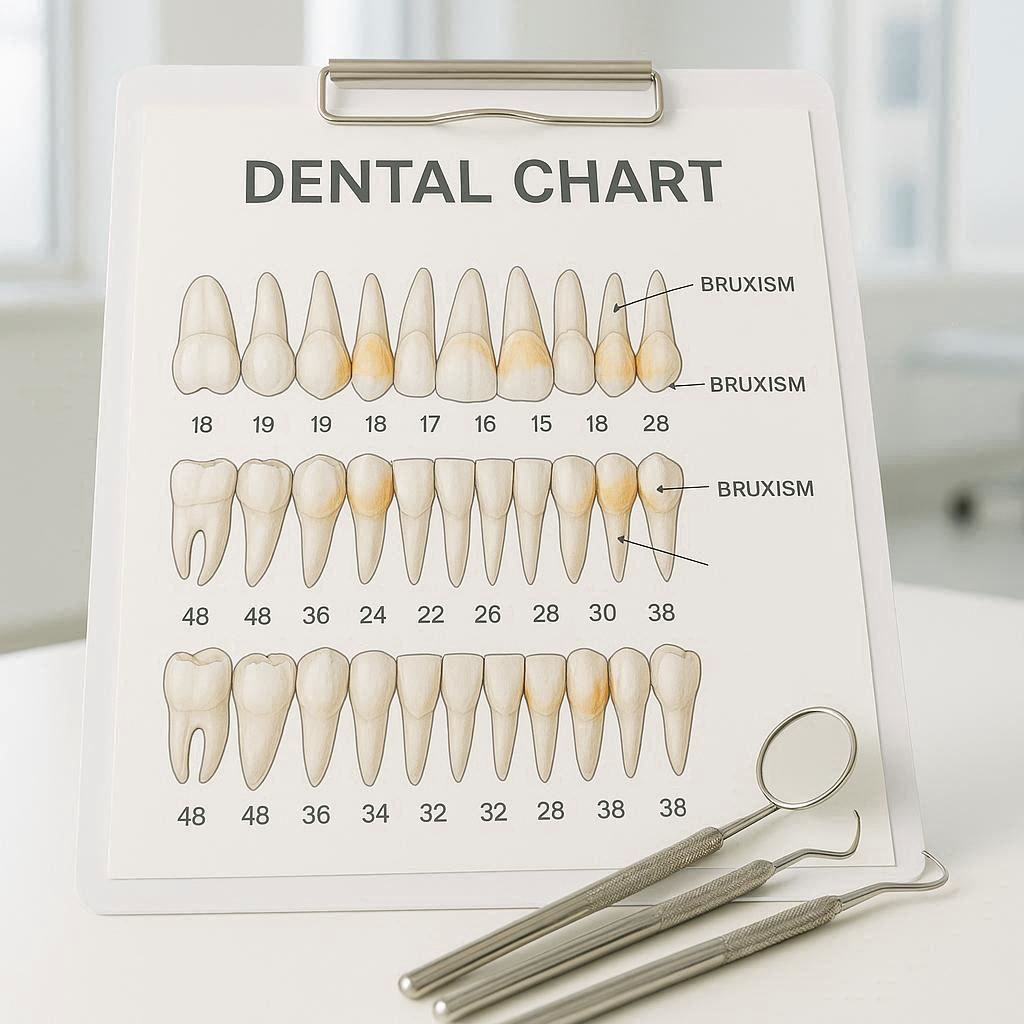
- Tooth wear patterns: Describe the facets. “Generalized attrition with exposed dentin on #8-11 and #23-26.”
- Muscle hypertrophy: Note palpable masseter bulk.
- Tongue indentations: Scalloped lateral borders.
- Fractured restorations: Repeated failure of crowns or fillings.
2. Patient-Reported Symptoms
Include direct quotes. For example:
“Patient reports waking with jaw soreness and headache three to four times per week. Spouse confirms loud grinding sounds during sleep.”
3. Ruling Out Other Causes
Bruxism is a diagnosis of exclusion. Note that you have ruled out:
- Sleep apnea (which can coexist or mimic bruxism)
- Dental malocclusion
- Medication-induced movements (SSRIs, amphetamines)
Documenting these exclusions protects you from denials and audits.
Billing Medical Insurance for Bruxism: A Step-by-Step Guide
You have the code (G47.63). Now how do you get paid?
Medical insurers cover bruxism treatment under specific circumstances. Follow this checklist.
Step 1: Verify Medical Necessity
The patient must have:
- Documented sleep bruxism (G47.63)
- Significant tooth damage or TMD symptoms
- Failure of conservative measures (soft diet, stress reduction)
Step 2: Use the Correct Claim Form
For medical billing, you use the CMS-1500 form, not the ADA dental claim form. Yes, even as a dentist.
You will need:
- Patient’s medical insurance card (not their dental card)
- Referring physician’s name (sometimes required)
- Diagnosis code G47.63 in block 21
- Procedure code (e.g., E0486 for an oral appliance for sleep bruxism)
Step 3: Submit a Prior Authorization
Do not assume coverage. Send a prior authorization request with:
- Sleep history questionnaire
- Clinical photos of tooth wear
- Letter of medical necessity (sample provided below)
Sample Medical Necessity Letter for Bruxism
Date: [Current date]
RE: [Patient name, DOB, insurance ID]
Diagnosis: G47.63 – Sleep related bruxism
Dear Medical Reviewer,
This patient presents with objectively documented nocturnal bruxism causing irreversible tooth structure loss, chronic myofascial pain, and disrupted sleep quality. Conservative measures including stress management and occlusal adjustment have failed to provide relief. A custom-fabricated oral appliance is medically necessary to prevent further dental destruction and reduce orofacial pain. Please authorize coverage under durable medical equipment (DME) benefits.
Sincerely,
[Your name, DDS]
Common Coding Mistakes Dentists Make (And How to Avoid Them)
Even experienced billers slip up. Here are the top three errors.
Mistake #1: Using Only a Dental Procedure Code Without a Diagnosis Code
Some dental claim forms leave the diagnosis field blank. That works for basic cleanings. For bruxism, you need the ICD-10 code on the claim. Without it, medical cross-coding is impossible.
Fix: Always populate Box 34 (Diagnosis Code) on the ADA 2023 claim form with G47.63.
Mistake #2: Using G47.63 for Awake Bruxism
Daytime clenching is not a sleep disorder. If you use G47.63 for a patient who only clenches while working at a computer, you are committing coding fraud.
Fix: Use F45.8 or R45.89 for awake bruxism.
Mistake #3: Forgetting the Sleep Study Requirement
Some medical policies require a polysomnography (sleep study) to confirm G47.63 before covering an appliance. If you skip this step, the claim will be denied.
Fix: Check the patient’s medical policy. If a sleep study is required, refer to a sleep medicine physician first.
Comparison Table: Bruxism Codes by Insurance Type
| Insurance Type | Preferred Code | Will They Pay for a Nightguard? |
|---|---|---|
| Dental PPO | G47.63 (for reference only) | Rarely – most exclude bruxism appliances |
| Dental HMO | Not required | No – capitation plans exclude D9940 |
| Medical PPO | G47.63 + prior auth | Yes – if medically necessary and policy allows |
| Medicare (Part B) | G47.63 | No – excludes dental appliances |
| Medicaid (varies by state) | G47.63 or F45.8 | Sometimes – if TMD with severe functional impairment |
Note: Always call the insurance provider to verify. Policies change every year. What worked last January may be denied this March.
Frequently Asked Questions (FAQ)
1. Is there a specific CDT code for bruxism as a diagnosis?
No. The CDT code set only describes procedures (what you do), not diagnoses (what the patient has). You must use ICD-10 codes for diagnosis.
2. Can I bill medical insurance for a nightguard using G47.63?
Yes, but only if the patient’s medical plan includes DME coverage for oral appliances and does not specifically exclude “dental conditions.” Always verify first.
3. What is the difference between G47.63 and G47.8 for bruxism?
G47.63 is specific to sleep bruxism. G47.8 (“other sleep disorders”) is a catch-all code. Use G47.63 whenever possible. It is more precise and less likely to be rejected.
4. Do I need a sleep study to use G47.63?
Not always. Many payers accept clinical diagnosis based on history and exam. However, some require objective confirmation. When in doubt, document: “Sleep study not obtained due to patient preference/insurance limitation. Diagnosis based on clinical criteria per ICSD-3.”
5. What code should I use for bruxism caused by antidepressants?
SSRI-induced bruxism is still reported with G47.63 if it occurs during sleep. You can add an external cause code if desired (Y46.4 for selective serotonin reuptake inhibitors), but it is rarely required.
6. How do I code bruxism in a child?
Use the same codes. For pediatric sleep bruxism, G47.63 applies to children as well. There is no separate pediatric code.
7. Will using G47.63 raise a red flag for an audit?
No. It is a standard, valid code. However, ensure your documentation supports it. If you use G47.63 for every patient with mild wear, you will attract attention.
Additional Resources for Dental Professionals
For the most current coding guidelines and quarterly updates, bookmark this official resource:
🔗 American Dental Association (ADA) Coding Resources
Link: https://www.ada.org/en/publications/ada-coding-resources
This page includes the annual CDT code changes, insurance white papers, and a direct help line for coding questions.
Conclusion
Choosing the correct dental diagnosis code for bruxism comes down to one decision: sleep or awake? For nighttime grinding, G47.63 is your primary tool. For daytime clenching, turn to F45.8. Document objective findings, pair the code with the right procedure, and always verify medical coverage before delivering an appliance. Master these steps, and you will reduce denials while providing better care for patients who grind their teeth.