
What Is the Average Cost of a Molar Dental Implant?
Losing a molar can feel unsettling. That wide, flat tooth at the back of your mouth plays a major role in grinding your food. When it goes missing, chewing becomes harder. Over time, your other teeth might shift. Your jawbone can even start to weaken.
A dental implant is often the best long-term solution. But there is one question that stops most people in their tracks: what is the average cost of a molar dental implant?
The honest answer is not a single number. It depends on where you live, what kind of specialist you see, whether you need a bone graft, and what type of crown you choose. This guide will walk you through every single factor. No confusing medical jargon. No unrealistic promises. Just real, practical information to help you plan your budget and restore your smile.
Why Molar Implants Are Different from Other Dental Implants
Before we talk dollars and cents, it helps to understand why a molar implant is not the same as replacing a front tooth.
Front teeth are smaller. They handle less chewing force. A standard implant for an incisor or canine is typically 3.0 to 3.5 millimeters wide. Molars, however, are workhorses. They endure up to 200 pounds of pressure per square inch when you chew tough foods.
To handle that force, a molar implant needs to be wider and stronger. Most molar implants are 4.0 to 5.0 millimeters in diameter. Sometimes, dentists use an even larger platform. The crown itself must be thick enough to resist cracking.
This means more materials, more precision, and often a more complex procedure. So yes, replacing a molar generally costs more than replacing a smaller tooth.
What Is the Average Cost of a Molar Dental Implant? The Short Answer
Let’s get straight to the number you came for.
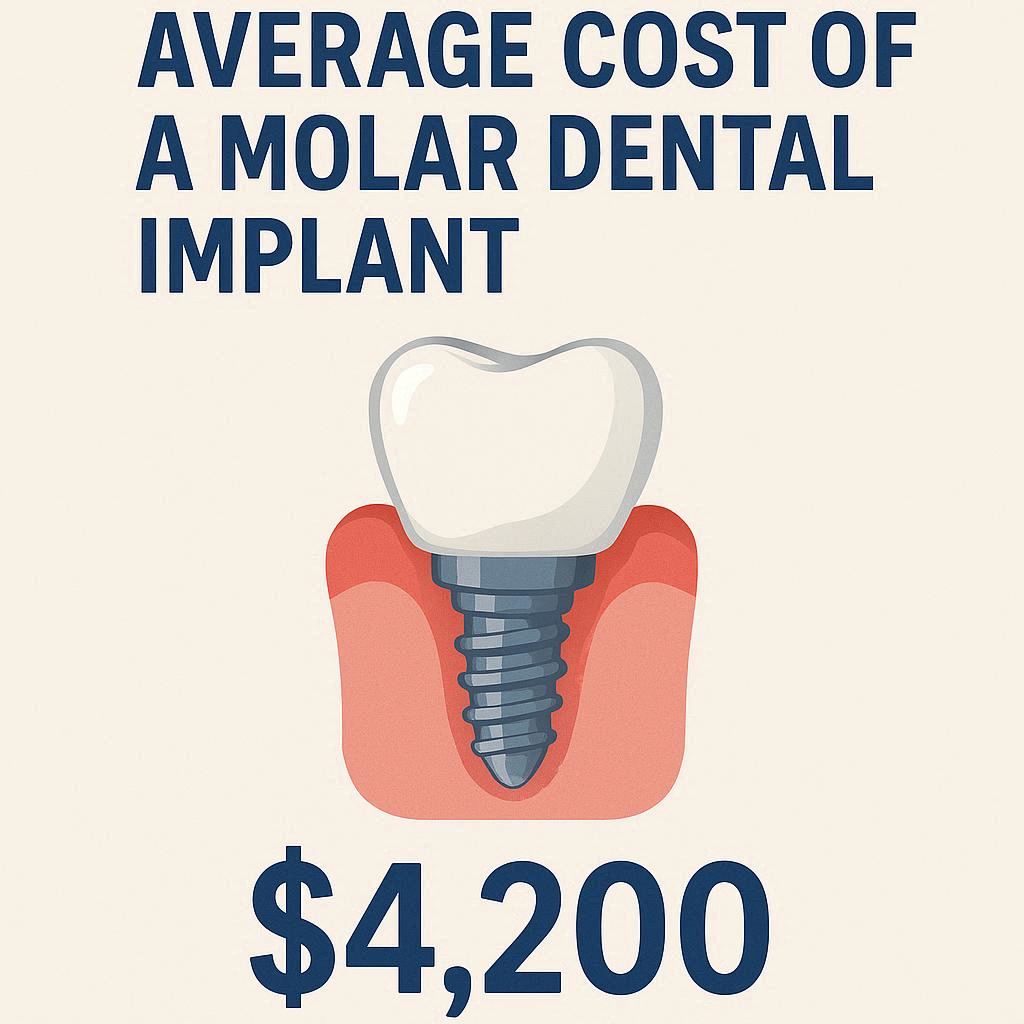
The average cost of a single molar dental implant in the United States ranges from $3,000 to $6,000 when you include the implant post, the abutment, and the crown.
If you need additional procedures like a bone graft or sinus lift, the total can climb to $7,000 to $10,000 or more.
These numbers reflect the full treatment, not just the implant itself. Many people see a low advertised price of $1,500 or $2,000, only to realize later that covers only the surgical placement of the metal post. The crown on top adds another $1,500 to $3,000.
Important note: Prices vary significantly by region. A molar implant in rural Mississippi may cost $3,000 total. The same procedure in downtown Manhattan or San Francisco can easily exceed $7,000.
Breaking Down the Three Main Components of a Molar Implant
To truly understand the cost, you need to see what you are paying for. A complete molar implant consists of three separate parts, each with its own price tag.
The Implant Fixture (The Screw)
This is the titanium or zirconia post that goes into your jawbone. It acts like the natural tooth root. The surgeon places it during the first surgical appointment.
- Typical cost: $1,000 to $2,500
- What influences price: Brand (premium brands like Nobel Biocare or Straumann cost more), material (zirconia is often pricier than titanium), and the complexity of placement.
The Abutment (The Connector)
The abutment is a small metal or ceramic piece that screws into the implant. It sits slightly above the gum line and holds the crown in place.
- Typical cost: $300 to $800
- What influences price: Stock abutments are cheaper. Custom-milled abutments, which look more natural and fit better, cost more. Gold or titanium abutments also vary in price.
The Dental Crown (The Visible Tooth)
The crown is the part you see and chew with. For a molar, this crown must be exceptionally strong.
- Typical cost: $1,000 to $3,000
- What influences price: Material is the biggest factor. Porcelain-fused-to-metal crowns are cheaper but can wear down opposing teeth. All-ceramic or zirconia crowns cost more but look better and last longer. Zirconia is especially popular for molars because it is nearly unbreakable.
| Component | Low-End Cost | High-End Cost | Typical Material |
|---|---|---|---|
| Implant Fixture | $1,000 | $2,500 | Titanium or Zirconia |
| Abutment | $300 | $800 | Titanium, Gold, or Ceramic |
| Crown | $1,000 | $3,000 | Zirconia or PFM |
| Total (no extras) | $2,300 | $6,300 | — |
The Hidden Costs Almost No One Talks About
The numbers above assume a perfect, straightforward case. But real life is rarely that simple. Here are the most common additional expenses you might face.
Bone Grafting
When you lose a molar, the jawbone underneath slowly resorbs (shrinks) over time. After six months to a year, there may not be enough bone height or width to hold an implant.
A bone graft rebuilds that lost structure. The surgeon takes bone from another part of your body, uses donor bone, or places synthetic bone material into the extraction site.
- Typical cost for a molar site: $500 to $1,500 per graft
- Healing time: 4 to 9 months before the implant can be placed
Sinus Lift (For Upper Molars)
Upper molars sit directly below your maxillary sinuses. When those teeth are lost, the sinus cavity can expand downward, leaving very little bone. A sinus lift adds bone to that area.
- Typical cost: $1,500 to $3,000
- Healing time: 6 to 12 months
Extraction and Site Preservation
If your damaged molar is still in place, you need an extraction before the implant. A simple extraction costs $75 to $300. A surgical extraction (for broken or impacted teeth) costs $150 to $650.
Many dentists recommend site preservation after extraction. They place bone graft material into the empty socket to prevent bone loss. This adds $200 to $500.
Temporary Partial Denture or Fla
While your implant heals, you might want a temporary tooth for cosmetic reasons. A flipper (removable partial denture) costs $300 to $1,000.
CBCT Scan (3D Imaging)
Modern implant planning requires a 3D cone beam CT scan. This gives the surgeon a detailed map of your nerves, sinuses, and bone density.
- Typical cost: $250 to $500
Consultation and Treatment Planning Fees
Many clinics charge a separate consultation fee of $100 to $300. Some apply this toward your final bill if you proceed with treatment.
Complete Cost Examples: Three Realistic Scenarios
To make this more concrete, let’s walk through three typical patient situations.
Scenario 1: Simple, No Extra Procedures
You lost your lower first molar six months ago. You have good bone density. No gum disease. You are a non-smoker.
- Consultation and CBCT scan: $350
- Implant fixture placement: $1,800
- Abutment: $500
- Zirconia crown: $1,800
- Total: $4,450
Scenario 2: Bone Graft Needed
You lost your upper molar two years ago. The bone has thinned significantly. You need a bone graft before the implant.
- Consultation and CBCT: $400
- Bone graft (including materials): $1,200
- Implant fixture (placed 6 months later): $2,000
- Abutment: $600
- Zirconia crown: $2,200
- Total: $6,400
Scenario 3: Sinus Lift + Bone Graft
You lost your upper second molar three years ago. The sinus has expanded downward. You need both a sinus lift and a bone graft.
- Consultation and CBCT: $450
- Sinus lift: $2,500
- Bone graft: $1,000
- Implant fixture (placed 8 months later): $2,200
- Abutment: $700
- Zirconia crown: $2,500
- Total: $9,350
Does Insurance Cover Molar Dental Implants?
This is where many people get frustrated. Most dental insurance plans were designed decades ago, when implants were considered experimental. Today, coverage varies wildly.
What Most Plans Do
- No coverage for implants: Many PPO plans explicitly exclude implants from coverage. They only pay for bridges or dentures.
- Partial coverage: Some plans cover a portion of the crown (usually 50%) but nothing for the implant fixture or abutment.
- Medical necessity exceptions: If you lost a molar due to an accident or injury, your medical insurance might cover the surgical portion. This is rare but worth checking.
What You Can Claim
Even if your plan excludes implants, you may still get coverage for related procedures:
- Extraction of the damaged tooth
- Bone grafting (sometimes covered as a surgical procedure)
- The crown (if coded as a standard crown on an implant)
Practical tip: Ask your dentist’s billing coordinator to run a pre-treatment estimate. This tells you exactly what your plan will pay before you commit.
Affordable Options: How to Save Money on a Molar Implant
A $4,000 to $6,000 bill is intimidating. But you have more options than you might think.
Dental Schools
Teaching hospitals and dental schools offer implant treatment at 30% to 50% less than private practices. A dental student performs the work under the close supervision of an experienced implantologist.
- Typical cost at a dental school: $2,000 to $3,500 for the complete implant
- Trade-off: Longer appointment times (3 to 4 hours per visit) and more visits overall.
Find accredited programs through the American Dental Education Association (ADEA) website.
Dental Tourism
Traveling to Mexico, Costa Rica, Colombia, or Thailand for dental work has become common. A complete molar implant in these countries often costs $1,000 to $2,500 total.
- Risks: Follow-up care is difficult if something goes wrong. Quality varies widely.
- Recommendation: If you choose this route, stay for at least one week to handle any immediate complications. Use only clinics accredited by the International Joint Commission.
In-House Dental Discount Plans
Some dental offices offer their own membership plans. You pay a flat annual fee (often $200 to $400) and receive 15% to 25% off all implant procedures.
- Example: A clinic might charge $400 per year and reduce your $5,000 implant to $3,750.
- Best for: People without any dental insurance.
Nonprofit and Charitable Programs
Organizations like Dental Lifeline Network provide free or reduced-cost dental care to seniors, people with disabilities, and those with medical conditions. Waitlists are long, but the savings are substantial.
Flexible Spending Accounts (FSA) and Health Savings Accounts (HSA)
You can use pre-tax dollars from an FSA or HSA to pay for implants, bone grafts, and even travel expenses for dental tourism. This effectively saves you 20% to 40% depending on your tax bracket.
Financing Options: Paying Over Time
Most dental offices partner with third-party financing companies. These are not loans from the clinic itself but medical credit cards or installment plans.
CareCredit
The most widely accepted healthcare credit card.
- How it works: Pay for your implant over 6, 12, or 18 months with no interest if paid in full by the deadline.
- Watch out: Deferred interest. If you miss the final payment date, you owe all the back interest (often 26% APR).
LendingClub and Prosper Healthcare Lending
These offer fixed-rate installment loans for dental work.
- Typical terms: 24 to 60 months at 5% to 15% APR
- No deferred interest traps
In-House Payment Plans
Some independent dentists offer their own payment plans. You pay 25% to 50% upfront and the rest in monthly installments over 3 to 12 months.
- Interest: Often 0% to 5%
- Requirement: Good credit and a history with the practice
What About Mini Dental Implants for Molars?
Mini dental implants (MDIs) are narrower than standard implants. They cost less, typically $1,500 to $3,000 for the complete tooth. But they are not ideal for molars.
- Why: Mini implants have a higher fracture rate under heavy chewing forces. Most implant specialists do not recommend them for back teeth.
- When they work: For temporary implants, denture stabilization, or small premolars. Not for a primary molar that will grind tough food.
Stick with a standard-diameter implant for your molar. Paying less upfront often leads to failure and more costs later.
How to Choose the Right Professional for Your Molar Implant
Not all dentists place implants. And not all implant dentists place molars regularly.
You have three main types of providers:
General Dentist with Implant Training
Many general dentists take weekend courses in implant placement. They can handle simple, straightforward molar cases.
- Cost: Lower than specialists (10% to 20% less)
- Risk: Less experience with complications like nerve injury or sinus perforation
Oral Surgeon
Oral surgeons complete four to six years of additional training after dental school. They handle complex bone grafting, sinus lifts, and cases with limited bone.
- Cost: Higher (often 20% to 30% more than a general dentist)
- Best for: Upper molars near the sinus, lower molars near the inferior alveolar nerve
Periodontist
Periodontists specialize in gum health and the bone surrounding teeth. They place implants daily and are experts at managing soft tissue.
- Cost: Similar to oral surgeons
- Best for: Patients with gum disease or thin gum tissue
Prosthodontist
These specialists focus on the crowns and abutments. They often work with an oral surgeon who places the implant, then the prosthodontist restores it.
- Cost: Most expensive (two specialists involved)
- Best for: Complex aesthetic cases or full-mouth reconstruction
Recommendation: For a single molar with normal bone, a skilled general dentist or periodontist is excellent. For upper molars needing a sinus lift, choose an oral surgeon.
The Timeline: How Long from Start to Finish
You are not just paying for a procedure. You are paying for a process that takes months. Each step has its own cost and waiting period.
- Consultation and imaging (1 visit): $100 to $500
- Extraction and bone graft (if needed): $500 to $2,000. Heal for 4 to 9 months.
- Implant placement surgery (1 visit): $1,000 to $2,500. Heal for 3 to 6 months for osseointegration.
- Abutment placement (1 visit): $300 to $800. Heal for 2 to 4 weeks for gum shaping.
- Crown fabrication and placement (2 to 3 visits): $1,000 to $3,000.
Total typical timeline: 6 to 18 months from extraction to final crown.
Long-Term Value: Is a Molar Implant Worth the Cost?
When you see a $5,000 price tag, your first thought might be: Should I just get a bridge or a partial denture?
Let’s compare the three main options for replacing a missing molar.
| Option | Upfront Cost | Lifespan | Pros | Cons |
|---|---|---|---|---|
| Dental Implant | $3,000 – $6,000 | 20+ years (often lifetime) | Preserves bone; no damage to adjacent teeth; feels natural | Expensive upfront; requires surgery; long timeline |
| Fixed Bridge | $2,000 – $4,000 | 10 – 15 years | Faster (3 weeks); no surgery | Shaves down healthy adjacent teeth; does not stop bone loss |
| Removable Partial Denture | $700 – $1,800 | 5 – 10 years | Cheapest option; no tooth alteration | Uncomfortable; affects taste and speech; accelerates bone loss |
Over 20 years, an implant is often cheaper than a bridge. Why? A bridge needs replacement every 10 to 15 years. Two bridges over 20 years can cost $4,000 to $8,000. An implant, once placed, rarely needs replacement.
Plus, a bridge requires grinding down two healthy teeth. That is permanent damage to teeth that might have lasted your whole life.
Signs You Are Getting a Fair Price
How do you know if a quote is reasonable? Look for these indicators:
- The quote is itemized. It lists implant fixture, abutment, crown, and any extras separately.
- The clinic uses premium implant brands. Straumann, Nobel Biocare, Zimmer, and Dentsply Sirona have decades of research behind them. No-name implants from discount suppliers have higher failure rates.
- The warranty is in writing. Many reputable clinics offer a 1 to 5 year warranty on the implant and crown.
- The price includes all follow-up visits. Adjustments to the crown and check-ups for the first 90 days should be included.
Avoid any clinic that:
- Quotes a single low price but cannot break it down
- Uses aggressive sales tactics like “today only” discounts
- Cannot show you before-and-after photos of molar cases
Regional Price Variations in the United States
Location changes everything. Here are rough averages for a complete single molar implant (implant + abutment + crown) without bone grafting.
| Region | Average Cost Range |
|---|---|
| Rural Southeast (Mississippi, Alabama, Arkansas) | $3,000 – $4,500 |
| Midwest (Ohio, Indiana, Missouri) | $3,500 – $5,000 |
| Texas and Southwest | $3,800 – $5,500 |
| Florida | $4,000 – $5,800 |
| Northeast (Pennsylvania, New Jersey) | $4,500 – $6,500 |
| West Coast (Oregon, Washington) | $4,500 – $6,500 |
| Major Cities (NYC, LA, San Francisco, Boston) | $5,500 – $8,000+ |
These are estimates. Always call three to four clinics in your area for a written estimate.
Questions to Ask Before You Commit
Walk into any consultation with these questions written down. The answers will tell you everything about the clinic’s quality and pricing.
- “What brand of implant do you use, and why?”
- “Does your fee include the final crown, or is that separate?”
- “What happens if the implant fails to integrate? Do you replace it for free?”
- “How many molar implants do you place each month?”
- “Do you have a payment plan or financing options with 0% interest?”
- “Can you show me a CBCT scan of a similar case you treated?”
- “What is your policy on sedated vs. awake placement?”
A confident, transparent dentist will answer every question without hesitation.
Red Flags: When to Walk Away
Not every clinic deserves your trust or your money. Watch for these warning signs.
- The price is half the local average. If everyone else charges $5,000 and this clinic charges $2,500, something is wrong. They may use low-quality implants, skip the CBCT scan, or have a high failure rate.
- They promise a crown in two weeks. A real implant requires 3 to 6 months of healing. Same-day implants exist, but they are rarely appropriate for molars.
- They refuse to give a written estimate. Verbal quotes can change after surgery.
- No CBCT scan is performed. Placing a molar implant without 3D imaging is reckless. The inferior alveolar nerve runs through the lower jaw. Hitting it can cause permanent numbness.
- They pressure you to sign a contract immediately. Ethical implant care gives you time to think.
Frequently Asked Questions (FAQ)
How painful is getting a molar implant?
Most patients report less pain than a tooth extraction. The procedure is done with local anesthesia. You feel pressure but not sharp pain. Afterward, over-the-counter ibuprofen usually controls soreness for two to four days.
Can I get a molar implant years after extraction?
Yes. But you will almost certainly need a bone graft first. The longer you wait, the more bone loss occurs. After five or more years, a sinus lift or significant grafting may be required.
Do molar implants feel like real teeth?
Yes. Once healed, most people cannot tell the difference between an implant and a natural tooth. You can chew steak, nuts, and crunchy vegetables normally.
What is the failure rate for molar implants?
Studies show a 95% to 98% success rate over 10 years for lower molars. Upper molars have a slightly lower success rate (92% to 95%) due to lower bone density. Smoking, uncontrolled diabetes, and poor oral hygiene raise failure rates significantly.
Can I have a molar implant if I grind my teeth at night?
Yes, but you must wear a custom night guard. Bruxism (teeth grinding) puts extreme force on implants. Without a guard, the crown or implant could fracture.
How do I clean a molar implant?
Treat it like a natural tooth. Brush twice daily, floss once daily, and use a water flosser around the gum line. Regular dental cleanings every six months are essential.
Can an allergic reaction happen with titanium implants?
Extremely rare. Less than 0.6% of the population has titanium sensitivity. Zirconia implants are a metal-free alternative, but they cost 20% to 40% more and have less long-term data.
Are molar implants covered by Medicare or Medicaid?
Original Medicare does not cover dental implants. Some Medicare Advantage plans (Part C) include dental benefits, but coverage for implants is rare. Medicaid coverage varies by state. Most states do not cover implants for adults.
Additional Resource
For a more detailed look at implant brands, success rates, and clinical studies, visit the American Academy of Implant Dentistry’s patient education page:
https://www.aaid.com/for-patients
This resource includes a searchable directory of accredited implant dentists in your area.
Final Thoughts: Making Your Decision
A molar dental implant is a significant financial investment. But it is also an investment in your long-term health, comfort, and quality of life.
You now know what the average cost of a molar dental implant truly includes. You understand the hidden fees, the financing options, and the warning signs. You can walk into any consultation with confidence.
Take your time. Compare three to four providers. Ask every question on the list above. And remember: the cheapest option today is rarely the cheapest over 20 years. A well-placed molar implant, done with quality materials and an experienced professional, can serve you for decades.
Your smile deserves that kind of care.
Conclusion :
A single molar dental implant typically costs $3,000 to $6,000 for the complete tooth, or up to $10,000 with bone grafts and sinus lifts. Dental insurance rarely covers the full procedure, but financing options, dental schools, and discount plans can make treatment affordable. Choosing a skilled professional and quality materials ensures your implant lasts 20 years or more, offering better long-term value than a bridge or denture.


