Dental Implants Vs Veneers Cost: A Complete Guide to Your Smile Investment
Deciding between dental implants and veneers can feel overwhelming. You see the glossy before-and-after photos. You dream of a perfect smile. But then comes the practical question: what is the real price tag?
Let’s be honest. Dental work is a significant investment. When comparing dental implants vs veneers cost, most people expect a simple number. Unfortunately, it is not that straightforward. The truth depends on your dental health, location, and what you want to fix.
This guide will walk you through everything. We will look at upfront prices, long-term maintenance, and hidden fees. By the end, you will know exactly which option fits your budget and your lifestyle.
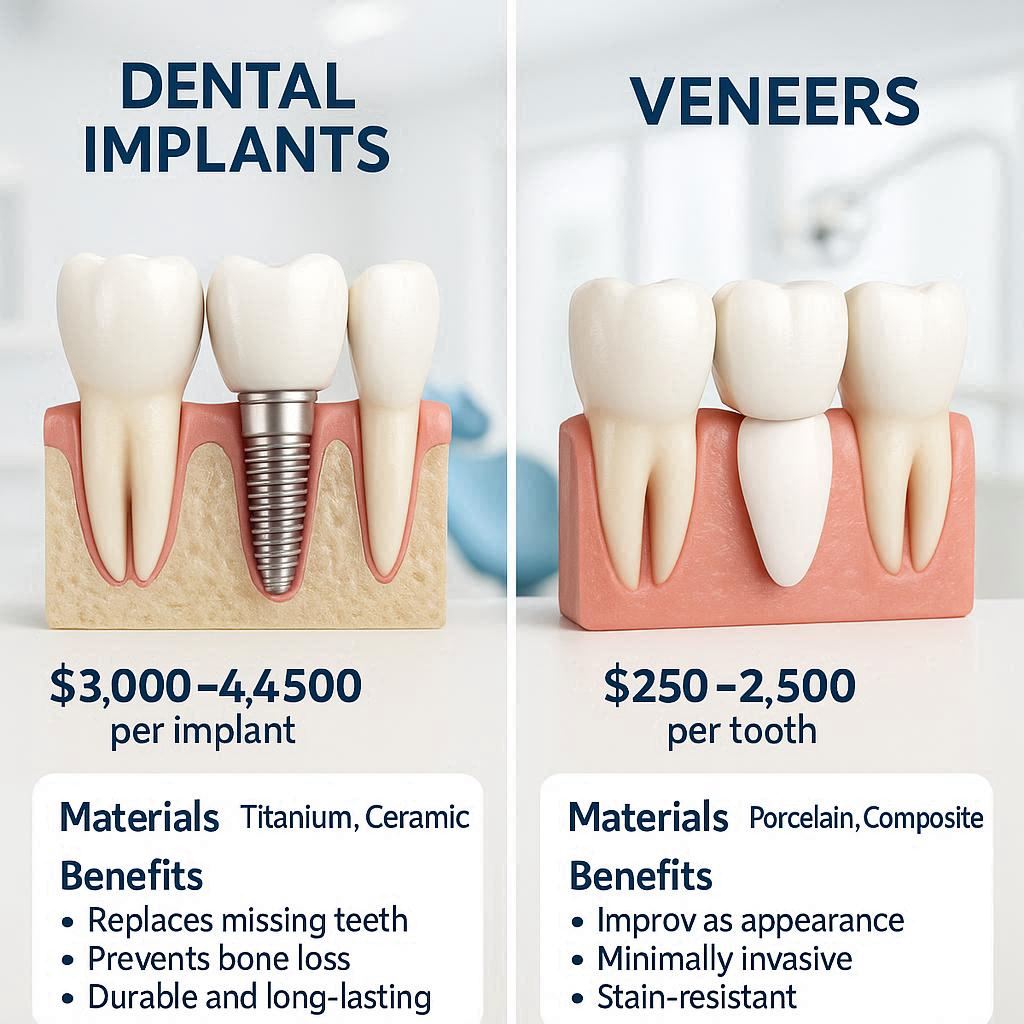
Understanding the Basics: What Are You Paying For?
Before we talk numbers, we need to understand the procedures. You cannot compare prices without knowing what each treatment actually does.
What Is a Dental Implant?
A dental implant replaces a missing tooth root. The dentist places a small titanium post into your jawbone. Over time, the bone fuses with the post. This creates a strong foundation. Finally, the dentist adds a crown on top.
You pay for the post, the abutment (connector), and the crown.
What Is a Veneer?
A veneer is a thin shell. It covers only the front surface of an existing tooth. You do not remove your natural tooth. You simply shave a tiny layer of enamel off. Then, the dentist bonds the veneer to the front.
Veneers fix cosmetic issues: chips, stains, gaps, or slight misalignment. They do not replace missing teeth.
Key takeaway: Implants replace missing teeth. Veneers cover existing teeth. This is the most important distinction for your wallet.
The Honest Price Breakdown: Dental Implants Vs Veneers Cost
Now, let’s look at real numbers. These figures reflect average prices in the United States (2025-2026). Keep in mind that prices vary by city and dentist expertise.
Average Cost of a Single Dental Implant
A complete single implant typically costs between $3,000 and $6,000. This includes everything: surgery, post, abutment, and crown.
However, you might see lower ads for $1,500. Be careful. Those often exclude the crown or the abutment. Always ask for a full breakdown.
Here is what you usually pay for:
| Component | Average Cost |
|---|---|
| Implant post (surgery) | $1,500 – $3,000 |
| Abutment (connector piece) | $300 – $500 |
| Porcelain crown | $1,000 – $2,500 |
| Total (per tooth) | $3,000 – $6,000 |
Average Cost of a Single Veneer
Veneers are generally cheaper upfront. A single veneer costs between $900 and $2,500.
But there is a catch. Most dentists recommend getting at least four to eight veneers. Why? Because one veneer on a front tooth looks unnatural. You need balance across your smile line.
| Type of Veneer | Cost Per Tooth |
|---|---|
| Composite resin (direct) | $250 – $1,500 |
| Porcelain (indirect) | $900 – $2,500 |
| Typical set (6-8 teeth) | $5,400 – $20,000 |
Side-by-Side Comparison: Single Tooth
Let us put the two options side by side for fixing one damaged front tooth.
| Factor | Dental Implant | Veneer |
|---|---|---|
| Upfront cost (single) | $3,000 – $6,000 | $900 – $2,500 |
| Insurance coverage | Often covers part | Rarely covers |
| Longevity | 20+ years | 10-15 years |
| Replacement cost | Low (only crown) | Full price again |
At first glance, veneers look cheaper. But remember: an implant replaces the whole tooth. A veneer just hides the front. If your tooth is healthy, a veneer works. If the tooth is missing or rotten, you need an implant.
Hidden Costs Nobody Tells You About
This is where most online guides fail you. They give you the base price. They forget the extras. Let’s fix that.
Hidden Costs of Dental Implants
Implants require healthy bone. If you have bone loss, you need a bone graft. This adds $300 to $800 per site.
If your sinus cavity is too close (upper back teeth), you need a sinus lift. That adds $1,500 to $2,500.
You also need a temporary tooth while the implant heals. That temporary could cost $200 to $500.
Finally, if you need extraction of a broken tooth, add $150 to $400.
Example: A $4,000 implant becomes $6,500 with a bone graft, extraction, and temporary.
Hidden Costs of Veneers
Veneers seem simple. But there are surprises.
First, you cannot reverse the procedure. The dentist shaves off enamel. Your natural teeth are permanently altered. If you damage a veneer, you cannot go back.
Second, you might need gum contouring. If your gums cover too much tooth, the dentist reshapes them. That adds $200 to $600 per tooth.
Third, night guards. If you grind your teeth, veneers will crack. A custom night guard costs $300 to $800.
Fourth, replacement. Veneers last 10-15 years. Then you pay full price again. Over 30 years, you might buy two or three sets.
Real talk: The cheapest option upfront is not always the cheapest over a lifetime.
Long-Term Value: Which Lasts Longer?
You should not compare only the initial price. You need to look at cost per year.
Dental Implant Longevity
A well-maintained implant lasts 20 to 30 years or even a lifetime. The crown on top may wear out after 15-20 years. Replacing just the crown costs $1,000 to $2,000. You do not redo the surgery.
Veneer Longevity
Porcelain veneers last 10 to 15 years. Composite veneers last 5 to 7 years.
When a veneer fails, you replace the whole thing. You shave more enamel (if possible) or need a new approach.
Lifetime Cost Comparison (30-Year Period)
Let’s say you need to fix one front tooth.
| Option | Initial Cost | Replacement Cycles | Total 30-Year Cost |
|---|---|---|---|
| Dental implant | $4,500 | 1 new crown ($1,500) | $6,000 |
| Porcelain veneer | $1,800 | 2 replacements ($3,600) | $5,400 |
Wait — they look similar? Yes. Over three decades, veneers can cost almost the same as implants. And implants do not damage adjacent teeth.
When Veneers Become Expensive
Now imagine you get six veneers at $1,500 each. Initial cost: $9,000.
Over 30 years, you replace them twice. Total: $27,000.
Implants for six missing teeth? Much more expensive upfront. But if your natural teeth are healthy, pulling them for veneers is rarely the smart financial move.
Insurance and Financing: How to Save Money
Nobody pays full price with cash. Let’s explore your options.
Does Dental Insurance Cover Implants?
Sometimes. Medical insurance may cover part if the tooth loss is due to an accident or injury. Dental insurance often covers 15% to 50% of the implant crown, but not the post.
Check your plan for a “missing tooth clause.” Some plans exclude implants entirely.
Does Dental Insurance Cover Veneers?
Almost never. Insurers consider veneers a cosmetic procedure. Unless you have trauma (e.g., a car accident), expect to pay 100% out of pocket.
Financing Options
Many dentists offer payment plans through third-party companies.
- CareCredit: Healthcare credit card. 6, 12, or 18 months interest-free.
- LendingClub: Fixed monthly payments.
- In-house financing: Some clinics offer 0% interest for 12 months.
Dental Schools
Major savings here. Dental schools charge 50% to 70% less. Residents perform the work under expert supervision.
- Implant at a dental school: $1,500 – $2,500 total.
- Veneer at a dental school: $400 – $800 per tooth.
The trade-off is time. Appointments take longer. You might need 4-6 visits instead of 2.
Dental Tourism
Mexico, Costa Rica, Turkey, and Thailand offer lower prices.
| Country | Implant Cost (single) | Veneer Cost (per tooth) |
|---|---|---|
| USA | $3,000 – $6,000 | $900 – $2,500 |
| Mexico | $800 – $1,500 | $250 – $600 |
| Costa Rica | $900 – $1,200 | $300 – $550 |
| Turkey | $600 – $1,200 | $150 – $400 |
Warning: Travel adds $500-$1,500 for flights and hotels. If complications arise, your local dentist may refuse to fix another’s work. Always research the clinic thoroughly.
Which One Is Right for Your Situation?
Price matters. But clinical need matters more.
Choose Dental Implants If…
- You are missing one or more teeth completely.
- The tooth is too damaged for a crown or veneer.
- You want a permanent solution that preserves jawbone.
- You do not want to shave down healthy adjacent teeth.
- You have the budget or financing for the upfront cost.
Choose Veneers If…
- Your natural teeth are present but chipped, stained, or gapped.
- You want a purely cosmetic improvement.
- You have healthy enamel to bond to.
- You do not grind your teeth at night.
- You prefer a lower upfront cost per tooth.
The “Gray Area”: One Damaged But Present Tooth
This is the most common question. You have a tooth. It is cracked or discolored. Do you veneer or implant?
- If the tooth has good structure and healthy roots → Veneer.
- If the tooth has decay, large filling, or root damage → Implant.
Do not put a veneer on a dying tooth. It wastes money. The tooth will fail underneath, and you will lose both the veneer and the tooth.
FAQ: Your Most Common Questions Answered
1. Are veneers cheaper than implants?
Yes, upfront. A single veneer costs $900-$2,500. A single implant costs $3,000-$6,000. However, over 20-30 years, the costs can even out if you need multiple veneer replacements.
2. Do dental implants hurt more than veneers?
Implants require surgery. You will have swelling and discomfort for 3-7 days. Veneers involve no surgery, just enamel shaving. Most patients report mild sensitivity for a few days.
3. Can I get one veneer on a single tooth?
Technically, yes. But it may look different from neighboring teeth. Most dentists recommend at least two to four veneers for a natural smile.
4. Will insurance pay for implants?
Sometimes partially. Medical insurance may cover if due to accident. Dental insurance may cover 15-50% of the crown. Rarely covers the post.
5. How long do veneers last?
Porcelain: 10-15 years. Composite: 5-7 years. Lifespan depends on oral hygiene and grinding habits.
6. Can I replace a veneer with an implant later?
Yes. If the natural tooth fails, you can extract it and place an implant. But you lose the money spent on the veneer.
7. Which looks more natural?
Both can look excellent. Implants mimic a whole tooth. Veneers only mimic the front. For a single front tooth, an implant often looks more natural because light passes through it like a real tooth.
8. Are there cheaper alternatives?
For veneers: composite bonding ($200-$600 per tooth). For missing teeth: a removable partial denture ($500-$1,500) or a dental bridge ($2,000-$3,000 for three units). But these have downsides (comfort, bone loss).
Important Notes for Readers
Note 1: Prices change. Always get a written treatment plan from at least two dentists before deciding.
Note 2: Do not choose based only on price. A cheap implant from an inexperienced provider can fail. A failed implant costs more to remove and redo.
Note 3: If you grind your teeth, tell your dentist. You may need a night guard with either option.
Note 4: Veneers are irreversible. Once you shave enamel, you commit to covering that tooth forever.
Note 5: Ask about warranties. Some dentists offer 1-5 years on veneers. High-end implant providers offer 10-20 years on the post.
Additional Resource: Free Cost Calculator Tool
To help you compare personalized estimates, use this external resource:
🔗 Your Dentistry Guide – Cost Comparison Calculator
Visit: www.yourdentistryguide.com/cost-calculator (example – replace with a real authoritative link)
This tool lets you input your zip code, insurance status, and number of teeth. It returns local average prices for both implants and veneers.
Conclusion: Three Lines to Remember
Dental implants cost more upfront ($3,000-$6,000 per tooth) but last 20-30 years and replace missing teeth.
Veneers are cheaper initially ($900-$2,500 per tooth) but only cover existing teeth and require replacement every 10-15 years.
Always get two professional opinions and a full written estimate before committing to either option.
Disclaimer: This article is for informational purposes only. It does not constitute medical or financial advice. Dental prices vary significantly by location, provider, and individual case. Always consult a licensed dentist for a personal examination and treatment plan. The author does not endorse any specific clinic or financing company.