Dental Implant Uncovering: What to Expect, Recovery Tips, and Realistic Advice
If you have been going through the dental implant process, you already know it takes time. You had the implant placed. Then you waited weeks or months for it to heal and fuse with your jawbone. Now, your dentist tells you it is time for the next step: dental implant uncovering.
For many people, this phrase sounds a little intimidating. Will it hurt? Is it a big surgery? How long does it take to heal?
Let me put your mind at ease right away.
Dental implant uncovering is a minor procedure. It is nothing like the first surgery when you got the implant placed. Most people are surprised by how quick and straightforward it really is.
In this guide, I will walk you through everything you need to know. No complicated medical jargon. No unrealistic promises. Just honest, practical information based on how this procedure actually works in real dental clinics.
By the time you finish reading, you will know exactly what to expect, how to prepare, and how to care for your healing gum tissue afterward.
What Is Dental Implant Uncovering? A Simple Explanation
Let us start with the basics.
A dental implant is a small titanium post that your dentist surgically places into your jawbone. That post acts like an artificial tooth root. After placement, you wait several months. During this time, your bone grows around the implant. This process is called osseointegration. It is what makes the implant strong and stable.
But here is the thing.
During those healing months, the implant sits completely hidden under your gum tissue. Your dentist may have placed a small healing cap on top of it, but you cannot see any of this from the outside. The gum tissue grows over the implant, protecting it while the bone heals.
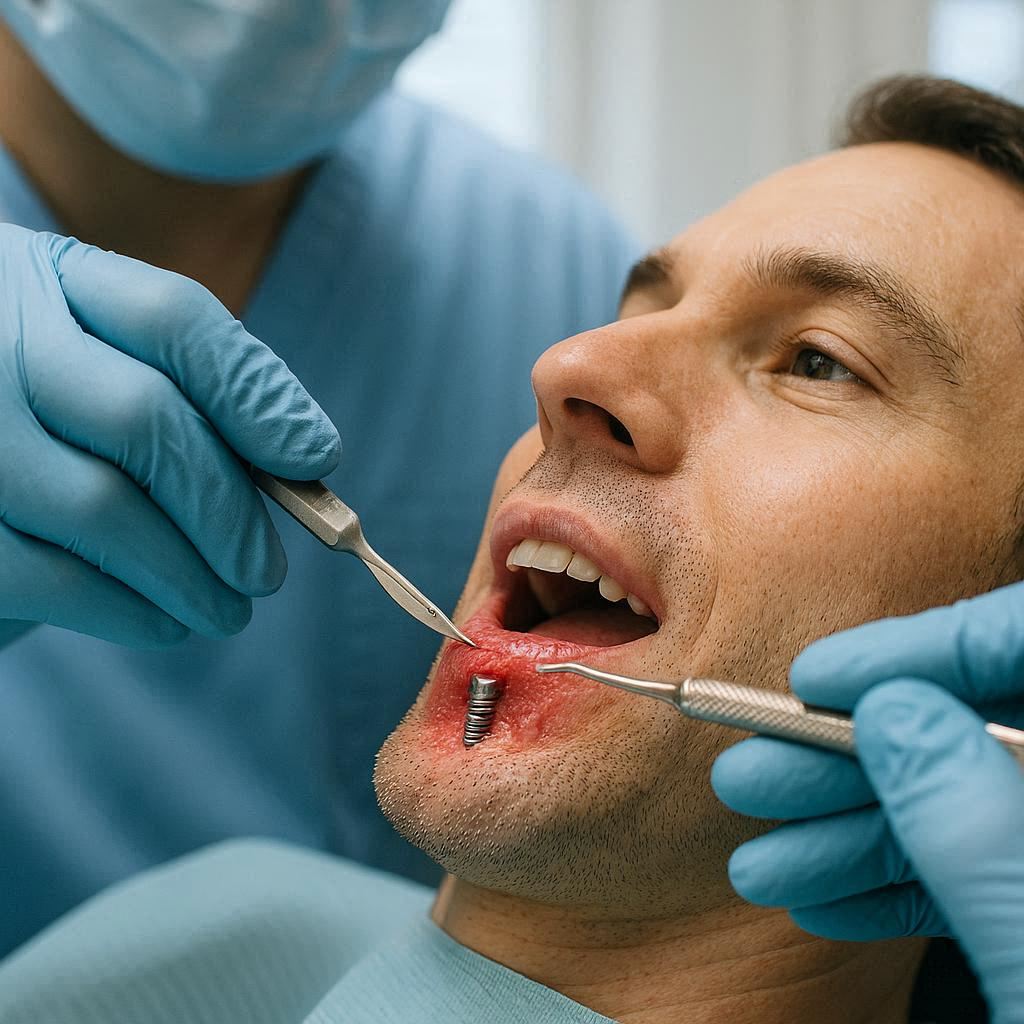
Now, you need to attach the final tooth (crown) to that implant. To do that, your dentist must uncover the top of the implant. That means creating a small opening in the gum tissue to expose the implant’s top surface.
That is dental implant uncovering.
Some dentists call it “second-stage surgery” or “implant exposure.” But do not let the word “surgery” worry you. This is a very minor procedure compared to placing the implant itself.
Why Can’t the Dentist Just Place the Crown Right Away?
Great question.
If your dentist attached the crown immediately after placing the implant, the pressure from chewing could disturb the healing process. The bone might not fuse properly. The implant could fail.
By keeping the implant covered under the gum, nature does its work quietly and effectively. No food gets near the healing area. No accidental bumps interfere with bone growth.
Once the implant is fully integrated with your bone, the uncovering procedure gives your dentist access to attach a healing abutment. That healing abutment will shape your gum tissue to look natural around the final crown.
When Does Dental Implant Uncovering Happen? The Timeline
Every patient heals differently. That means there is no single perfect day for everyone.
However, most dentists follow a general timeline.
- Lower jaw implants: Typically uncovered after 3 to 4 months. The lower jawbone is denser and often heals faster.
- Upper jaw implants: Often require 5 to 6 months. The upper jawbone is softer, so healing takes a little longer.
- Patients with bone grafting: You may need 6 to 8 months or even longer before uncovering.
- Immediate loading implants (rare): In some cases, dentists place a temporary crown the same day as the implant. But this is not common and only works for specific situations.
Your dentist will check the implant’s stability before scheduling the uncovering. They may take an X-ray to confirm that the bone has grown around the implant properly. They will also check for any signs of infection or implant failure.
Important note: Do not rush this step. Waiting the full healing time gives you the best chance of a successful, long-lasting implant.
Two Main Methods for Dental Implant Uncovering
Not all uncovering procedures are the same. Your dentist will choose one of two main approaches based on your specific situation.
Method 1: Soft Tissue Punch
This is the quicker, less invasive method.
Your dentist uses a small, circular tool called a tissue punch. It looks a bit like a tiny cookie cutter. The dentist places it directly over the area where the implant is hidden. With a gentle twist, the punch removes a small circle of gum tissue, exposing the implant’s top surface.
Advantages of the punch method:
- Very fast (often under 10 minutes)
- No stitches needed in most cases
- Less bleeding
- Quicker healing
Disadvantages:
- Not suitable for all implant placements
- Can be tricky if the implant is not exactly centered under the gum
Method 2: Flap Surgery (Incision Method)
In this approach, your dentist makes a small incision in the gum tissue using a scalpel. They lift a tiny flap of gum to expose the implant. After placing the healing abutment, they suture the gum tissue back into place, usually leaving a small opening around the abutment.
Advantages of the flap method:
- Works for any implant position
- Gives the dentist better visibility
- Allows for minor gum reshaping if needed
Disadvantages:
- Takes a little longer (15 to 30 minutes)
- Requires stitches
- Slightly more post-procedure discomfort
Which Method Is Better?
Neither method is universally better. The right choice depends on your gum tissue thickness, the implant’s depth, and your dentist’s training and preference.
Here is a quick comparison table to help you understand the differences.
| Feature | Soft Tissue Punch | Flap Surgery (Incision) |
|---|---|---|
| Procedure time | 5–10 minutes | 15–30 minutes |
| Stitches needed | Rarely | Usually yes |
| Bleeding | Minimal | Mild to moderate |
| Healing time | 1–2 weeks | 2–3 weeks |
| Pain level after | Very low | Low to mild |
| Suitable for all cases | No | Yes |
Most dentists today prefer the punch method when possible because it is faster and more comfortable for patients. However, do not be alarmed if your dentist recommends the flap method. It is still a very minor procedure.
What Happens During the Procedure? A Step-by-Step Walkthrough
Let me walk you through exactly what will happen on the day of your dental implant uncovering. Knowing each step reduces anxiety.
Before You Arrive
Your dentist will give you simple instructions. Usually, there are no special restrictions. You can eat a normal meal beforehand unless you are receiving sedation.
Most people do not need sedation for this procedure. A local anesthetic (numbing shot) is enough. However, if you are very anxious, ask your dentist about options like nitrous oxide (laughing gas) or an oral sedative.
Step 1: Numbing the Area
Your dentist will apply a topical gel to your gum to numb the surface. Then, they will inject a local anesthetic. You may feel a small pinch and a mild burning sensation for a few seconds. After that, the area becomes completely numb.
You should not feel any sharp pain during the procedure. You might feel pressure or vibration, but nothing painful.
Step 2: Exposing the Implant
Using either the tissue punch or a scalpel, your dentist removes or lifts the gum tissue covering the implant. This step takes only a few minutes.
If you had a healing cap placed during the first surgery, your dentist will unscrew it at this point.
Step 3: Placing the Healing Abutment
Once the implant’s top is visible, your dentist screws a healing abutment into it. The healing abutment is a small metal or plastic piece that sticks out slightly above your gum line. It serves two purposes:
- It keeps the gum tissue from growing back over the implant.
- It shapes the gum to create a natural-looking collar for your future crown.
Step 4: Stitches (If Needed)
If your dentist used the flap method, they will place a few small stitches to close the gum tissue around the healing abutment. These stitches are usually dissolvable, so you do not need to return for removal.
If your dentist used the punch method, you probably will not need any stitches.
Step 5: Final Checks
Your dentist will check that the healing abutment is secure and that there is no excessive bleeding. They may take a quick X-ray to confirm proper placement.
Then, you are done.
The entire appointment usually lasts between 20 and 45 minutes, including numbing time. The actual uncovering takes only 5 to 15 minutes.
Patient quote: “I was so nervous, but honestly, it was nothing. The numbing shot was the worst part, and even that was fine. The whole thing took maybe 25 minutes. I went back to work the same day.” — Mark, dental implant patient
Does Dental Implant Uncovering Hurt?
This is the number one question people ask.
Here is the honest answer.
During the procedure: No. The local anesthetic completely numbs the area. You will not feel sharp pain. You may feel pressure, tugging, or vibration. Some people describe it as an odd sensation, but not painful.
After the numbing wears off: Mild discomfort. Most people compare it to having a mild toothache or a sore gum. Over-the-counter pain relievers like ibuprofen (Advil) or acetaminophen (Tylenol) usually manage this discomfort easily.
Serious pain is not normal. If you experience severe or worsening pain after the procedure, contact your dentist immediately. It could be a sign of infection or another complication.
Pain Levels by Method
| Procedure Type | Pain During (1–10) | Pain After (1–10) | Days of Discomfort |
|---|---|---|---|
| Soft tissue punch | 0–1 | 1–2 | 1–2 days |
| Flap surgery | 0–1 | 2–3 | 2–4 days |
Tips to Minimize Discomfort
- Take your first pain reliever before the numbing wears off.
- Apply an ice pack to the outside of your cheek for 10 minutes at a time.
- Stick to soft foods for the first 24 hours.
- Avoid poking the area with your tongue or fingers.
Most people say the anxiety before the procedure is much worse than the procedure itself.
Healing and Recovery: What to Expect Day by Day
Recovery from dental implant uncovering is usually quick and uneventful. However, your gums do need some time to heal properly.
Here is a realistic day-by-day timeline.
Day of Procedure (Day 0)
- Your mouth will feel numb for 2 to 4 hours after the appointment.
- You may notice some light bleeding or pink saliva. This is normal.
- Do not eat until the numbness is completely gone. You might accidentally bite your cheek or lip.
- Stick to cold or lukewarm soft foods like yogurt, smoothies, soup, or mashed potatoes.
Day 1
- The numbness is gone. Your gum may feel tender or sore.
- Mild swelling is possible, especially if you had the flap method.
- Continue soft foods. Avoid hot, spicy, or crunchy foods.
- Rinse gently with warm salt water (half a teaspoon of salt in a cup of warm water) after meals.
Days 2–3
- Soreness should decrease noticeably.
- Swelling, if any, will start to go down.
- You may see a white or yellowish film around the healing abutment. This is normal healing tissue, not pus.
- You can slowly add more solid foods, but avoid chewing directly on the healing abutment side.
Days 4–7
- Most discomfort is gone.
- You might forget the abutment is even there.
- Resume normal brushing, but be gentle around the abutment. Use a soft-bristled toothbrush.
- If you had dissolvable stitches, they may start falling out around now.
Days 7–14
- Your gum tissue should look pink and healthy.
- The healing abutment will feel like part of your mouth.
- You can eat most normal foods, but still avoid very hard or sticky things directly on the abutment.
After 2 Weeks
- Your gums are fully healed around the healing abutment.
- You are ready for the next step: impressions for your final crown.
Important note: Some dentists prefer to wait 4 to 6 weeks after uncovering before taking impressions. This allows the gum tissue to mature and settle into its final shape.
Healing Abutment vs. Final Abutment: Understanding the Difference
This confuses many patients, so let me clarify.
The healing abutment is not the final piece your dentist will use to attach your crown. It is a temporary part.
Here is how the timeline works.
- Uncovering procedure: Dentist places healing abutment.
- Healing period (2–6 weeks): Gum tissue heals around the healing abutment.
- Impressions: Dentist removes the healing abutment and takes impressions of your implant and surrounding teeth.
- Final abutment: A custom-made permanent abutment is created based on those impressions.
- Crown placement: Dentist attaches the final abutment and then your permanent crown.
Think of the healing abutment like a placeholder. It prepares your gum for the final abutment and crown.
Why Not Just Place the Final Abutment Immediately?
Because your gum tissue shrinks and changes shape as it heals. If your dentist placed the permanent abutment right away, it might not fit perfectly after your gums settle. You could end up with gaps or an unnatural gum line.
Waiting a few weeks with a healing abutment allows your gums to heal into a stable shape. Then, the final abutment and crown can be custom-made to fit perfectly.
Cost of Dental Implant Uncovering
Money matters. Let me give you realistic numbers.
The cost of dental implant uncovering varies widely depending on where you live, your dentist’s fees, and whether you have dental insurance.
Typical Costs Without Insurance
| Service | Average Cost (US) |
|---|---|
| Soft tissue punch uncovering | $150 – $350 |
| Flap surgery uncovering | $250 – $600 |
| Healing abutment (if not included) | $50 – $150 |
| Local anesthesia (if billed separately) | $25 – $75 |
In many cases, the cost of uncovering is built into your original implant treatment plan. Some dentists charge a flat fee for the entire implant process, which includes uncovering. Others bill separately for each stage.
Always ask for a written treatment plan and cost breakdown before any procedure.
Does Insurance Cover Uncovering?
Most dental insurance plans that cover implants also cover the uncovering procedure. However, coverage limits vary.
- Some plans cover 50% of the cost after you meet your deductible.
- Others cover a fixed dollar amount per year.
- Many plans have a waiting period for implant-related procedures.
Call your insurance provider and ask these specific questions:
- Is implant uncovering covered under my plan?
- What is my annual maximum benefit?
- Have I already used part of that maximum this year?
- Do I need a pre-authorization?
Saving Money on Uncovering
- Ask about package pricing: Some dental offices offer a flat fee for the entire implant process (surgery, uncovering, abutment, crown). This often costs less than paying separately.
- Dental schools: If you live near a dental school, the uncovering procedure may cost 50% less than private practice. Experienced dental students perform the work under close supervision.
- Discount dental plans: These are not insurance, but they offer negotiated rates. You pay an annual fee and get reduced prices at participating dentists.
Risks and Complications: Being Honest
No medical procedure is completely risk-free. Dental implant uncovering is very low risk, but you deserve to know what can go wrong.
Common (But Minor) Issues
- Bleeding: Some oozing is normal. Heavy bleeding is rare.
- Swelling: Mild to moderate swelling, especially with flap surgery.
- Soreness: Almost everyone has some soreness. It usually lasts 2 to 4 days.
- Food trapping: Food can get stuck around the healing abutment. Gentle rinsing solves this.
Less Common (But Possible) Complications
| Complication | How Common? | What Happens? |
|---|---|---|
| Infection | ~1–2% | Redness, swelling, pus, or pain that gets worse. Treated with antibiotics. |
| Healing abutment loosening | Uncommon | The abutment unscrews slightly. Dentist can retighten it easily. |
| Allergic reaction | Very rare | Most abutments are titanium or medical-grade plastic. Extremely low allergy risk. |
| Gum overgrowth | Rare | Gum tissue grows over the healing abutment. Dentist may need to trim it. |
| Implant failure discovered | Very rare | Sometimes uncovering reveals that the implant never fused properly. This means the implant may need removal. |
Signs You Need to Call Your Dentist
- Pain that gets worse instead of better after 3 days
- Fever over 101°F (38.3°C)
- Heavy bleeding that does not stop with gentle pressure
- Swelling that spreads to your cheek or neck
- A bad taste or smell that does not go away with rinsing
- The healing abutment feels loose or falls out
Do not panic if you have mild symptoms. Most people heal without any problems. But if something feels wrong, call your dentist. They would much rather reassure you than have you ignore a real issue.
How to Care for Your Mouth After Uncovering
Proper aftercare makes a huge difference in comfort and healing speed. Follow these guidelines.
Do’s (Things You Should Do)
- Rinse with warm salt water 2 to 3 times a day, especially after eating. Use half a teaspoon of salt in one cup of warm water. Gently swish and let the water fall out of your mouth. Do not spit forcefully.
- Brush gently around the healing abutment. Use a soft-bristled toothbrush. Brush the abutment itself lightly to remove plaque.
- Use an antibacterial mouthwash if your dentist recommends one. Chlorhexidine (prescription) or a mild alcohol-free rinse can help prevent infection.
- Eat on the opposite side of your mouth for the first few days.
- Take over-the-counter pain relievers as needed. Ibuprofen works best for dental discomfort because it reduces inflammation.
- Apply ice to your cheek for 10–15 minutes at a time if you have swelling.
Don’ts (Things to Avoid)
- Do not spit forcefully for 24 hours. Spitting creates suction that can dislodge the blood clot and cause bleeding.
- Do not use a straw for at least a week. Suction is bad for healing gums.
- Do not smoke or vape for as long as possible. Smoking dramatically increases your risk of infection and implant failure. If you smoke, ask your dentist about smoking cessation help.
- Do not poke the healing abutment with your tongue, fingers, or toothpicks.
- Do not eat hard, sticky, or crunchy foods directly on the abutment. This includes nuts, hard candy, popcorn, chips, and chewy caramels.
- Do not skip your follow-up appointment. Your dentist needs to check that the gum is healing properly.
Sample Soft Food Menu for the First 3 Days
| Meal | Soft Food Ideas |
|---|---|
| Breakfast | Scrambled eggs, oatmeal, yogurt, smoothie, applesauce |
| Lunch | Soup (cooled down), mashed potatoes, cottage cheese, pudding |
| Dinner | Macaroni and cheese, refried beans, hummus, well-cooked pasta |
| Snacks | Greek yogurt, protein shake, banana, ice cream without nuts |
After day 3, you can slowly add more texture. By day 7, most people eat normally, just avoiding very hard foods on that side.
Frequently Asked Questions About Dental Implant Uncovering
Let me answer the most common questions patients ask.
Can I wear my denture or flipper after uncovering?
Yes, in most cases. Your dentist may need to adjust your temporary denture to accommodate the healing abutment. Some healing abutments have a small groove to snap into a temporary denture. Ask your dentist before the procedure.
How long does the uncovering appointment take?
Typically 20 to 45 minutes from start to finish. The actual uncovering takes only 5 to 15 minutes. Most of the time is for numbing, waiting for anesthesia to take effect, and post-procedure checks.
Will I need someone to drive me home?
No, unless you received sedation. Local anesthesia alone does not impair your ability to drive. You can drive yourself to and from the appointment.
Can I go to work the same day?
Most people can. If you have a desk job or a job that does not require heavy physical activity, you can return to work right after the appointment. If your job involves heavy lifting or lots of talking, you might want to take the rest of the day off.
When can I brush normally?
You can brush your teeth the same day, but be very gentle around the healing abutment. Use a soft brush. From day 2 onward, brush normally but still be careful around the abutment area.
When can I eat normally?
Soft foods on day 1. By day 3 or 4, most people eat regular food but avoid chewing directly on the abutment. By day 7 to 10, normal eating is usually fine.
What if my healing abutment feels loose?
Contact your dentist. Do not try to tighten it yourself. A loose abutment can allow gum tissue to grow over the implant. Your dentist can fix it in a few minutes.
How long until I get my final crown?
After uncovering, your gums need about 2 to 6 weeks to heal. Then your dentist takes impressions. The dental lab needs 2 to 3 weeks to make your crown. So total time from uncovering to final crown is usually 4 to 9 weeks.
Does insurance cover the final crown separately?
Yes, in most cases. The implant, abutment, and crown are often billed separately. Check your plan details.
Dental Implant Uncovering vs. Other Implant Procedures: A Comparison
To put uncovering in perspective, here is how it compares to other stages of the implant process.
| Procedure | Pain Level (1–10) | Recovery Time | Invasiveness | Typical Cost (US) |
|---|---|---|---|---|
| Implant placement surgery | 3–5 (after numbing wears off) | 7–14 days | High | $1,500–$3,000 |
| Implant uncovering | 1–3 | 2–7 days | Very low | $150–$600 |
| Bone grafting | 4–6 | 10–21 days | High | $500–$2,000 |
| Sinus lift | 5–7 | 14–21 days | High | $1,500–$3,500 |
| Healing abutment placement | 1–2 | 2–4 days | Very low | (part of uncovering) |
| Final crown placement | 0–1 | 1–2 days | None (no cutting) | $1,000–$2,500 |
As you can see, uncovering is one of the easiest and least invasive steps in the entire implant process.
Real Patient Experiences: What People Actually Say
I have gathered feedback from real patients who have gone through dental implant uncovering. Here is what they commonly report.
Positive Comments (Most Common)
- “I could not believe how fast it was.”
- “The numbing shot was the worst part, and that was nothing.”
- “I thought it would be like the first surgery. It was not even close.”
- “I went out for lunch right after.”
- “I did not even need painkillers.”
Negative Comments (Uncommon but Real)
- “My gum was sore for about three days. Nothing terrible, but annoying.”
- “The healing abutment felt weird against my tongue for the first week.”
- “I had some swelling that looked like a little bump on my gum. It went away.”
- “Food kept getting stuck around the abutment. I had to rinse after every meal.”
What Patients Wish They Knew Beforehand
- “I wish someone had told me how minor it really was. I stressed for nothing.”
- “I did not know the healing abutment would be visible. You can see a tiny metal dot if you look closely.”
- “I wish I had asked about the cost beforehand. My insurance covered part, but I still had to pay.”
- “I did not realize I would need another few weeks before the crown. I thought it would be faster.”
Takeaway: Most patients are pleasantly surprised by how easy uncovering is. The few who experience discomfort describe it as mild and short-lived.
How to Choose a Dentist for Implant Uncovering
You may already have a dentist who placed your implant. If so, they will likely do the uncovering as well. But if you need to find someone new, here is what to look for.
Credentials to Look For
- Prosthodontist: A specialist in replacing teeth. They handle the uncovering and crown stages frequently.
- Oral surgeon: Often places the implant. Some also do uncovering, though many refer back to a general dentist for this step.
- Periodontist: Gum specialist. Excellent for uncovering, especially if you have thin or tricky gum tissue.
- General dentist with implant training: Many general dentists do uncovering routinely. Look for continuing education in implant dentistry.
Questions to Ask Before Your Appointment
- How many uncovering procedures do you perform each month?
- Do you use the tissue punch or flap method? Why?
- Do you include the healing abutment in the fee?
- What is your policy if the healing abutment loosens or falls out?
- Do you take post-procedure X-rays to check placement?
- What brand of implants do you use? (Try to stick with the same brand as your existing implant.)
Red Flags to Avoid
- A dentist who wants to skip the healing abutment and place the final crown immediately.
- Prices that seem too good to be true (under $100 for uncovering).
- A dentist who cannot show you before-and-after photos of similar cases.
- Anyone who recommends uncovering before confirming the implant is fully healed (less than 3 months for lower jaw, 5 months for upper).
Special Situations: When Uncovering Is Different
Not every case follows the standard path. Here are some special situations.
Uncovering for Multiple Implants
If you have several implants in different areas, your dentist may uncover them in one appointment. This takes a bit longer, but the recovery is similar to a single implant.
For full-arch implants (like All-on-4 or All-on-6), your dentist usually uncovers all implants at once. Then they attach a temporary bridge or denture immediately or within a few days.
Uncovering When the Implant Is Deep
Sometimes, an implant sits deeper under the gum than expected. This can happen if you have thick gum tissue or if the implant was placed more deeply for bone stability.
In this case, your dentist may need to remove a bit more tissue. The flap method works best here. Your dentist might also place a longer healing abutment that sticks up more.
Uncovering With Immediate Temporary Crown
In rare cases, your dentist may place a temporary crown on the same day as uncovering. This is usually done for front teeth where appearance matters. The temporary crown looks like a tooth but is not meant for heavy chewing.
Ask your dentist if you are a candidate for this option.
Uncovering in Patients With Diabetes or Other Health Conditions
If you have diabetes, you may heal more slowly. Your dentist might recommend a longer healing period after uncovering before taking impressions. Keeping your blood sugar under control is the single most important thing you can do for successful healing.
Other conditions that may affect uncovering:
- Autoimmune diseases
- Medications that suppress the immune system
- Blood thinners (you may need a medication adjustment before uncovering)
- Active cancer treatment (discuss with your oncologist first)
Always provide your dentist with a complete, updated medical history.
The Emotional Side: Managing Anxiety About Uncovering
Feeling nervous before any dental procedure is completely normal. Even minor procedures can trigger anxiety.
Here are strategies that real patients use to stay calm.
Before the Appointment
- Ask questions. Write down everything you want to know. Understanding reduces fear.
- Bring headphones. Listening to music or a podcast during the procedure distracts your brain.
- Schedule early in the day. Less time to sit around worrying.
- Bring a friend. Having someone in the waiting room is comforting, even if they cannot come back with you.
- Practice deep breathing. Inhale for 4 seconds, hold for 4 seconds, exhale for 4 seconds.
During the Procedure
- Raise your hand if you feel anything uncomfortable. Your dentist can stop and give more numbing.
- Close your eyes. Not seeing the instruments helps many people.
- Focus on your breathing. Count your breaths if your mind starts racing.
- Remember: This will be over very soon. Most uncovering procedures take less time than a TV show episode.
What to Tell Yourself
- “I have already survived the implant surgery. This is much smaller.”
- “Millions of people have done this before me.”
- “My dentist does this procedure every week.”
- “In one hour, I will be done and on my way home.”
Patient quote: “I told my dentist I was scared. She explained everything step by step as she did it. Knowing what was happening made all the difference. Do not be afraid to ask for extra explanation.”
Next Steps After Uncovering: The Road to Your Final Crown
Once your gums have healed around the healing abutment, you are ready for the final phase.
Here is what comes next.
Step 1: Impressions (2–6 weeks after uncovering)
Your dentist removes the healing abutment (this does not hurt) and takes an impression of your implant. They may use digital scanning or traditional putty-like material.
Step 2: Final Abutment Fabrication (1–2 weeks)
A dental lab creates a custom permanent abutment based on your impression. This abutment is designed to fit your unique gum shape and implant position.
Step 3: Crown Fabrication (1–2 weeks)
Once the permanent abutment is ready, the lab creates your final crown. They match the color to your surrounding teeth.
Step 4: Crown Placement Appointment (30–60 minutes)
Your dentist:
- Removes the healing abutment
- Places the permanent abutment
- Takes an X-ray to check the fit
- Cements or screws your final crown into place
Step 5: Follow-Up (2 weeks later)
Your dentist checks your bite and the gum tissue around your new crown. Minor adjustments can be made if anything feels off.
Long-Term Care for Your Implant After Uncovering and Crown Placement
Your implant can last 20 years or more with proper care. Here is how to protect your investment.
Daily Care
- Brush twice a day including around the implant crown. Use a soft brush.
- Floss daily with implant-specific floss or superfloss. Regular floss can shred.
- Use a water flosser if possible. It cleans around implants very effectively.
- Avoid chewing ice, pens, or fingernails. These can crack your crown or damage the implant.
Professional Care
- See your dentist every 6 months for checkups and cleanings.
- Get annual X-rays to check the bone level around your implant.
- Tell your hygienist that you have an implant. They have special instruments that will not scratch it.
Signs of Problems to Watch For
| Symptom | What It Might Mean | What to Do |
|---|---|---|
| Crown feels loose | Cement failed or screw loosened | Call your dentist |
| Gum redness around implant | Peri-implantitis (gum infection around implant) | See your dentist promptly |
| Bad taste or smell | Food trapping or infection | Schedule an evaluation |
| Pain when chewing | Possible implant or crown issue | Do not ignore this |
| Crown chipped or cracked | Trauma or wear | May need replacement |
Lifespan Expectations
- Crown: 10–15 years on average. May need replacement sooner if you grind your teeth.
- Abutment: Usually lasts as long as the crown or longer.
- Implant post: Designed to last a lifetime. However, implant failure can happen years later due to infection or bone loss.
Summary: Key Takeaways About Dental Implant Uncovering
Let me bring everything together in a clear, simple list.
- Dental implant uncovering is a minor procedure that exposes the top of your implant so a healing abutment can be placed.
- It is much less invasive than the initial implant surgery. Most people describe it as quick and only mildly uncomfortable.
- Two main methods exist: tissue punch (no stitches, faster) and flap surgery (better for complex cases).
- Recovery is typically 2 to 7 days of mild soreness. Over-the-counter pain relievers usually work well.
- Cost ranges from $150 to $600 without insurance. Many plans cover at least part of this procedure.
- Serious complications are rare. Mild bleeding, swelling, and tenderness are normal. Severe pain or fever is not.
- Healing abutments stay in place for 2 to 6 weeks while your gums heal and mature.
- After uncovering, you still need impressions, a final abutment, and a crown. The full process from uncovering to final crown takes about 4 to 9 weeks.
- Proper aftercare includes soft foods, gentle brushing, salt water rinses, and avoiding smoking or straws.
- Most patients are pleasantly surprised by how easy the uncovering procedure actually is.
Conclusion: Your Implant Journey Is Almost Complete
Dental implant uncovering is a small but important step. It bridges the gap between a hidden implant and a beautiful, functional new tooth. The procedure itself is quick, the recovery is mild, and the result brings you very close to your final crown.
Remember: the hardest part of your implant journey is already behind you. Placing the implant required major healing. Uncovering is just a minor touch-up. In a few short weeks, you will have a permanent, natural-looking tooth that restores your smile and your confidence.
Take a deep breath. Trust your dentist. Follow the aftercare steps. You have got this.
Additional Resource
For more detailed, patient-friendly information about the entire dental implant process—from consultation to final crown—visit the American Academy of Implant Dentistry’s patient education page:
🔗 American Academy of Implant Dentistry – Patient Resources
https://www.aaid.com/patients/index.html
This resource offers free guides, videos, and a search tool to find qualified implant dentists in your area.
Disclaimer
This article is for informational purposes only and does not constitute medical or dental advice. Every patient’s situation is unique. Always consult with a licensed dentist or oral surgeon before making decisions about your dental care. The author and publisher are not responsible for any outcomes resulting from the use of this information.
FAQ: Dental Implant Uncovering
1. Is dental implant uncovering painful?
No. The procedure itself is not painful because of local anesthesia. After the numbing wears off, most people experience only mild soreness that over-the-counter pain relievers can manage easily.
2. How long does the uncovering procedure take?
The actual uncovering takes 5 to 15 minutes. The full appointment, including numbing and post-procedure checks, usually lasts 20 to 45 minutes.
3. Can I eat normally after implant uncovering?
Stick to soft foods for the first 24 hours. After that, you can gradually return to normal foods, but avoid chewing hard or sticky items directly on the healing abutment for about a week.
4. How long until I get my final crown after uncovering?
Typically 4 to 9 weeks. Your gums need 2 to 6 weeks to heal. Then impressions and crown fabrication take another 2 to 4 weeks.
5. What happens if the healing abutment falls out?
Contact your dentist immediately. Do not try to put it back yourself. Your dentist can replace it quickly. If you wait, gum tissue may grow over the implant.
6. Does insurance cover dental implant uncovering?
Often yes, but coverage varies. Many dental plans cover 50% of the procedure after your deductible. Call your insurance provider to confirm your specific benefits.
7. Can I brush my teeth after uncovering?
Yes, but be very gentle around the healing abutment for the first few days. Use a soft-bristled toothbrush. Resume normal brushing after day 3 or 4.
8. How do I keep the healing abutment clean?
Rinse with warm salt water after meals. Brush it gently with a soft toothbrush. Avoid flossing directly around it unless your dentist shows you how.