Single Tooth Implant
Losing one tooth might not seem like a big deal at first. After all, you have plenty more to chew with, right?
But your smile is a finely tuned system. Every tooth plays a role in keeping your jawbone healthy, your bite aligned, and your confidence high. When a single tooth goes missing, even if it is in the back of your mouth, the rest of your teeth start to shift. Over time, that small gap can lead to bigger problems, like bone loss, gum disease, or even changes in the shape of your face.
That is where a single tooth implant comes in.
Think of it as the closest thing to growing a natural tooth back. Unlike a bridge that files down healthy neighboring teeth, or a partial denture that clips onto other teeth, an implant stands alone. It has its own root.
This guide walks you through everything you need to know. We will cover costs, compare alternatives, explain the surgery step-by-step, and share honest advice about recovery. Whether you are just starting to explore your options or you have a surgery date already scheduled, this article is here to help.
Note for readers: Dental implants are medical devices. The information here is for educational purposes. Always consult with a licensed dentist or oral surgeon for a personal evaluation.

What Exactly Is a Single Tooth Implant?
Let us clear up a common confusion right away.
A lot of people think a “dental implant” is the whole tooth you see in their mouth. Actually, that is not quite right.
An implant is actually the small, screw-like post made of titanium. A dentist places this post into your jawbone where your old tooth root used to be. Over several months, your bone grows around this post and locks it into place. This creates a super strong foundation.
On top of that post, the dentist attaches a connector piece called an abutment. Finally, a custom-made dental crown goes on top of the abutment. That crown is the white, tooth-shaped part that everyone sees when you smile.
So, a single tooth implant is really three parts working together:
- The Implant Post (the root) – Titanium, placed in the bone.
- The Abutment (the connector) – Attaches the post to the crown.
- The Crown (the visible tooth) – Custom-made to match your other teeth.
Why Titanium?
You might wonder why dentists do not use plastic or steel. Titanium is special because it is biocompatible. That is a fancy way of saying your body does not reject it. In fact, your bone loves titanium. Bone cells will actually grow right onto the surface of the implant. This process is called osseointegration (oss-ee-oh-in-tuh-gray-shun).
This fusion is what makes implants so much stronger than other options. It becomes part of you.
Who Is a Good Candidate for a Single Tooth Implant?
The short answer is: most healthy adults who have lost a single permanent tooth.
But let us get more specific.
Good candidates typically have:
- Healthy gums – No active gum disease. If you have gingivitis or periodontitis, that needs treatment first.
- Enough jawbone density – You need enough bone to hold the implant. If you have been missing the tooth for years, some bone may have melted away. That is not always a dealbreaker, but it might mean an extra step (bone grafting).
- Good general health – Conditions like uncontrolled diabetes, cancer treatments involving radiation to the jaw, or autoimmune diseases can affect healing.
- Non-smoker or willing to quit temporarily – Smoking dramatically slows down healing and increases failure rates.
- Commitment to oral hygiene – Implants do not get cavities, but they can get a form of gum disease called peri-implantitis. You still need to brush and floss.
What about age?
There is no upper age limit. Many people in their 80s and 90s get implants successfully. However, implants are generally not placed in children or teenagers whose jaws are still growing. If you place an implant in a growing jaw, it could end up looking too short as the child matures. Dentists usually wait until jaw growth is complete, around ages 18 to 21 for women and slightly older for men.
Important note: Just because a dentist says you are not a candidate today does not mean you will never be one. Many people need preliminary treatments like gum therapy or bone grafting. After those heal, they become excellent candidates.
Single Tooth Implant vs. The Alternatives
You have options for replacing one missing tooth. Let us compare them honestly. No sales pitch. Just the facts.
| Feature | Single Tooth Implant | Traditional Dental Bridge | Removable Partial Denture |
|---|---|---|---|
| What it is | A titanium root + crown | A false tooth held by crowns on adjacent teeth | A fake tooth on a plastic base with metal clasps |
| Impact on other teeth | None. Adjacent teeth are untouched. | Requires filing down healthy teeth on both sides. | Clasps can rub and wear down neighboring teeth over time. |
| Bone health | Preserves jawbone. Stimulates bone like a natural root. | Does nothing for bone. Bone beneath the missing tooth shrinks. | No bone stimulation. Bone loss continues. |
| Longevity | 20+ years, often a lifetime with good care. | 5 to 15 years on average. Then needs replacement. | 3 to 8 years. Clasps loosen, plastic wears out. |
| Cost (upfront) | Higher | Medium | Lowest |
| Cost (long-term) | Lower because it lasts longer. | Higher because you may replace it multiple times. | Highest over decades due to frequent replacements. |
| Eating comfort | Feels like a real tooth. 90-95% chewing power. | Good, but large forces on abutment teeth. | Only 30-50% chewing power. Can feel unstable. |
| Aesthetics | Excellent. Crown looks natural. Gum line recedes less. | Good, but abutment teeth may show gray lines over time. | Fair. Metal clasps can show when smiling. |
A real-world example
Imagine you are missing your lower left first molar. A bridge would mean shaving down the second molar and the premolar in front of it. Those two healthy teeth now share the work of three teeth. Over time, that extra stress can crack or damage them. A removable partial denture might feel bulky on your tongue, and food can get trapped underneath.
With an implant, you leave those healthy neighbors alone. You replace only what is missing.
Step-by-Step: The Single Tooth Implant Procedure
This sounds more intimidating than it actually is. Most patients compare the procedure to getting a filling or a root canal, just spread out over a longer timeline.
The entire process from first consult to final crown usually takes 4 to 9 months. That may feel like a long time, but remember: you are building something that could last 30 or 40 years. A little patience now pays off for decades.
Step 1: Initial Consultation (1 hour)
You meet with your dentist or an oral surgeon. They will:
- Examine your mouth and take X-rays or a 3D CBCT scan (a special type of X-ray that shows your bone in 3D).
- Review your medical history.
- Discuss your goals and budget.
- Tell you if you need bone grafting first.
If you have active gum disease or cavities elsewhere, you will treat those before moving forward.
Step 2: Bone Grafting (If Needed – 1 to 2 hours)
If your jawbone is too thin or soft, the implant will not hold. In that case, the dentist adds bone graft material to the area. This might come from a donor, a cow (bovine bone) or synthetic material. Sometimes they take a small piece from your own chin or hip.
Then you wait 4 to 9 months for the graft to turn into your own solid bone. This step adds time, but it makes the implant much more likely to succeed.
Step 3: Implant Placement Surgery (1 to 2 hours)
This is the main event.
You will receive local anesthesia to numb the area completely. If you feel nervous, ask about sedation options like nitrous oxide (laughing gas) or oral sedatives.
The dentist makes a small cut in your gum to expose the bone. Then they drill a precise, tiny hole into the jawbone. They screw the titanium implant post into that hole. Finally, they place a healing cap over the post and stitch the gum closed or leave a small opening.
Do you feel pain during this? No. The anesthesia blocks everything. You will feel pressure and vibrations, like someone pressing on your chin, but not sharp pain.
Step 4: Osseointegration and Healing (3 to 6 months)
Now the magic happens. Your jawbone grows around the implant and locks it in place. During this time, you go about your normal life. You will have a gap in your smile unless your dentist gives you a temporary tooth to wear.
You need to be patient here. Eating on that side is usually off-limits during early healing. Follow your dentist’s instructions carefully.
Step 5: Abutment Placement (15 to 30 minutes)
Once the implant is fully fused to your bone, you return for a small second procedure. The dentist numbs the area, reopens the gum (if needed), and attaches the abutment – the small metal connector piece. Then they take an impression of your mouth. The abutment will stay in place while the gum heals around it.
Sometimes dentists place the abutment at the same time as the implant, but that is less common.
Step 6: Crown Fabrication and Placement (2 weeks after Step 5)
The dentist sends your impression to a dental lab. Skilled technicians handcraft your custom crown. They match the shape, size, and color to your neighboring teeth so no one can tell the difference.
At your final appointment, the dentist checks the fit and bite. Then they cement or screw the crown onto the abutment.
And that is it. You have a new tooth.
A helpful timeline visual
| Stage | Typical Duration | What Happens |
|---|---|---|
| Consult + X-rays | 1 day | Planning. No surgery yet. |
| Bone graft (if needed) | 1 appointment | Build foundation. Then wait 4-9 months. |
| Implant placement | 1-2 hours | Post placed. Then wait 3-6 months. |
| Abutment placement | 15-30 minutes | Connector attached. Then wait 2 weeks. |
| Crown placement | 30-60 minutes | Final tooth screwed or cemented. |
Cost Breakdown: How Much Does a Single Tooth Implant Really Cost?
Let us talk money openly. This is often the biggest question people have.
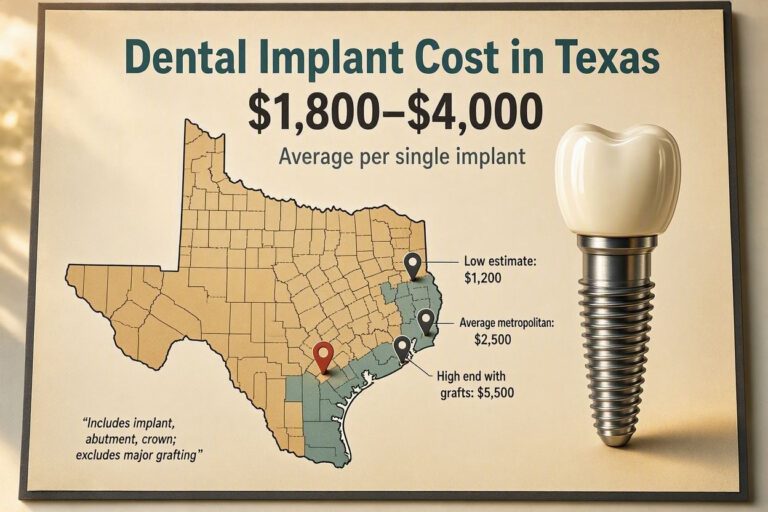
A single tooth implant in the United States typically costs between 3,000and3,000and6,000 for everything. That includes the surgery, the implant parts, the abutment, and the crown. In some high-cost cities like New York or Los Angeles, it could reach 7,000to10,000 if you choose a specialist.
If you need a bone graft first, add 300to300to1,000 to the total.
Why is there such a wide range?
The price depends on:
- Your location – Rural vs. major city.
- Who performs the surgery – A general dentist costs less than a periodontist or oral surgeon. But specialists have extra years of training.
- What material the crown uses – Zirconia (strong and white) costs more than porcelain-fused-to-metal.
- Whether you have insurance – Most dental insurance does not cover the implant post well, but many cover part of the crown.
A realistic price table
| Component | Low Estimate | High Estimate |
|---|---|---|
| Consultation + X-rays/CBCT | $150 | $500 |
| Implant post placement | $1,500 | $3,000 |
| Abutment | $300 | $600 |
| Custom crown | $1,000 | $2,500 |
| Bone graft (if required) | $300 | $1,000 |
| Total average (no graft) | $2,950 | $6,100 |
| Total average (with graft) | $3,250 | $7,100 |
Does insurance cover anything?
Some dental plans call implants “cosmetic” and pay zero. Others have changed their tune because they know implants prevent future problems.
Here is typical dental insurance coverage:
- Implant post: 0% to 50% coverage (often subject to a yearly max of 1,000to1,500).
- Abutment and crown: 50% to 80% coverage, similar to any other crown.
- Bone graft: Rarely covered unless medically necessary.
Medical insurance sometimes covers implants if you lost the tooth due to an accident (trauma) or a medical condition like a tumor. But not for ordinary tooth decay.
Ways to make it more affordable
- Dental schools – Supervised students perform the work at 40-60% less cost. The appointments take longer, but the quality is excellent.
- Payment plans – Many offices offer CareCredit or in-house financing with 0% interest for 6-12 months.
- Dental tourism – Mexico, Costa Rica, Colombia, and Thailand offer implants for 1,000to2,500 total. But factor in travel costs and the challenge if something goes wrong when you are home.
- FSA/HSA accounts – Use pre-tax dollars to save 20-30% on out-of-pocket costs.
Warning: If a price sounds too good to be true (like $500 for a full implant), it probably is. Avoid anything that seems sketchy. Cheap implants overseas sometimes use low-quality materials or unsterile techniques. Infections and failures cost far more to fix later.
Recovery Timeline: What to Expect After a Single Tooth Implant
Healing happens in stages. Most people feel fine within a few days, but complete bone fusion takes months. Here is what a normal recovery looks like.
Days 1-3: The toughest part
- What you feel: Some swelling, mild bruising, and occasional bleeding. Your gum might feel sore, like after a deep cleaning. Most patients manage pain with over-the-counter ibuprofen (Advil) or acetaminophen (Tylenol).
- What to do: Rest today. Apply ice packs to your cheek in 20-minute intervals. Eat soft, cool foods like yogurt, smoothies, mashed potatoes, and scrambled eggs. Drink from a cup, not a straw (sucking can dislodge the blood clot).
- What to avoid: No spitting, no smoking, no alcohol, no crunchy foods, and no touching the area with your tongue or finger.
Days 4-14: Back to normal life
- What you feel: Swelling goes down. Any stitches may dissolve or get removed. You might feel a hard bump under your gum – that is the implant, and it is supposed to be there.
- What to do: Resume most normal activities. Brush and floss carefully, avoiding direct pressure on the surgery site. Rinse gently with warm salt water twice daily.
- What to avoid: Still no chewing directly on the implant side. Stick to your other side for now.
Weeks 3-12: Quiet healing
- What you feel: Almost nothing. You might forget you even had surgery. The implant is silently fusing to your bone.
- What to do: Return to a normal diet but still go easy on really hard foods like nuts or ice on that side. Keep all follow-up appointments so your dentist can monitor healing.
- What to watch for: Any sudden pain, swelling, or the implant feeling loose. That is rare, but call your dentist if it happens.
Months 4-9: Final stages
- What you feel: Normal. The area should feel like a natural part of your mouth, even before the crown goes on.
- What to do: Show up for your abutment and crown appointments. Once the final crown is in place, you can chew normally on that side again. Enjoy your new tooth.
Signs of a problem (call your dentist immediately)
- Fever over 101°F (38.3°C)
- Pus or a bad taste coming from the site
- Severe pain that painkillers do not touch
- The implant feels loose or moves
- Numbness that does not go away after 24 hours (rare)
Most of these never happen. But it is good to know what to watch for.
Success Rates and Longevity: How Long Will It Last?
Here is the honest truth that dentists rarely say out loud: No medical procedure has a 100% success rate.
But a single tooth implant comes very close.
The success rate for a lower jaw (mandible) implant is 95-98% over 10 years. The upper jaw (maxilla) has slightly softer bone, so success is around 90-95%. These are excellent numbers. For comparison, a dental bridge has a 10-year survival rate of about 74%.
What causes an implant to fail?
Early failure (within the first few months):
- The bone did not integrate with the implant. This is rare but happens.
- Infection at the surgery site.
- You smoked heavily during healing.
- You have uncontrolled diabetes.
Late failure (months or years later):
- Peri-implantitis – This is gum disease around the implant. It causes bone loss and loosening. This is the #1 cause of late failure.
- Grinding or clenching your teeth (bruxism) – Extra force can break the crown or the implant screw.
- Poor oral hygiene – Implants need cleaning just like real teeth.
How to make your implant last 30+ years
Treat your implant like a premium athlete treats their body.
- Brush twice daily – Use a soft toothbrush. Pay special attention to the gumline around the crown.
- Floss every day – Use unwaxed floss or special “super floss” with a stiff end. Or use a water flosser (like Waterpik) on a low setting.
- Avoid chewing ice, pens, or hard candy – These can crack the crown porcelain.
- Wear a nightguard if you grind your teeth. Your dentist can make one for $300-500. It will save your implant (and your other teeth).
- Visit your dentist every 6-12 months – They will take X-rays to check the bone level around your implant. Problems caught early are easier to fix.
- Stop smoking – Smokers have twice the failure rate of non-smokers.
Do those six things, and there is a very good chance your implant will outlive you.
Risks and Complications: An Honest Discussion
No sugarcoating. Every surgery has risks. For a single tooth implant, serious complications are uncommon, but they exist. Knowing them helps you make an informed decision.
Common (but minor) risks
- Swelling and bruising – Expected. Usually gone in a week.
- Minor bleeding – Normal for the first 24-48 hours.
- Soreness in the jaw joint – From holding your mouth open during surgery. Resolves in a day or two.
Uncommon (but more serious) risks
| Complication | How often? | What it means for you |
|---|---|---|
| Infection | ~1-2% | Treated with antibiotics. Rarely requires implant removal. |
| Nerve damage (lower jaw) | Less than 1% | Temporary or permanent numbness in lip, chin, or tongue. Very rare with modern 3D X-rays. |
| Sinus perforation (upper back teeth) | ~2-4% for upper molars | The implant pokes into your sinus. Usually heals on its own. May need a sinus lift procedure. |
| Implant failure to integrate | 2-5% | The bone never fuses. Implant is removed. You try again after healing. |
| Peri-implantitis (late) | Up to 20% over 10 years if hygiene is poor | Bone loss around implant. Treatable if caught early. Can lead to implant loss if ignored. |
How dentists prevent these risks
- 3D CBCT scans – These show exactly where your nerves and sinuses are. The dentist plans the implant placement on a computer before touching your mouth.
- Surgical guides – A 3D-printed guide fits over your teeth and shows the dentist exactly where to drill. This is incredibly precise.
- Antibiotics – Most dentists prescribe a short course before or after surgery.
- Chlorhexidine rinse – A special mouthwash that kills bacteria during healing.
You can see why this is not a “cheap” procedure. You are paying for advanced technology and years of training.
What Does a Single Tooth Implant Feel Like? Real Patient Experiences
Let us hear from people who have actually done it. Names are changed for privacy, but the feelings are real.
Maria, 42, lost a front tooth in a biking accident:
“I was terrified of the surgery. I hate drills. But the numbing was so strong, I did not feel anything except pressure. The weirdest part was hearing the drill but feeling nothing. After the numbing wore off, I took one ibuprofen and went to sleep. The next day, I felt fine. A little sore, but less than a bad workout.
Now, I honestly forget which tooth is the implant. I floss right over it. I bite into apples. It feels 100% natural. No one has ever noticed unless I tell them.”
David, 58, replaced a lower molar that had been missing for 15 years:
“I waited way too long. The teeth next to the gap had started tipping over. My dentist said I might not have enough bone because it had been gone so long. Sure enough, I needed a bone graft first. That added 8 months and $800.
Was it annoying? Yes. Was it worth it? A thousand times yes. I can chew steak on both sides of my mouth for the first time in a decade. My other teeth stopped shifting. I should have done this years ago.”
Linda, 35, had an implant fail:
“I want to be honest because everyone only shares happy stories. I am a smoker, and my dentist warned me the risk was higher. I thought I would be fine. I smoked during healing. Three months later, the implant was loose. It never integrated.
They removed it, let it heal, and I tried again. I quit smoking for four months. The second time worked perfectly. Now I have a tooth. But I wasted $3,000 because I did not listen the first time. Listen to your doctor.”
Carlos, 27, got his implant at a dental school:
“I could not afford 5,000.Adentalschoolnearmecharged1,800 total. A student did the surgery with a supervising professor watching everything. It took longer – every step was checked twice – but the work was great. Two years later, my implant is perfect. If you have a school nearby, at least go for a consultation.”
These stories reflect the range of experiences. Most are positive. A few have hiccups. But the common thread is that people overwhelmingly say it was worth it.
7 Common Myths About Single Tooth Implants – Busted
Let us clear up some misinformation floating around the internet.
Myth 1: “The surgery is extremely painful.”
Truth: The surgery itself is painless due to local anesthesia. Afterward, most patients compare the soreness to a tooth extraction. Over-the-counter pain relievers handle it just fine.
Myth 2: “Dental implants fail all the time.”
Truth: 95%+ success rates over a decade is better than most medical procedures. Knee replacements have a similar success rate, and no one calls those experimental.
Myth 3: “I am too old for an implant.”
Truth: Age alone does not matter. Your health and bone density matter. Many people in their 80s get implants to improve chewing and nutrition.
Myth 4: “My body might reject the titanium.”
Truth: Titanium allergies exist but are incredibly rare (less than 0.6% of people). True rejection is not really a thing because implants are not living tissue. Failure happens due to infection or poor bone integration, not an immune response.
Myth 5: “Implants cause headaches or metal poisoning.”
Truth: There is zero scientific evidence that titanium dental implants cause systemic health problems or “metal poisoning.” This myth comes from anti-vaccine or pseudoscience circles. Trust peer-reviewed research, not Facebook groups.
Myth 6: “A bridge is just as good and half the price.”
Truth: A bridge costs less upfront but damages healthy teeth and does not stop bone loss. Over 20 years, you will likely replace the bridge once or twice. The implant becomes the more cost-effective option.
Myth 7: “I cannot get an implant if I have gum disease.”
Truth: You cannot get an implant while gum disease is active. But once you treat the gum disease and keep it under control, you can absolutely get an implant. Many people do this.
How to Choose the Right Dentist for Your Single Tooth Implant
This decision matters as much as the procedure itself. A good dentist sets you up for success. A poor one creates problems.
Types of providers
| Provider | Training | Best for | Typical cost |
|---|---|---|---|
| General dentist | Dental school + maybe a weekend implant course | Simple cases, enough bone, no health complications | Lower |
| Oral surgeon | Dental school + 4-6 years surgical residency | Complex cases, bone grafting, sinus lifts, impacted teeth | Higher |
| Periodontist | Dental school + 3 years gum/bone specialty | Implants in areas with gum disease history, soft tissue grafting | Higher |
| Prosthodontist | Dental school + 3 years restorative specialty | Complex crowns, aesthetic cases (front teeth), full mouth rehab | Highest |
Questions to ask before committing
- “How many single tooth implants have you placed in the last year?” (You want at least 50 if they are a general dentist; specialists do hundreds.)
- “What is your success rate?” (Should be 95% or higher.)
- “Do you use a 3D CBCT scan for planning?” (If they say no, walk away.)
- “What happens if the implant fails – do I pay again?” (Fair offices will replace a failed implant at no charge for the implant part, but you may pay for the new crown.)
- “Can I speak to a former patient?” (A confident dentist will say yes.)
Red flags
- They quote a price that includes everything but then adds surprise fees later.
- They push you to decide the same day.
- They have no online reviews or many 1-star reviews about pain or failures.
- They say you do not need any X-rays.
Trust your gut. If something feels off, get a second opinion. It is worth the consultation fee.
Caring for Your Single Tooth Implant: A Long-Term Maintenance Guide
You made a big investment. Protect it.
Daily care routine (5 minutes)
Morning:
- Brush for two minutes with a soft or extra-soft toothbrush. Pay attention to where the crown meets the gum. Angle your brush 45 degrees toward the gumline.
- Use a non-abrasive toothpaste. Avoid whitening toothpastes with baking soda or charcoal – they can scratch the crown’s glossy surface.
Evening:
- Brush again.
- Floss around the implant. Use regular floss, but check for signs of shredding. If floss catches or tears, that could mean the crown has a rough edge. Tell your dentist.
- Rinse with an alcohol-free mouthwash. Alcohol can dry out gum tissue over time.
Weekly:
- Use a water flosser on a low to medium setting. Aim the stream at the gumline from both the cheek side and the tongue side.
Products that help
- Super floss – Has a stiff end to thread under the crown.
- Interdental brushes – Tiny brushes that clean between teeth. Look for soft, rubber-coated ones.
- Single-tufted toothbrush – A small, round brush head that gets into tight spaces around the crown.
- Nightguard – A must if you grind or clench.
What to avoid forever (do not cheat on these)
- Chewing ice, hard candies, or popcorn kernels – The porcelain crown can chip.
- Using your teeth as tools (opening packages, tearing tape).
- Smoking or vaping – Nicotine constricts blood vessels and reduces bone health.
- Skipping dental checkups – Period.
Professional maintenance
Your dentist should:
- Take a small X-ray (periapical) of your implant every 12-24 months to check bone levels.
- Probe around the implant gently with a special plastic instrument (metal probes can scratch the implant surface).
- Clean the crown with special non-metallic scalers.
If your hygiene slips and you develop peri-implantitis, treatment options include deep cleaning (like a root planing but for the implant), antibiotics, and in advanced cases, surgery to clean the implant threads. Do not let it get that far.
Single Tooth Implant for Front Teeth vs. Back Teeth: Key Differences
Not all single tooth implants are created equal. Where the missing tooth sits in your mouth changes the treatment plan.
Front tooth implant (incisors or canines)
The biggest challenge: Aesthetics. Your front teeth show when you talk, smile, and laugh. The crown needs to look perfect.
Special considerations:
- Gum shape matters – The gum tissue around the crown must mimic the curve of your natural adjacent teeth. This takes an artistic touch.
- No metal showing – The abutment can be made of zirconia (white) instead of titanium (gray) so it does not darken the gum.
- Temporary crown during healing – You will leave the office with a temporary tooth so you never have a gap. This temporary does not touch the implant itself (non-loading) to let bone heal.
- Longer healing time – Front teeth receive more force from biting and tongue movement. Some dentists wait 6 months or more before placing the final crown.
Average cost: 4,000–7,500 (because of higher aesthetic skill required)
Back tooth implant (premolars or molars)
The biggest challenge: Chewing forces. Molars take 200+ pounds of force per square inch. The implant must be robust.
Special considerations:
- Wider implant post – Molar implants are sometimes wider in diameter to handle the force.
- Bone quantity is usually better – Back jaws have denser bone than the front upper jaw. Success rates are slightly higher.
- Appearance is less critical – You can use a porcelain-fused-to-metal crown (stronger but with a metal inside). It costs less than all-ceramic.
- Potential sinus issues (upper back only) – Upper molars sit right under your sinus cavity. Your dentist must check the sinus floor height carefully.
Average cost: 3,000–5,500
Comparison table
| Feature | Front Tooth Implant | Back Tooth Implant |
|---|---|---|
| Visibility | High | Low |
| Aesthetic demand | Very high | Low to moderate |
| Chewing forces | Moderate | Very high |
| Typical crown material | Zirconia or all-ceramic | Porcelain-fused-to-metal or zirconia |
| Risk of sinus involvement | None (unless very unusual) | Moderate for upper molars |
| Average total cost | 4,000–7,500 | 3,000–5,500 |
Single Tooth Implant FAQ
Q: How long does the whole process take from start to finish?
A: Typically 4 to 9 months. This includes healing time for bone to fuse to the implant. If you need a bone graft first, add another 4 to 9 months.
Q: Does a single tooth implant hurt?
A: The surgery itself does not hurt because of local anesthesia. Afterward, most people have mild soreness for 2-4 days. Many compare it to having a tooth pulled, not worse.
Q: Can I get a same-day implant?
A: In select cases, yes. “Immediate placement” means the implant goes in right after a tooth is pulled. “Immediate loading” means a temporary crown goes on the same day. But same-day is not right for everyone. Your dentist will tell you if you qualify.
Q: What happens if I wait too long to replace a missing tooth?
A: The neighboring teeth tilt into the gap. The opposing tooth (the one that used to bite against the missing tooth) may drift upward or downward. You lose bone in the gap, which makes an implant harder later. So earlier is generally better, but later is still possible with a bone graft.
Q: Can my body reject a titanium implant?
A: True allergy-driven rejection is extremely rare (less than 1 in 200,000 people). Most failures happen from infection, poor bone quality, or smoking – not “rejection.”
Q: Is a single tooth implant covered by insurance?
A: Most dental insurance plans cover a portion of the crown (50-80%) but less of the implant post. Check your specific plan. Medical insurance rarely covers it unless from trauma or a medical condition.
Q: Can I have an MRI with a dental implant?
A: Yes. Titanium is not magnetic. Dental implants are completely safe for MRI and CT scans.
Q: Will my implant feel different from my natural teeth?
A: For biting pressure, it feels almost identical. The main difference is that an implant cannot feel hot or cold because it has no nerve. You will not notice that day to day.
Q: What is the failure rate for smokers?
A: Smokers have a failure rate roughly twice that of non-smokers – around 10-15% instead of 5%. Heavier smokers have even higher risk. Quitting for at least 2 weeks before and 2 months after surgery dramatically improves success.
Q: Can I whiten my implant crown?
A: No. Dental crowns do not respond to whitening gel. If you want to whiten your natural teeth, do it before you get the crown made. That way the lab can match the new, whiter shade.
Additional Resources
For more reliable, evidence-based information on single tooth implants, visit the American Academy of Periodontology’s patient education page:
https://www.perio.org/for-patients/dental-implant-procedures/
This resource covers implant types, maintenance, and how to find a specialist in your area.
Conclusion
A single tooth implant is the closest modern dentistry can come to giving you back a natural tooth. It preserves your jawbone, protects your neighboring teeth, and can last a lifetime. The process takes several months and costs more upfront than a bridge or denture, but the long-term benefits – comfort, function, and confidence – make it a worthwhile investment for most people.
If you have a missing tooth, schedule a consultation with an implant dentist or specialist. Ask questions. Get a second opinion if you need one. And remember: taking care of your implant with daily cleaning and regular checkups is the secret to never worrying about that gap again.