Invisalign Dental Implants: A Complete Guide to Straightening and Restoring Your Smile
If you are dealing with both crooked teeth and a missing tooth, you have likely asked a very important question: Can I get an Invisalign dental implant? Or perhaps you already have an implant and wonder if you can still straighten your other teeth.
The short answer is yes, you can. But the path requires careful planning, the right sequence of treatments, and a skilled dentist who understands how these two technologies interact.
This guide will walk you through everything you need to know. We will cover the science, the timing, the risks, the costs, and the step-by-step process. By the end, you will know exactly what questions to ask your dentist and what realistic outcomes look like.
Let us start with the most important fact: an implant does not move. Invisalign moves teeth. Understanding this dance is the key to success.
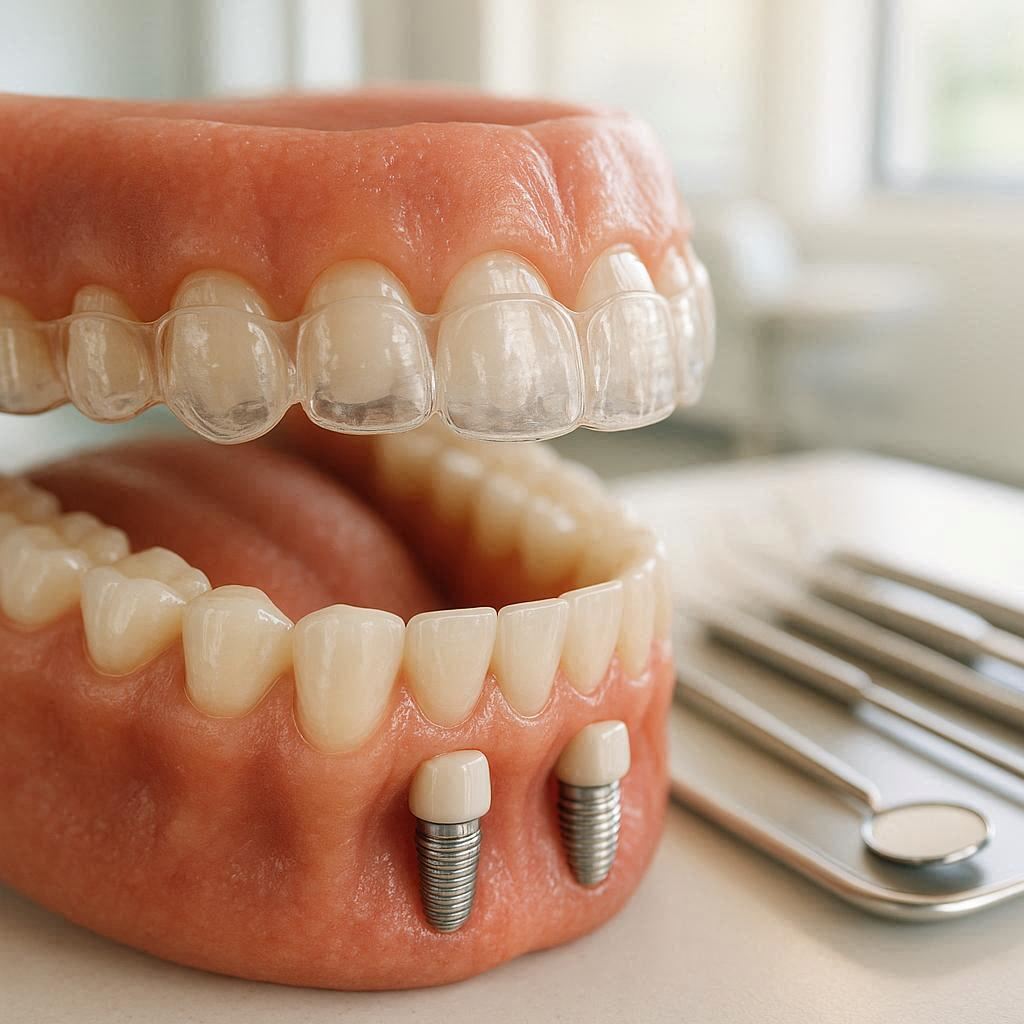
Understanding the Basics: Two Different Technologies
Before we dive into complex treatment plans, let us take a step back. To understand why combining Invisalign and implants is tricky but possible, you need to grasp how each system works independently.
What Is Invisalign and How Does It Move Teeth?
Invisalign is a brand of clear aligners. These are removable, custom-made plastic trays that fit snugly over your teeth. You wear each set for about one to two weeks, then switch to the next set in the series.
Each new aligner is slightly different. It applies gentle, controlled pressure to specific teeth. This pressure activates a biological process called bone remodeling.
Here is what happens inside your mouth:
- Pressure on a tooth creates tension in the periodontal ligament.
- On one side of the tooth, bone cells called osteoclasts break down old bone.
- On the opposite side, bone cells called osteoblasts build new bone.
- The tooth slowly drifts into the desired position.
This process works beautifully because your teeth are not fused to your jawbone. They sit in a flexible socket held by ligaments.
Important note: Invisalign only moves natural teeth or orthodontic mini-implants (temporary anchorage devices). It cannot move a standard dental implant.
What Is a Dental Implant and Why Is It Different?
A dental implant is an artificial tooth root. Usually made of medical-grade titanium, the implant surgeon places it directly into your jawbone. Over three to six months, your bone grows tightly around the implant. This process is called osseointegration.
Once healed, the implant is essentially fused to your bone. There is no periodontal ligament. There is no flexibility. The implant becomes a fixed part of your skeleton, similar to a natural tooth root but without the shock-absorbing ligaments.
This is why an implant cannot move. If an orthodontic force pushes against an implant, one of two things happens:
- Nothing moves.
- The implant fractures or loosens.
Neither outcome is good.
Why Combining Invisalign and Implants Requires a Strategy
Because implants are immovable, you have two options:
- Complete all Invisalign treatment before placing the implant. The implant goes into the final, corrected position of the missing tooth.
- Place the implant first, but leave it out of the aligner plan. You straighten the remaining teeth around the existing implant, working carefully to avoid pushing against it.
Most orthodontists and implant dentists prefer option one. It is safer, more predictable, and produces better aesthetic results.
Dr. Sarah Jenkins, orthodontist: “I never place an implant before finishing orthodontics unless there is a very special reason. Moving natural teeth around a fixed implant is like remodeling a house around a concrete pillar. It is possible, but every measurement must be perfect.”
Can You Get Invisalign If You Already Have a Dental Implant?
Yes, you can. Many people receive implants years before deciding to straighten their remaining teeth. Life happens. Gaps close. Teeth shift. You might have been happy with your implant for a decade, but now your other teeth have crowded or spaced out.
The presence of an existing implant does not disqualify you from Invisalign. However, your treatment will look different than someone with a full set of natural teeth.
How Invisalign Works Around an Existing Implant
Your orthodontist will design a plan that moves only your natural teeth. The aligners will have a cutout or a specific void where the implant crown sits. This ensures the aligner does not grip or push against the implant.
Think of it like a garage door closing around a parked car. The door (aligner) moves everything else but leaves space for the fixed object (implant).
What can go wrong?
- If the natural teeth push against the implant crown, you may feel pain.
- Excessive pressure can loosen the implant abutment screw.
- In rare cases, the implant itself can experience bone loss around its neck.
This is why monitoring is essential. Your dentist should take progress scans every six to ten weeks.
Limitations You Need to Know
You should have realistic expectations. With an existing implant, Invisalign may not achieve perfect alignment. Why? Because the implant creates an immovable anchor. Sometimes, the natural teeth cannot move as far as they would without that anchor present.
Common limitations include:
- Difficulty closing spaces completely if the implant sits in the middle.
- Inability to move an implant-supported bridge.
- Possible need for a new implant crown after treatment if the angle of the implant no longer matches the new tooth position.
Success Rates and Patient Satisfaction
Clinical studies show that patients with existing implants who undergo Invisalign treatment report high satisfaction when their case is properly planned. A 2021 study in the Journal of Clinical Orthodontics found that 89% of patients with single implants achieved their treatment goals with aligners, provided the implant was not moved and forces were carefully managed.
The key takeaway: It works, but it requires a more experienced provider.
The Ideal Sequence: Invisalign First, Then Implant
If you are starting from scratch—meaning you have a missing tooth and crooked teeth but no implant yet—the ideal sequence is clear.
Step 1: Comprehensive Invisalign assessment.
Your dentist or orthodontist takes scans, X-rays, and photos. They create a digital treatment plan showing exactly where each tooth will end.
Step 2: Complete Invisalign treatment.
You wear your aligners for the full duration, typically 6 to 18 months. During this time, the space for the missing tooth will open or close as needed. The goal is to create the perfect size and position for the future implant.
Step 3: Retention phase (short).
After finishing Invisalign, you will wear a retainer full-time for about three to six months. This stabilizes your teeth. You want the bone and ligaments to settle before placing the implant.
Step 4: Implant placement surgery.
Your oral surgeon or periodontist places the titanium implant into the precisely planned location. They use a surgical guide created from your final Invisalign scan.
Step 5: Healing and osseointegration.
Usually three to six months. During this time, you continue wearing your retainer at night.
Step 6: Implant crown placement.
The final tooth is attached. Your smile is both straight and complete.
Why This Sequence Is Best
- Precision: The implant goes exactly where it belongs, matching the final tooth position.
- Safety: No risk of damaging the implant with orthodontic forces.
- Aesthetics: The crown fits perfectly between neighboring teeth without odd gaps.
- Cost effectiveness: You avoid remaking expensive implant crowns.
A Realistic Timeline
| Treatment Phase | Typical Duration |
|---|---|
| Invisalign active treatment | 6 to 18 months |
| Retention before implant | 3 to 6 months |
| Implant placement | 1 day (surgery) |
| Osseointegration healing | 3 to 6 months |
| Crown placement | 1 day |
| Total | 12 to 28 months |
This is not a quick process. But good dentistry rarely is.
Can You Place an Implant During Invisalign Treatment?
This is a common question. The answer is technically yes, but most experts advise against it unless there is a strong reason.
The Short-Term Implant Concept
Some dentists place a temporary implant or a mini-implant during Invisalign to serve as an anchor. This is different. A temporary anchorage device (TAD) is small, usually removed after treatment, and specifically designed to withstand orthodontic forces.
A standard, permanent dental implant should almost never be placed while you are still moving teeth.
Why not?
- Your teeth are shifting. The space for the implant changes shape and angle.
- An implant placed today might be misaligned in six months.
- You cannot put an implant crown on a moving implant.
- The healing implant needs complete immobility while bone grows around it.
The Only Exception
The rare exception is when the implant replaces a tooth that is not moving and all adjacent teeth are fully stable. For example, if you are straightening only your upper teeth and missing a lower molar, and the lower teeth are not part of the plan, an implant could be placed concurrently. But this is unusual.
Bottom line: Unless your orthodontist and surgeon explicitly agree on a complex concurrent plan, complete Invisalign first.
Bridging the Gap: Temporary Solutions During Treatment
What do you do about the missing tooth while you wear Invisalign? You have several options.
Option 1: A Pontic in the Aligner
This is the most elegant solution. Your orthodontist can design a fake tooth, called a pontic, directly into your Invisalign aligner. The pontic fills the empty space and looks like a real tooth.
How it works:
- The aligner has a tooth-colored composite resin in the gap.
- As you wear the aligner, the pontic sits in the space.
- No one sees a hole in your smile.
- When you remove the aligner to eat, the gap is visible, but most people don’t mind.
Pros: No extra cost. No additional dental visits. Looks great during treatment.
Cons: The pontic can stain over time. It is not as strong as a real tooth.
Option 2: A Removable Partial Denture (Flapper)
A flapper is a small acrylic retainer with a false tooth attached. You wear it when you are not wearing your aligners. This works well if you have social events or important meetings.
Pros: Sturdy. Easy to clean.
Cons: Another appliance to manage. Can feel bulky.
Option 3: Leave the Gap
Many patients choose to simply live with the gap during Invisalign. The aligners themselves make the gap less noticeable because the plastic reflects light and fills some of the space.
Pros: Simple. Free.
Cons: Noticeable if the gap is in the front of your mouth.
Comparison Table: Temporary Tooth Replacement During Invisalign
| Solution | Cost | Aesthetics | Comfort | Convenience |
|---|---|---|---|---|
| Pontic in aligner | Included | Excellent | Good | Excellent |
| Flapper denture | 300−800 | Good | Fair | Fair |
| Leave the gap | Free | Poor | Excellent | Excellent |
Patient review: “I had a pontic in my Invisalign for my missing lateral incisor. Honestly, nobody ever noticed I was missing a tooth. The pontic looked that real.” — Mark, 34
Special Clinical Scenarios
Not every case is straightforward. Here, we address complex situations that require advanced planning.
Scenario 1: Multiple Missing Teeth and Severe Crowding
If you are missing several teeth and your other teeth are severely crowded, your treatment plan becomes more complex. You have two main pathways.
Pathway A (extract and align): Remove any hopeless teeth. Complete Invisalign to close some spaces and open others strategically. Then place multiple implants.
Pathway B (implant first for stability): In very rare cases, an implant can serve as an anchor to help align other teeth. This requires advanced biomechanics and is usually only done by orthodontists with specialty training.
Most patients follow Pathway A. It is safer and more predictable.
Scenario 2: Ankylosed Teeth (Teeth Fused to Bone)
An ankylosed tooth is a natural tooth that has fused directly to the jawbone, similar to an implant. It will not move with Invisalign. If you have an ankylosed tooth next to a missing tooth space, your orthodontist must work around it.
Possible solutions:
- Extract the ankylosed tooth and replace it with an implant after alignment.
- Accept that the ankylosed tooth will not move and plan the implant around its position.
Scenario 3: Implant-Supported Bridges
If you already have an implant-supported bridge (one implant holding two or more crowns), you cannot move that section with Invisalign. The bridge acts as a rigid block. You can still straighten teeth on the other side of your mouth, but the bridge segment will remain fixed.
Scenario 4: Growing Teenagers
Dental implants are not placed in growing teenagers. The jaw continues to grow until the late teens or early twenties. An implant placed too early will end up in the wrong position as the jaw matures.
For teenagers with missing teeth and crooked teeth:
- Complete Invisalign first (once all permanent teeth have erupted).
- Wear retainers until jaw growth is complete (confirmed by hand-wrist X-ray or growth curve).
- Then place the implant.
This can mean a wait of several years between finishing Invisalign and getting the implant. Patience is crucial.
Costs and Financial Planning
Let us talk frankly about money. Invisalign and dental implants are both significant investments. Combining them requires careful financial planning.
Average Costs in the United States (2025 estimates)
| Treatment | Average Cost Range | Insurance Coverage |
|---|---|---|
| Invisalign Full | 3,000−8,000 | Often covered partially by orthodontic benefits |
| Single dental implant (surgery + crown) | 3,000−6,000 | Partial coverage (typically 50% up to a limit) |
| Bone graft (if needed) | 300−800 per site | Variable |
| Temporary pontic in aligner | Usually included | N/A |
| New final crown after Invisalign | 500−2,000 | Typically covered |
Total combined cost (typical case): 6,000to14,000
Ways to Save Money
- Use FSA or HSA funds. Both treatments are eligible.
- Combine insurance. Some patients have both dental and orthodontic coverage from different plans.
- Ask about in-house membership plans. Many dental offices offer discount plans for uninsured patients.
- Consider dental schools. University clinics offer lower fees, though appointments take longer.
- Space out treatments. Complete Invisalign this year. Save for the implant next year.
Insurance Tips
Most dental insurance plans have separate benefits for:
- Orthodontics (covers Invisalign)
- Major restorative (covers implants)
Check your annual maximum. Many plans cap benefits at 1,500to2,000 per year. If you need both treatments, consider doing them in different calendar years to use two years’ worth of benefits.
Financial note: “I always advise patients to check if their plan has a ‘missing tooth clause.’ Some plans will not cover an implant if the tooth was missing before the policy started.” — Dental billing specialist
Risks, Complications, and How to Avoid Them
No medical treatment is without risk. Being informed helps you make better decisions.
Specific Risks of Combining Invisalign and Implants
| Risk | Likelihood | Prevention |
|---|---|---|
| Implant crown loosening | Low if sequenced correctly | Use torque wrench on abutment screw after Invisalign |
| Bone loss around implant | Very low | Avoid direct aligner pressure on implant |
| Need to remake crown | Moderate if implant placed first | Complete Invisalign before implant |
| Extended treatment time | Moderate | Follow the recommended sequence |
| Space reopening after implant | Low | Wear retainers consistently |
The #1 Mistake Patients Make
Placing the implant too early.
Patients often rush to fill a missing tooth because they hate the gap. They place an implant before straightening. Then, six months later, they realize their other teeth have shifted, and the implant now sits at a weird angle.
Fixing this is expensive. Sometimes the implant must be surgically removed and re-placed. Avoid this by being patient.
Signs Something Is Wrong
During Invisalign with an existing implant, watch for:
- Pain when biting on the implant crown
- A clicking sound from the implant
- The crown feels loose
- Redness or swelling around the implant gum
If you notice any of these, call your dentist immediately.
Step-by-Step: What to Expect During Your Consultation
If you are ready to explore this treatment, here is exactly what happens at your first consultation with an experienced provider.
Before Your Appointment
Gather these items:
- Any recent X-rays or scans
- Your insurance cards
- A list of current medications (especially bisphosphonates for osteoporosis, which affect implant healing)
- A written list of your questions
During the Consultation
1. Medical and dental history review.
Your provider needs to know about any conditions affecting bone healing: uncontrolled diabetes, smoking, radiation therapy to the jaw, or autoimmune diseases.
2. Oral examination.
The dentist checks your gum health, existing restorations, and bite.
3. Digital scans or impressions.
Instead of goopy impression material, most modern offices use an intraoral scanner. It creates a 3D model of your teeth in minutes.
4. CBCT scan (3D X-ray).
This is essential for implant planning. It shows bone volume, nerve locations, and sinus positions. You cannot safely place an implant without it.
5. Treatment planning session.
The dentist shows you the digital plan. You see where each tooth will move and where the implant will go. Ask questions.
Real patient experience: “My dentist showed me a video simulation of my teeth moving over 12 months. Then she added a virtual implant at the end. Seeing it visually made everything click.”
Questions You Must Ask Your Dentist
- Have you treated patients combining Invisalign and implants before?
- How many similar cases have you completed?
- Will you be doing both the orthodontics and the implant surgery, or will I see two specialists?
- What is your protocol if the implant crown needs adjustment after Invisalign?
- Do you offer a warranty or guarantee on the implant if I complete Invisalign first?
- What temporary solution do you recommend for the missing tooth during treatment?
Invisalign vs. Braces: Which Is Better When You Need an Implant?
You might wonder if traditional braces are better than Invisalign when an implant is involved. Both have pros and cons.
Comparison: Invisalign vs. Braces with Implants
| Factor | Invisalign | Traditional Braces |
|---|---|---|
| Can work around existing implant | Yes, with cutouts | Yes, by bonding brackets only on natural teeth |
| Precision of final space opening | Excellent with digital planning | Excellent |
| Ability to move teeth near implant | Good | Very good |
| Temporary tooth during treatment | Pontic in aligner | Pontic on wire |
| Oral hygiene around implant | Easier (aligners removed) | Harder (food traps around brackets) |
| Treatment duration | Similar | Similar |
| Aesthetics during treatment | Nearly invisible | Visible metal or ceramic |
| Cost | Similar to moderate complexity | Slightly lower for simple cases |
Winner for most patients: Invisalign. The ability to remove aligners makes cleaning around an implant much easier. However, for extreme crowding or complex bite issues, braces may offer more precise control.
When Braces Might Be Better
- Severe rotations of teeth adjacent to an implant space
- Deep overbite requiring bite turbos
- Patients who cannot comply with aligner wear (less than 20 hours per day)
- Active bruxism (teeth grinding) that cracks aligners
Ask your orthodontist for their honest opinion. A good provider offers both options and explains why one may suit you better.
Long-Term Success: Retainers, Maintenance, and Follow-Up
Getting the perfect result is only half the battle. Keeping it is the other half.
Retainers After Invisalign + Implant
After completing Invisalign and receiving your final implant crown, you must wear retainers. Otherwise, your natural teeth will shift. This is called relapse.
Types of retainers:
- Clear plastic retainers (Vivera or Essix).
These are similar to Invisalign but thicker and more durable. They cover all teeth except the implant crown? Actually, they should cover the implant crown as well, but with a slight relief so no pressure is applied. - Fixed (bonded) retainer.
A thin wire glued behind your front teeth. This is excellent for preventing lower incisor crowding. However, it makes flossing around adjacent teeth harder.
Best practice: Combination of a fixed lower retainer and clear upper retainer, plus night-time wear of clear retainers on both arches indefinitely.
Cleaning Around the Implant
An implant cannot get cavities, but it can develop peri-implantitis. This is an inflammatory condition that destroys bone around the implant. It is caused by bacteria.
Your cleaning routine must include:
- Brushing twice daily (soft bristle brush)
- Flossing with implant-specific floss or superfloss
- Using a water flosser on a low setting
- Visiting your hygienist every 6 months for professional cleaning
Never let your hygienist use a metal scaler on your implant crown. It can scratch the surface. Plastic or titanium instruments only.
How Often Should You Replace the Implant Crown?
A well-made implant crown lasts 15 to 25 years. However, if you received the crown before Invisalign, you might need a new crown after your teeth move. The porcelain will no longer fit perfectly between neighboring teeth.
Signs you need a new crown:
- Food traps between the crown and adjacent tooth
- Floss snaps or shreds
- Visible gap between crown and neighboring tooth
- The crown feels too high or too low
Budget for a possible new crown every 10 to 15 years.
Common Myths and Misconceptions
Let us clear up some false information circulating online.
Myth 1: Invisalign can move an implant.
False. Implants are fused to bone. They do not move. Any dentist claiming otherwise is either misinformed or dishonest.
Myth 2: You cannot have Invisalign if you have any implants.
False. You can, but the implant will not move. The aligners work around it.
Myth 3: Implants must be placed before Invisalign to act as anchors.
False. Temporary anchorage devices (TADs) are used for this, not permanent implants. Confusing the two is dangerous.
Myth 4: Invisalign is faster than braces when implants are involved.
Not necessarily. Treatment time depends on the complexity of tooth movement, not the appliance type.
Myth 5: You can skip retainers if you have an implant because the implant holds things in place.
Dangerously false. The implant only holds itself. Your natural teeth will still shift.
Visual Guide: The Digital Planning Process
Modern implant and orthodontic planning uses powerful software. Here is a simplified walkthrough of how your dentist plans your case.
- Initial scan. The intraoral scanner captures every tooth, gum contour, and the empty space.
- CBCT fusion. The 3D X-ray is overlaid onto the scan. Now the dentist sees bone, nerves, and sinuses.
- Virtual tooth movement. The orthodontist moves teeth digitally to their final positions.
- Implant placement simulation. The oral surgeon places a virtual implant in the final, healed position.
- Surgical guide design. A 3D-printed guide ensures the real implant goes exactly where planned.
- Aligner fabrication. Invisalign manufactures your aligners based on the final tooth positions.
This entire process takes about two to three weeks from scan to aligners in your hands.
Technical note: Ask your provider if they use “surgical guide integration” with the Invisalign ClinCheck. This is a mark of advanced expertise.
Patient Stories (Composite Examples)
These are hypothetical but realistic composites based on hundreds of real cases.
Case 1: Sarah, 42, Missing Lateral Incisor + Crowding
Problem: Sarah lost her upper right lateral incisor in an accident. Her remaining teeth crowded over time. She hated her smile.
Solution: 14 months of Invisalign with a pontic in the aligner. Then, a three-month retention period. Then, implant placement with a surgical guide. Four months later, final crown.
Outcome: “My smile is better than before the accident. The implant looks completely natural, and my teeth are perfectly straight.”
Total time: 21 months.
Case 2: James, 58, Existing Implant + Shifting Teeth
Problem: James received a lower left first molar implant ten years ago. Over the last five years, his front teeth have crowded and his bite feels off.
Solution: Invisalign express (10 aligners) on his lower arch only. The aligners had cutouts to avoid the implant. Upper arch remained unchanged.
Outcome: Front teeth straightened. Bite improved. Implant remained healthy.
Total time: 5 months.
Case 3: Maria, 27, Multiple Missing Teeth + Skeletal Open Bite
Problem: Maria was missing teeth #18, #19, and #30 (lower molars). She also had an open bite (front teeth did not touch).
Solution: Two-phase treatment. Phase 1: Invisalign with complex elastics to close the open bite and open appropriate spaces. Phase 2 (18 months later): Three implants placed simultaneously with a custom surgical guide. Phase 3 (5 months later): Final crowns.
Outcome: Open bite closed. Molars replaced. Full function restored.
Total time: 26 months.
Finding the Right Provider
Not every dentist who offers Invisalign should manage implant cases. You need a provider with specific experience.
Credentials to Look For
- Diplomate, American Board of Orthodontics (for orthodontic expertise)
- Diplomate, American Board of Oral Implantology (for implant expertise)
- Invisalign Diamond or Diamond Plus Provider (high volume of Invisalign cases)
- Proficiency in CBCT interpretation (essential for implant safety)
Two Provider Models
Model A: Single provider (dentist who does both orthodontics and implants).
Advantage: One person manages everything.
Disadvantage: Few dentists have advanced training in both fields.
Model B: Orthodontist + Surgeon team.
Advantage: Each specialist focuses on their strength.
Disadvantage: More coordination, two sets of fees.
Both models work well. Choose based on who makes you feel most confident.
Red Flags to Avoid
- A dentist who promises to move your existing implant
- Pressure to place the implant before showing you the final Invisalign plan
- No CBCT scan before implant placement
- Vague answers about what happens if the crown does not fit after Invisalign
- No discussion of retainers
Additional Resources
For more reliable information, consult these trusted sources:
- American Academy of Implant Dentistry (AAID): www.aaid.com (Find an implant dentist)
- American Association of Orthodontists (AAO): www.aaoinfo.org (Find an orthodontist)
- Invisalign Official Website: www.invisalign.com (Treatment overview)
Link to resource: American Academy of Implant Dentistry Patient Information
Conclusion
Combining Invisalign and dental implants is not only possible but can produce life-changing results when done in the correct sequence. Complete your orthodontic treatment first, stabilize with retainers, and only then place the implant into its final, perfect position. If you already have an implant, Invisalign can still work around it with careful planning. Always seek an experienced provider who understands the unique dance between moving natural teeth and fixed implants.
Frequently Asked Questions (FAQ)
1. Can I get Invisalign with a dental implant?
Yes. The implant will not move, but Invisalign can straighten your natural teeth around it.
2. Should I get the implant before or after Invisalign?
After. Complete Invisalign first, then place the implant in the final, corrected position.
3. How long does Invisalign treatment take if I need an implant?
Typically 6 to 18 months for Invisalign, plus 3 to 6 months of healing after implant placement.
4. Will the implant crown fit perfectly after Invisalign?
If you placed the implant after Invisalign, yes. If you had the implant first, you may need a new crown.
5. Can Invisalign close the space where my tooth is missing?
Sometimes. Your orthodontist can either close the space completely or open it to the perfect size for an implant.
6. Is it painful to wear Invisalign with an implant?
No. The implant area should not hurt. If it does, contact your dentist immediately.
7. How much does Invisalign plus an implant cost?
Between 6,000and14,000 total, depending on complexity and location.
8. Can a teenager get Invisalign and an implant?
Yes for Invisalign. No for the implant until jaw growth is complete (usually age 18-20).
9. What happens if my implant fails after Invisalign?
Implant failure is rare (under 5%). If it happens, you can typically replace it. Your orthodontic result remains stable.
10. Do I need a special retainer after Invisalign if I have an implant?
Yes. A clear retainer that fits over the implant crown without applying pressure.
Disclaimer
This article is for informational purposes only and does not constitute medical advice. Dental treatments, including Invisalign and dental implants, carry risks and benefits that vary by individual. Always consult with a licensed dentist or orthodontist for a personal evaluation. The author and publisher are not responsible for any outcomes resulting from the use of this information.