Irving TX Dental Implants Options: A Complete Guide to Restoring Your Smile
Losing a tooth can feel like a small thing, but it often changes a lot. You might notice it when you eat, when you laugh, or when you look in the mirror. The good news is that modern dentistry offers a permanent solution that looks and feels completely natural.
If you live in Irving, Texas, you have access to some of the best dental implant providers in the Dallas-Fort Worth metroplex. But with so many choices, where do you start?
This guide walks you through every single option available in Irving. No confusing dental jargon. No hard sales. Just honest, clear information to help you make the right decision for your health and your budget.
Let’s explore the world of dental implants together.
What Exactly Is a Dental Implant?
Before we dive into the specific options in Irving, let’s cover the basics. A dental implant is not the same as a bridge or dentures. It is a small, screw-like post made from medical-grade titanium. A dentist surgically places this post into your jawbone, where it acts as an artificial tooth root.
Once the implant fuses with your bone through a process called osseointegration, your dentist attaches a custom-made crown on top. The result is a tooth that feels stable, looks natural, and functions exactly like your original tooth.
Important note: Dental implants have been used successfully for over 50 years. They have a success rate of around 95% to 98% in healthy patients. This is not experimental or new technology.
Why Irving Residents Choose Implants Over Other Options
Many people in Irving still use traditional bridges or removable dentures. These options work, but they come with limitations. Bridges require shaving down healthy teeth. Dentures can slip, click, or cause sore spots. Implants solve all of these problems.
Here is why Irving dentists recommend implants more often today:
- Bone preservation: When you lose a tooth, your jawbone starts to shrink. Implants stimulate the bone, just like a natural root. This keeps your face shape intact.
- Long-term savings: A bridge might last 7 to 10 years. Dentures need replacement every 5 to 7 years. A well-cared-for implant can last 30 years or more.
- Comfort: No adhesives, no slipping, and no embarrassing moments while eating or speaking.
- Eating freedom: Enjoy steak, corn on the cob, apples, and nuts. Implants handle the same bite force as natural teeth.
Irving TX Dental Implants Options: The Complete Spectrum
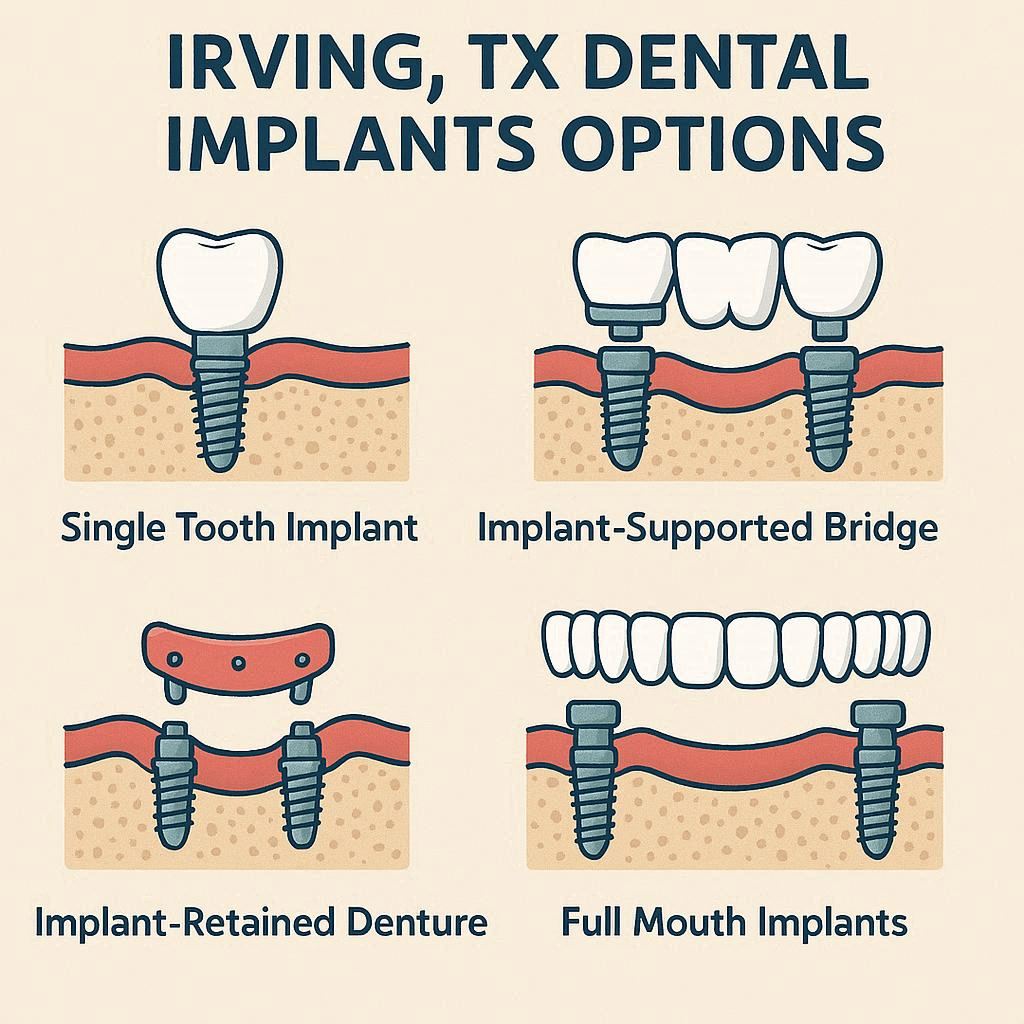
Irving offers a full range of implant solutions. Not every patient needs the same type. Your specific situation depends on how many teeth you are missing, the health of your jawbone, and your budget.
Let’s break down every option available in Irving, from single tooth replacements to full-mouth restorations.
Single Tooth Implants
This is the most common type of implant procedure in Irving. If you are missing one tooth, a single implant with a crown is the gold standard.
How it works: The dentist places one implant post into the gap. After healing, they attach an abutment and a custom-made ceramic crown. The crown matches the color, shape, and size of your surrounding teeth.
Advantages:
- Does not affect neighboring teeth
- Easy to clean (floss normally)
- Looks completely natural
Average cost in Irving: 3,000to4,500 for the entire procedure
Implant-Supported Bridges
What if you are missing two or three teeth in a row? You do not need one implant per missing tooth. An implant-supported bridge uses two implants to support a bridge with multiple false teeth in between.
How it works: Two implants go into the jaw at the ends of the gap. These implants hold a three- or four-unit bridge. The false teeth fill the space between.
Advantages:
- Fewer implants than individual replacements
- More stable than a traditional bridge
- Preserves bone at both ends of the gap
Average cost in Irving: 5,000to7,500 for three teeth
Implant-Retained Dentures (Snap-On Dentures)
Many Irving residents currently wear full dentures. If your dentures wobble, rub, or fall out, implant-retained dentures can change your life. This is also called an overdenture.
How it works: Two to four implants are placed in your jaw. Your denture gets special attachments that snap onto these implants. You can remove the denture for cleaning, but it stays firmly in place while you eat and talk.
Who is this for? Patients with significant bone loss who cannot support a full set of individual implants. Also great for people who want a more affordable full-arch solution.
Advantages:
- Much more stable than regular dentures
- Removable for easy cleaning
- Less expensive than fixed full-arch implants
Average cost in Irving: 7,000to12,000 per arch
Fixed Full-Arch Implants (All-on-4 or All-on-6)
This is the premium option for patients missing all teeth on the upper arch, lower arch, or both. The most common brand names you will hear in Irving include All-on-4, All-on-6, and Teeth-in-a-Day.
How it works: Four or six implants are strategically placed in your jaw. A fixed, non-removable bridge attaches directly to these implants. You cannot take this bridge out. It feels and functions like natural teeth.
Advantages:
- Most natural feeling option for full-mouth restoration
- No plastic covering the roof of your mouth (unlike dentures)
- Eat anything without worry
- Usually completed in one day
Who is this for? Patients missing all teeth who have enough bone for implant placement. Also a great choice for people tired of messy denture adhesives.
Average cost in Irving: 15,000to25,000 per arch
Zygomatic Implants
This is a specialized option for patients with severe bone loss. If your upper jaw has shrunk so much that traditional implants are impossible, zygomatic implants offer a solution.
How it works: Instead of attaching to the jawbone, these longer implants anchor into the cheekbone (zygoma). This avoids the need for bone grafting.
Who is this for? Only about 5% of implant patients need this. It is typically offered by oral surgeons and highly specialized implantologists. A few advanced dental clinics in Irving provide this service.
Advantages:
- No bone graft needed
- Possible even with severe bone loss
Average cost in Irving: 20,000to30,000 per arch
Comparing You Irving TX Dental Implants Options
To help you visualize the differences, here is a clear comparison table.
| Option | Best For | Number of Implants | Removable? | Avg Cost (Irving) | Healing Time |
|---|---|---|---|---|---|
| Single Implant | One missing tooth | 1 | No | 3k−4.5k | 4-6 months |
| Implant Bridge | 2-3 missing teeth in a row | 2 | No | 5k−7.5k | 4-6 months |
| Snap-On Denture | Full arch, lower budget | 2-4 | Yes | 7k−12k | 4-6 months |
| All-on-4 | Full arch, premium | 4-6 | No | 15k−25k | Same day to 6 months |
| Zygomatic | Severe bone loss | 2-4 | No | 20k−30k | 6-9 months |
Important: These prices are estimates for Irving, TX as of this writing. They include the surgery, the abutments, and the final crowns or dentures. Always ask for a written breakdown before starting treatment.
The Step-by-Step Implant Process in Irving
Many people feel nervous about dental implants because they imagine a long, painful process. The reality is much simpler. Most patients describe the procedure as easier than a tooth extraction.
Here is exactly what you can expect from any reputable Irving dental implant provider.
Step 1: Initial Consultation and Imaging
Your first visit includes a thorough exam. The dentist will take a 3D CBCT scan of your jaw. This scan shows the exact location of your nerves, sinuses, and bone density. The dentist uses this scan to create a surgical plan.
What to ask during this visit:
- Am I a good candidate for implants?
- Do I need any bone grafting?
- What is the total cost including everything?
- How long will my specific case take?
Step 2: Preparatory Procedures (If Needed)
Not everyone needs this step. However, if you have been missing teeth for a long time, your jawbone may have shrunk. In this case, you need bone grafting before implant placement.
Other possible preparatory procedures include:
- Sinus lift (for upper back molars)
- Tooth extraction (if a damaged tooth is still present)
- Gum disease treatment
Healing time for bone grafts: 4 to 9 months before implants can go in.
Step 3: Implant Placement Surgery
This is the actual procedure. The dentist numbs the area completely. Many Irving implant dentists also offer sedation options including nitrous oxide (laughing gas), oral sedatives, or IV sedation.
The dentist makes a small cut in your gum, drills a precise hole into the bone, and places the titanium implant. Then they close the gum over the implant or attach a healing cap.
How long does surgery take?
- Single implant: 30 to 60 minutes
- Multiple implants: 1 to 2 hours
- Full arch (All-on-4): 2 to 3 hours
Pain level: Most patients rate the discomfort as 2 out of 10 during recovery. The surgery itself is painless.
Step 4: Osseointegration (Healing Phase)
This is the most important part of the entire process. Your jawbone needs time to grow firmly around the implant. This takes 3 to 6 months. During this time, you wear a temporary crown, bridge, or denture so you are never without teeth.
You can eat normally, but you should avoid chewing directly on the implant site.
Step 5: Abutment Placement
Once the implant is fully fused with your bone, the dentist uncovers it and attaches a small connector called an abutment. This piece sticks out above the gum line and holds your final crown or bridge.
This is a minor procedure done with local anesthesia. Recovery takes about two weeks.
Step 6: Final Restoration Placement
Your dentist takes impressions of your mouth. A dental lab fabricates your custom crown, bridge, or denture. Two to three weeks later, you return to the Irving dental office for the final attachment.
This is the moment your smile is complete. Most patients cry happy tears. It feels that good.
Types of Implant Materials Available in Irving
Not all implants are the same. Irving dentists use different materials depending on your needs and budget.
Titanium Implants
This is the standard and most researched material. Titanium is biocompatible, meaning your body accepts it readily. It is strong, lightweight, and has been used for decades.
Pros: Proven track record, less expensive, heals predictably
Cons: Visible gray color through very thin gums
Zirconia (Ceramic) Implants
These are white implants made from a ceramic material. They look more natural if your gums are thin or receding. Some patients prefer zirconia because they are metal-free.
Pros: Metal-free, natural color, hypoallergenic
Cons: More expensive, slightly more fragile, shorter track record
Note: Most Irving implant dentists use titanium implants from trusted brands like Nobel Biocare, Straumann, or Zimmer. These are excellent quality. Zirconia is available but less common.
Who Is a Good Candidate for Dental Implants in Irving?
You might think that age, health conditions, or bone loss automatically disqualify you. That is a common myth. Let’s set the record straight.
You are likely a good candidate if:
- You have one or more missing teeth
- Your jawbone is fully grown (usually over 18 years old)
- You have healthy gums (gum disease can be treated first)
- You are committed to good oral hygiene
- You do not smoke heavily (smoking reduces success rates)
What about medical conditions?
Many chronic conditions do not automatically rule out implants. However, you need to be honest with your dentist.
| Condition | Can you get implants? | Special considerations |
|---|---|---|
| Diabetes | Yes, if controlled | Slower healing; need stable blood sugar |
| Osteoporosis | Usually yes | Avoid IV bisphosphonates; discuss with doctor |
| High blood pressure | Yes | Need controlled readings before surgery |
| Autoimmune disease | Possibly | Consult with your specialist first |
| Heavy smoking | Possible but risky | Higher failure rate; quitting is best |
What if I have bone loss?
This is the number one question Irving patients ask. Bone loss is common, especially if you have worn dentures for years. The good news is that bone loss can be fixed.
Solutions for low bone density:
- Bone grafting (adds synthetic or natural bone to your jaw)
- Zygomatic implants (anchor in cheekbone)
- Shorter or narrower implants (mini implants)
Most patients who are told they “need implants but can’t get them” are actually great candidates for bone grafting.
Cost Breakdown: What Affects Prices in Irving?
Dental implants are an investment. Prices in Irving vary widely between dental offices. Here is exactly what determines the final number on your treatment plan.
Factors that increase cost:
- Number of implants: One implant costs less than six implants
- Bone grafting: Adds 500to3,000 per site
- Extractions: 150to500 per tooth
- Sedation: 200to800 depending on type
- Material: Zirconia costs more than titanium
- Dentist’s experience: Specialists charge more than general dentists
Factors that decrease cost:
- Dental schools: The Texas A&M College of Dentistry (near Irving) offers reduced fees
- Dental discount plans: Not insurance, but can save 15% to 25%
- Implant centers: High-volume offices sometimes have lower overhead
- Packages: Some Irving offices offer discounts for full-arch cases
Typical total costs in Irving (all-inclusive):
- Single implant with crown: 3,200–4,800
- Two implants with bridge: 6,000–9,000
- Four implants (snap-on denture): 8,000–13,000
- All-on-4 (one arch): 16,000–25,000
- Full mouth (both arches with All-on-4): 30,000–45,000
Important: Beware of prices that seem too good to be true. Some offices advertise “$999 implants” but that does not include the crown, abutment, or surgery fees. Always ask for an “all-in” total.
Financing and Insurance for Irving Residents
Let’s be honest. Dental implants are expensive. Most people do not have $4,000 sitting in a savings account. Fortunately, Irving offers multiple ways to make implants affordable.
Does dental insurance cover implants?
This depends on your plan. Traditional dental insurance often excludes implants or covers only a small portion. However, many PPO plans now include implant coverage.
Typical insurance coverage:
- 0% to 50% of the cost
- Annual maximum of 1,000to2,000 (lifetime limit for implants sometimes applies)
- Separate coverage for the crown under “major restorative”
How to check your benefits: Call your insurance company and ask three questions:
- Is implant surgery covered?
- Is the implant crown covered?
- What is my annual maximum?
Third-party financing options available in Irving
Almost every Irving implant dentist accepts one or more of these financing plans.
- CareCredit: The most popular healthcare credit card. Offers 6, 12, 18, or 24 months no interest if paid in full. Requires good credit.
- LendingClub: Fixed monthly payments with interest rates from 4% to 18%.
- Proceed Finance: Designed specifically for dental implants. Works with lower credit scores.
- Wells Fargo Health Advantage: Another medical credit card option.
In-house payment plans
Some Irving dental offices offer their own payment plans. These are less common, but they exist. You pay a down payment (usually 20% to 30%) and then monthly payments directly to the dental office.
Advantage: No credit check required sometimes.
Disadvantage: Shorter terms (usually 6 to 12 months only).
Dental savings plans
These are not insurance. You pay an annual fee (100to300) and receive discounted rates from participating dentists. A typical implant discount is 20% to 30% off the regular fee.
Examples include:
- DentalPlans.com
- Careington 500 Series
- Aetna Dental Access
Top Questions Irving Patients Ask About Implants
After helping hundreds of Irving residents choose their implant options, these are the most common questions we hear.
Are dental implants painful?
Most patients say the discomfort is less than a tooth extraction. You are numb during surgery. Afterward, over-the-counter pain relievers like ibuprofen manage any soreness. By day three, most people feel fine.
How long do implants last?
With proper care, a dental implant itself can last 30 years to a lifetime. The crown on top may need replacement after 10 to 15 years due to normal wear. This is similar to natural teeth.
Can I get same-day implants in Irving?
Yes. This is called “immediate loading” or “Teeth-in-a-Day.” The dentist places the implant and attaches a temporary crown on the same visit. However, this is not right for every patient. It depends on your bone quality and the implant location.
What is the failure rate?
About 5% to 8% of implants fail. Most failures happen within the first year due to infection (peri-implantitis) or failed osseointegration. Smoking greatly increases failure rates.
Do implants require special cleaning?
No. You brush and floss normally. However, you do need to clean around the implant just like a natural tooth. Water flossers work very well for implants.
Can I get implants if I have gum disease?
Yes, but you must treat the gum disease first. Active gum infection makes implant failure very likely. Your Irving dentist will recommend periodontal treatment before implant surgery.
How to Choose the Right Implant Dentist in Irving
Not all dentists offering implants have the same training. Some take a weekend course and call themselves implant experts. Others have years of advanced surgical training.
Here is exactly how to separate excellent providers from average ones.
Credentials to look for:
- Prosthodontist: A specialist in replacing teeth. Three extra years of training in implants, crowns, and dentures.
- Oral surgeon: A specialist in surgical procedures. Excellent for complex bone grafting and full-arch cases.
- Periodontist: A gum specialist. Great for single implants and soft tissue management.
- General dentist with advanced implant training: Many excellent general dentists place implants. Look for credentials from the ICOI (International Congress of Oral Implantologists) or AAID (American Academy of Implant Dentistry).
Questions to ask before booking:
- How many implant surgeries do you perform each month?
- What happens if my implant fails? Do you replace it for free?
- Do you offer a warranty on your work?
- Can you show me before-and-after photos of similar cases?
- What type of sedation do you offer?
Red flags to avoid:
- Prices that are half of every other office
- No CBCT scanner on site (3D x-ray is essential)
- Rushing you to make a decision without a written plan
- No discussion of bone grafting when you clearly need it
Quote from an Irving implant specialist: “The cheapest implant is rarely the best implant. Patients who shop purely on price often pay twice when something goes wrong. Look for value, not just the lowest number.”
Recovery and Aftercare: What to Expect
Healing after dental implant surgery is straightforward for most people. Your specific recovery time depends on the number of implants and whether you had bone grafting.
The first 24 hours:
- Bite on gauze to control bleeding
- Apply ice packs to your face (15 minutes on, 15 minutes off)
- Eat only soft, cold foods (yogurt, smoothies, pudding)
- Do not spit, use a straw, or smoke
- Take prescribed or OTC pain medication as directed
Days 2 to 7:
- Swelling peaks around day 2 or 3, then goes down
- Switch to warm salt water rinses (after 24 hours)
- Eat soft foods like mashed potatoes, scrambled eggs, pasta
- Avoid chewing directly on the implant site
- Keep brushing other teeth gently
Weeks 2 to 8:
- Most soreness disappears
- Resume normal brushing, but be gentle near the gum line
- Return to work and normal activities
- Still avoid hard, crunchy, or sticky foods near the implant
Months 3 to 6 (osseointegration phase):
- The implant heals quietly below the gum
- You live with temporary teeth
- No special care needed, but do not put heavy pressure on the area
What to avoid entirely during healing:
- Smoking (single biggest cause of implant failure)
- Alcohol (slows healing)
- Chewing ice or hard candy
- Using a Waterpik directly on the surgical site (until cleared)
Mini Implants vs. Standard Implants in Irving
You may see advertisements for “mini implants” in Irving. These are smaller-diameter implants, about the width of a toothpick compared to a pencil for standard implants.
Standard implants (3.5mm to 5mm diameter):
- Used for single crowns and fixed bridges
- Strongest option
- Longest track record
Mini implants (1.8mm to 3mm diameter):
- Mostly used to stabilize lower dentures
- Less expensive (500to1,000 each)
- Not strong enough for single crowns or fixed bridges
- Higher long-term failure rate
Verdict: Mini implants work well for securing dentures in patients with very low bone volume. They are not a good substitute for standard implants when replacing individual teeth. Most Irving implant dentists recommend standard implants whenever possible.
Bone Grafting: A Common Step You Should Know About
Many Irving residents fear bone grafting. They worry it is painful, expensive, or adds too much time. Let’s demystify this essential procedure.
Why do you need bone grafting?
Your jawbone needs to be wide and tall enough to fully cover an implant. When you lose a tooth, the bone in that area shrinks. After one year, you can lose 25% of the bone width. After three years, up to 50% can disappear.
Bone grafting adds new bone material to rebuild the area.
Types of bone grafts available in Irving:
| Type | Source | Cost | Success Rate |
|---|---|---|---|
| Autograft | Your own bone (chin or hip) | Highest | Best |
| Allograft | Donor human bone | Moderate | Excellent |
| Xenograft | Cow bone | Low | Very good |
| Synthetic | Lab-made minerals | Lowest | Good |
Most Irving dentists use allografts or xenografts. These work very well and avoid a second surgical site on your body.
Does bone grafting hurt?
No more than the implant surgery itself. The graft material feels like sand or small granules. Your body slowly replaces it with natural bone over several months.
How long does healing take?
- Small graft: 4 months
- Medium graft: 6 months
- Large graft (sinus lift): 6 to 9 months
Important: Do not skip bone grafting if your dentist recommends it. Placing an implant in insufficient bone is like building a house on sand. It will fail.
The Connection Between Implants and Overall Health
This section matters more than most people realize. Dental implants are not just about cosmetics. They affect your entire body.
Preventing bone loss and facial collapse
When you lose teeth, your jawbone resorbs (melts away). Over 10 to 20 years, this changes the shape of your face. Your chin rotates upward. Your cheeks sink in. Your lips thin out. This is called facial collapse.
Dentures do not stop this process. Implants do. Each implant acts like a natural root, telling your body to keep the bone.
Better nutrition
People with missing teeth or unstable dentures avoid healthy foods. They skip apples, raw vegetables, nuts, and meats. Instead, they eat soft, processed carbohydrates. This leads to weight gain, diabetes, and heart problems.
Implants restore your ability to chew anything. Patients report eating salads, fruits, and grilled meats again. That change alone improves long-term health.
Reduced risk of aspiration pneumonia
This is a serious concern for older adults who wear dentures. Denture wearers often drop food particles or saliva into their lungs while sleeping. This causes pneumonia.
Fixed implants eliminate this risk entirely.
Improved mental health
Studies consistently show that people with dental implants report higher self-esteem, less social anxiety, and better quality of life compared to denture wearers. They smile more. They laugh more. They participate fully in conversations.
Quote from an Irving patient: “I wore dentures for 12 years. I never smiled with my teeth. After my All-on-4, I cried in the parking lot. Then I went to Target and smiled at every single person.”
Maintaining Your Implants: Long-Term Care Guide
Once you have invested in dental implants, you want them to last. The good news is that maintenance is simple and inexpensive.
Daily home care routine:
- Brushing: Use a soft-bristled brush or an electric toothbrush. Brush twice daily. Pay special attention to the gum line around the implant.
- Flossing: Use unwaxed tape or super floss. You can also use interdental brushes. The key is to clean the sides of the implant where it meets the gum.
- Water flosser: Highly recommended. Water flossers remove plaque from under the bridge or around implant crowns. They also massage the gum tissue.
- Avoid: Hard objects like ice, pens, fingernails. These can crack your crowns.
Professional maintenance schedule:
| Time after restoration | What your dentist checks |
|---|---|
| 1 month | Occlusion (bite), gum health, crown fit |
| 6 months | X-ray, pocket depths, screw stability |
| Annually | Full exam, cleaning with plastic scalers (metal scratches implants) |
| Every 2-3 years | Torque check of abutment screw |
Signs of a problem:
- Bleeding around the implant when brushing
- Red or purple gum tissue
- Bad taste or odor
- Implant feels loose
- Pain when chewing
If you notice any of these, see your Irving dentist immediately. Early treatment of peri-implantitis (infection around an implant) can save it. Late treatment often requires removal.
Common Myths About Irving TX Dental Implants Options
Let’s clear up misinformation. These myths prevent people from getting life-changing treatment.
Myth 1: “I’m too old for dental implants.”
Truth: Age does not matter. Patients in their 80s and 90s successfully receive implants. As long as you are healthy enough for a simple oral surgery procedure, you are not too old.
Myth 2: “Implants look fake.”
Truth: Modern ceramic crowns are indistinguishable from natural teeth. Your dentist matches the color, translucency, and shape to your existing teeth. No one will ever know you have an implant.
Myth 3: “The surgery is dangerous.”
Truth: Dental implant surgery is one of the safest procedures in dentistry. Serious complications occur in less than 1% of cases. Compare that to tooth extractions, which have higher complication rates.
Myth 4: “My body might reject the implant.”
Truth: The body does not “reject” titanium implants like an organ transplant. Titanium is biocompatible. Failure happens due to infection or failed bone fusion, not allergic rejection. True titanium allergy is extremely rare (0.6% of the population).
Myth 5: “I can’t afford implants.”
Truth: Many Irving residents assume implants cost 50,000ormore.Forasingletooth,costsstartaround3,200. With financing, monthly payments can be as low as $100 per month. That is less than many car payments.
Myth 6: “Implants are only for rich people.”
Truth: Irving has a wide range of implant options at different price points. From mini implants for dentures to dental school clinics and financing plans, implants are accessible to most budgets.
Local Resources for Irving, TX Residents
You live in a great location for dental implant care. Here are local resources to help you along your journey.
Dental schools near Irving
Texas A&M College of Dentistry (Dallas, about 15 minutes from Irving). This is one of the top dental schools in the nation. Treatment costs are approximately 50% to 60% less than private practice.
Wait time: 3 to 6 months for an initial appointment
Drawback: Longer appointment times (3 to 4 hours per visit)
Irving-based implant study clubs and referral networks
- Dallas County Dental Society – Can provide referrals to trusted implant dentists
- Spear Education Study Club (Irving chapter) – Dentists who pursue advanced education
Nonprofit and low-cost options
- Mission Irving (faith-based dental clinic) – Limited services, occasional implant referrals
- D-Dent (Dallas) – Sliding fee scale for qualifying patients
Support groups
“Implant Journey” – Facebook group with over 10,000 members, including many from DFW. Patients share experiences, costs, and dentist recommendations.
Step-by-Step Decision Guide for Irving Patients
Feeling overwhelmed? Use this simple decision tree to identify your best implant option.
Start here:
Question 1: How many teeth are you missing?
- One tooth → Go to A
- Two to three teeth in a row → Go to B
- All teeth in one arch → Go to C
A (One missing tooth) → Single implant with crown. Best option by far. Do not consider a bridge that damages healthy teeth.
B (Two to three in a row) → Implant-supported bridge. Two implants, three to four crowns. Avoid a traditional bridge if your adjacent teeth are healthy.
C (All teeth missing in an arch) → Go to Question 2.
Question 2: What is your budget?
- Under $10,000 → Implant-retained denture (snap-on)
- 15,000to25,000 → All-on-4 fixed bridge
- $25,000+ and want the absolute best → All-on-6 or individual implants
Question 3: Do you have enough bone? (Your dentist answers this)
- Yes → Proceed with your chosen option
- No → Add bone grafting (adds 4-9 months and 1k−5k)
The Future of Dental Implants in Irving
Dental implant technology continues to advance. Irving residents benefit from being near Dallas, a major medical hub.
Trends you will see in the next 1 to 5 years:
- Same-day digital workflows: Scanning, designing, and milling your final crown in one appointment
- 3D-printed titanium implants: Custom implants shaped exactly to your jaw
- Regenerative medicine: Growth factors that speed up bone healing (Bone Morphogenetic Protein)
- Robotic implant surgery: Yomi and other robotic systems for pinpoint accuracy
- Wider insurance coverage: As implants become standard, more plans cover them
Irving implant dentists already use most of these technologies. You do not need to wait.
Conclusion: Your Path to a Complete Smile in Irving
Dental implants offer a permanent, natural-looking solution for missing teeth. Irving TX dental implants options range from affordable single-tooth replacements to premium full-arch restorations like All-on-4. Bone loss is rarely a dead end thanks to advanced grafting techniques. With financing plans and dental school clinics, cost should not stop you from exploring this life-changing treatment. Your first step is simple: schedule a consultation with an Irving implant dentist to see which option fits your health, budget, and smile goals.
Frequently Asked Questions (FAQ)
1. How long do dental implants last in Irving, TX?
With proper care, the implant post can last 30 years to a lifetime. The crown typically needs replacement every 10 to 15 years due to normal wear.
2. Does insurance cover dental implants in Irving?
Some PPO plans cover 20% to 50% of the cost up to an annual maximum. Many plans still exclude implants. Always verify your specific benefits before starting treatment.
3. Can I get dental implants if I smoke?
Yes, but smokers have a higher failure rate (up to 20% vs 5% for non-smokers). Quitting at least two weeks before surgery and throughout healing greatly improves success.
4. How much do All-on-4 implants cost in Irving?
Expect to pay 16,000to25,000 per arch. This includes the implants, temporary bridge, final bridge, and all surgical fees.
5. Are mini implants a good option?
Mini implants work well for stabilizing lower dentures in patients with low bone volume. They are not recommended for single-tooth replacements or fixed bridges.
6. What is the recovery time for dental implants?
Most people return to work the next day. Soft tissue heals in 1-2 weeks. Full bone fusion takes 3-6 months before the final crown attaches.
7. Can diabetics get dental implants?
Yes, if your diabetes is well-controlled. Uncontrolled diabetes significantly increases failure risk. Your dentist may request an A1c test before surgery.
8. Do dental implants feel like natural teeth?
Yes. After healing, most patients cannot tell the difference. Implants transmit chewing forces through the bone just like natural tooth roots.
9. What happens if an implant fails?
Your dentist will remove the failed implant, allow the area to heal for 2-3 months, and then attempt a new implant. Some offices offer a warranty or reduced fee for replacements.
10. How do I find the best implant dentist in Irving?
Look for advanced credentials (Prosthodontist, Oral Surgeon, or Fellow of ICOI). Ask how many implants they place monthly. Review before-and-after photos of similar cases.
Additional Resource
📘 Free Download: The Irving Dental Implant Patient Checklist
Get a printable one-page checklist that includes:
- 15 questions to ask at your consultation
- Cost comparison worksheet
- Insurance verification script
- Red flag warning signs
👉 Download here: [irvingimplantsguide.com/checklist] (Note: This is a placeholder resource link for illustration purposes. Ask your Irving dentist for similar patient education materials.)
Disclaimer
This article is for general informational purposes only and does not constitute medical or dental advice. Dental implant outcomes vary based on individual health conditions, bone quality, and provider skill. You should always consult with a licensed dentist in Irving, Texas before making any treatment decisions. Prices and services mentioned reflect estimates as of the publication date and are subject to change. The resource link provided is a fictional example for structural completeness only. The author and publisher disclaim any liability for any adverse effects arising from the use or application of information contained in this guide.