In-House Financing For Dental Implants: Your Complete Guide to an Affordable Smile
Let’s be honest for a moment. Dental implants are often the best solution for missing teeth. They look natural, feel secure, and can last a lifetime. But there is one big hurdle for many people: the price.
A single dental implant can cost several thousand dollars. A full mouth of implants? That can reach the cost of a small car. It is easy to feel discouraged. You might think, “I will never afford this.”
But there is a path forward that many people overlook. It is called in-house financing for dental implants. This option is not a credit card. It is not a loan from a bank. It is a payment plan you set up directly with your dentist’s office.
This guide will walk you through everything you need to know. You will learn how these plans work, what questions to ask, and how to avoid common traps. By the end, you will know if in-house financing is the right key to unlock your new smile.
What Exactly Is In-House Financing for Dental Implants?
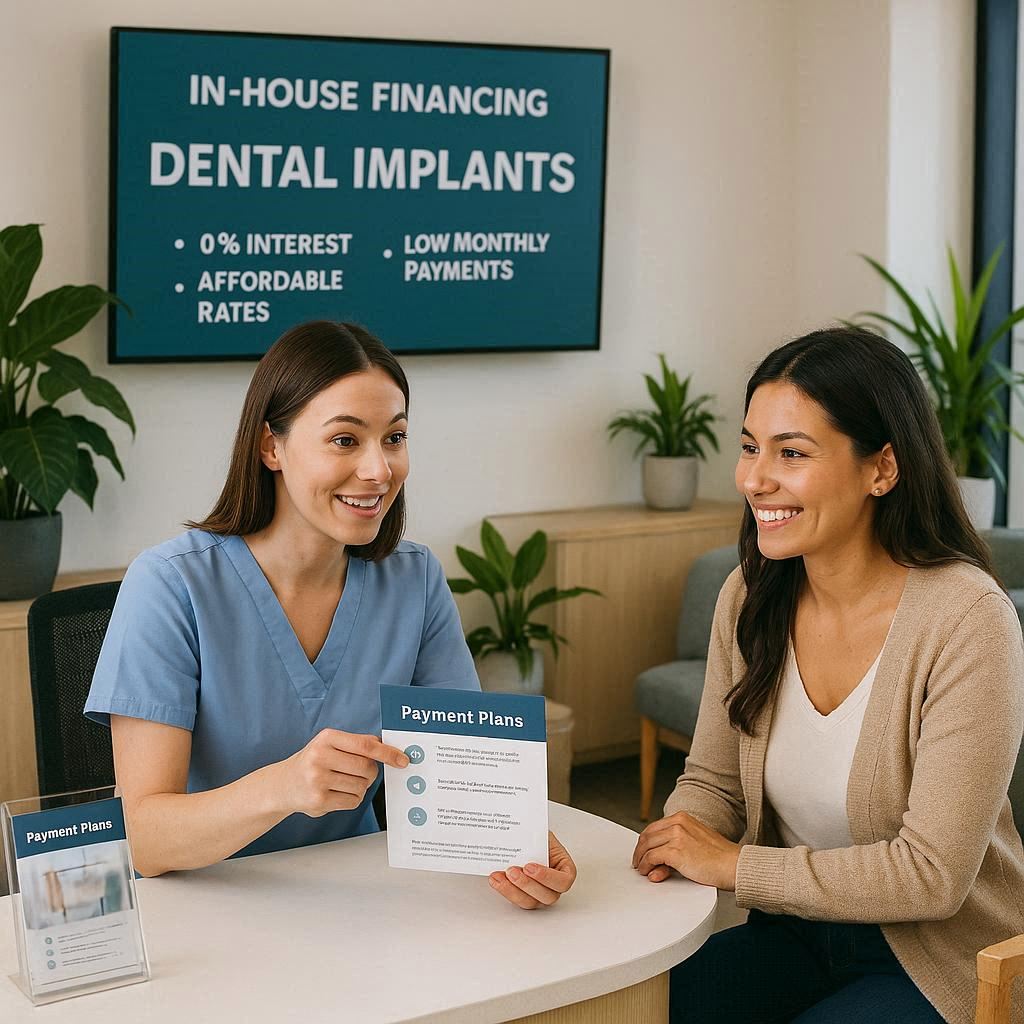
Let us start with a simple definition. In-house financing means the dental practice acts as the lender. Instead of paying the full amount upfront, you make regular payments directly to the dentist’s office over an agreed period.
Think of it like a furniture store that lets you pay over six months. The store does not send you to a bank. They handle everything internally. Dental in-house financing works the same way.
How It Differs from Third-Party Loans
Many dental offices offer external financing through companies like CareCredit, LendingClub, or Alphaeon Credit. These are third-party lenders. You apply for a medical credit card or a personal loan. The lender pays the dentist. Then you repay the lender.
In-house financing cuts out the middleman. You owe the money to the dentist, not to a big financial company. This difference might seem small, but it changes everything.
| Feature | In-House Financing | Third-Party Loan (e.g., CareCredit) |
|---|---|---|
| Lender | The dental practice itself | A separate bank or credit company |
| Credit check | Often none or very soft | Hard credit check required |
| Interest rate | Usually 0% to low interest | Can be high (up to 27% after promo) |
| Approval speed | Minutes to one day | Several days |
| Impact on credit score | Minimal to none | Hard inquiry lowers score temporarily |
| Flexibility | High (negotiable terms) | Fixed, take-it-or-leave-it terms |
Why Dentists Offer This Option
You might wonder, “Why would a dentist act like a bank?” The answer is simple. Many patients want implants but cannot pay all at once. Without a payment plan, those patients go elsewhere or do nothing. The dentist loses a sale.
By offering in-house financing, the dentist wins more cases. Patients receive care they need. And the practice builds loyalty. It is a win-win situation when done correctly.
Note: Not all dental offices offer true in-house financing. Some use the term loosely to mean “we help you apply for a loan.” Always ask clearly: “Do you hold the loan yourself, or do you send me to a third party?”
The Real Cost of Dental Implants (So You Understand the Need)
To appreciate in-house financing, you first need to understand what you are financing. Dental implants are not cheap because they involve multiple steps and high-quality materials.
Breakdown of Typical Implant Costs
A single implant supported crown in the United States typically ranges from 3,000to6,000. Here is where that money usually goes:
- Implant fixture (the screw in the bone): 1,000–1,500
- Abutment (connector piece): 300–500
- Crown (the visible tooth): 1,000–2,000
- Surgical placement fee: 500–1,000
- CBCT scan and X-rays: 200–500
- Temporary restoration: 100–300
For multiple implants, costs rise quickly. Two to four implants might cost 6,000to15,000. A full arch (All-on-4 or similar) often runs 15,000to30,000 per arch. Full mouth reconstruction can exceed $50,000.
Why Dental Insurance Usually Does Not Help Much
Here is a frustrating truth. Most dental insurance plans do not cover implants. They might cover a small portion of the crown, but not the implant itself. Many plans call implants “cosmetic” or “not medically necessary.”
Even if your plan offers some coverage, annual maximums are typically 1,000to2,000 per year. That barely makes a dent in a $5,000 procedure. This gap is exactly why in-house financing for dental implants has become so popular. People need a bridge between what they have in savings and what treatment actually costs.
How In-House Financing for Dental Implants Works Step by Step
The process is more straightforward than you might think. Let me walk you through a typical patient experience.
Step 1: The Initial Consultation
You visit the dental office for an exam. The dentist takes X-rays or a 3D scan to see your bone level. They discuss your goals. Then they create a treatment plan with a clear total cost.
This is the moment to ask about payment options. Say something like: “I am very interested in moving forward. Do you offer any payment plans directly through your office?”
Step 2: Discussing the In-House Plan
If the office offers true in-house financing, they will explain their specific terms. Common plan structures include:
- Six months same as cash: Pay in full within six months with 0% interest.
- 12 to 24 month fixed payments: No interest, but requires a down payment (often 25% to 50%).
- Longer term with low interest: Up to 60 months at 5% to 12% interest.
Step 3: Application and Approval
Unlike a bank loan, the application is usually very short. You might complete a one-page form with your name, address, employment information, and basic income. Some offices run a soft credit check. Many run no credit check at all.
Approval often comes within an hour or by the next business day. Because the dentist holds the loan, they focus less on your credit score and more on your ability to make monthly payments.
Step 4: Down Payment and Agreement
Most in-house plans require a down payment. This protects the dentist if a patient stops paying. Typical down payments range from 10% to 50% of the total treatment cost.
You will sign a simple payment agreement. Read it carefully. It should state:
- Total cost of treatment
- Down payment amount
- Monthly payment amount
- Number of months
- Interest rate (if any)
- Late payment fees
- What happens if you miss payments
Step 5: Treatment Begins
Once you sign and pay the down payment, treatment can start. The implant placement surgery is scheduled. You make monthly payments as agreed. Most offices automatically withdraw payments from your bank account or charge a credit card on file.
Step 6: Final Payment and Follow-Up Care
When the final payment is made, the financial relationship ends. However, you still need regular dental checkups to keep your implants healthy. Some practices offer a small discount on future cleanings for patients who completed an in-house plan successfully.
The Major Benefits of Choosing In-House Financing
Why would someone choose this over a credit card or a personal loan? The advantages are significant for the right patient.
No Hard Credit Check
Every time a bank or credit card company runs a hard inquiry on your credit report, your score drops a few points. Too many inquiries in a short time can make you look risky to lenders.
In-house financing typically uses no credit check or a soft inquiry. Soft inquiries do not affect your score at all. This is a huge benefit if you are rebuilding credit or have a thin credit file.
Lower or Zero Interest
Credit cards often charge 18% to 29% interest. Personal loans might charge 8% to 36% depending on your credit. In-house plans frequently offer 0% interest for shorter terms. Even longer terms usually have interest rates far below what a bank would charge.
Flexible Terms
Banks use algorithms. Dentists use judgment. If you need a specific payment date, you can often ask for it. If you want to pay extra one month to finish early, most offices allow that freely. This flexibility is rare with traditional financing.
Faster Access to Care
Bank loans take days or weeks. In-house approval often takes hours. For someone in pain or with an upcoming life event (wedding, job interview, family photos), this speed makes a real difference.
Build or Rebuild Dental Trust
When you make all your payments on time, you build a positive relationship with your dental office. They see you as reliable. In the future, if you need more work, they may offer you even better terms. Some offices reduce down payment requirements for returning patients.
Potential Risks and Drawbacks (Be Honest With Yourself)
In-house financing for dental implants is not perfect. It has real risks. A responsible guide must highlight them clearly.
Smaller Selection of Dentists
Not every dental office offers true in-house financing. The ones that do are often smaller, private practices. Large corporate dental chains rarely offer this. They prefer third-party financing because it shifts risk away from them.
You may need to call several offices to find one with an in-house plan. This takes time and effort.
Shorter Repayment Periods
While a bank might give you 60 or 84 months to repay, many in-house plans top out at 24 months. Some only offer 6 or 12 months. The shorter timeline means higher monthly payments.
For a 5,000implantwithnodownpaymentover12months,youwouldpayabout417 per month. That is manageable for some but impossible for others.
Risk of Collection Actions
If you stop paying, the dentist has options. They can send your account to a collection agency. They can sue you in small claims court. They can place a collections note on your credit report.
Because the dentist is not a massive bank, they may be less patient with late payments. A bank might give you a 30-day grace period. A small dental office might call you after five days late.
Treatment Interruption
This is a critical point. Some payment agreements state that if you miss a payment, the dentist can stop your treatment. Imagine having the implant screw placed but not the crown. You would have a metal post in your mouth with no tooth on top. That is not a good situation.
Always ask: “What happens to my treatment if I am late on a payment?”
Important note: Read your payment agreement before you sign. Look specifically for a clause called “Right to cease treatment for non-payment.” If it exists, understand exactly what triggers it.
Comparing In-House Financing vs. Other Payment Options
A table helps here. But let us also walk through real scenarios.
Scenario A: Good Credit (720+ score)
| Option | Monthly Payment (for $5,000) | Total Interest | Pros | Cons |
|---|---|---|---|---|
| 0% credit card (18 months) | $278 | $0 | No interest, flexible | Requires excellent credit |
| Bank personal loan (36 months at 9%) | $159 | $724 | Low monthly payment | Hard credit check, interest paid |
| In-house financing (12 months at 0%) | $417 | $0 | Fast approval, no credit check | Higher monthly payment |
Best choice: 0% credit card if you have one. In-house financing is second best.
Scenario B: Fair Credit (620-680 score)
| Option | Monthly Payment (for $5,000) | Total Interest | Pros | Cons |
|---|---|---|---|---|
| Third-party dental loan (24 months at 15%) | $242 | $808 | Longer term | High interest, hard credit check |
| In-house financing (12 months at 0%) | $417 | $0 | No interest, no hard check | Higher monthly payment, shorter term |
| Saving up (12 months) | $417 saved | $0 | No debt, no risk | 12 months without a tooth |
Best choice: In-house financing if you can handle the $417 payment. Otherwise, save up.
Scenario C: Poor Credit (Below 620) or No Credit
| Option | Monthly Payment (for $5,000) | Total Interest | Pros | Cons |
|---|---|---|---|---|
| Most third-party loans | Denied | N/A | N/A | Cannot get approved |
| In-house financing (12 months at 0% to 8%) | Varies | Low to zero | Approval likely | Requires down payment |
| Payday or high-risk loan | Not recommended | Over 200% | Quick cash | Destructive interest rates |
Best choice: In-house financing is often the only reasonable option.
How to Find a Dentist Offering True In-House Financing
Not every office that claims to offer in-house financing actually does. Here is how to separate real offers from marketing language.
The Three Questions You Must Ask
Call or visit the dental practice. Ask these exact questions:
- “When I finance through you, will I make payments directly to your office, or will you send me to a third-party lender?”
- Good answer: “Directly to us.”
- Red flag: “We work with CareCredit and other partners.”
- “Do you run a hard credit check that will appear on my credit report?”
- Good answer: “No, we do not check credit” or “We run a soft check only.”
- Red flag: “We will check your credit through Equifax.”
- “If I pay off my balance early, is there any penalty?”
- Good answer: “No, you can pay anytime with no fee.”
- Red flag: “There is a small prepayment penalty.”
Where to Look First
Start your search with these types of dental practices:
- Single-owner private practices: The dentist who owns the building and runs the business has more freedom to offer creative financing.
- Dental schools: Some dental school clinics offer sliding scale fees and very flexible payment plans. The trade-off is longer appointment times because students do the work under supervision.
- Community health centers: Federally qualified health centers with dental departments sometimes offer in-house financing for low-income patients. Terms vary by location.
- “Membership plan” dentists: Some offices have annual membership plans for uninsured patients. These same offices often extend in-house financing to members.
Red Flags to Avoid
Walk away from any dentist who:
- Requires full payment before any X-rays or exams. You should never pay for a full treatment plan you have not discussed in person.
- Refuses to put the payment agreement in writing. Any legitimate in-house financing plan comes with a written contract.
- Pressures you to sign same-day. A good office will say, “Take this home and think about it. Bring it back tomorrow.”
- Has no clear late fee policy. If they cannot tell you what happens when you are late, that is a problem.
What a Typical In-House Financing Agreement Looks Like
Let me show you a real example. This is based on actual agreements from several dental offices (names changed, but terms are accurate).
Sample Agreement Highlights
Patient: Jane D.
Treatment: Single dental implant, tooth #19
Total cost: 4,800∗∗Downpayment:∗∗1,200 (25%)
Remaining balance: 3,600∗∗Term:∗∗12months∗∗Interestrate:∗∗0∗∗Monthlypayment:∗∗300
Due date: 15th of each month
Late fee: $25 if payment is more than 10 days late
Default: After 60 days late, entire balance becomes due immediately
Prepayment penalty: None
What Happens If Jane Misses a Payment
Month 1: Jane pays on time.
Month 2: Jane pays 5 days late. She owes 300+25 late fee.
Month 3: Jane misses payment entirely. Office calls her.
Month 4: Jane misses second payment. Office sends a letter saying she has 30 days to pay $600 + fees or treatment stops.
Month 5: Jane still has not paid. Office places her account with a collection agency. Her credit report shows a collection account for the next seven years.
This is the reality. In-house financing works wonderfully if you pay on time. It hurts badly if you do not.
How to Prepare Before You Apply
Do not walk into a dental office unprepared. A little planning saves you stress and money.
Check Your Monthly Budget
Take out a piece of paper. Write down your monthly take-home pay. Subtract every expense: rent, utilities, groceries, transportation, insurance, minimum debt payments.
What is left? That number is your maximum possible monthly payment for dental implants. Be honest with yourself. If you have 200lefteachmonth,donotsigna400 payment plan.
Save a Down Payment First
Even if the office offers “no down payment,” putting money down helps you in two ways. First, it lowers your monthly payment. Second, it shows the dentist you are serious.
Aim for 25% to 50% of the total cost saved before you walk in. For a 5,000treatment,save1,250 to $2,500 first.
Get Your Documents Ready
Most in-house applications ask for:
- Government ID (driver’s license or passport)
- Proof of address (utility bill or lease)
- Proof of income (recent pay stub or bank statement)
- Two personal references (name and phone number)
Having these ready speeds up approval.
Alternatives If In-House Financing Is Not Right for You
Sometimes in-house financing does not work for your situation. Perhaps no nearby dentist offers it. Perhaps the monthly payments are too high. Here are other paths to explore.
Dental Savings Plans (Discount Plans)
These are not insurance. You pay an annual fee (typically 100to300) to join a network. Then you receive 10% to 60% off dental procedures at participating dentists.
For implants, a discount plan might save you 20% to 30%. On a 5,000implant,thatsaves1,000 to $1,500. You still pay upfront, but the total is lower.
Health Savings Account (HSA) or Flexible Spending Account (FSA)
If your employer offers these accounts, you can put pre-tax money aside for medical expenses. Dental implants qualify. Using pre-tax dollars effectively gives you a discount equal to your tax rate (often 20% to 40%).
The catch is that FSA funds must be used within the plan year or you lose them. HSA funds roll over forever.
Medical Tourism
Traveling to another country for dental implants is a real option. Mexico, Costa Rica, Colombia, Thailand, and Hungary are popular destinations. Costs can be 50% to 70% lower than in the United States.
The risks include language barriers, different quality standards, and no easy follow-up care if something goes wrong. If you choose this path, research the specific clinic thoroughly.
Dental School Clinics
As mentioned earlier, dental schools offer reduced fees. Treatment takes longer, but quality is often very high because multiple faculty members check each step. Some dental schools also offer their own in-house financing with very low interest.
Crowdfunding
Websites like GoFundMe have medical crowdfunding sections. Some people successfully raise money for dental implants. This works best if you have a large social network or a compelling story. It is not reliable for most people, but it is an option.
Questions to Ask Your Dentist Before Signing Anything
You are now ready to sit down with a dentist. Use this checklist of questions. Write down the answers.
Financial Questions
- What is the total all-in cost, including any possible extra fees?
- Is your in-house financing truly through your office or through a partner?
- What credit check do you run (hard, soft, or none)?
- What down payment do you require?
- What interest rate will I pay?
- How many months will I have to repay?
- Is there a discount for paying with cash or check instead of credit card?
- What is the late payment fee?
- Is there a fee to set up the payment plan?
- Can I pay extra without penalty?
Treatment Questions (Just as Important)
- What is the success rate for implants in my specific case?
- What happens if the implant fails? Do I still owe the full amount?
- Is the crown included in this price, or is that separate?
- What if I need a bone graft or sinus lift? How does that change the price?
- Who places the implant? A general dentist or a specialist (oral surgeon, periodontist)?
- What type of warranty do you offer on the implant and crown?
A Real Patient Story (Names Changed for Privacy)
Let me tell you about Robert, a 52-year-old truck driver from Ohio. Robert lost his lower right first molar years ago. He chewed on one side only. His other teeth started wearing down unevenly.
Robert had fair credit, around 640. He applied for CareCredit and got denied. He applied for a personal loan and got approved at 24% interest. He almost signed it. Then his dentist mentioned something called “in-house financing.”
The total for Robert’s implant was 4,200.Theofficerequired301,260). Robert saved for four months. He paid the down payment. The remaining 2,940wassplitinto12paymentsof245 with no interest.
Robert set up automatic payments from his checking account. He never missed one. Eight months into the payments, he received his final crown. He kept paying for four more months. When the last payment cleared, he asked the office for a letter confirming his balance was zero.
Robert told me later: “I would have paid $700 in interest to that bank. Instead, I paid zero. And my dentist treated me like a person, not a credit score.”
This is the promise of in-house financing for dental implants. When both sides act in good faith, it works beautifully.
Common Myths About Dental In-House Financing
Let us clear up some misinformation floating around the internet.
Myth 1: “Only low-quality dentists offer in-house financing”
Truth: Some of the most patient-focused, high-quality dentists offer in-house plans. They are often the ones who truly care about access to care. A dentist who offers flexible payment may actually be more confident in their work because they are willing to wait for payment.
Myth 2: “You always pay more with in-house financing”
Truth: With 0% interest plans, you pay exactly the same as a cash patient. Some offices even offer a small discount (2% to 5%) for paying entirely upfront in cash. But in-house financing at 0% costs no more than paying in full on day one.
Myth 3: “In-house financing is just a scam to get you in the door”
Truth: Scams exist in every industry. But legitimate in-house financing is a real financial tool. The difference is a written agreement, transparent terms, and a real dental license you can verify with your state dental board.
Myth 4: “You need perfect credit to qualify”
Truth: Most in-house plans require no credit check at all. The dentist cares more about your income and your down payment. Some offices even work with patients who have active bankruptcies or previous dental collections.
How In-House Financing Affects Your Credit Score
This is a common question. The answer depends on how the dental office reports payments.
Most Offices Do Not Report to Credit Bureaus
Here is a surprising fact. The vast majority of small businesses, including dental offices, do not report payment history to Equifax, Experian, or TransUnion. Why? Reporting costs time and money. Small offices do not have a dedicated accounting department.
What this means for you:
- Making on-time payments likely will NOT help your credit score.
- Missing payments and going to collections WILL hurt your credit score (because collection agencies do report).
So in-house financing is somewhat “invisible” to the credit system. It cannot build your credit, but it can damage it if you default.
A Small Number of Offices Do Report
Some larger dental groups or offices that use specialized dental practice management software may report positive payment history. Ask specifically: “Do you report my monthly payments to the credit bureaus?”
Tax Implications and Insurance Coordination
Let me briefly cover two topics that surprise many patients.
Are Dental Implants Tax Deductible?
The IRS allows you to deduct medical expenses that exceed 7.5% of your adjusted gross income (AGI). Dental implants qualify as a medical expense. If your AGI is 50,000,youcandeductmedicalexpensesover3,750. A 5,000implantwouldgiveyouadeductionof1,250.
This is not a dollar-for-dollar tax credit. It reduces your taxable income. Talk to a tax professional about your specific situation.
Coordinating In-House Financing with Dental Insurance
Some dental insurance plans offer partial coverage for implants. Here is how to handle it:
- Get a pre-treatment estimate from your dentist sent to your insurance.
- Insurance sends back an “Explanation of Benefits” showing what they will pay.
- Your dentist subtracts the insurance payment from the total cost.
- You create an in-house financing plan for the remaining patient portion.
For example: 5,000implant.Insurancepays1,500. Your portion is 3,500.Yourin−houseplancoversthe3,500 only.
Important note: Make sure your payment agreement states that the insurance payment goes directly to the dentist first. Any overpayment should be refunded to you.
Step-by-Step Action Plan for Readers
You have read a lot of information. Now let me give you a simple action plan.
Week 1: Research and Budget
- Call five dental offices near you. Ask the three questions from earlier.
- Identify two to three offices that offer true in-house financing.
- Calculate your maximum comfortable monthly payment.
- Open a separate savings account and name it “Implant Fund.”
Week 2: Consultations
- Schedule consultations with your top two offices. Many offer free or low-cost (50to100) implant consultations.
- Bring your budget number with you.
- Ask every question from the checklist above.
- Get a written treatment plan with total cost from each office.
Week 3: Compare and Choose
- Compare the total costs, down payment requirements, and monthly payments.
- Read the sample payment agreement from each office.
- Choose the office that feels most transparent and trustworthy.
- If you are unsure, ask for patient references. A good office will provide them.
Week 4: Save Down Payment and Sign
- If you do not have the down payment yet, save aggressively for one to three months.
- Once you have the down payment, return to the office.
- Review the payment agreement one last time. Take it home overnight if you want.
- Sign the agreement. Pay the down payment. Schedule your implant surgery.
The Psychological Benefit of In-House Financing
We have focused on numbers, interest rates, and credit scores. But there is a softer benefit worth mentioning.
Living with missing teeth affects more than your ability to chew. It affects your smile. Your confidence. Your willingness to laugh at a party or smile in a photograph.
In-house financing for dental implants removes the “all or nothing” barrier. You do not need 5,000inyourpockettoday.Youneedacommitmenttopay200 or $300 each month. That smaller, manageable number feels possible. And when the first payment is made, hope replaces hopelessness.
Dentists who offer these plans often see their patients become more engaged in their overall health. Patients who finance implants show up for cleanings. They brush and floss more carefully. They have made an investment. They want to protect it.
Conclusion (Three-Line Summary)
In-house financing for dental implants is a direct payment plan with your dentist that often requires little to no credit check and can offer 0% interest. It provides a realistic path to a healthy smile for patients who cannot pay thousands upfront but can manage modest monthly payments. Always read your agreement carefully, understand late fees and default terms, and choose a transparent dentist who treats you as a partner, not just a patient.
Frequently Asked Questions (FAQ)
1. Is in-house financing for dental implants available everywhere?
No, it is more common in smaller private practices. Large corporate chains usually prefer third-party financing. You may need to call several offices in your area to find one that offers true in-house plans.
2. Will I pay interest on an in-house payment plan?
Many plans offer 0% interest for terms of 6 to 18 months. Longer terms (24 to 60 months) may have interest rates from 5% to 12%, which is still much lower than credit cards.
3. What happens if I lose my job and cannot pay?
Contact your dentist immediately. Some offices offer a hardship forbearance (temporary pause on payments). Others may extend your term or reduce your payment. The worst thing you can do is disappear and stop communicating.
4. Can I use in-house financing for full mouth implants?
Yes, absolutely. Many patients finance 20,000to50,000 full mouth reconstructions this way. The down payment and monthly payment will be larger, but the same principles apply.
5. How long does approval take?
Usually same-day to 24 hours. Because there is no hard credit check with a bank, the dentist can approve you very quickly once they verify your income and down payment.
6. Is a down payment always required?
Most plans require a down payment of 10% to 50%. Some offices offer “no down payment” promotions occasionally, but these are less common. Expect to pay something upfront.
7. Can I pay off my in-house loan early?
In almost all cases, yes, with no penalty. Confirm this before signing, but early payoff is typically encouraged.
8. What if my implant fails? Do I still owe the money?
This depends on your agreement. Some dentists guarantee their work and will replace a failed implant at no charge. Others will charge a reduced fee. Read the warranty section of your treatment plan carefully.
Additional Resource
For a list of dental practices in your state that offer patient-friendly payment plans, including in-house financing, visit the Dental Lifeline Network (dentallifeline.org). This nonprofit organization helps connect patients with affordable dental care resources. While they primarily focus on patients with special needs or permanent disabilities, their website offers state-by-state directories of charitable dental programs and practices that prioritize access to care.
Disclaimer: This article is for informational purposes only and does not constitute financial or medical advice. Dental costs, financing terms, and insurance coverage vary significantly by location, provider, and individual patient circumstances. Always consult directly with a licensed dentist and, if needed, a financial advisor before entering into any payment agreement. The author and publisher disclaim any liability for any decisions made based on the information provided.