Dental Implants in Hamilton: Your Complete Guide to a Permanent Smile
Losing a tooth can feel frustrating. It might affect your confidence or make chewing difficult. If you live in Hamilton, you have excellent options for getting your smile back. Dental implants in Hamilton have become the gold standard for tooth replacement.
But you probably have questions. How much do they cost? Does the procedure hurt? How long do they last?
This guide answers everything. We will walk through the process, the benefits, the risks, and exactly what to expect as a Hamilton resident. No fluff. Just honest, useful information.
Why Consider Dental Implants? A Modern Solution
Decades ago, people with missing teeth had limited choices: dentures or bridges. Both have downsides. Dentures can slip. Bridges require shaving down healthy teeth. Implants solve these problems.
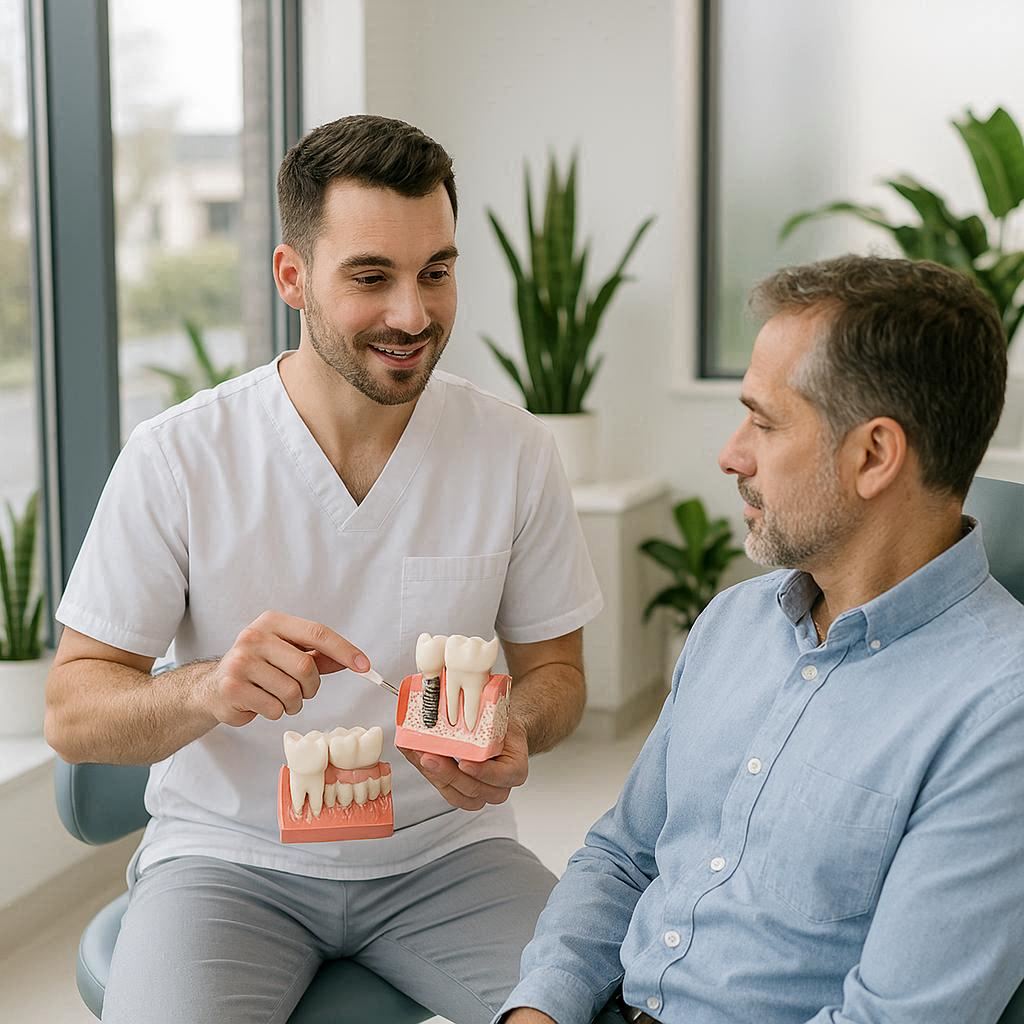
An implant is a small titanium post. A surgeon places it into your jawbone. Over time, the bone grows around it. This creates a rock-solid foundation. Then, a crown (artificial tooth) attaches to the post.
Key Insight: Implants look, feel, and function like natural teeth. With proper care, they can last a lifetime.
Implants vs. Other Options: A Quick Comparison
Let’s see how implants stack up against traditional methods.
| Feature | Dental Implants | Traditional Bridge | Removable Dentures |
|---|---|---|---|
| Bone Preservation | Prevents bone loss | Does not prevent loss | Accelerates bone loss |
| Impact on Adjacent Teeth | None | Requires shaving healthy teeth | None |
| Stability | Permanent (fixed) | Permanent (fixed) | Can slip or click |
| Lifespan | 20+ years to lifetime | 5–15 years | 5–10 years |
| Comfort | Feels natural | Good | Often uncomfortable |
| Cost (Initial) | Higher | Medium | Lower |
The table shows one clear truth: Implants cost more upfront but offer better long-term value.
Understanding the Dental Implant Procedure in Hamilton
Most local clinics follow a similar, proven process. Knowing the steps reduces anxiety. Here is what a typical timeline looks like.
Step 1: Initial Consultation (Day 1)
Your dentist examines your mouth. They take X-rays or a CT scan. This checks your jawbone density. Do you have enough bone to hold the implant? If not, you might need a bone graft. The dentist also reviews your medical history.
Step 2: Treatment Planning
Using 3D imaging, the surgeon plans the exact implant position. This avoids nerves and sinuses. The plan ensures the new tooth aligns perfectly with your bite.
Step 3: The Surgical Placement (Day of Surgery)
This is usually done under local anesthesia. You are awake but feel no pain. The surgeon makes a small cut in the gum. They drill a precise hole into the bone. Then, they screw the titanium implant into place. Finally, they stitch the gum closed over or around the implant.
How long does surgery take? A single implant takes about 60–90 minutes.
Step 4: Osseointegration (Healing Period)
This is the most critical phase. Your jawbone grows and fuses with the titanium surface. This process is called osseointegration. It takes 3 to 6 months.
During this time, you may wear a temporary denture or flipper to fill the gap.
Step 5: Abutment Placement
Once healed, the surgeon reopens the gum to attach a small connector piece. This is the abutment. It connects the implant to the crown. Some clinics do this step at the same time as surgery. That avoids a second incision.
Step 6: Crown Fabrication & Fitting
Your dentist takes impressions of your mouth. A dental lab custom-makes your crown to match the color and shape of your other teeth. After 2–3 weeks, you return. The dentist screws or cements the crown onto the abutment.
Result: A complete, natural-looking tooth.
Are You a Candidate for Dental Implants?
Good candidates share these traits:
- Healthy gums (no active gum disease).
- Sufficient jawbone density (or willing to get a bone graft).
- Non-smoker or willing to quit during healing. Smoking drastically increases failure rates.
- Commitment to oral hygiene (brushing, flossing, regular checkups).
- Controlled chronic conditions (diabetes, high blood pressure managed).
Important Note for Hamilton Residents
If you have neglected your teeth for years due to dental anxiety, do not worry. Many Hamilton clinics offer sedation options. You can be asleep during the entire procedure.
Cost of Dental Implants in Hamilton: A Realistic Breakdown
Let’s talk money. This is the biggest concern for most people. Prices in Hamilton are competitive compared to Toronto, but they are still an investment.
A single dental implant in Hamilton typically costs between 3,500and3,500and6,500. This total usually includes:
- The surgical placement (implant fixture).
- The abutment.
- The crown.
However, remember the hidden extras.
What Affects the Final Price?
- Number of implants: One tooth costs less than a full arch.
- Bone graft: If you need one, add 500–1,500.
- Sinus lift: For upper back molars, add 1,500–3,000.
- Material of crown: Zirconia (metal-free) costs more than porcelain-fused-to-metal.
- Clinic location and surgeon’s experience.
Payment and Insurance
- Insurance: Many dental plans cover part of the crown and abutment. But they often label the implant (surgical part) as “major restorative” with a 50% coverage limit. Check your policy carefully.
- Financing: Most Hamilton clinics offer payment plans. You can pay over 12, 24, or 36 months. Some use third-party lenders like DentalCard or PayBright.
Realistic advice: Never choose an implant based on price alone. Cheap implants often mean cheap materials or inexperienced surgeons. A failed implant costs double to fix.
Top Considerations When Choosing a Hamilton Implant Dentist
Not all dentists are equal. Some focus on general dentistry. Others are specialists (oral surgeons or periodontists).
Questions to Ask Before Booking
- “How many implants have you placed in the last year?”
- “What happens if my implant fails? Do you offer a warranty?”
- “Do you use 3D CT scanning for planning?”
- “Can I see before-and-after photos of your Hamilton patients?”
- “What sedation options do you have?”
Types of Implant Professionals in Hamilton
| Professional | Best For | Typical Cost |
|---|---|---|
| General Dentist | Single, straightforward cases | Lower ($) |
| Prosthodontist | Complex cases, full mouth rehab | Medium ($$) |
| Oral Surgeon | Cases needing bone grafts or sinus lifts | Higher ($$$) |
| Periodontist | Patients with gum disease history | Medium-High ($$) |
Local Clinics with Strong Reputations (Examples)
Note: This is not an endorsement. Always do your own research.
- Hamilton Mountain Dental: Known for sedation options.
- Stonehill Dental: Offers digital smile design.
- Downtown Hamilton Smiles: Focuses on single-tooth implants.
- Ancaster Dental Arts: Specializes in All-on-4 (full arch).
Read Google Reviews specifically for “dental implants.” Ignore reviews about cleanings or fillings. Look for keywords like “painless,” “explained everything,” or “healed fast.”
The Risks and Complications (Be Honest)
Implants have a 95-98% success rate. But failures happen. You need to know the risks.
Early Failures (within 3-4 months)
- Infection: Bacteria contaminate the surgical site.
- Failed osseointegration: The bone rejects the implant. This is more common in smokers.
- Nerve damage: Rare, but can cause lip or tongue numbness.
- Excessive bleeding.
Late Failures (after 1 year or more)
- Peri-implantitis: This is the #1 cause of late failure. It is like gum disease but around the implant. The gum gets inflamed, bone dissolves, and the implant loosens.
- Crown fracture: The porcelain chip or break.
- Abutment screw loosening.
How to Minimize Risks
- Stop smoking for 2 weeks before and 2 months after surgery.
- Follow post-op instructions to the letter (soft diet, no straws).
- Use a water flosser to clean around the implant.
- Visit your dentist every 6 months for professional cleaning.
Warning sign: If your implant feels wobbly or you see bleeding when brushing, call your Hamilton dentist immediately. Early intervention can save the implant.
Life After Implants: Maintenance and Longevity
You placed the implant. Now, how do you make it last?
Think of your implant like a luxury car. It needs routine maintenance.
Daily Home Care Checklist
- Brush twice a day with a soft nylon brush (no metal scrapers).
- Floss daily using super floss or implant-specific floss.
- Use a water flosser on low pressure to clean the gumline.
- Avoid biting ice, hard candies, or pens. Implants have no ligaments to sense pressure.
- Wear a night guard if you grind your teeth.
Professional Maintenance
Your dentist will check the implant’s stability during cleanings. They will use plastic instruments to avoid scratching the titanium surface. X-rays every 1-2 years check the bone level around the implant.
Expected Lifespan:
- Implant fixture (titanium screw): Lifetime (if bone stays healthy).
- Crown: 10-20 years (can be replaced if worn).
- Abutment: 10-20 years.
Full Mouth Reconstruction: All-on-4 in Hamilton
What if you are missing all your top or bottom teeth? Single implants for each tooth would cost $50,000+. There is a better way.
All-on-4 uses just four implants to support a full fixed bridge. The two back implants are angled to use the strongest bone.
Benefits of All-on-4
- Lower cost (15,000–25,000 per arch vs. $50k).
- No bone grafting needed in most cases.
- Immediate teeth: You leave with a fixed temporary bridge the same day.
Downsides
- Harder to clean (requires special floss threaders).
- If one implant fails, the entire bridge may need replacement.
- The hybrid bridge is acrylic, which can wear down over 10 years.
If you are a Hamilton senior on a fixed income, ask your clinic about All-on-4 payment plans. It is life-changing.
Local Resources for Dental Implants in Hamilton
Hamilton offers unique support systems for dental care.
Ontario Seniors Dental Care Program (OSDCP)
If you are 65+ and have no private insurance, you may qualify. The program covers some basic dental care. However, implants are typically not covered. It covers exams, fillings, and extractions only.
Hamilton Public Health Dental Clinics
They offer low-cost extractions and cleanings. They do not place implants. But they can remove hopeless teeth for free or cheap before you see an implant surgeon.
Dental Schools
The closest dental school is the University of Toronto (Faculty of Dentistry). Students place implants at approximately 50-60% of private clinic costs. The trade-off? Longer appointment times (3-4 hours per visit).
FAQ: Dental Implants in Hamilton
Q1: Are dental implants painful?
A: The surgery itself is not painful because of local anesthesia. After the numbness wears off, you feel soreness like a tooth extraction. Over-the-counter painkillers (ibuprofen) usually manage it well. Most patients say the anxiety is worse than the reality.
Q2: How long do I have to wait between implant placement and the crown?
A: Typically 3-6 months for the lower jaw and 5-7 months for the upper jaw. The upper jaw has softer bone, so healing takes longer.
Q3: Can I get dental implants if I have diabetes?
A: Yes, but your blood sugar must be well-controlled (HbA1c below 7%). Uncontrolled diabetes significantly slows healing and increases infection risk. Inform your surgeon about your exact levels.
Q4: Does OHIP cover dental implants in Hamilton?
A: No. OHIP covers medically necessary hospital procedures. Implants are considered cosmetic or dental, not medical. However, if you have a congenital defect (cleft palate) or tumor removal, OHIP may cover the implant fixture in a hospital setting.
Q5: What is the failure rate for smokers?
A: Smokers have a 15-20% failure rate compared to 2-5% for non-smokers. Nicotine restricts blood flow to the gums, preventing bone healing. If you smoke, consider quitting at least 2 weeks before surgery.
Q6: Can I have an MRI if I have dental implants?
A: Yes. Titanium is not magnetic. Modern dental implants are MRI-safe. However, inform the MRI technician beforehand. The crown (if metal) may create a small artifact (blurring) on the images.
Q7: What is the cheapest dental implant in Hamilton?
A: You might find promotions for 1,999perimplant.Beextremelycareful.Thatpricerarelyincludesthecrown(800-1,500)ortheabutment(400). Read the fine print. The cheapest legitimate all-in cost is around $3,500.
Q8: How do I clean my implant after 10 years?
A: The same way as day one. Use a water flosser daily and see your hygienist every 6 months for plastic scaler cleaning. Avoid electric toothbrushes with metal tips.
Additional Resources
For a deeper understanding of implant materials and scientific studies, visit the American Academy of Implant Dentistry (AAID) public information page.
👉 Link: AAID Public Guide to Dental Implants (Opens in new window)
This resource provides unbiased, science-based facts about implant safety, types of implant systems, and how to choose a qualified implant dentist.
Conclusion:
Dental implants in Hamilton offer a permanent, natural-looking solution that preserves your jawbone and restores chewing power. While the upfront cost is higher than bridges or dentures, their longevity (20+ years) makes them a smarter long-term investment for most adults. Always choose an experienced Hamilton surgeon, follow post-op care strictly, and maintain excellent oral hygiene to avoid peri-implantitis.
Disclaimer: This article is for informational purposes only and does not constitute medical or dental advice. Always consult a licensed dental professional in Hamilton for a personal examination and treatment plan. Individual results, costs, and healing times vary based on medical history and compliance with aftercare instructions.