Dental Implants Failure Signs: A Clear, Honest Guide for Patients
You made a big decision when you chose a dental implant. It’s a strong, long-lasting solution to replace a missing tooth. But like any medical procedure, things don’t always go as planned. Sometimes, an implant starts to show signs of trouble.
The good news is that failure rarely happens without warning. Your body gives you signals. The key is knowing what to look for.
In this guide, we will walk through the most common dental implants failure signs. We will keep things simple, clear, and honest. No scare tactics. No fake promises. Just real information to help you recognize a problem early and take action.
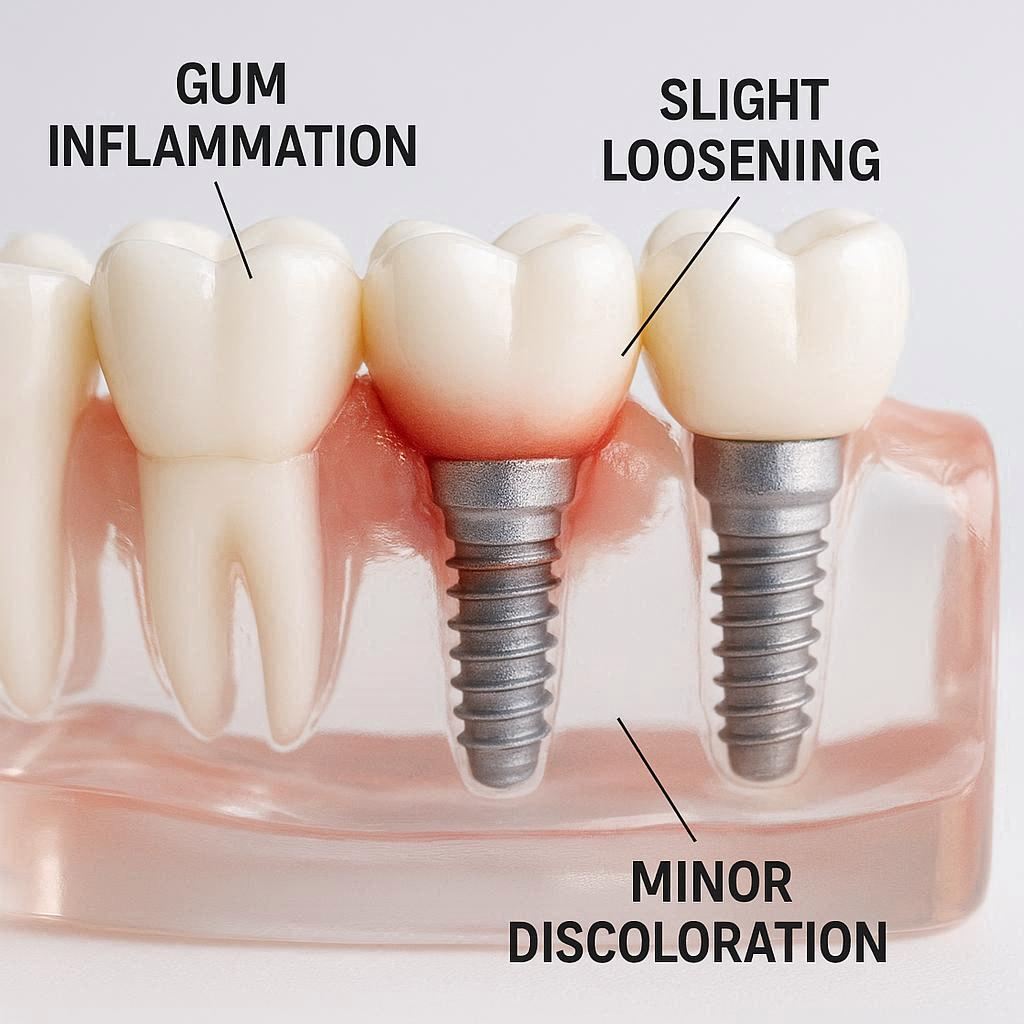
What Does “Dental Implant Failure” Actually Mean?
Before we talk about signs, let’s clarify what failure means. An implant fails when it no longer does its job safely and comfortably.
There are two main types of failure:
- Early failure – Happens within the first three to six months after surgery. The bone never properly fuses with the implant.
- Late failure – Happens after the implant has already been working for a year or more. It usually results from infection, overloading, or general health changes.
Failure does not always mean losing the implant. Some problems can be treated if caught early. Other times, removal is the safest option. A good dentist will always be honest about which situation you are facing.
Important note for readers: Not every ache or weird feeling means failure. Healing takes time. But knowing the difference between normal healing and warning signs can save your implant.
Early Signs vs. Late Signs: A Quick Overview
Let’s start with a simple table. This will give you the big picture before we dive into details.
| Timing | Common Signs | Most Likely Cause |
|---|---|---|
| First 2 weeks | Mild swelling, slight discomfort, minor bruising | Normal healing |
| Week 3 to month 6 | Increasing pain, implant feels loose, gum redness | Failed osseointegration (bone didn’t bond) |
| After 1 year+ | Gum bleeding, bad taste, pain when chewing, gum recession | Peri-implantitis (infection around the implant) |
| Any time after healing | The crown clicks or moves, metal visible through gum | Mechanical failure or bone loss |
Now, let us explore each warning sign in detail.
1. Pain That Gets Worse, Not Better
Some discomfort after implant surgery is completely normal. You just had a titanium post placed into your jawbone. But there is a clear difference between healing pain and failing pain.
Normal healing pain:
- Feels like a dull ache
- Peaks around day 2 or 3
- Gets better with over-the-counter painkillers
- Improves noticeably after one week
Failure-related pain:
- Starts mild but intensifies over time
- Does not fully respond to painkillers
- Feels sharp or throbbing when you touch the area
- May keep you awake at night
If you are two months post-surgery and the pain is worse than week one, something is wrong. Do not wait for it to go away on its own. Schedule a check-up.
A patient once told me: “I thought pain was part of the process. I kept waiting. By the time I saw my dentist, the bone had already started dissolving around the implant.”
2. The Implant Feels Loose or Moves When You Touch It
A successful implant becomes part of your jaw. It does not move. Even a tiny amount of movement is a major red flag.
Try this gentle test at home:
- Wash your hands thoroughly.
- Place a clean finger on top of the crown (the fake tooth).
- Try to wiggle it side to side.
If you feel any movement at all, do not ignore it. A firm implant should feel as solid as a natural tooth that is healthy.
What causes looseness?
- The bone never fused properly (failed osseointegration)
- The abutment screw (the connector piece) has loosened
- The surrounding bone has broken down over time
A loose implant does not always mean removal. Sometimes, a dentist can tighten the screw or clean the area. But if the bone bond is gone, the implant will likely need to come out.
3. Red, Swollen, or Bleeding Gums Around One Implant
A little gum redness right after surgery is expected. But if you are months or years past your procedure and your gums suddenly look angry, pay attention.
Signs of gum trouble:
- The gum around the implant looks puffy or shiny
- Bleeding when you brush or floss near that tooth
- The gum feels tender to the touch
- You notice the gum pulling away (receding), exposing more of the implant
Healthy gums around an implant should be pink, firm, and non-bleeding. Just like around your natural teeth.
Why does this happen? Bacteria build up below the gum line. Your body fights back with inflammation. Over time, that inflammation destroys the bone that holds the implant in place.
This condition has a specific name: peri-implantitis. We will talk more about it soon.
4. Difficulty or Pain When Chewing
You got an implant so you could chew normally again. If chewing becomes painful, something has changed.
Compare these two experiences:
| Normal implant chewing | Failing implant chewing |
|---|---|
| You feel pressure, not pain | You feel sharp or dull pain with every bite |
| You can chew on that side without thinking | You unconsciously avoid chewing near the implant |
| Food textures feel normal | It hurts more with hard or crunchy foods |
| No pain the next day | Pain lingers for hours after eating |
Pain when chewing can mean:
- The implant has micro-movement (early looseness)
- The nerve nearby is irritated
- The crown is cracked or poorly fitted
- Bone loss has changed how forces transfer to your jaw
Listen to your body. If you notice yourself favoring the other side of your mouth for more than a week, call your dentist.
5. A Bad Taste or Persistent Bad Breath
You brush. You floss. You use mouthwash. But there is still a bad taste in your mouth, especially near the implant site.
This is one of the most overlooked dental implants failure signs. People assume it is just normal bad breath. But an implant should not cause chronic halitosis.
Where the bad taste comes from:
- Bacteria trapped in a pocket around the implant
- Pus draining from an infected site
- Food debris collecting under the crown if the fit is poor
The taste is often described as:
- Metallic
- Salty
- Sour
- Like “morning breath that never goes away”
If you notice this along with any gum redness or bleeding, you likely have an infection. Do not try to mask it with mints or spray. See your dentist.
6. Visible Changes in Your Gum Shape or Color
Your gums tell a story. Look at them in a well-lit mirror once a week. You are looking for changes, even small ones.
What healthy looks like:
- The gum hugs the implant snugly
- Color is consistent with the rest of your mouth
- No dark triangles or gaps between the crown and gum
What trouble looks like:
- The gum looks bluish, dark red, or purple
- You can see the metal edge of the implant peeking through
- The gum has receded, making the crown look longer
- There is a visible “pocket” or hole next to the implant
Gum recession around an implant is serious. Natural teeth can lose some gum and still be fine. Implants do not have the same biological seal. Once the gum pulls away, bacteria march straight down to the bone.
7. The Implant Crown Feels Different When You Bite Down
You know how your teeth feel when you bite. You know where your bite “meets” comfortably. An implant should blend right in.
If you suddenly notice that:
- The crown feels too high compared to other teeth
- You hit that tooth first when you close your mouth
- The tooth feels like it is “catching” or “grinding”
- You hear a clicking sound when you bite
…then something has shifted.
This can happen for a few reasons:
- The crown or abutment screw has loosened
- The implant has sunk slightly into the bone (bone loss)
- The opposite tooth has moved, changing your bite
Do not ignore bite changes. A bad bite can overload the implant and speed up failure.
8. Swelling in Your Face, Cheek, or Jaw
Swelling after surgery is normal. Swelling that comes back months later is not.
Late swelling red flags:
- Puffiness near your jawline, under your eye, or along your cheek
- The swelling does not go away with ibuprofen
- It gets worse throughout the day
- You feel a warm or hot spot on your face
Deep swelling often means an abscess or bone infection. The body is walling off an area it cannot clean. This is not something that resolves on its own.
If you combine swelling with fever or chills, seek care immediately. You may need antibiotics and possibly implant removal.
9. The Implant Makes a Clicking or Creaking Noise
You should not hear your dental implant. A healthy implant is silent.
Sounds to never ignore:
- A click when you start chewing
- A creak or squeak when you grind your teeth at night
- A popping sensation when you press on the crown
These sounds usually mean metal-on-metal movement. Either the crown screw is loose, or the implant itself is moving inside the bone.
One patient described it as “walking on a loose floorboard.” That is a perfect analogy. Something that should be solid is not.
Do not try to fix this yourself. Do not glue anything. See your dentist for an X-ray.
10. A Feeling of Pressure or Fullness in Your Sinus (Upper Implants Only)
If your implant is in the upper jaw, especially near the back, it sits close to your sinus cavity. That empty space behind your cheekbone.
Warning signs related to sinuses:
- A feeling of pressure under your eye or in your cheek
- Frequent sinus infections on only one side
- Fluid coming from your nose when you lean forward
- Pain that feels like a sinus headache but never fully goes away
What is happening? The implant may be protruding into the sinus space. Or the bone between the implant and sinus has thinned or disappeared.
This does not always require implant removal. But it does require imaging and a specialist evaluation.
What Is Peri-Implantitis? (And Why It Matters Most)
We have mentioned peri-implantitis several times. Let us give it proper attention. This is the number one cause of late implant failure.
Peri-implantitis is inflammation and infection that destroys the bone around an implant. It is similar to severe gum disease around natural teeth, but it progresses faster.
Stages of peri-implantitis:
| Stage | What you notice | Bone loss | Outlook |
|---|---|---|---|
| Early (mucositis) | Bleeding when probing, red gums | None | Fully reversible with cleaning |
| Moderate | Pockets 4-5mm deep, bad taste, mild pain | Up to 25% | Treatable but needs professional care |
| Advanced | Pus, loose implant, gum recession, pain with chewing | 50% or more | Difficult to save the implant |
| End-stage | Implant moves visibly, constant infection | Over 75% | Implant removal required |
The scary part? Peri-implantitis often has no pain in the early stages. You can lose bone silently. That is why regular check-ups with X-rays are essential, not optional.
Important note for readers: Do not assume that because you have no pain, everything is fine. Peri-implantitis is a silent thief of bone. X-rays are the only way to catch it early.
Risk Factors That Increase Your Chance of Failure
Some people are more likely to see dental implants failure signs than others. These factors do not guarantee failure, but they raise the odds.
Medical conditions:
- Uncontrolled diabetes (high blood sugar impairs healing)
- Osteoporosis or low bone density
- Autoimmune diseases (lupus, rheumatoid arthritis)
- Conditions that require long-term steroids
Habits and lifestyle:
- Smoking or using any tobacco products
- Heavy alcohol use
- Poor oral hygiene
- Teeth grinding or clenching (bruxism)
Medications:
- Bisphosphonates (Fosamax, Actonel, Boniva) – especially IV forms
- Some blood thinners
- Chemotherapy drugs
If you have any of these risk factors, be extra vigilant. You may need more frequent check-ups, like every four to six months instead of once a year.
Can a Failing Implant Be Saved?
Yes, sometimes. But not always. And the window to save it can be small.
When saving is possible:
- The problem is a loose screw (not a loose implant)
- Peri-implantitis is caught early (less than 25% bone loss)
- The implant is still firmly attached to bone
- You are willing to change habits (stop smoking, improve hygiene)
When removal is the better choice:
- More than 50% bone loss around the implant
- The implant spins or moves visibly
- You have had multiple infections in the same spot
- The implant is fractured (rare, but happens)
Saving an implant usually involves:
- Deep cleaning below the gum line
- Antibiotics (topical or oral)
- Bone grafting around the exposed threads
- Changing your crown or bite adjustment
Do not let anyone promise you a 100% save rate. Honest dentists will tell you the chances based on your specific case.
What Happens When an Implant Is Removed?
Removal sounds scary. But it is often simpler than the original placement.
The dentist will:
- Numb the area completely
- Use a special instrument to unscrew or gently lift out the implant
- Clean the socket (the hole in your bone)
- Place a bone graft if needed
- Let the area heal for several months
Most people say removal hurts less than the initial surgery. And the bone usually heals well.
After healing, you have options:
- A smaller implant (if enough bone remains)
- A dental bridge
- A partial denture
- Leaving the space empty (if it is not visible)
Removing a failed implant is not a personal failure. It is a medical decision. Many people go on to have a second successful implant in the same spot after proper bone grafting.
How to Monitor Your Implant at Home (Monthly Checklist)
You do not need special tools. Just five minutes and good light.
Each month, ask yourself:
- Does the implant feel the same as last month?
- Can I chew on that side without thinking about it?
- Do my gums look pink and flat around the crown?
- Does flossing feel smooth (not rough or catching)?
- Is there any bad taste that stays after brushing?
Each month, do this:
- Look in a mirror at the gum color
- Gently press the crown with a clean finger (no movement allowed)
- Smell your floss after using it near the implant (no bad smell allowed)
- Bite down on a soft piece of bread – does it hurt?
If you answer “no” to any question or notice anything unusual, call your dentist. Not in three months. Not “when you have time.” Call this week.
When to Call an Emergency Dentist
Most implant problems are not emergencies. But a few situations require same-day care.
Go to an emergency dentist or ER if:
- Your face is swollen so much you cannot open your eye
- You have a fever over 101°F (38.3°C) with jaw swelling
- You cannot swallow liquids because of pain or swelling
- You see pus draining from your gum and feel generally sick
- The implant has completely fallen out with heavy bleeding
For everything else, a routine appointment within one to two weeks is fine. Do not panic. But do not delay forever.
Realistic Expectations: What a Healthy Implant Feels Like
Let us end the worry cycle by describing a truly healthy implant.
A healthy implant:
- Feels like a natural tooth when you touch it with your tongue
- Does not hurt when you chew steak, nuts, or crusty bread
- Has pink, flat gums around it that do not bleed
- Never makes sounds or clicks
- Does not change position over the years
You should mostly forget you have an implant. That is the goal. If you think about it every day because something feels “off,” get it checked.
Prevention: The Best Way to Avoid Failure Signs
Most failures are preventable. You have more control than you think.
Your daily prevention routine:
- Brush twice a day, paying special attention to the gumline around the implant
- Floss daily using implant-specific floss or superfloss (not regular waxed floss)
- Use a water flosser on a low setting to clean below the crown
- Avoid chewing ice, hard candy, or pens (implants hate shock loading)
Your yearly prevention routine:
- See your dentist for exams and X-rays every 6-12 months
- Ask for a “peri-implant probing” – they measure the pocket depth around your implant
- Wear a night guard if you grind your teeth
- Quit smoking – this single change reduces failure risk by over 60%
Important note for readers: Do not skip your annual X-ray just because nothing hurts. Dental X-rays use very low radiation. That one image can show bone loss you cannot feel.
Conclusion (Three Lines)
Dental implants failure signs include progressive pain, looseness, gum changes, bad taste, and chewing discomfort. Recognizing these signs early gives you the best chance to save the implant or plan a safe removal. Stay proactive with monthly self-checks and regular dental visits to protect your investment and your health.
Frequently Asked Questions (FAQ)
1. How common is dental implant failure?
About 5-10% of implants fail. Early failure is slightly more common than late failure. Most people (over 90%) have successful long-term results.
2. Can a failed implant be replaced?
Yes, in most cases. After removing the failed implant and allowing bone to heal (often with a bone graft), a new implant can be placed in the same location.
3. How long does it take for an implant to fail?
Early failure happens within 3-6 months. Late failure can happen 2, 5, or even 10+ years after placement.
4. Can my body reject a dental implant?
Not in the allergy sense. Titanium is biocompatible. But your body can fail to bond with it (failed osseointegration) or destroy bone around it (peri-implantitis).
5. Will my insurance cover implant failure treatment?
It depends. Some dental insurances cover removal but not replacement. Medical insurance sometimes covers infection-related treatment. Check both policies.
6. Is it always my fault if my implant fails?
No. Factors like genetics, previous radiation, undiagnosed bone disease, or even surgical technique play a role. Do not blame yourself without a full diagnosis.
7. What is the difference between a loose crown and a loose implant?
A loose crown moves slightly but the post below stays still. A loose implant moves as one piece. A dentist can tell you which with a simple X-ray.
8. Can I get an MRI if I have a dental implant?
Yes. Dental implants are not magnetic. They are safe for MRI, but they may create some image distortion near the head and neck area.
Additional Resource
For a deeper look into how to care for your implants between dental visits, including product recommendations and video guides, visit the American Academy of Implant Dentistry’s patient education page:
🔗 Recommended link: American Academy of Implant Dentistry – Patient Resources
Note: Always confirm that any online resource aligns with your specific health situation and consult your own dentist before changing your care routine.
Disclaimer: This article is for informational purposes only and does not constitute medical or dental advice. Individual cases vary. Always consult a licensed dentist or oral surgeon for a personal examination and treatment plan. Do not delay seeking care based on information you read online.