Dental Implants in Des Moines
Losing a tooth can feel frustrating. Maybe you hide your smile in photos. Maybe chewing has become a careful chore. You are not alone. Thousands of people in Des Moines face this same challenge every year.
The good news? Dental implants offer a solution that looks, feels, and functions like natural teeth. Unlike dentures that slip or bridges that damage healthy teeth, implants stand on their own.
But let us be clear: getting dental implants is a journey. It requires surgery, healing time, and a financial investment. This guide walks you through every step with honesty and warmth.
Whether you live near the East Village, Waukee, or Ankeny, this article will help you make a smart, informed decision about dental implants in Des Moines.
What Exactly Are Dental Implants? (A Simple Breakdown)
Imagine a replacement tooth that has its own root. That is an implant.
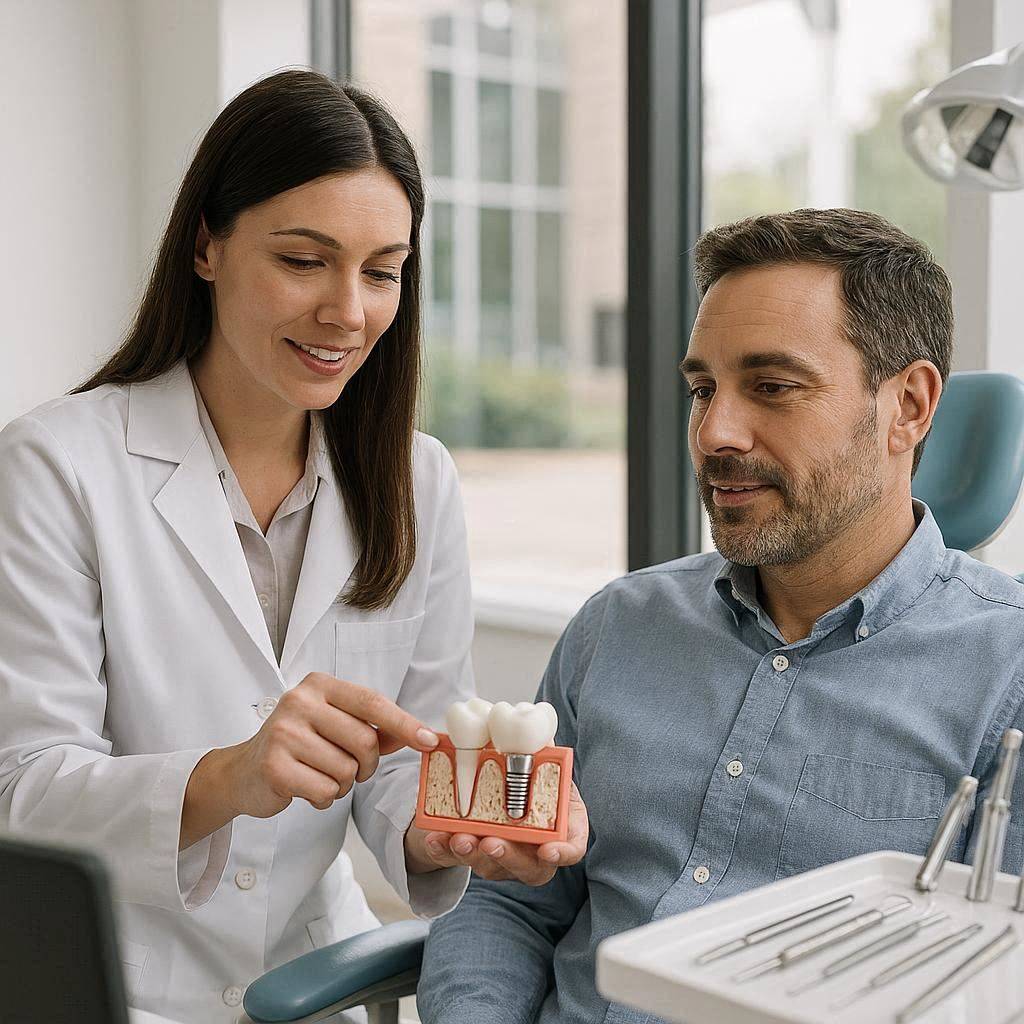
A dental implant is a small titanium post. A surgeon places this post into your jawbone. Over time, the bone grows around the metal. This creates a rock-solid foundation. Then, a crown (the visible tooth) is attached on top.
Three main parts make up a complete implant:
- The Implant Post: The titanium screw that acts as the root.
- The Abutment: A small connector piece.
- The Crown: The custom-made artificial tooth.
Note for readers: Titanium is used because it is biocompatible. Your body accepts it. In rare cases, zirconia (a white ceramic) is used for patients with metal sensitivities. Most Des Moines implant dentists offer both options.
Why Choose Dental Implants Over Other Options?
You have choices. Bridges, partials, and dentures all cost less upfront. But cheaper does not always mean better for your long-term health.
Let us compare honestly.
| Feature | Dental Implants | Traditional Bridge | Dentures |
|---|---|---|---|
| Bone health | Preserves jawbone | No effect; bone shrinks | Accelerates bone loss |
| Nearby teeth | Left untouched | Requires grinding down healthy teeth | No effect on remaining teeth |
| Stability | Permanent; will not slip | Stable but can decay underneath | Can move, click, or fall out |
| Lifespan | 20+ years (often lifetime) | 7–15 years | 5–8 years |
| Eating restrictions | None | Avoid sticky/hard foods | Soft foods only |
| Cleaning | Brush and floss normally | Special floss required | Removed and soaked |
A real patient’s perspective:
“I wore partial dentures for three years. Every meal was stressful. Then I got two implants in Des Moines. I forgot I even have them. That is the difference.” — Linda, 62, Beaverdale.
The Complete Process: Step-by-Step Guide to Implants in Des Moines
No two implant journeys look exactly the same. But most follow this general timeline. Understanding each step reduces fear and surprises.
Step 1: Initial Consultation (60–90 minutes)
Your first visit is all about information. The dentist examines your mouth. They take 3D scans (CBCT). This imaging shows bone density, nerve locations, and sinus position.
What they check:
- Do you have enough jawbone?
- Are your gums healthy?
- Do you have untreated cavities or gum disease?
Important note: Not everyone is a candidate on day one. Some patients need bone grafting first. Do not panic. This is extremely common.
Step 2: Treatment Planning
Your dentist creates a custom blueprint. They decide:
- How many implants you need.
- Whether you need bone grafting.
- The type of anesthesia (local, sedation, or general).
Step 3: The Surgery Day (Placement)
The procedure itself is surprisingly calm. Most patients receive local numbing plus optional sedation.
What happens:
- A small incision is made in the gum.
- A hole is carefully drilled into the jawbone.
- The titanium post is screwed into place.
- The gum is stitched over or around the implant.
You go home the same day. Expect mild swelling for 2–3 days.
Step 4: Osseointegration (The Waiting Game)
This is the most critical phase. Osseointegration means “bone fusing to metal.” Your jawbone grows tightly around the implant. This takes 3 to 6 months.
During this time, you wear a temporary partial or remain toothless. Patience here determines long-term success.
Step 5: Abutment Placement (Minor Procedure)
Once the implant is solid, the dentist reopens the gum and attaches a small metal cap (abutment). This sticks out above the gumline. Healing takes 2 weeks.
Step 6: Crown Fabrication
Your dentist takes impressions. A lab in Iowa or a neighboring state creates your custom crown. They match the color, shape, and size to your natural teeth. This takes 2–4 weeks.
Step 7: Final Attachment
Your permanent crown is screwed or cemented onto the abutment. Your dentist checks your bite. You walk out with a complete, beautiful smile.
How Much Do Dental Implants Cost in Des Moines?
Let us talk money directly. This is the number one question patients ask.
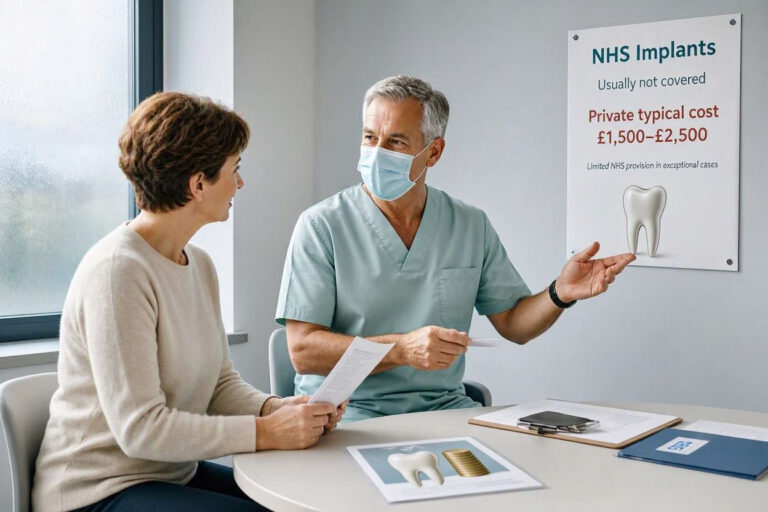
A single dental implant in Des Moines typically costs between 3,500and3,500and6,000. This includes the surgery, abutment, and crown.
Here is a realistic breakdown:
| Component | Price Range |
|---|---|
| Consultation & 3D scan | 150–400 |
| Implant post placement | 1,500–2,500 |
| Abutment | 300–600 |
| Custom crown | 1,200–2,000 |
| Bone graft (if needed) | 500–1,200 per site |
Full arch implants (All-on-4 or All-on-6) range from 15,000to15,000to30,000 per arch.
Note for readers: Beware of “cheap implants” advertised for $1,500 total. These often exclude the crown, the abutment, or the follow-up care. Always ask for a complete written quote.
Does Insurance Cover Dental Implants in Des Moines?
This is tricky. Most standard dental insurance plans do not cover the implant post. However, they often cover parts of the process.
What insurance may pay for:
- The crown (50% after deductible)
- Extractions (80–100%)
- Bone grafting (sometimes)
- Anesthesia
Medical insurance may help if tooth loss resulted from an accident or injury.
How to save money in Des Moines:
- Look for in-network providers.
- Ask about CareCredit or LendingClub payment plans.
- Check if the dentist offers in-house membership plans (typically $300–500/year for discounts).
Local clinics like Des Moines University Clinic and Iowa Mission of Mercy occasionally offer reduced-cost implant services. Waitlists apply.
Who Is a Good Candidate for Implants?
You might assume implants are only for young, healthy people. That is false.
Good candidates include:
- Adults with one or more missing teeth.
- People with dentures who hate the slipping.
- Patients with gum disease (once treated).
- Older adults (age alone is never a barrier).
- People who do not smoke heavily (smoking reduces success rates).
Challenges that can be fixed:
- Low bone density: Solved with bone grafting.
- Infected gums: Solved with deep cleaning (scaling/root planing).
- Chronic illness: Diabetes, osteoporosis, and autoimmune disorders can still allow implants if well-managed. Talk to both your doctor and dentist.
Absolute contraindications (rare):
- Uncontrolled cancer in the jaw.
- Recent head/neck radiation.
- Severe uncontrolled bleeding disorders.
Bone Grafting: What You Need to Know
One third of patients need bone grafting before implants. This sounds scary. It is not.
When you lose a tooth, the jawbone melts away. It resorbs. Within one year, you can lose 25% of the bone width.
A bone graft rebuilds that foundation.
- The dentist places donor bone (human, cow, or synthetic) into the socket.
- Your body replaces it with living bone over 4–6 months.
- Then you proceed with the implant.
Grafting adds one extra procedure and 4–6 months to your timeline. But it turns a “no” into a “yes” for most patients.
Important note: Do not skip bone grafting just to save time. An implant placed in weak bone will fail. Patience pays off.
Top 5 Qualities to Look for in a Des Moines Implant Dentist
Not all dentists place implants. Many refer to specialists. Here is what separates excellent providers from average ones.
- Advanced training. Look for “Fellow” or “Diplomate” status from the American Board of Oral Implantology (ABOI) or the International Congress of Oral Implantologists (ICOI).
- In-house 3D CBCT scan. No one should place implants without this imaging.
- Transparent pricing. They give you a printed quote before you schedule surgery.
- Same-day temporaries. Top offices provide a temporary tooth so you never go out in public with a gap.
- Sedation options. Fear is normal. A good dentist offers nitrous oxide, oral sedatives, or IV sedation.
Types of implant providers in Des Moines:
- Oral surgeons: Best for complex cases, bone grafting, and full arch.
- Periodontists: Gum specialists; excellent for front-tooth implants.
- General dentists with implant training: Convenient for single teeth; check their case volume.
Recovery and Healing: A Realistic Timeline
Healing takes time. Do not rush it.
| Time Period | What to Expect |
|---|---|
| Days 1–3 | Swelling, mild bruising, soft food diet. Pain managed with ibuprofen. |
| Days 4–7 | Swelling goes down. Stitches may dissolve. Resume light chewing. |
| Weeks 2–4 | Gum tissue heals. No pain. You forget the implant is there. |
| Months 3–6 | Bone fuses. Little to no sensation. |
| After final crown | Full function. Eat steak, apples, nuts — anything. |
Warning signs (call your dentist immediately):
- Swelling that worsens after day 3.
- Fever over 101°F (38.3°C).
- Pus or foul taste (sign of infection).
- Implant feels loose.
Note for readers: True implant failure is rare (under 5%). Most failures happen in the first 3 months due to infection or poor bone quality.
Foods to Eat and Avoid During Healing
Your diet changes after surgery. Here is a simple list to keep you safe.
Week 1 (Soft and cold foods):
- Yogurt, applesauce, smoothies (no straws)
- Mashed potatoes, scrambled eggs
- Ice cream (the cold reduces swelling)
- Protein shakes
Weeks 2–4 (Semi-soft foods):
- Soft bread, pasta, pancakes
- Cooked vegetables, bananas
- Ground meat, fish, tofu
Avoid completely until healed:
- Popcorn (husks get stuck in incisions)
- Nuts, seeds, chips
- Steak or tough meats
- Sticky candies (caramel, taffy)
- Straws (the suction can dislodge blood clots)
Long-Term Care: Making Your Implant Last for Decades
Implants do not decay. But they are not invincible. Gum health determines how long they last.
Your daily implant care routine:
- Brush twice a day with a soft toothbrush.
- Floss daily using implant-specific floss or superfloss.
- Use a water flosser (Waterpik) set on low pressure to clean around the abutment.
- Avoid chewing ice, pens, or hard candy (this can crack the crown).
Professional maintenance:
- See your dentist every 6 months.
- They will check the crown’s bite and screw tightness.
- Annual X-rays confirm bone levels are stable.
With good care, your implant has a 95% success rate at 10 years and 85–90% at 20 years. Many patients keep their original implants for 30+ years.
Common Fears (And Why You Can Relax)
Fear of pain, failure, or cost stops many people. Let us address each one directly.
Fear #1: “It will hurt.”
- Reality: The surgery is done with numbing and sedation. Most patients say the injection is the only pinch. Post-op pain is less than a tooth extraction. Ibuprofen controls it completely.
Fear #2: “It will fail.”
- Reality: In healthy non-smokers, the success rate is 97–98%. Failing implants can often be replaced with a larger implant.
Fear #3: “I cannot afford it.”
- Reality: Monthly payment plans make implants $100–200 per month. Also, consider the long-term cost of dentures (replacements every 5 years, adhesives, sore spots). Implants often save money over 20 years.
Fear #4: “I am too old.”
- Reality: Implants have been placed successfully in patients over 90. Age is irrelevant. Bone density and overall health matter.
Dental Implants vs. Mini Implants: What Is the Difference?
You may see ads for “mini implants.” These are smaller (1.8mm to 3mm vs. standard 4mm to 5mm). They require less bone but are less stable.
| Feature | Standard Implant | Mini Implant |
|---|---|---|
| Diameter | 3.5 – 6 mm | 1.8 – 3 mm |
| Bone requirement | Moderate to high | Low |
| Lifespan | 20+ years | 5–8 years |
| Best for | Single teeth or full arch | Loose denture stabilization |
| Crown fracture risk | Low | Higher |
Our advice: Mini implants work well for securing lower dentures. But for single tooth replacement, always choose standard implants.
Finding the Right Implant Dentist in Des Moines: A Practical Checklist
You are ready to take action. Use this checklist when calling local offices.
Questions to ask during your consultation:
- “How many implants have you placed in the last year?”
- “Do you use a CBCT scanner?”
- “What sedation options do you offer?”
- “Can I see before-and-after photos of similar cases?”
- “What is your policy on failed implants?” (A confident dentist will replace a failed implant at no charge for the first year.)
- “Do you use American-made crowns and abutments?”
- “Will I leave with a temporary tooth?”
Red flags to avoid:
- The dentist refuses to show credentials.
- No written quote before surgery.
- Pushing you to sign up for treatment the same day.
- Vague answers about bone grafting (“We will know when we open you up.”)
Neighborhood Guide: Implant Access Across Des Moines
Good implant care is available across the metro. Here is a quick neighborhood breakdown.
| Area | Types of Providers | Average Cost (Single Implant) |
|---|---|---|
| Downtown/East Village | Oral surgeons, high-tech offices | 4,500–6,500 |
| West Des Moines / Jordan Creek | Many general dentists with implant training | 3,800–5,500 |
| Ankeny | Mixture of periodontists and family dentists | 3,500–5,000 |
| Waukee / Clive | Newer clinics with competitive pricing | 3,700–5,200 |
| South Side / Indianola | Fewer specialists; longer wait times | 3,200–4,800 |
Note for readers: Driving 15–20 minutes outside downtown can save you $500–1,000 on a single implant. But prioritize skill over savings.
Real Patient Stories (Names Changed for Privacy)
Case 1: Tom, 55 – Single front tooth lost in a bike accident.
- Timeline: Bone graft in March, implant in July, crown in October.
- Total cost: $5,200.
- Outcome: “I cried when I saw the final crown. It matches perfectly.”
Case 2: Diane, 68 – Lower denture that would not stay in place.
- Solution: Two mini implants to snap the denture down.
- Timeline: One surgery day. Denture modified. Total four weeks.
- Total cost: $3,800.
- Outcome: “I ate corn on the cob for the first time in 12 years.”
Case 3: Marcus, 42 – Missing two molars since childhood.
- Solution: Two standard implants placed simultaneously.
- Timeline: Implants in January. Crowns in May.
- Total cost: $8,400.
- Outcome: “My chewing efficiency went from 40% to 95%.”
Frequently Asked Questions (FAQ)
1. Are dental implants safe?
Yes. They have been used for over 50 years. Titanium is one of the most studied medical materials.
2. How long does the whole process take?
From first consult to final crown: 5 to 9 months on average. Complex cases can take 12 months.
3. Can I get all my teeth done in one day?
Yes, with All-on-4 or Teeth-in-a-Day. But you will receive temporary teeth. Permanent ones come after 4–6 months of healing.
4. Do implants feel different from natural teeth?
Slightly. They cannot feel hot or cold. But the biting sensation is nearly identical.
5. What happens if I wait too long to replace a missing tooth?
Bone loss accelerates. The teeth next to the gap tilt. The tooth above the gap drifts down. Implants become harder (more expensive) over time.
6. Can I smoke with dental implants?
Smoking is the #1 cause of implant failure. If you smoke, your failure rate doubles or triples. Quitting for 2 weeks before and 2 months after surgery dramatically improves outcomes.
7. Are there any age restrictions?
No. Teenagers must wait until jaw growth finishes (around age 17–18 for girls, 19–20 for boys). Older adults have no upper age limit.
8. Do implants require special cleaning?
No. But you need to clean under the crown where the gum meets the abutment. A water flosser makes this easy.
Additional Resources
For deeper, trusted information, visit the American Academy of Implant Dentistry (AAID) patient education page.
👉 Link: AAID – Dental Implants Patient Guide (Open in a new tab. This resource explains implant types, risks, and how to find a qualified specialist.)
Disclaimer
This article is for general informational purposes only. It does not constitute medical advice. Dental implant outcomes vary based on individual health, anatomy, and provider skill. Always seek the advice of a licensed dentist or oral surgeon in Des Moines with any questions you have regarding your specific condition. Never disregard professional medical advice because of something you have read here. The author and publisher are not liable for any decisions you make based on this information.
Conclusion
Dental implants in Des Moines offer a permanent, natural-feeling solution for missing teeth — but they require time, healing, and investment. Bone grafting is normal, recovery takes months, and success depends on choosing an experienced provider. With realistic expectations and good daily care, your implant can last a lifetime.