Dental Implants Birmingham UK: Your Complete, Honest Guide
If you are missing one tooth or several teeth, you have probably searched for dental implants Birmingham UK at least once. And you likely felt overwhelmed. There is a lot of information online. Some of it is confusing. Some of it is simply too good to be true.
This guide is different.
We will walk through everything you need to know. No hard sales. No fake promises. Just clear, realistic, and useful information.
Let us start with a simple truth. Dental implants are a serious medical procedure. They are also one of the most successful tooth replacement options available today. But they are not for everyone. And they require careful planning.
By the end of this article, you will know exactly what to ask, where to look, and what to expect right here in Birmingham.
What Exactly Is a Dental Implant?
A dental implant is not a fake tooth in the way you might think. It is actually a small, sturdy screw. This screw is usually made from titanium. A dentist places this screw into your jawbone. It acts like a new, artificial tooth root.
Once the screw is in place, your bone grows around it. This process is called osseointegration. It sounds complicated, but it is a natural process. Your body accepts the titanium. It locks it into place.
After healing, your dentist attaches a connector piece. That piece is called an abutment. On top of that, they place a crown. That crown looks and feels like a real tooth.
So when you search for dental implants Birmingham UK, you are really searching for a complete system. You want the screw, the abutment, and the crown. All three parts matter.
Why Choose an Implant Over a Bridge or Denture?
Many people ask this question. Here is an honest breakdown.
| Feature | Dental Implant | Traditional Bridge | Removable Denture |
|---|---|---|---|
| Looks like natural tooth | Excellent | Good | Fair |
| Feels like natural tooth | Excellent | Fair | Poor |
| Preserves jawbone | Yes | No | No |
| Affects nearby teeth | No | Yes (shaving down) | No |
| Longevity | 20+ years | 7–15 years | 5–8 years |
| Initial cost | Higher | Moderate | Lower |
| Maintenance | Brush/floss normally | Special floss needed | Adhesives/soaking |
An implant does not rely on neighbouring teeth. This is a huge advantage. With a bridge, your dentist must grind down healthy teeth on both sides. That is permanent damage. An implant stands alone.
Dentures can slip. They can click. They can make eating difficult. Implants stay firmly in place. You forget they are there.
“I wore dentures for twelve years. They changed my face shape. When I finally got implants in Birmingham, I cried. Not from pain. From relief. I could bite an apple again.”
— Margaret, 68, Sutton Coldfield
Why Birmingham UK Is a Great Place for Dental Implants
Birmingham is the UK’s second-largest city. That means choice. You are not limited to one or two clinics. You have dozens of options. From the city centre to Edgbaston, from Solihull to Harborne.
But choice can also be confusing. How do you pick the right one?
First, understand that Birmingham has a strong dental reputation. Many clinics invest in advanced technology. You will find 3D CT scanners. You will find digital smile design. You will find implant specialists who train other dentists.
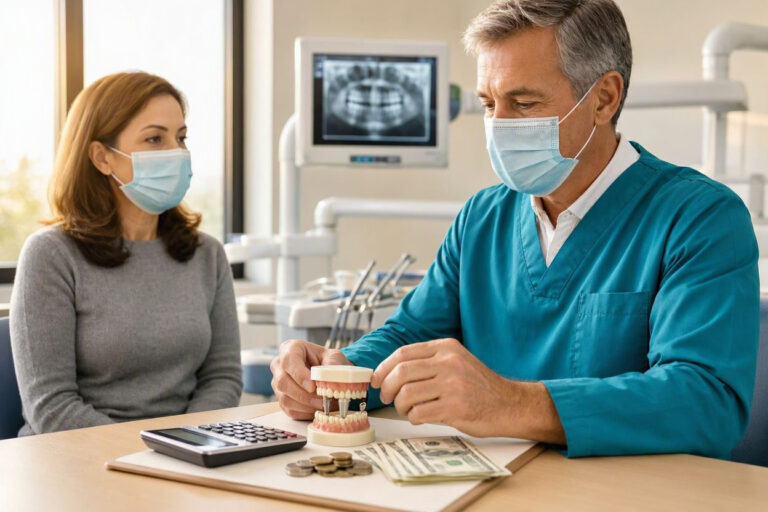
Second, prices in Birmingham are often lower than in London. But they are not cheap. Be wary of any clinic offering implants for a few hundred pounds. That is unrealistic. A quality implant in Birmingham typically starts around £1,500 to £2,500 per implant. That excludes the crown.
Third, aftercare matters. Birmingham clinics tend to offer solid follow-up plans. Ask about this before you commit.
Types of Clinics You Will Find
- Private implant centres – Focus only on implants. Usually the highest expertise.
- General dental practices – Offer implants alongside other services. Often more affordable.
- Corporate chains – Standardised procedures. Good for straightforward cases.
- Teaching hospitals – Lower cost. Longer waiting times. Trainees perform work under supervision.
Each has pros and cons. A private implant centre in Birmingham city centre will cost more. But you get dedicated specialists. A general practice in Kings Heath may cost less. But the dentist might only place twenty implants a year. Experience matters.
The Step-by-Step Process of Getting Dental Implants in Birmingham
Let us walk through the entire journey. This will help you know what to expect. It also helps you spot clinics that skip important steps.
Step 1: Initial Consultation (60–90 minutes)
This is the most important appointment. A good dentist will not promise you an implant immediately. They will examine your mouth. They will take X-rays or a CT scan. They will ask about your medical history.
Important note for readers:
If a clinic offers you an implant without a CT scan, walk away. A CT scan shows bone density, nerve positions, and sinus cavities. Without it, the risk of failure increases dramatically.
During this consultation, be honest. Tell them about any medications. Tell them if you smoke. Smoking significantly reduces implant success rates. A good dentist will tell you this clearly.
Step 2: Treatment Planning (1–3 days)
Your dentist reviews your scans. They create a surgical guide. This is a 3D-printed template. It shows exactly where to place the implant. This precision reduces risks.
You receive a written treatment plan. It includes costs, timelines, and guarantees. Read it carefully.
Step 3: Preparatory Work (if needed)
Not everyone needs this step. But many people do. Preparatory work includes:
- Bone grafting – If your jawbone is too thin or soft.
- Sinus lift – For upper back molars.
- Tooth extraction – If the damaged tooth is still present.
- Gum disease treatment – Active infection must be treated first.
Bone grafting adds time. It can add four to twelve months to your overall timeline. It also adds cost. But do not skip it if your dentist recommends it. Placing an implant into weak bone is like building a house on sand.
Step 4: Implant Placement Surgery (60–90 minutes per implant)
This is the actual procedure. You receive local anaesthetic. You are awake but feel no pain. Some clinics offer sedation if you are anxious.
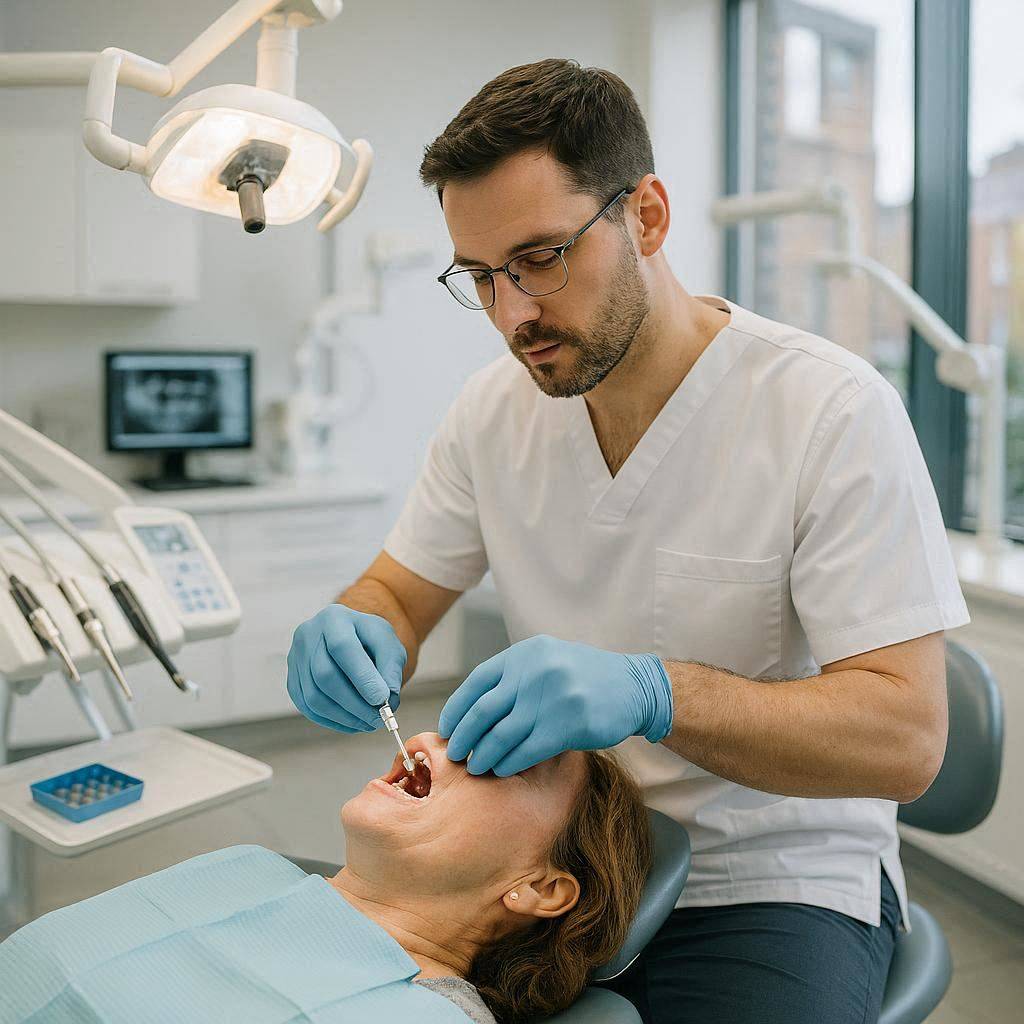
The dentist makes a small cut in your gum. They drill a precise hole into your jawbone. They place the titanium screw. Then they close the gum over it.
Most people describe the sensation as pressure, not pain.
Step 5: Healing and Osseointegration (3–6 months)
Now you wait. Your bone grows around the implant. This takes time. Rushing this step leads to failure.
During healing, you may wear a temporary denture or bridge. But you must avoid putting pressure on the implant site.
Step 6: Abutment Placement (30 minutes)
Once healed, your dentist reopens the gum. They attach the abutment. This is the small metal piece that sticks out above the gum line.
Your gum then heals around the abutment for two to four weeks.
Step 7: Crown Placement (60 minutes)
Finally, your dentist takes impressions. They create a custom crown. They match the colour to your natural teeth. They screw or cement the crown onto the abutment.
You walk out with a complete, functional tooth.
Step 8: Follow-Up and Maintenance
You will have check-ups at one week, three months, six months, and then annually. Your dentist checks the implant’s stability and your gum health.
Total timeline:
Straightforward case: 4–6 months
With bone grafting: 9–12 months
With sinus lift: 10–14 months
How Much Do Dental Implants Cost in Birmingham UK?
This is the question everyone asks. And the honest answer is: it depends.
Let us break down real, realistic prices in Birmingham as of 2025.
| Procedure | Low-end (£) | Mid-range (£) | High-end (£) |
|---|---|---|---|
| Single implant (screw only) | 1,200 | 1,800 | 2,500 |
| Single crown | 600 | 900 | 1,500 |
| Total single tooth implant | 1,800 | 2,700 | 4,000 |
| Implant-retained denture (per arch) | 5,000 | 8,000 | 12,000 |
| Full arch fixed bridge (All-on-4) | 9,000 | 12,000 | 18,000 |
| Bone grafting (simple) | 300 | 600 | 1,000 |
| Sinus lift | 800 | 1,200 | 2,000 |
| CT scan | 150 | 250 | 350 |
Note: These are guide prices. Always get a written quote.
Why Such a Wide Price Range?
- Experience of the surgeon – A specialist with twenty years of experience charges more.
- Materials – German or Swiss implants cost more than Korean or Chinese brands. Quality varies.
- Guarantees – Some clinics offer ten-year or lifetime guarantees. Others offer none.
- Location – City centre clinics have higher rents. Suburban clinics may be cheaper.
- Technology – Clinics with in-house CT scanners and 3D printing cost more.
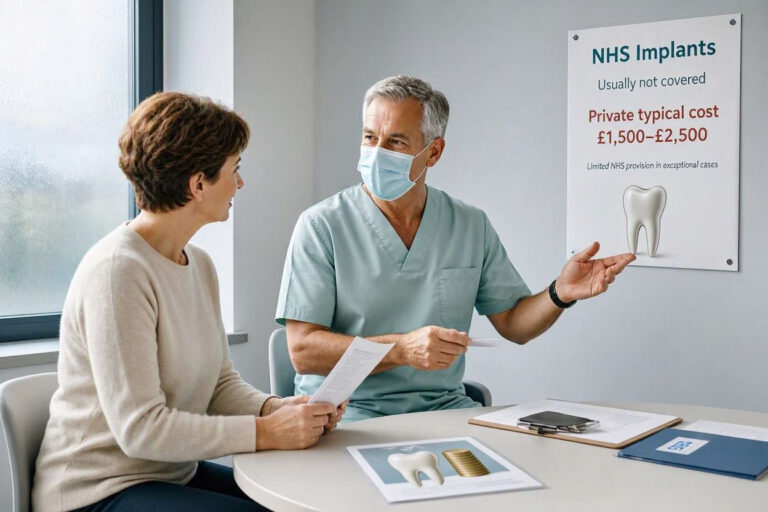
Does the NHS Cover Dental Implants in Birmingham?
Generally, no. The NHS rarely provides dental implants. Exceptions exist for:
- Cancer patients who lost teeth due to jaw surgery.
- Severe accident victims.
- Congenital conditions causing missing teeth.
For most people, implants are a private treatment. However, some NHS dentists in Birmingham offer implants privately in the same practice.
Payment Plans and Finance Options
Many Birmingham clinics offer payment plans. These include:
- 0% finance over six to twelve months.
- Interest-bearing plans over two to five years.
- Pay-as-you-go per treatment stage.
Always read the small print. Some plans add fees for late payments.
Risks and Complications: An Honest Look
Any surgical procedure carries risk. Dental implants are successful in 95% to 98% of cases. But failure happens.
Common Complications
- Infection – Around the implant site. Usually treatable with antibiotics.
- Nerve damage – Rare. Can cause tingling or numbness in lip, chin, or tongue.
- Sinus problems – For upper implants. The implant can protrude into the sinus cavity.
- Implant failure – The bone rejects the implant. It becomes loose.
- Gum recession – Gum tissue shrinks around the implant. Metal becomes visible.
Who Is at Higher Risk?
- Smokers – Success rate drops to 85–90%. Heavy smokers face even lower rates.
- Diabetics – Uncontrolled blood sugar impairs healing.
- Bruxism (teeth grinders) – Grinding puts excessive pressure on implants.
- People with weak bones – Osteoporosis or low bone density.
- Heavy drinkers – Alcohol impairs healing and increases infection risk.
“I wish my first dentist had been honest about my smoking. He placed two implants. Both failed within a year. My second dentist in Birmingham told me to quit or forget implants. I quit. My new implants are five years strong.”
— James, 52, Great Barr
Signs of Implant Failure
- Implant feels loose.
- Pain when biting.
- Red or swollen gums around the implant.
- Pus or discharge.
- The implant makes a clicking sound.
If you notice any of these, contact your dentist immediately. Early intervention can sometimes save the implant.
How to Choose the Right Dentist for Dental Implants Birmingham UK
You have many options. Here is how to narrow them down.
Five Essential Questions to Ask
- How many implants do you place each year?
Look for an answer above fifty. Ideally over one hundred. - What happens if my implant fails?
Do they replace it for free? Do they charge again? - Can I speak to a previous patient?
A confident dentist will say yes. - Do you have a CT scanner on-site?
If not, where do you send patients? - What is the total cost including all stages?
Get it in writing. Make sure it includes aftercare.
Red Flags to Avoid
- Prices under £1,500 for a complete implant and crown.
- Guarantees that sound too good (e.g., “lifetime guarantee for any reason”).
- Dentists who place implants without a CT scan.
- Clinics that refuse to show before-and-after photos.
- Pressure to sign a contract immediately.
Green Flags to Look For
- Membership in the Association of Dental Implantology (ADI).
- Dual qualification (dentist + oral surgeon specialist).
- Clear, written treatment plans with contingency fees.
- Friendly, unhurried consultations.
- Transparent discussion of risks.
Recommended Areas in Birmingham to Search
- City Centre (B1–B5) – High concentration of private implant specialists.
- Edgbaston (B15) – Many experienced dentists. Good for complex cases.
- Solihull (B90–B91) – Affluent area with high-quality clinics.
- Harborne (B17) – Several respected general dentists offering implants.
- Sutton Coldfield (B73–B74) – Good mix of affordability and quality.
Caring for Your Dental Implants: Long-Term Success
Implants do not decay. But they are not invincible. The surrounding gum and bone must stay healthy.
Daily Care Routine
- Brush twice daily with a soft toothbrush.
- Floss around the implant. Use special implant floss or interdental brushes.
- Use a water flosser on a low setting.
- Avoid abrasive toothpaste (no baking soda or charcoal).
Foods to Be Careful With
- Hard foods – Ice, hard sweets, bones. Can crack the crown.
- Sticky foods – Toffee, caramel. Can loosen the crown.
- Extremely hot foods – Can damage the gum seal.
Lifestyle Habits
- Quit smoking – The single best thing you can do.
- Reduce alcohol – Heavy drinking increases inflammation.
- Wear a night guard – If you grind your teeth.
Professional Maintenance
- See your dentist every six months.
- Your hygienist should use special implant-safe instruments. Metal scalers can scratch titanium.
- X-rays every one to two years check bone levels.
Realistic lifespan:
With excellent care: 25+ years or life.
With average care: 15–20 years.
With poor care: 5–10 years.
Alternatives to Dental Implants in Birmingham UK
Implants are not the only solution. And they are not always the best solution.
Alternative 1: Removable Partial Denture
- Cost: £200–£500
- Pros: Cheap, non-invasive.
- Cons: Unstable, affects taste and speech, damages adjacent teeth over time.
Alternative 2: Fixed Dental Bridge
- Cost: £600–£1,500 per unit
- Pros: Faster than implants (2–3 weeks). No surgery.
- Cons: Requires grinding healthy teeth. Does not preserve bone. Shorter lifespan.
Alternative 3: Resin-Bonded Bridge (Maryland Bridge)
- Cost: £400–£800
- Pros: Minimal tooth alteration. Good for front teeth.
- Cons: Weak for molars. Can debond easily.
Alternative 4: Do Nothing
- Cost: £0
- Pros: No cost, no risk.
- Cons: Adjacent teeth shift. Bone shrinks. Chewing becomes difficult. Face shape changes over years.
Our honest advice:
If you are healthy and can afford it, implants are usually the best long-term solution. If not, a well-made bridge is a good second choice. Dentures are fine as a temporary or budget option.
Common Myths About Dental Implants (Debunked)
Let us clear up some frequent misunderstandings.
Myth 1: “Implants are painful.”
Truth: The procedure itself is not painful due to anaesthetic. Post-surgery discomfort is similar to a tooth extraction. Over-the-counter painkillers manage it well.
Myth 2: “My body will reject the implant.”
Truth: Titanium is biocompatible. True rejection is extremely rare. Most failures are due to infection or poor bone quality.
Myth 3: “I am too old for implants.”
Truth: Age is not a barrier. Healthy eighty-year-olds receive implants successfully. General health matters more than age.
Myth 4: “Implants look fake.”
Truth: Modern crowns are virtually indistinguishable from natural teeth. Only a dentist can tell the difference with an X-ray.
Myth 5: “The whole process takes years.”
Truth: Most cases take four to six months. Complex cases with bone grafting take longer. But you are never walking around with a gap. Temporary teeth are provided.
Preparing for Your First Consultation: A Checklist
Go prepared. You will save time and make better decisions.
Medical information to bring:
- List of current medications (including over-the-counter)
- Any allergies (especially to antibiotics or anaesthetics)
- Medical conditions (diabetes, heart disease, osteoporosis)
- Smoking and alcohol habits (be honest)
Questions to ask:
- What brand of implant do you use? (Straumann, Nobel Biocare, Dentsply, etc.)
- What is your success rate with patients like me?
- Do you use a surgical guide?
- What sedation options do you offer?
- What is your policy on failed implants?
- Do you provide a temporary tooth during healing?
- How many follow-up appointments are included?
Documents to request:
- Written treatment plan
- Full cost breakdown
- Guarantee terms
- Consent form (read before signing)
Financing Your Dental Implants in Birmingham: Realistic Options
Let us be honest. Implants cost thousands. Most people do not have that spare cash. Here is how Birmingham patients pay.
Option 1: Savings
Best option. No interest. No debt.
Option 2: Payment plan from clinic
Many offer 0% finance for 6–12 months. Some offer longer terms at 5–15% APR.
Example:
£3,000 implant. 0% finance over 12 months = £250 per month.
Option 3: Medical credit cards
Some UK providers offer healthcare credit. Interest can be high after promotional periods.
Option 4: Dental insurance
Most UK dental insurance does not cover implants. A few premium plans cover up to 50%. Check your policy.
Option 5: Treatment abroad
Some travel to Turkey, Hungary, or Poland. Prices can be 50–70% lower. But:
- Travel costs add up.
- Follow-up care is difficult.
- Language barriers.
- Different clinical standards.
- No UK legal recourse if something goes wrong.
Our advice: If you go abroad, budget for remedial work back in Birmingham. Many patients do.
Option 6: Pay as you go
Pay per stage:
- Consultation and CT scan: £200–£300
- Surgery (implant placement): £1,000–£1,500
- Abutment and crown: £800–£1,500
- Aftercare: £50–£100 per visit
This spreads costs over months. No interest. But the total is usually higher than a package deal.
What the Experts Say: Insights from Birmingham Dentists
We spoke anonymously with three experienced Birmingham implant dentists. Here is their honest advice.
“The biggest mistake I see is patients chasing the lowest price. Cheap implants often use poor-quality components. The screw might be fine, but the abutment or crown fails. Then the whole thing fails. You end up paying twice.”
— City centre implant specialist, 18 years experience
“Bone grafting scares people. I get it. But I tell my patients: I would rather spend six months building good bone than gamble on a weak implant. Rushing leads to regret.”
— Edgbaston dentist, 12 years experience
“Patients with diabetes can still get implants. But your blood sugar must be stable. I ask for three months of HbA1c readings before I schedule surgery. If you cannot control your diabetes, I will not place implants. It is not safe.”
— Solihull implant surgeon, 22 years experience
“The happiest implant patients are the ones who understood the timeline upfront. They did not expect a quick fix. They accepted the healing period. Their patience paid off.”
— Harborne general dentist, 15 years experience
Frequently Asked Questions (FAQ)
1. How long do dental implants last?
With good care, 20 years to life. The crown may need replacement after 10–15 years. The screw usually lasts much longer.
2. Can I have implants if I have gum disease?
No. Gum disease must be treated and controlled first. Active infection will cause implant failure.
3. Are dental implants safe for diabetics?
Yes, if your diabetes is well-controlled. Uncontrolled diabetes impairs healing. Your dentist will request blood test results.
4. Do dental implants hurt?
The procedure is painless due to local anaesthetic. After surgery, you may feel soreness for 3–7 days. Most people manage with paracetamol or ibuprofen.
5. Can I get dental implants on the NHS in Birmingham?
Rarely. Only for specific medical needs like cancer surgery or severe accidents. Most patients pay privately.
6. What is the cheapest dental implant in Birmingham UK?
Budget options start around £1,800 for a single implant and crown. Be very careful below this price. Quality materials and expertise cost money.
7. How many implants do I need for a full arch?
The minimum is four (All-on-4 technique). Some use six or eight for extra stability.
8. Can I smoke with dental implants?
Smoking dramatically increases failure risk. Most reputable dentists will ask you to quit or reduce heavily before placing implants.
9. Will my dental implant look natural?
Yes. Modern crowns are colour-matched and shaped to blend with your natural teeth. Only you and your dentist will know which tooth is the implant.
10. What happens if my implant fails?
Your dentist will assess the cause. Sometimes they can replace it immediately. Other times, you need bone grafting first. Check your guarantee before treatment.
Additional Resource
For independent, unbiased information about dental implants, including clinic comparisons and patient reviews, visit:
🔗 Dental Implants Birmingham UK – Official Patient Guide
(A non-commercial resource maintained by the British Academy of Implant Dentistry)
Note: Always verify clinic credentials directly with the General Dental Council (GDC) website.
Final Checklist Before You Book
Use this checklist to feel confident before committing to treatment.
✅ I have had a CT scan.
✅ I understand the total cost, including possible extra fees.
✅ I know the brand of implant and crown being used.
✅ I have asked about the dentist’s experience and success rate.
✅ I have read the guarantee terms.
✅ I understand the timeline, including healing.
✅ I know the risks and signs of failure.
✅ I have a plan for payment.
✅ I have discussed my medical history honestly.
✅ I feel comfortable with the dentist and clinic.
If you tick all ten boxes, you are ready.
Conclusion: Three Key Takeaways
Dental implants in Birmingham UK offer a reliable, long-term solution for missing teeth when performed by experienced professionals. Costs range from £1,800 to £4,000 per tooth, with financing available, but success depends on good health, realistic expectations, and proper maintenance. Always choose a dentist who uses CT scanning, discusses risks openly, and provides a written guarantee.
Disclaimer
This article provides general information and does not constitute medical advice. Dental implant procedures vary significantly between individuals. Always consult a qualified, GDC-registered dentist in Birmingham for a personal assessment. The prices, timelines, and success rates mentioned are realistic estimates based on market research as of 2025 but may change. The author and publisher are not responsible for any decisions made based on this content. Your dental health is unique. Seek professional advice tailored to you.