Dental Implant Failing Symptoms: 10 Early Signs You Should Never Ignore
You invested time, money, and hope into your dental implant. It was supposed to be the permanent solution—a new tooth that looked, felt, and functioned like a natural one. For most people, that is exactly what happens. But sometimes, things go wrong.
The good news? Implant failure is relatively rare. The better news? When it does happen, it rarely happens overnight. Your body gives you clear signals long before the implant actually falls out or needs to be removed.
Learning to recognize dental implant failing symptoms early can save your implant, your jawbone, and a lot of unnecessary pain. It can also save you thousands of dollars in repair or replacement costs.
In this guide, we will walk through every major warning sign—from the obvious to the subtle. You will learn what is normal after surgery, what is not, and exactly what to do if you notice something concerning.
Important note: This article is for educational purposes only. It does not replace professional medical advice. If you think your implant is failing, contact your dentist or oral surgeon immediately.
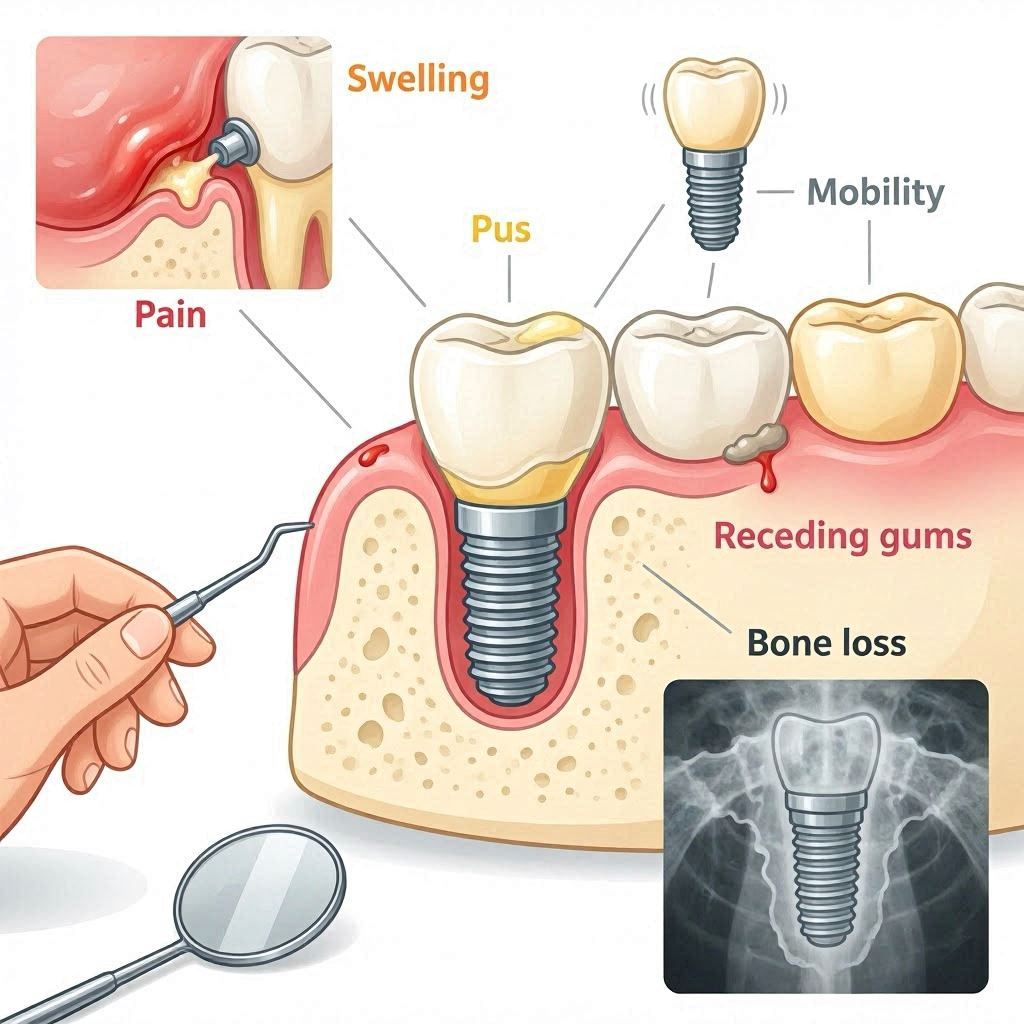
How Common Is Dental Implant Failure? (A Realistic Look)
Before we dive into symptoms, let us set realistic expectations.
Dental implants have a success rate of approximately 95% to 98% over ten years. That means for every one hundred implants placed, ninety-five to ninety-eight of them are still functioning perfectly a decade later.
However, “success” does not mean zero problems. Some implants develop complications that can be treated without removal. Others fail completely.
There are two main types of implant failure:
- Early failure (within the first three to six months): Usually related to healing problems, infection, or the implant not fusing with the bone.
- Late failure (after one year or more): Typically caused by excessive biting forces, poor oral hygiene, or general health changes.
Knowing this timeline matters because symptoms often look different depending on when they appear.
The 10 Most Common Dental Implant Failing Symptoms
Let us get straight to the point. Below are the most reliable signs that something may be wrong with your dental implant.
1. A Loose or Wiggling Implant
This is the biggest red flag of them all.
A healthy implant should feel completely solid—like it is part of your jawbone. You should not be able to move it with your finger, your tongue, or when you bite down.
If you notice even the slightest wiggle, something has broken down. Either:
- The implant lost its connection to the bone (failed osseointegration), or
- The abutment screw (the connector piece) has loosened, or
- The crown itself is loose while the implant remains stable
What to do: Do not ignore this. Do not “wait to see if it tightens up.” It will not. Call your dentist immediately. Sometimes a simple screw tightening fixes everything. Other times, the implant needs to be removed.
Note: A very small amount of movement is never normal. If you feel any motion at all, consider it an urgent issue.
2. Pain When Biting or Chewing
Some sensitivity after implant surgery is normal for a few days. But pain that appears weeks, months, or years later is a different story.
Specifically, pay attention to:
- Sharp pain when you first bite down
- A dull ache that builds as you chew
- Pain that gets worse over time rather than better
- Discomfort that feels like it is coming from deep inside the jawbone
This type of pain often means the implant is pressing on a nerve, the surrounding bone is infected, or the implant is failing under pressure.
Important distinction: If your gum tissue hurts, that is one thing. If the bone or the area deep around the implant hurts, that is more serious.
3. Red, Swollen, or Bleeding Gums Around the Implant
Healthy gums around an implant should look pink, firm, and free of bleeding when you brush or floss.
So what does trouble look like?
- Gums that are dark red or purple
- Swelling that makes the gum look puffy or shiny
- Bleeding with very light brushing
- Bleeding when you simply touch the area
- Gums that feel tender or warm to the touch
These are classic signs of peri-implantitis—an infection similar to gum disease, but around an implant instead of a natural tooth.
Peri-implantitis is the leading cause of late implant failure. The infection destroys the bone holding the implant in place. And here is the scary part: you may not feel much pain until significant bone loss has already occurred.
4. Receding Gums (The Implant Threads Become Visible)
Take a look at your dental implant right now. Can you see any metal?
When an implant is healthy, the gum tissue covers the top part of the implant completely. You should only see the crown (the fake tooth).
If you start noticing:
- A dark or metallic line at the gum line
- Visible threads of the implant
- The crown looking longer than before
- A black triangle between the implant and neighboring teeth
These are signs that your gums are receding. This exposes the implant to bacteria and plaque. It also suggests that the bone underneath is shrinking.
Once the threads become visible, cleaning becomes harder. And harder cleaning leads to more infection. It is a downward spiral if not addressed.
5. Difficulty or Pain While Chewing
This symptom deserves its own spotlight because it often shows up before pain at rest.
You might find yourself:
- Chewing only on one side of your mouth
- Avoiding certain foods (especially hard or crunchy things)
- Feeling like your bite is “off” or uneven
- Experiencing a shock-like sensation when your teeth come together
Why does this happen? A failing implant no longer absorbs chewing forces properly. Those forces then get transferred to the bone and surrounding tissues in an abnormal way.
Over time, this can cause microfractures in the bone or loosen the implant further.
Real talk: If you have started changing how you eat without realizing it, that is a major clue. Pay attention to your chewing habits.
6. Chronic Bad Breath or Bad Taste
This symptom surprises many people. But it makes perfect sense once you understand what is happening.
Peri-implantitis creates pockets around the implant—similar to the pockets you get with gum disease. These pockets trap food, bacteria, and dying tissue. All of that material decomposes. And decomposition smells.
Signs to watch for:
- Bad breath that does not go away with brushing or mouthwash
- A metallic or sour taste in your mouth
- A salty or “dirty” taste when you press on the gum near the implant
- Pus draining from the gum line (sometimes you can feel it, sometimes you just taste it)
If you notice pus, that is a clear sign of active infection. Do not wait. See your dentist.
7. Visible Pus or Drainage
Let us be very direct about this one.
If you see white, yellow, or greenish fluid coming from around your implant, you have an abscess. The infection has formed a pocket of pus that is now draining out.
Other signs of an abscess include:
- A pimple-like bump on the gum near the implant
- Swelling that comes and goes
- A bad taste that suddenly appears and then disappears (this happens when the abscess bursts and drains)
An abscess around an implant is a dental emergency. The infection can spread to your jawbone, your sinuses (if the implant is in the upper jaw), or even into your bloodstream.
Do not try to “pop it” or drain it yourself. You could push the infection deeper.
8. The Implant Feels “Too High” or Your Bite Changed
Have you ever gotten a filling that felt too tall? That annoying sensation where your teeth touch too early?
A failing implant can create a similar feeling—even if nothing changed with your crown.
Here is why: As the bone around a failing implant deteriorates, the implant may shift slightly. It might also sink deeper into the bone or tilt. Either way, your bite changes.
You might notice:
- The implant crown hitting first when you close your mouth
- Neighboring teeth suddenly feeling sore (they are taking extra force)
- Clicking or popping in your jaw joint
- Headaches or jaw muscle pain
Your dentist can check your bite with articulation paper. If the implant is hitting too hard, they can adjust the crown. But if bone loss is the real problem, adjusting the crown is just a band-aid.
9. Numbness, Tingling, or a Burning Sensation
This is less common, but it matters a lot.
Dental implants are placed near nerves—especially in the lower jaw. If an implant fails, it can irritate or compress those nerves.
Symptoms to watch for:
- Numbness in your lower lip, chin, or gums
- A pins-and-needles sensation that comes and goes
- A burning feeling on one side of your tongue
- Sensation changes that started after the implant was placed
Some nerve issues resolve on their own. Others do not. If you feel any unusual sensation in your lip, chin, or tongue, tell your dentist immediately.
Note: Minor numbness immediately after surgery is normal while the anesthetic wears off. But numbness that appears weeks or months later? That is a red flag.
10. The Entire Crown or Implant Falls Out
Obviously, if your implant or crown falls out, the failure is complete. But how you handle this moment matters.
If the crown (the fake tooth part) falls off:
- Do not try to glue it back yourself
- Keep it safe and clean
- Call your dentist—sometimes this is just a cement failure, not an implant failure
If the entire implant (the metal screw part) falls out:
- This is rare, but it happens
- You may see blood or feel a hole in your jawbone
- Do not try to push it back in
- See your dentist as an emergency
The good news? Even if an implant falls out completely, your jawbone can heal. And a new implant can often be placed after several months of healing.
Early vs. Late Failure Symptoms: A Comparison Table
Not all symptoms mean the same thing. The timing of your symptoms matters a great deal. Let us break it down.
| Symptom | Early Failure (0-6 months) | Late Failure (1+ year) |
|---|---|---|
| Looseness | Rare—if present, usually means no bone fusion | Common—gradual loosening over weeks or months |
| Pain when biting | Common—often sharp and intense | Common—may start as dull and worsen |
| Red/swollen gums | Common—often related to surgical healing gone wrong | Very common—classic peri-implantitis |
| Bleeding on brushing | Common—but may just be normal healing in first 2 weeks | Very common—never normal after initial healing |
| Visible pus | Less common | Common—sign of chronic infection |
| Receding gums | Uncommon | Very common—bone loss over time |
| Bad taste/breath | Possible but less common | Very common—pockets trap bacteria |
| Numbness/tingling | Possible—nerve damage during placement | Rare—usually appears early or not at all |
| Implant falls out | Possible—complete failure of osseointegration | Possible—bone loss progresses to total failure |
What Does “Normal Healing” Feel Like? (So You Can Compare)
Many people panic after implant surgery. They feel something unusual and immediately assume failure. Let us calm those fears.
Normal during the first 7-14 days:
- Mild to moderate pain (controlled by medication)
- Swelling of the gum and cheek
- Bruising around the surgical site
- Small amounts of bleeding for the first 24-48 hours
- A strange sensation when you touch the area
- Minor difficulty opening your mouth wide
Normal after 3-6 months (during osseointegration):
- No pain at all
- No bleeding when brushing
- Firm, pink gums
- A feeling of complete solidity
- Ability to chew normally (after the crown is placed)
The bottom line: If your symptoms get worse after the first two weeks, something is wrong. If new symptoms appear months or years after placement, something is wrong. Do not dismiss your gut feeling.
Why Do Dental Implants Fail? The Root Causes
Symptoms are just the smoke. Let us look at the fire. Understanding why implants fail helps you prevent failure in the first place.
Poor Osseointegration (Bone Fusion Failure)
For an implant to work, your jawbone must grow tightly around the titanium screw. This process is called osseointegration. It takes three to six months.
If osseointegration fails, the implant never becomes stable. Causes include:
- Poor bone quality or quantity at the time of surgery
- Overheating the bone during drilling (surgical error)
- Contamination of the implant surface before placement
- The patient smoking (nicotine is terrible for bone healing)
- Uncontrolled diabetes
- Certain medications (especially bisphosphonates for osteoporosis)
Peri-Implantitis (The Silent Destroyer)
This is the number one cause of late implant failure. Peri-implantitis is inflammation and infection of the tissues around an implant.
It starts as peri-implant mucositis (gum inflammation only, reversible). Without treatment, it progresses to peri-implantitis (bone destruction, not reversible).
Risk factors include:
- Poor oral hygiene
- Not flossing around the implant
- Skipping regular dental cleanings
- Previous history of gum disease
- Smoking
- Poorly designed crown (traps plaque)
- Cement left behind after crown placement
Excessive Mechanical Forces
Implants do not have a periodontal ligament. Natural teeth have this ligament, which acts like a shock absorber. Implants are rigidly fixed to bone.
This means implants handle vertical forces well but tolerate horizontal or twisting forces poorly.
What creates bad forces?
- Grinding or clenching your teeth (bruxism)
- Using the implant to open packages or crack nuts
- An uneven bite that puts too much pressure on one side
- Implants that are too small for the forces they receive
Medical or Health Changes
Your health at the time of implant placement matters. But your health five or ten years later matters just as much.
Conditions that can trigger late implant failure include:
- Developing diabetes later in life
- Starting chemotherapy or radiation therapy
- Osteoporosis medications (especially IV bisphosphonates)
- Autoimmune diseases that affect healing
- Significant weight loss (changes bite forces)
Surgical or Restorative Errors
Sometimes the problem started the day the implant was placed. Errors include:
- Placing the implant at the wrong angle
- Damaging adjacent teeth or nerves
- Leaving cement under the crown (happens more often than you think)
- Using an implant that is too short or narrow for the location
- Poor crown fit that traps food and bacteria
Quote from a prosthodontist: “In my fifteen years of practice, about 70% of failing implants I see are due to either peri-implantitis or excessive biting forces. The other 30% are split among surgical errors, medical conditions, and bad luck.”
What Should You Do If You Notice Symptoms?
You have read the list. You recognize one or more symptoms. Now what?
Step 1: Do Not Panic, But Do Not Wait
Many implant problems are treatable if caught early. A loose screw can be retightened. Early peri-implantitis can be reversed with deep cleaning. A damaged crown can be replaced.
But every day you wait, the problem gets worse. Bone loss is permanent. You cannot grow back bone that an infection destroyed.
Step 2: Call Your Dentist or Surgeon
Be specific when you call. Say:
- “I have a dental implant placed on [date/month/year].”
- “I am noticing [specific symptom].”
- “It started [when] and has [gotten better, worse, or stayed the same].”
Your dentist will likely want to see you within a few days. If you have pus, significant pain, or the implant is loose, they may ask you to come the same day.
Step 3: What to Expect at the Appointment
Your dentist will perform several tests:
- Visual exam: Looking for redness, swelling, pus, recession
- Probing: Measuring pocket depths around the implant (healthy = 3mm or less; concerning = 5mm+)
- Bleeding on probing: If the gums bleed when lightly touched, inflammation is present
- Mobility test: Trying to wiggle the implant with two instruments
- Bite test: Checking if the crown hits too hard or too early
- X-rays (periapical or CBCT): Looking for bone loss around the implant
Based on these findings, your dentist will diagnose the problem as one of several conditions:
| Diagnosis | What It Means | Prognosis |
|---|---|---|
| Peri-implant mucositis | Gum inflammation, no bone loss | Excellent—reversible with better hygiene and cleaning |
| Peri-implantitis (mild) | Some bone loss (less than 2mm) | Good—treatable with deep cleaning and possibly surgery |
| Peri-implantitis (moderate) | Significant bone loss (2-4mm) | Guarded—treatable but may lose the implant over time |
| Peri-implantitis (severe) | Major bone loss (over half the implant exposed) | Poor—likely need to remove the implant |
| Loose abutment screw | Crown wiggles but implant is solid | Excellent—simple tightening or screw replacement |
| Failed osseointegration | Implant never fused to bone | Fair—remove implant, allow healing, try again |
| Mechanical fracture | Implant, crown, or abutment cracked | Variable—some parts replaceable, others not |
Step 4: Follow the Treatment Plan
Depending on the diagnosis, treatment might include:
- Non-surgical cleaning: Scaling and root planing around the implant
- Antibiotics: Oral or locally placed (Arestin or similar)
- Laser therapy: Killing bacteria around the implant
- Surgical flap procedure: Opening the gum to clean deep pockets
- Bone grafting: Adding bone to areas of loss (if implant remains)
- Implant removal: Taking out the failing implant
- Replacement implant: Placing a new implant after healing
Note: In many cases, a failing implant can be saved. Do not assume removal is the only option until your dentist tells you otherwise.
Prevention: How to Keep Your Implant Healthy for Decades
You have heard the symptoms. Now let us talk about how to never need this article again.
Daily Home Care (Non-Negotiable)
Natural teeth get some grace. Implants do not. They require meticulous hygiene.
What you must do every single day:
- Brush twice daily with a soft-bristled toothbrush
- Floss once daily using implant-specific floss or superfloss
- Use a water flosser (Waterpik) on a low setting around the implant
- Consider interdental brushes for wide spaces
What to avoid:
- Toothpicks (can damage gum tissue)
- Metal scrapers or picks
- Whitening toothpaste (too abrasive for implant crowns)
- Electric toothbrushes on high speed near the gum line
Professional Maintenance
Your implant needs professional care just like your natural teeth. But it needs a specific kind of care.
Schedule:
- Dental cleanings every 6 months (or every 3-4 months if you have a history of gum disease)
- Annual X-rays to check bone levels
- Periodic bite checks (especially if you grind your teeth)
Make sure your hygienist uses:
- Plastic or graphite instruments (metal scalers scratch implants)
- Nylon or gauze polishing cups (not pumice)
- No sodium bicarbonate air polishing (too abrasive)
Lifestyle Factors
Stop smoking. This is the single most powerful thing you can do for your implant. Smokers have implant failure rates up to three times higher than non-smokers.
Manage your health conditions. Keep diabetes under control. Tell your dentist about any new medications. Inform them if you are diagnosed with osteoporosis, autoimmune disease, or cancer.
Protect your implant at night. If you grind your teeth, wear a nightguard. Not a cheap drugstore one. A custom-fitted guard from your dentist.
Eat smart. Avoid using your implant to chew ice, hard candy, bones, or unpopped popcorn kernels. Do not use your teeth as tools (ever, but especially not on an implant).
Frequently Asked Questions (FAQ)
Can a failing implant be saved?
Yes, often. If the problem is caught early—especially during the peri-implant mucositis stage—treatment can reverse the condition completely. Even with mild to moderate peri-implantitis, deep cleaning, antibiotics, and sometimes minor surgery can save the implant. Severe bone loss usually requires removal.
How long do dental implants last on average?
With proper care, most implants last 20 years to a lifetime. The crown on top may need replacement every 10 to 15 years due to normal wear, but the titanium implant itself can last indefinitely if bone stays healthy.
Is pain alone a sign of failure?
Not always. Pain can come from a simple problem like food stuck under the gum or a crown that is slightly too high. But pain combined with other symptoms (looseness, bleeding, bad taste) is more concerning. Always get new or worsening pain checked.
Can my body reject a dental implant?
“Rejection” is not the right word because implants are not living tissue. Your body cannot reject titanium like it rejects a transplanted organ. However, your body can fail to accept the implant through failed osseointegration (poor bone fusion) or immune-mediated inflammation. This is rare.
How do I know if my implant is loose or just the crown?
Try to wiggle the visible part with a clean finger. If the entire structure moves as one piece (including the gum area), the implant may be loose. If only the top part moves but the base feels solid, the crown or abutment screw is loose. Only a dentist can tell for sure with X-rays.
What happens if I ignore the symptoms?
Ignoring symptoms allows the underlying problem to progress. Infection destroys more bone. Looseness gets worse. Pain increases. Eventually, the implant will fail completely and may damage surrounding teeth or bone in the process. Early treatment is always easier and cheaper.
Can I get a new implant after one fails?
Usually, yes. After removing a failed implant, the bone needs time to heal—typically three to six months. Then your dentist can place a new implant, often in the exact same location. Success rates for second implants are very good as long as the cause of the first failure is addressed.
Additional Resource
For a deeper dive into how dentists diagnose and treat peri-implantitis using advanced techniques like laser therapy and guided bone regeneration, the American Academy of Periodontology offers a free patient guide:
👉 AAP Patient Education: Dental Implants and Peri-Implant Diseases
Note: This link leads to a trusted professional organization. Always verify any medical information with your own dentist.
Disclaimer
This article is for general informational purposes only and does not constitute medical advice. Dental implant diagnosis and treatment require professional evaluation. The information contained here should not be used to self-diagnose or delay seeking care from a licensed dentist or oral surgeon. Individual cases vary widely. Only a clinician who examines your mouth, reviews your X-rays, and understands your medical history can provide an accurate diagnosis. The author and publisher disclaim any liability for any adverse effects arising from the use or application of information in this article.
Conclusion
Recognizing dental implant failing symptoms early—especially looseness, pain with biting, bleeding gums, and bad taste—can save your implant from complete failure. Most failing implants can be treated or even saved if caught before significant bone loss occurs. If you notice any warning signs, call your dentist promptly; do not wait and hope the problem disappears on its own.