Dental Implant Crown Is Loose After 1 Week
You have waited months for your dental implant to heal. You finally received your beautiful new crown. You have been careful, gentle, and excited to eat normally again. Then, just seven days later, you feel it: a slight wiggle. A small click. A sense that something is moving when it should be rock solid.
Your heart sinks. You wonder if something went terribly wrong.
Take a deep breath. You are not alone, and this situation is almost always fixable. A loose dental implant crown one week after placement can be alarming, but it rarely means the implant itself is failing. In this guide, we will walk through exactly why this happens, what you should do today, and how your dentist will solve the problem.
Let us start with the most important news: stay calm. There is a big difference between a loose crown and a loose implant. Most of the time, the problem is small.
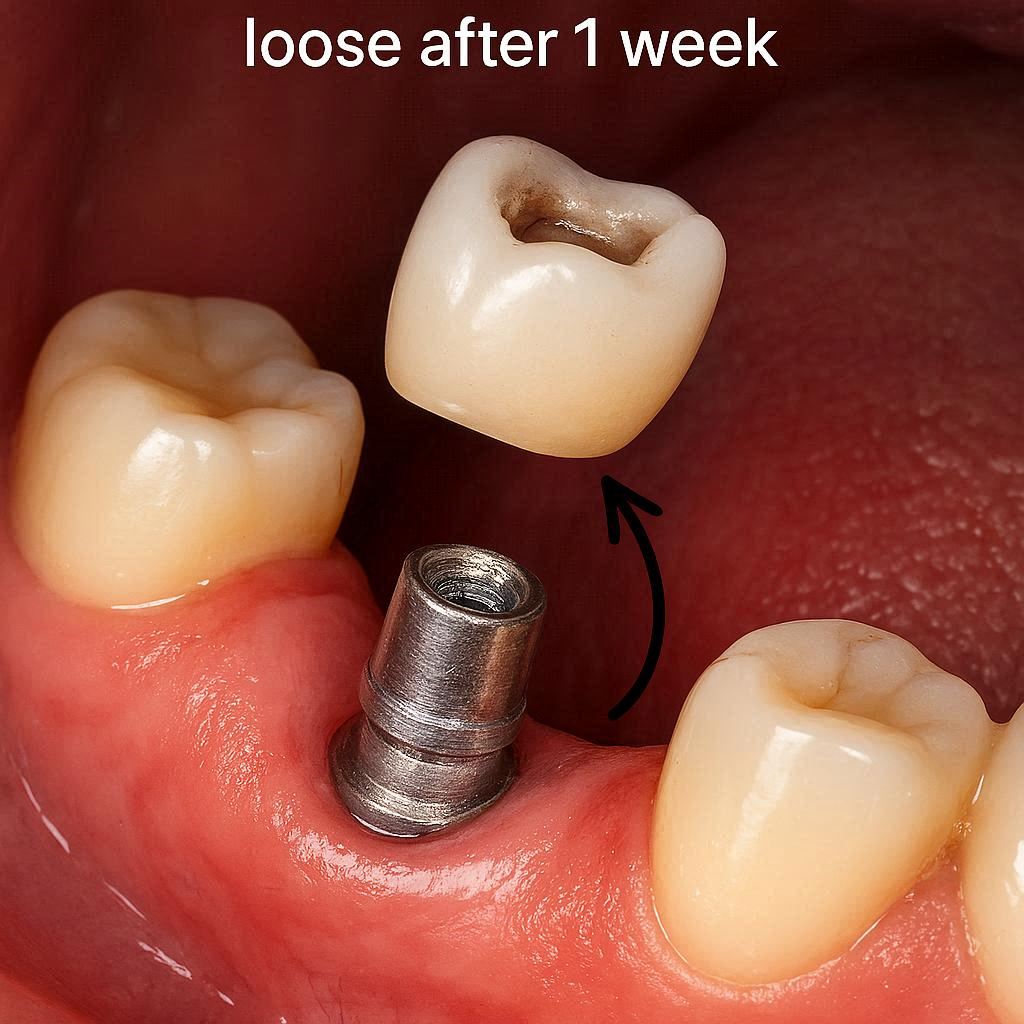
Understanding Your New Implant Crown: How It Stays in Place
Before we solve the problem, it helps to know what holds your new crown in place. Your dental implant system has three main parts:
- The Implant Fixture (The Root): This is the titanium screw surgically placed into your jawbone. It fuses with the bone over several months.
- The Abutment (The Connector): This is a small metal or ceramic piece that screws into the implant fixture. It sticks up above the gum line.
- The Crown (The Tooth): This is the visible, tooth-colored cap that you see in the mirror.
Your crown connects to the abutment in one of two ways:
- Screw-Retained Crown: A tiny screw goes through a hole in the crown and tightens directly into the abutment. The hole is later filled with tooth-colored material.
- Cement-Retained Crown: The crown is hollow on the inside. Your dentist fills it with dental cement and presses it onto the abutment, like gluing a cap onto a post.
Knowing which type you have helps explain why it might feel loose after only one week.
The Main Reasons Your Crown Feels Loose After 7 Days
A loose crown this early is not “normal,” but it is a known and treatable complication. Let us look at the most realistic causes.
1. The Abutment Screw Has Loosened (Most Common)
This is the number one reason. The tiny screw holding the abutment to the implant fixture can gradually unscrew over a few days. It happens because:
- The screw was not torqued to the exact manufacturer’s specification.
- Normal chewing forces created micro-movements.
- There was a tiny gap between the abutment and the implant (called “settling”).
What you feel: The entire crown moves slightly when you press on it. You might hear a clicking sound.
2. The Cement Failed (Cement-Retained Crowns)
For cement-retained crowns, the bond between the crown and the abutment broke. This can happen within a week because:
- Saliva or blood contaminated the abutment surface during placement.
- The cement was not mixed correctly.
- The crown did not seat fully onto the abutment.
What you feel: The crown feels like a loose hat. It might spin slightly or lift up a little. The abutment underneath feels stable.
3. The Crown Screw Is Loose (Screw-Retained Crowns)
If you have a screw-retained crown, the small screw holding the crown to the abutment (not the abutment to the implant) can back out. This is less common but happens.
What you feel: A very subtle wiggle, mostly when biting on something hard. You might see a tiny dark circle (the screw hole) if the filling material falls out.
4. Healing Abutment Confusion (Less Likely)
Some patients confuse a loose crown with a loose healing abutment. If your dentist placed a temporary healing cap and you are still waiting for your final crown, looseness means something else. But if you already have a permanent crown, ignore this.
5. Implant Failure (Very Rare at One Week)
True implant failure means the titanium fixture itself is moving inside the bone. This is extremely rare after only one week unless there was an underlying infection, poor bone quality, or extreme overloading. How can you tell? An implant failure feels like the whole tooth (including the “root”) is rocking side to side. You would also likely have pain, swelling, or a bad taste.
Important note: Do not assume the implant is failing. In over 90% of early loose crown cases, the implant itself is perfectly solid. Only your dentist can confirm.
Immediate Steps to Take at Home (What to Do Right Now)
You found the looseness today. Here is your realistic action plan.
Step 1: Stop Chewing on That Side
This is not panic. This is prevention. Do not test the crown by wiggling it with your tongue or finger. Do not try to bite down to “seat it back in place.” Every time you put pressure on a loose crown, you risk:
- Breaking the cement seal further.
- Stripping the threads of a loose screw.
- Damaging the abutment.
Step 2: Inspect Carefully (But Gently)
Use a small mirror and good light. Look for:
- Any visible gap between the crown and your gum.
- A dark hole on the chewing surface (screw access hole).
- Movement when you gently press with a finger (press once, not repeatedly).
Do not try to remove the crown yourself. You could swallow or inhale it.
Step 3: Do Not Use Super Glue or DIY Fixes
This is critical. Some online forums suggest using denture adhesive or temporary dental cement from a pharmacy. Do not do this. Those products are not designed for implant crowns. They can:
- Trap bacteria against the abutment.
- Make it impossible for your dentist to unscrew the crown later.
- Damage the delicate threads inside the implant.
Step 4: Call Your Dentist’s Office
This is the only correct step. Call them as soon as they open. Explain exactly: “My implant crown was placed one week ago, and it already feels loose.”
Most dentists will schedule you for a simple 10-15 minute repair appointment. This is rarely an emergency requiring after-hours care, unless the crown comes completely off and you cannot keep it safe.
Step 5: Safely Store the Crown If It Falls Out
If the crown completely detaches:
- Rinse it with water (no soap, no scrubbing).
- Do not let it dry out. Place it in a small container with a drop of water or saliva.
- Bring it to your dentist. Do not try to glue it back.
How Your Dentist Will Fix the Problem
The repair is usually quick, painless, and does not require numbing. Here is what to expect based on the cause.
| Cause of Looseness | Repair Method | Time Required | Cost (If Not Warranty) |
|---|---|---|---|
| Loose abutment screw | Retorque or replace screw | 10-15 min | 0−150 |
| Failed cement | Clean off old cement, recement crown | 15-20 min | 0−200 |
| Loose crown screw | Remove filling, tighten screw, replace filling | 10 min | 0−100 |
| Broken abutment or crown | Replace abutment or fabricate new crown | 1-2 weeks | 300−800+ |
| Loose implant fixture | Requires surgical evaluation (rare) | Varies | Significant |
What Actually Happens in the Chair
Your dentist will first test the crown with an instrument. They will then take a small X-ray (periapical) to see exactly where the looseness is coming from. The X-ray shows:
- If the abutment screw is fully seated.
- If the crown is fully seated on the abutment.
- If there is any gap or fracture.
If the screw is loose, they will tighten it with a torque wrench to the exact specification (usually 15-35 Ncm). If the cement failed, they will clean both surfaces, dry them completely, and apply fresh dental cement under controlled pressure.
Most patients walk out within 30 minutes feeling completely relieved.
Quote from a prosthodontist: “In my 15 years of practice, at least 5% of new implant crowns need a screw retightening within the first month. It is not a failure. It is a minor mechanical adjustment. Patients worry far more than they should.”
Will This Happen Again? Long-Term Prevention
Once your dentist fixes the loose crown, you want to avoid a repeat. Here is how to keep everything tight and stable.
Follow These Daily Habits
- Chew on both sides equally. Uneven force on one implant can gradually loosen screws over months.
- Avoid sticky or hard foods for the first month. Think caramel, taffy, hard bread crusts, ice, and hard candies.
- Use a night guard if you grind your teeth. Bruxism (teeth grinding) is a leading cause of repeated screw loosening. Most patients do not even know they grind at night.
- Do not use your teeth as tools. Never open packages, crack nuts, or hold objects with your implant crown.
Maintenance Schedule
- First check-up: 2 weeks after repair (to confirm tightness)
- Regular check-ups: Every 6 months (dentist will manually test all implant crowns)
- Annual X-ray: Once per year to check the screw and bone levels
When to Call the Dentist Again
Call your dentist if, after the repair, you notice:
- Any returning wiggle within the first 6 months.
- A new clicking sound when biting.
- The crown feels higher than the other teeth.
Most repaired crowns stay tight for years. A second looseness is not a disaster, but it may require replacing the screw with a new one coated with friction grip compound.
Cement-Retained vs. Screw-Retained: Which Is Better?
This is a common debate. Both have pros and cons when it comes to looseness.
| Feature | Screw-Retained Crown | Cement-Retained Crown |
|---|---|---|
| Looseness risk | Screw can back out (easy to retighten) | Cement can fail (needs recementation) |
| Retrievability | Very easy (unscrew through hole) | Difficult (may need to cut crown off) |
| Aesthetics | Small hole on top (filled) | No visible hole, more natural |
| Common issue after 1 week | Less common | More common (cement washout) |
| Repair cost | Lower | Moderate |
What do most dentists prefer today? Screw-retained crowns are becoming more popular because they are predictable and repairable. However, many front-tooth crowns are still cement-retained for better looks.
Your specific case depends on your dentist’s training and the location of the implant.
Costs, Insurance, and Warranty: What You Should Know
Money is a real concern. Let us be honest about what you might pay.
Is the Repair Free?
Often, yes. Most reputable dentists provide a warranty on their implant crown work. Typical warranty periods:
- Labor warranty: 6 months to 1 year (no charge for retightening or recementing)
- Crown warranty: 1 to 5 years (replacement if fractured)
- Implant fixture warranty: 10 years to lifetime (manufacturer covers defective implant)
Ask your dentist these questions now:
- Does your warranty cover screw tightening within the first year?
- Is there a fee for emergency appointments for crown looseness?
- If the crown breaks, do I pay for a new one?
If You Have to Pay Out of Pocket
Without warranty, here are realistic U.S. private practice estimates (2025 averages):
- Tightening a screw: 75−150
- Recementing a crown: 100−250
- New crown if damaged: 800−2,500
- New abutment: 300−600
Most insurance plans cover 50-80% of repair costs if the original crown is less than 5 years old. Check your policy under “restorative maintenance.”
Emotional Side: Anxiety and Trust After a Loose Crown
Let us talk about something most articles ignore: how you feel.
You saved money. You endured surgery. You waited through healing. You finally saw the finished result. And now, one week later, something is wrong. It is natural to feel frustrated, disappointed, or even angry at your dentist.
You might think: “Did they do a bad job?”
Usually, no. Screws loosen. Cement fails. These are mechanical realities, not personal failures. The human mouth is a harsh environment: moisture, bacteria, constant movement, and chewing forces up to 200 pounds per square inch. Even a perfectly placed crown can shift microscopically.
Give your dentist the chance to fix it. Most will apologize sincerely and resolve the issue immediately. If they refuse or blame you unfairly, that is a different problem. But in most cases, you will leave with a rock-solid crown and renewed trust.
When to Seek a Second Opinion
Sometimes a loose crown is a symptom of a larger problem. Consider a second opinion from a prosthodontist (implant specialist) if:
- Your dentist has tightened the same crown three or more times in one year.
- You are told the implant must be removed without clear X-ray evidence of failure.
- You feel pain deep in the bone when the crown is loose.
- There is a persistent bad taste or pus near the implant.
A true specialist will have a torque-controlled system, an intraoral scanner, and experience with screw-retained solutions.
Frequently Asked Questions (FAQ)
1. Can I eat if my implant crown is loose after one week?
Only soft foods on the opposite side. Think yogurt, soup, mashed potatoes, smoothies. Do not chew anything on the loose crown. You risk breaking the crown or damaging the abutment.
2. How loose is too loose?
Any noticeable movement is “too loose.” A healthy implant crown should feel completely solid, like a natural tooth. Even 0.5 mm of wiggle means something is wrong.
3. Will the crown fall off completely?
Possibly, but not always. A screw-retained crown rarely falls off because the screw holds it loosely. A cement-retained crown is more likely to detach completely. Either way, do not panic. Just store it safely.
4. Is it safe to wait one week for an appointment?
Yes, if you are careful. Avoid chewing on that side. Do not wiggle it. Most dentists can see you within a few days. Waiting one week is usually safe, but call your dentist to confirm.
5. Can I tighten the screw myself at home?
Absolutely not. Implant screws require a specific torque wrench. Over-tightening can strip the threads and ruin the implant. Under-tightening does nothing. Leave this to a professional.
6. Why did my dentist not use permanent cement?
Because “permanent” cement is not truly permanent. Dentists use semi-permanent or temporary cement on implant crowns so they can be removed later if needed. Permanent cement makes repairs nearly impossible.
7. Does a loose crown mean the implant is failing?
Rarely. In over 95% of cases, the implant fixture is perfectly solid. The looseness is only at the crown-abutment connection. Your dentist will confirm with an X-ray.
8. How long will the repair take?
Most repairs take 10 to 20 minutes. You do not need numbing. You can return to normal eating after 24 hours (or after the cement fully sets).
9. Will I have to pay again if the same crown loosens repeatedly?
Many dentists will waive the fee after the first repair if it is a recurring issue. However, if you grind your teeth or chew on hard objects, some offices may charge for each visit. Discuss this upfront.
10. Can I use temporary dental cement from a pharmacy?
No. Do not do this. Pharmacy cements are not sterile, not designed for implant abutments, and can ruin the passive fit of your crown. You will make the dentist’s job much harder.
Important Notes for Readers
Note #1: Do not confuse a loose crown with a loose implant. Gently press on the crown. If the whole thing rocks side to side as one unit (including under the gum), that suggests a loose implant. This is an emergency. Call your dentist immediately.
Note #2: Some looseness is normal in the first 24 hours after cementation if your dentist used temporary cement to check your bite. But after one full week, any looseness should be evaluated.
Note #3: If you feel sharp pain, swelling, or see pus, do not wait. This could be peri-implantitis (infection around the implant). Seek care within 24 hours.
Note #4: Always keep your post-operative instructions. Some dentists specifically say “do not chew on this crown for 10 days.” If you ignored that, looseness may be your fault. But most allow normal eating immediately.
Additional Resource
For a deeper understanding of implant crown maintenance and long-term success, review this trusted resource from the American Academy of Implant Dentistry:
AAID Patient Education Library – Implant Crown Maintenance and Troubleshooting
(Search for this official resource on their website. It provides video guides and X-ray examples of common issues.)
Conclusion (3 Lines)
A loose dental implant crown one week after placement is common, rarely serious, and almost always repairable in under 30 minutes. The cause is usually a loose screw or failed cement, not a failing implant. Call your dentist, avoid chewing on that side, and expect a simple, low-cost fix that restores full function.
Disclaimer: This article is for informational purposes only. It does not replace professional dental advice, diagnosis, or treatment. Always consult a licensed dentist for any concerns regarding your dental implants. Every case is unique, and only a clinical examination can determine the exact cause of your loose crown.