Cost of Dental Implants vs Dentures
Making a decision about missing teeth is never easy. You want to feel confident when you smile. You want to eat your favorite foods without worry. And, like most people, you need to work within a budget.
Two of the most common solutions are dental implants and dentures. Both can give you back a full smile. But they work very differently. They feel different. And their costs are worlds apart.
This guide will walk you through everything you need to know about the cost of dental implants vs dentures. We will look at short-term prices. We will explore long-term value. And we will help you decide which option fits your unique situation.
Let’s start by looking at what each solution actually is. Then we will get into real numbers you can expect to see on a treatment plan.
Understanding Your Tooth Replacement Options
Before we talk about dollars and cents, you need to understand what you are paying for. Dentures and implants are not the same type of product. Think of dentures as a removable appliance. Think of implants as a permanent restoration.
What Are Dentures? A Quick Overview
Dentures have been around for a very long time. They are removable replacements for missing teeth. You take them out at night. You clean them in a special solution. And they rest directly on your gums.
There are two main types:
- Full dentures. These replace an entire arch of teeth (upper or lower).
- Partial dentures. These fill in gaps when you still have some natural teeth left.
Modern dentures look more natural than your grandparents’ versions. But they still come with challenges. They can slip. They can cause sore spots. And they never feel exactly like real teeth.
What Are Dental Implants? A Quick Overview
Dental implants are a different world entirely. An implant is a small titanium post. A surgeon places that post into your jawbone. Over several months, the bone grows around the post. This creates a rock-solid anchor.
Once the implant heals, your dentist attaches an abutment and a crown on top. The result is a tooth that looks, feels, and functions like a natural one.
You can replace a single missing tooth with one implant. Or you can use multiple implants to support a bridge or even a full set of teeth.
Important note: Implants require surgery. They also require healthy gums and enough jawbone density. Not everyone is a candidate right away.
The Real Cost of Dental Implants vs Dentures: A Side-by-Side Look
Now let us get to the question you came here to answer. What will you actually pay?
First, a word of honesty. Prices vary dramatically based on where you live, who your dentist is, and what your specific case requires. The numbers below represent typical ranges in the United States as of 2025. Your personal quote may be higher or lower.
Upfront Costs: Dentures Are Cheaper Initially
There is no way around this fact. Dentures cost much less at the time of purchase.
| Type of Restoration | Average Cost (Without Insurance) |
|---|---|
| Basic full dentures (economy) | 300–1,000 per arch |
| Mid-range full dentures | 1,000–2,500 per arch |
| Premium full dentures | 3,000–5,000 per arch |
| Partial dentures (cast metal) | 700–1,800 |
| Partial dentures (flexible) | 900–2,500 |
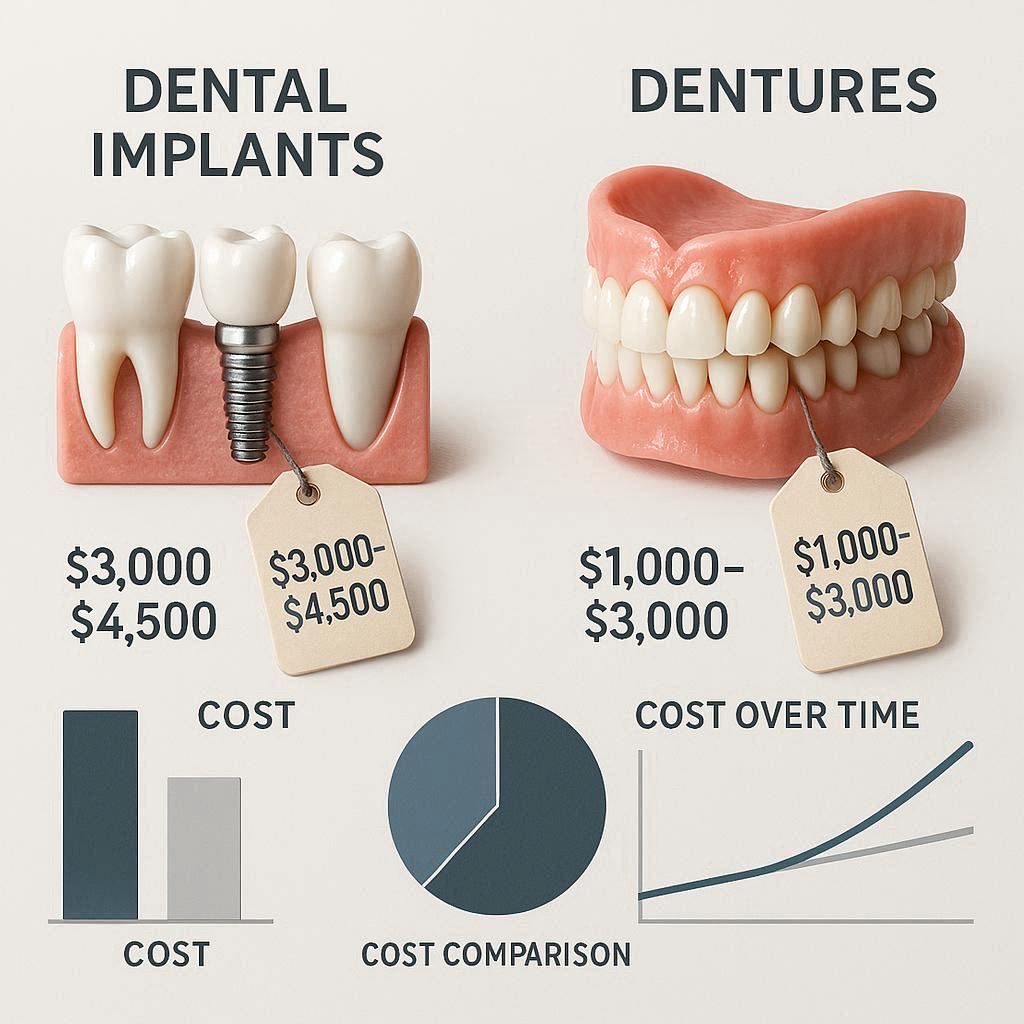
| Single tooth implant (post + crown) | 3,000–5,000 |
| Implant-supported bridge (3-4 teeth) | 5,000–16,000 |
| Implant-supported dentures (fixed) | 15,000–30,000 per arch |
| Full mouth implants (All-on-4 or All-on-6) | 25,000–50,000 per arch |
Look at the table above. You could get a full set of standard dentures for under $2,000. A single implant costs more than that by itself.
If money is tight right now, dentures seem like the obvious winner. But hold on. There is more to the story.
Long-Term Costs: Where Implants Start to Shine
The low upfront price of dentures can be misleading. Dentures are not a one-time purchase. They require ongoing costs. Some of these costs surprise people.
Let us break down what you might spend over 10, 20, or 30 years.
Ongoing costs with dentures:
- Relines: Every 1 to 3 years. Your gums change shape over time. Dentures become loose. A reline refits them. Cost: 200–500 each time.
- Replacements: Every 5 to 10 years. Dentures wear down. They stain. They break. You will likely need a new set every decade or so. Cost: Full replacement price each time.
- Adjustments and repairs: Cracked denture? Lost a tooth? Cost: 100–400 per incident.
- Adhesives and cleaning solutions: These add up month after month. Cost: 10–30 per month (120–360 per year).
- Potential bone loss complications: Without tooth roots, your jawbone shrinks over time. This can change your facial shape. It can also make future treatment more complex.
Ongoing costs with implants:
- Routine checkups: Same as natural teeth. Standard exam fees apply.
- Cleaning: You brush and floss normally. No special solutions needed.
- Repairs: Rare but possible. Crowns can chip. Screws can loosen. Cost: 200–800 if needed.
- Peri-implantitis treatment: This is gum disease around an implant. It is uncommon with good hygiene. But treatment can be expensive if it happens.
Key insight: Over 20 years, a 2,000setofdenturescancost8,000 to 15,000whenyouaddrelines,replacements,adhesives,andrepairs.A4,000 single implant will likely cost nothing beyond routine care over the same period.
Let us put this into a simple timeline comparison.
Scenario: Replacing a full upper arch for 30 years.
| Expense Category | Traditional Dentures | Implant-Supported Fixed Denture |
|---|---|---|
| Initial cost | $2,500 (mid-range) | $25,000 (All-on-4) |
| Relines (every 2 years x 15) | $4,500 | $0 |
| Replacement sets (every 8 years x 3) | $7,500 | $0 |
| Adhesives & cleaners ($20/month) | $7,200 | $0 |
| Repairs (average) | $1,000 | $500 |
| Total over 30 years | $22,700 | $25,500 |
The numbers get surprisingly close. And this does not include the comfort and quality of life benefits that implants provide.
Hidden Costs You Need to Know About
Dentists sometimes leave out certain fees when they give initial quotes. Do not assume the first number you hear is the final number.
Hidden Costs with Dentures
- Extractions: Do you have remaining teeth that need to come out? Add 75–300 per tooth.
- Bone smoothing (alveoloplasty): Sometimes the jawbone has sharp ridges. Dentists smooth these down before making dentures. Cost: 200–800 per arch.
- Immediate dentures: If you get teeth pulled and walk out with dentures the same day, you will pay extra. Cost: 500–1,500 more than standard.
- Soft liners: Some people need extra cushioning for comfort. Soft liners cost more and need replacement more often.
Hidden Costs with Implants
- Bone grafting: If your jawbone is too thin or soft, you need a graft first. Cost: 300–1,500 per site. Full arch grafts can cost 3,000–8,000.
- Sinus lift: For upper back teeth, the sinus cavity may be in the way. A sinus lift adds bone height. Cost: 1,500–3,000.
- CT scan: Most implant dentists require a 3D scan for planning. Cost: 300–650.
- Temporary teeth: While your implants heal, you need something in the space. Cost: 500–1,500 for a temporary partial or flipper.
- Abutment and crown: Some quotes include these. Some do not. Always ask. The abutment alone can cost 500–1,500.
- Surgical guide: Many modern implant placements use a 3D-printed guide for precision. Cost: 300–800.
Pro tip: Always ask for a “treatment plan” with every single fee listed. If a dentist refuses to give you a detailed breakdown, find another dentist.
Insurance Coverage: What Will Your Plan Pay?
Dental insurance rarely covers everything. You need to understand the limits.
How Insurance Treats Dentures
Most standard dental PPO plans cover dentures at 50%. But there are catches.
- Waiting periods: Many plans make you wait 6 to 12 months before covering major work like dentures.
- Annual maximums: Most plans cap benefits at 1,000–2,000 per year. That is often less than half the cost of good dentures.
- Frequency limits: Plans may pay for a new denture only once every 5 to 10 years.
- Reline coverage: Some plans cover one reline every 3 years. Others cover none.
Example: Your dentures cost 2,500.Yourplancovers501,250. But your annual maximum is 1,500.Youalreadyused300 for a cleaning and filling earlier that year. Now you only have 1,200leftinbenefits.Youpaytheremaining1,300 out of pocket.
How Insurance Treats Implants
Insurance coverage for implants is improving but still limited.
- Missing tooth clause: Many older plans do not cover implants for teeth that were missing before the policy started.
- Separate benefit limits: Some plans cap implant coverage at 1,500pertoothor3,000 per year.
- Exclusion of parts: A plan might cover the crown but not the implant post. Or cover the surgery but not the abutment.
- Better plans available: Some premium PPO plans now offer implant coverage at 50% with a separate implant lifetime maximum of 5,000–10,000.
Important reality check: Do not expect insurance to make implants cheap. Most people pay the majority of implant costs out of pocket.
Financing Options: How Real People Pay for This
Very few people write a single check for $30,000 of implant work. Most use some form of financing.
Common Ways to Pay for Dentures
- Cash or credit card: The most straightforward option.
- CareCredit: A healthcare credit card. Offers 6, 12, or 18 months of deferred interest. But if you miss a payment, you pay all the back interest.
- Dental discount plans: Not insurance. You pay an annual fee (100–150) and get 20% to 50% off from participating dentists.
- Payment plans through the dentist: Some offices offer in-house financing. Typically requires a down payment of 25% to 50%.
- Medicaid: Covers dentures in many states but often only the cheapest options. Does not cover implants except in rare cases (like after accident trauma).
Common Ways to Pay for Implants
- Medical credit cards: CareCredit and Alphaeon are the most common.
- Personal loans: LightStream, SoFi, and Upstart offer dental-specific loans. Interest rates range from 6% to 25% depending on your credit.
- In-house membership plans: Some implant practices offer annual memberships (300–600/year) that include discounts of 10% to 20% on implant work.
- Health Savings Account (HSA) or Flexible Spending Account (FSA): These accounts let you pay with pre-tax dollars. This effectively gives you a 20% to 35% discount depending on your tax bracket.
- Dental schools: Major savings (up to 50% off) in exchange for longer appointment times. Students work under supervision. More on this below.
Quote from a real patient: *”I saved for two years. Put away $400 a month into a separate savings account. When I finally got my All-on-4 implants, I paid cash and saved thousands in interest. It was hard. But waking up with teeth that don’t move? Worth every penny.”*
Quality of Life: The Non-Financial Side of the Decision
Money matters. But so does how you feel every single day. Let us compare the lived experience.
Daily Life with Dentures
The good:
- You can afford them sooner.
- No surgery required.
- Easy to clean (soak and scrub).
- Can be repaired or replaced relatively easily.
The challenging:
- They move. Especially lower dentures. Eating can be an exercise in frustration.
- Taste is reduced. The plastic palate covering the roof of your mouth blocks many flavors.
- Speaking takes practice. Many people develop a clicking sound or a lisp.
- You cannot wear them 24/7. You remove them at night. This changes morning and evening routines.
- Your face shape changes over time as bone shrinks. Dentures that fit well today may look loose and aged in five years.
- Sore spots are common, especially during the first year.
One patient put it this way: “I got used to my dentures. But I never loved them. There was always that little voice in my head wondering if they would slip during a business lunch.”
Daily Life with Implants
The good:
- They feel like your own teeth. No slipping. No clicking.
- You eat whatever you want. Steak. Nuts. Corn on the cob. Apples.
- No special cleaning. Just brush and floss normally.
- They never come out. You sleep with them. You wake up with them.
- Bone stays preserved. Your jaw remains strong. Your face keeps its natural shape.
- High success rate. Over 95% of implants last 20 years or more.
The challenging:
- The process takes months. You are not done in a week.
- Surgery has risks (infection, nerve damage, implant failure).
- Smoking greatly increases failure rates.
- If an implant fails, you lose the money and need a replacement or a different solution.
- You need healthy gums and enough bone. Not everyone qualifies.
Summary from an implant patient: “The recovery was not fun. And the cost made me dizzy. But three years later? I never think about my teeth. That is the gift. They just work.”
Who Is a Good Candidate for Each Option?
Your body and your health history play a huge role in which option makes sense.
You Might Be a Good Candidate for Dentures If:
- You are missing most or all of your teeth in an arch.
- You have significant bone loss and do not want bone grafting.
- You have health conditions that make surgery risky (uncontrolled diabetes, severe heart disease, radiation to the jaw, blood thinners that cannot be stopped).
- You smoke heavily and have no plans to quit.
- You simply cannot afford implants now or ever.
- You are okay with the limitations of removable teeth.
You Might Be a Good Candidate for Implants If:
- You are missing one or a few teeth and want to preserve adjacent healthy teeth.
- You have healthy gums and enough jawbone density.
- You are a non-smoker or willing to quit during the healing process.
- You can afford the upfront cost or financing.
- You are willing to wait 4 to 8 months for the complete process.
- You want the closest possible experience to natural teeth.
What About Implant-Supported Dentures?
This is the middle ground. You get 2, 4, or 6 implants placed in your jaw. Those implants snap onto a special denture. The denture is removable but stays firmly in place.
Hybrid option costs:
- 2-implant supported lower denture: 4,000–8,000
- 4-implant supported overdenture: 8,000–15,000 per arch
- Fixed implant denture (non-removable): 15,000–30,000 per arch
This option is excellent for people who cannot afford a full set of individual implants but want more stability than regular dentures provide.
Ways to Save Money Without Sacrificing Quality
You have options to lower costs. Some of them come with trade-offs. Let us be honest about each one.
1. Consider Dental Schools
Dental schools need patients for their students. You get high-quality care (supervised by expert faculty) at roughly half the price.
What to expect:
- Appointments take 2 to 4 times longer.
- You might see multiple students during your treatment.
- Not all schools offer implant placement. Call ahead.
- You are helping train the next generation of dentists.
How to find one: Search “[your state] dental school clinic” or visit the American Dental Education Association website.
2. Travel for Dental Tourism
Mexico, Costa Rica, Colombia, and Thailand offer dental work at 40% to 70% less than US prices.
Real examples:
- All-on-4 implants in the US: 25,000–50,000 per arch
- All-on-4 implants in Costa Rica: 10,000–18,000 per arch
- Premium dentures in Mexico: 800–1,500 vs 3,000–5,000 in the US
Risks to know:
- Follow-up care is hard if something goes wrong.
- Language barriers can cause misunderstandings.
- Quality varies wildly. Research the specific clinic. Do not just pick the cheapest one.
- Infection control standards may differ from US regulations.
- You pay for travel and lodging.
If you go this route: Ask for before/after photos of at least 10 patients. Read Google reviews and dental tourism forum posts. Consider a clinic accredited by the American Dental Association’s International Dentist Program.
3. Ask About “Same-Day” Options Not Being Right for Everyone
Same-day implants (like Teeth in a Day or All-on-4 with immediate loading) sound convenient. But they have higher failure rates than traditional implants that heal for 4-6 months before getting teeth.
Do not pay extra for speed if your bone quality is average or poor.
4. Negotiate with Your Dentist
Many people do not realize you can negotiate dental fees. Especially for large cases like full mouth implants.
What to say: “I love your work and want to move forward. But the price is higher than I expected. Is there any flexibility if I pay in cash or schedule treatment during a slower month?”
Dentists often give 5% to 15% discounts for cash payment. Some offer 10% off for scheduling in January or February (historically slow months for dentistry).
5. Split Treatment Across Calendar Years
Remember those insurance annual maximums? You can double them.
Start treatment in October. Use this year’s 1,500maximum.CompletetreatmentinJanuary.Usenextyear′s1,500 maximum. This turns 1,500into3,000 of coverage.
This works best for dentures. Implant timelines often span longer than three months, so plan carefully.
Step-by-Step Comparison: What the Process Looks Like
Understanding the timeline helps you see why costs differ so much.
The Denture Process (Traditional Full Dentures)
Step 1: Initial exam and impressions (1 visit)
Your dentist examines your mouth. Takes molds. Discusses options. Cost included in treatment fee.
Step 2: Extractions and bone smoothing (1 visit, if needed)
Remaining teeth removed. Bone smoothed. Healing begins. Immediate dentures placed same day if requested. Healing time: 2 to 6 months for gums to settle.
Step 3: Final impressions (1 visit)
Once gums heal, new molds taken for final dentures.
Step 4: Try-in appointment (1 visit)
Wax model of dentures placed in your mouth. You check fit and appearance. Adjustments made as needed.
Step 5: Final denture delivery (1 visit)
Your permanent dentures are ready. Dentist shows you how to insert, remove, and clean them.
Total time from start to finish: 3 to 8 months (including healing).
Total visits: 5 to 8.
The Implant Process (Single Tooth Implant)
Step 1: Initial exam and planning (1 visit)
X-rays or CT scan. Treatment plan created. Cost: 200–600 (often separate from implant fee).
Step 2: Bone grafting (if needed) (1 visit)
Graft material placed. Healing: 4 to 6 months. Cost: 300–1,500.
Step 3: Implant placement surgery (1 visit)
Titanium post inserted into bone. You receive a temporary partial denture or flipper. Healing: 4 to 6 months for osseointegration (bone growing around implant).
Step 4: Abutment placement (1 visit)
Small connector attached to implant. Gum tissue heals around it. Healing: 2 to 4 weeks.
Step 5: Crown delivery (1-2 visits)
Final crown screwed or cemented onto abutment.
Total time from start to finish: 7 to 12 months (longer with grafting).
Total visits: 6 to 10.
As you can see, implants require more time, more visits, and more healing phases. That time costs money. But it also creates the durable result.
What the Research Says About Long-Term Satisfaction
Studies on patient satisfaction paint a clear picture. Let us look at the data.
Denture satisfaction rates:
- About 60% of full denture wearers report being “satisfied” with chewing ability.
- Only 35% say they can eat all the foods they want.
- Lower dentures have the lowest satisfaction. Many patients describe them as “useless” for chewing.
- Soft tissue irritation affects nearly 70% of denture wearers at some point.
Implant satisfaction rates:
- Over 95% of implant patients report being “very satisfied” or “completely satisfied.”
- Chewing function scores near 98% of natural teeth.
- Quality of life scores improve dramatically, especially for people who switched from dentures to implants.
- Regret rates are under 3% for implant procedures. Most regrets relate to the cost or recovery time, not the final result.
Bottom line from the research: Dentures work. Millions of people use them every day. But if you can afford implants and qualify medically, you will almost certainly be happier with implants five years from now.
Real Patient Scenarios: Which Path Would You Choose?
Let us walk through three common situations. Each person has different priorities and budgets.
Scenario 1: Sarah, Age 68, Fixed Income
Situation: Sarah has worn a full upper denture for 15 years. She hates it. But she lives on Social Security and has $4,000 in savings.
Options:
- New premium denture: $4,000. Uses all her savings.
- Implant-supported overdenture with 4 implants: $12,000 minimum. Impossible on her budget.
What she does: Sarah finds a dental school. They make her a mid-range denture for 1,200.Shesaves2,800 for future relines. It is not her dream smile. But it works for her life right now.
Scenario 2: Mike, Age 45, Missing Lower Molars
Situation: Mike lost two lower molars years ago. He hates his partial denture. It moves when he eats. He makes $80,000 per year and has good credit.
Options:
- New flexible partial denture: $1,500. Quick fix but same movement issues.
- Two single implants with crowns: 8,000total.Financedover24monthsat350/month.
What he does: Mike chooses implants. He pays 2,000cashfromsavings.Finances6,000 through CareCredit with 12 months no interest. He pays $500 per month for one year. After that, he has teeth that never move.
Scenario 3: Linda, Age 58, Full Mouth Failure
Situation: Linda’s teeth are failing. Cracked roots. Loose teeth. Chronic infections. She needs full mouth extraction. Her dentist says dentures will be difficult because her lower jaw ridge is flat.
Options:
- Conventional dentures: $6,000 for both arches. High risk of lower denture being unwearable.
- All-on-4 upper and lower: $50,000. Out of her range.
- Lower implant overdenture (2 implants) + upper conventional denture: $14,000.
What she does: Linda gets the hybrid plan. Upper denture cost 2,500.Lowertwoimplantswithsnap−ondenturecost11,500. She uses 5,000fromsavingsandtakesa9,500 personal loan at 9% interest over 3 years ($300/month). She finally eats comfortably.
Common Questions People Ask About Cost
Let me answer the specific questions readers ask most often.
Are implants cheaper in the long run?
For single tooth replacements, yes. The 30-year cost of one implant is often lower than three denture replacements plus adhesives and relines. For full arches, the math is closer. Conventional dentures may still come out slightly cheaper over a lifetime, but the quality of life gap is enormous.
Do dentures ruin your face?
“Ruin” is strong. But yes, they change your face. Without tooth roots, your jawbone resorbs (shrinks). This happens fastest in the first year after extractions. Your lower face height decreases. Your chin rotates forward. Your lips sink in. This is why some long-term denture wearers look older than their age. Implants prevent this bone loss entirely.
Can I get implants years after wearing dentures?
Yes, but you may need significant bone grafting first. After years of denture wear, your jawbone can be very thin. Extensive grafting adds 5,000–15,000 to the cost. This is one reason to consider implants sooner rather than later.
What is the cheapest way to replace all my teeth?
Traditional economy dentures (300–800 per arch) are the absolute cheapest upfront option. But be careful. Very cheap dentures often fit poorly, look artificial, and break easily. A mid-range denture (1,000–2,000) is usually the better value.
What is the cheapest implant option?
A two-implant overdenture on the lower arch. This gives you stability for about 4,000–8,000. It is far more affordable than replacing each tooth individually.
Does Medicare cover dentures or implants?
Original Medicare (Part A and B) does not cover dental work. This includes dentures and implants. Some Medicare Advantage plans (Part C) include dental benefits. These usually cover dentures at 50% up to 1,000–2,000 per year. Implant coverage through Medicare Advantage is rare.
How much do dentures cost with insurance?
Assuming a PPO plan with 50% coverage and a $1,500 annual max:
- 2,000dentures→Insurancepays1,000. You pay $1,000.
- 4,000dentures→Insurancepays1,500 (max). You pay $2,500.
How much do implants cost with insurance?
Most people pay 80% to 100% of implant costs out of pocket. A 4,000implantmightget500 – $1,500 from insurance if you have a good plan. Never assume insurance will make implants affordable. Get a pre-determination from your insurer before starting treatment.
Making Your Final Decision: A Practical Framework
You have read the numbers. You understand the trade-offs. Now let us turn this into a decision.
Ask yourself these five questions.
1. What is my budget right now?
If you have less than $3,000 saved, dentures or a dental school are your realistic options. Do not go into credit card debt at 25% interest for implants.
2. Can I qualify for financing with reasonable rates?
Check your credit score. Above 680? You can likely get a personal loan at 8% to 15% for implants. Below 600? Focus on dentures or save longer.
3. How much do I value stability when eating?
If food is a central joy in your life, implants are worth the sacrifice. If you eat simply and do not mind softer foods, dentures may be fine.
4. Am I willing to go through surgery and healing?
Implant surgery is not trivial. There is pain. There is swelling. There are food restrictions during healing. Be honest with yourself about your tolerance for medical procedures.
5. What does my long-term health look like?
Smokers, uncontrolled diabetics, and people on bisphosphonate medications (for osteoporosis) have higher implant failure rates. For some, dentures are the safer medical choice.
Decision Table: Quick Reference
| Your Situation | Recommended Path | Approximate Cost |
|---|---|---|
| Missing 1 tooth, healthy, $4k+ saved | Single implant | 3,000–5,000 |
| Missing 1 tooth, tight budget | Partial denture | 700–1,800 |
| Missing all lower teeth, bone is good, $10k+ saved | Implant overdenture (2-4 implants) | 6,000–15,000 |
| Missing all teeth, budget under $3k | Standard full dentures | 1,000–3,000 |
| Missing all teeth, want best function, can finance $25k+ | All-on-4 or fixed implant denture | 25,000–50,000 per arch |
| Missing all teeth but poor surgical candidate | Premium dentures with soft liner | 3,000–6,000 |
Additional Resources to Help You Save
Free cost estimator tool: The American Dental Association offers a “Dental Care Cost Calculator” on their website. It uses your zip code to estimate local prices.
Dental school clinic locator: Search “ADEA GoDental dental school clinic” for a complete list of US and Canadian dental schools offering reduced-cost care.
State dental association programs: Many states have “Donated Dental Services” programs. These connect low-income, elderly, or disabled patients with volunteer dentists. Wait lists are long. But the work is completely free.
Clinical trials: The National Institute of Dental and Craniofacial Research (NIDCR) lists ongoing studies. Some offer free or reduced-cost implants to qualifying participants.
Conclusion
The cost of dental implants vs dentures is not just a number on a treatment plan. It is a choice between two very different experiences. Dentures give you an affordable, non-surgical path to a full smile. They work. Millions of people use them. But they come with slipping, sore spots, ongoing costs, and eventual bone loss. Implants give you the closest thing to natural teeth. They feel solid. They preserve your jaw. They last for decades. But they require surgery, healthy bone, and a much larger upfront investment.
Here is the honest bottom line: If you can afford implants and your body can handle the surgery, choose implants. You will not regret it. If your budget is tight or your health makes surgery risky, high-quality dentures are a perfectly respectable choice. The worst decision is doing nothing. Missing teeth lead to shifting teeth, bone loss, and greater expense down the road.
Talk to two or three dentists. Get written estimates. Ask about financing. And then choose the path that fits your mouth, your money, and your life.
Frequently Asked Questions (FAQ)
1. Which is cheaper: dentures or implants?
Dentures are much cheaper upfront. A full set of dentures costs 1,000–3,000. A full mouth of individual implants costs 30,000–60,000. However, over 20-30 years, dentures require relines, replacements, and adhesives that narrow the gap.
2. Can I switch from dentures to implants later?
Yes. Many people start with dentures due to cost, then get implants years later. Be aware that bone loss from long-term denture wear often requires expensive bone grafting before implants.
3. Do dental implants hurt?
Placement surgery happens under local anesthesia. You should not feel pain during the procedure. Afterward, expect soreness similar to a tooth extraction for 3-7 days. Most people manage fine with over-the-counter pain relievers.
4. How long do dentures last?
Quality dentures last 7-10 years with proper care. Lower-cost dentures may last only 3-5 years. You will need relines every 1-3 years as your gums change shape.
5. How long do implants last?
With good oral hygiene and regular dental checkups, implants last 20+ years. The crown on top may need replacement after 10-15 years from normal wear. The implant post itself often lasts a lifetime.
6. Will my insurance pay for implants?
Some PPO plans now cover implants at 50% up to an annual or lifetime maximum. Many still exclude them completely. Always check your specific policy or get a pre-determination.
7. What is cheaper than dentures?
Nothing. Dentures are the least expensive professional tooth replacement. The only cheaper option is doing nothing, which leads to more dental problems and higher costs later.
8. Can I get free dentures or implants?
Free dental care exists through Medicaid (for eligible low-income adults in some states), clinical trials, and Donated Dental Services programs. Free implants are extremely rare. Free dentures are uncommon but possible through charitable clinics.
9. Are snap-in dentures better than regular dentures?
Snap-in dentures (implant-supported overdentures) are dramatically more stable than regular dentures. They cost more (4,000–15,000 vs 1,000–3,000) but many patients find the security well worth the extra money.
10. What is the cheapest country for dental implants?
Turkey, Hungary, Mexico, Costa Rica, and Thailand offer the lowest prices. Turkey is often cheapest (All-on-4 for 6,000–10,000). However, factor in travel costs and the difficulty of managing complications from far away.
Additional Resource
For a detailed, state-by-state guide to low-cost dental clinics and sliding-scale fee programs, visit the Health Resources and Services Administration (HRSA) website. Search for “Find a Health Center” and enter your zip code. HRSA-funded community health centers provide dental care on a sliding fee scale based on your income. Many offer dentures at reduced prices. A small number even provide implant services in major metropolitan areas.
Direct link suggestion: www.hrsa.gov/gets-care/health-centers
Disclaimer: The information in this article is for educational purposes only. It does not constitute medical or dental advice. Prices and insurance coverage vary by location and change over time. Always consult with a licensed dentist for a personal treatment plan and exact pricing. The author and publisher are not responsible for any decisions you make based on this content.