Cortical Dental Implants
If you have recently learned that you need a dental implant, you have probably heard the term “cortical dental implants” floating around. Maybe your dentist mentioned it, or you saw it while researching alternatives to traditional screw-like implants.
First, take a deep breath. The world of dental implants can feel overwhelming. Between the jargon, the different techniques, and the price tags, it is easy to feel lost.
This guide is here to change that.
We will walk you through everything you need to know about cortical dental implants. No confusing medical school language. No exaggerated promises. Just clear, honest, and practical information to help you make a smart decision for your smile and your health.
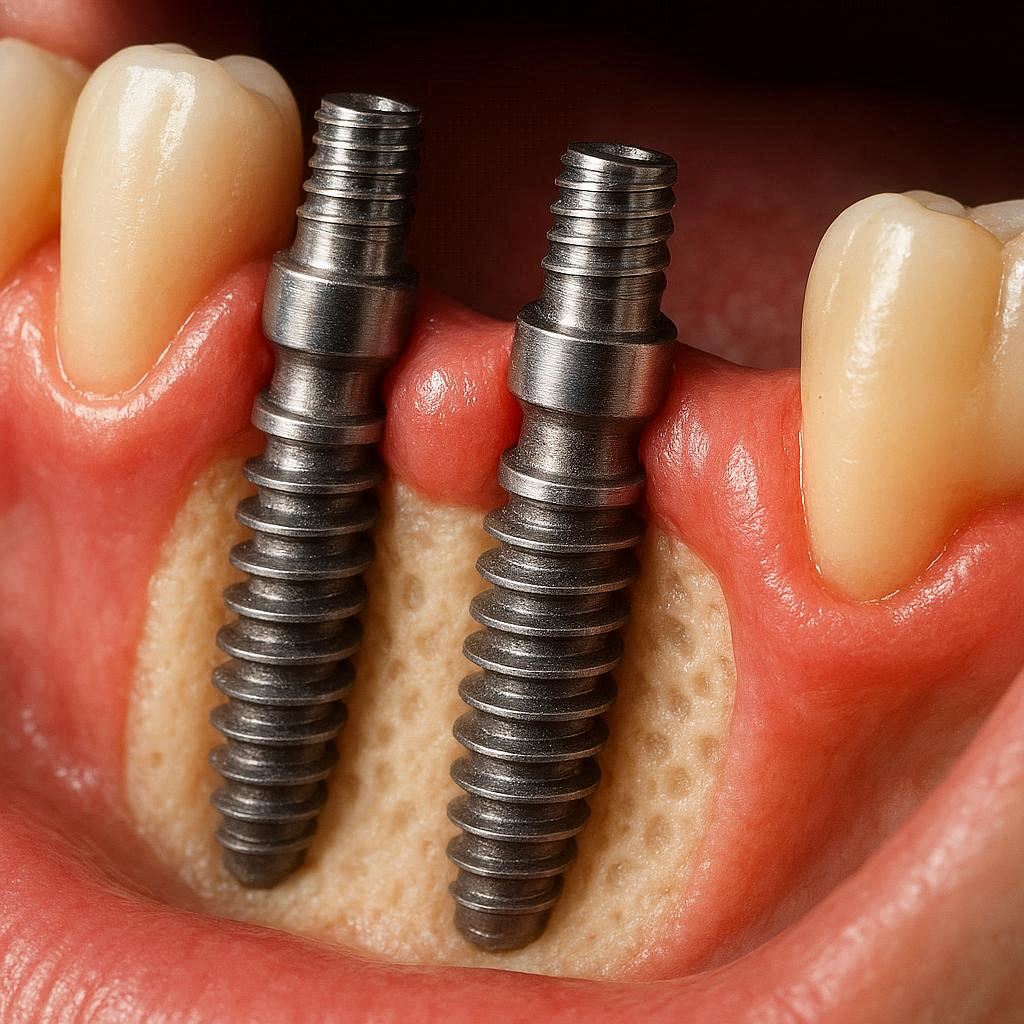
What Exactly Are Cortical Dental Implants? (A Simple Explanation)
To understand cortical implants, you first need to understand a tiny bit about your jawbone. Your jawbone has two main layers:
- Cancellous bone: The soft, spongy inner layer.
- Cortical bone: The hard, dense outer layer.
Think of it like an M&M candy. The hard outer shell is the cortical bone. The softer chocolate inside is the cancellous bone.
Traditional dental implants are long screws that go deep into the softer cancellous bone. They rely on that inner spongy tissue to hold them in place.
Cortical dental implants are different. Instead of going deep, they are shorter and wider. They anchor primarily into the hard, dense cortical bone layer near the surface of your jaw.
Imagine a short, thick button instead of a long screw. That button grabs onto the hard shell (cortical bone) rather than sinking into the soft center.
Why Does This Difference Matter?
This matters because not everyone has healthy, deep cancellous bone. If you have suffered from bone loss, gum disease, or simply have naturally thin jawbones, traditional implants might not work for you without a bone graft. Cortical implants offer an alternative path.
Important note for readers: Cortical implants are not “magic” or suitable for every case. They are a specific tool for specific situations. Your dentist will need to evaluate your unique bone structure.
How Do Cortical Implants Work? The Mechanism Explained Simply
Let us break down the science into a simple story.
Step 1: The Cortical Engagement
The implant has a special design. Its threads are wider and flatter than those of a traditional implant. When your dentist places it, the implant engages the dense cortical plate of bone. This is the strongest part of your jawbone.
Step 2: Immediate Stability
Because cortical bone is so dense, the implant feels very stable right after placement. In many cases, this stability allows for immediate loading. That means you might get a temporary tooth on the same day. Traditional implants often require months of waiting.
Step 3: Osseointegration (The Healing Phase)
Just like traditional implants, cortical implants need to fuse with your bone. This process is called osseointegration. Because cortical bone has a better blood supply than the inner cancellous bone in some patients, healing can sometimes be faster. However, this varies from person to person.
Step 4: The Final Restoration
Once the implant is fully integrated (usually within 8 to 12 weeks), your dentist attaches the abutment and the final crown. You now have a new tooth that feels and functions like a natural one.
Cortical vs. Traditional Dental Implants: A Detailed Comparison
This is where things get practical. You need to see the differences side by side. Below is a clear, honest table comparing the two main options.
| Feature | Cortical Dental Implants | Traditional Dental Implants |
|---|---|---|
| Primary anchor point | Hard outer cortical bone layer | Soft inner cancellous bone |
| Implant length | Shorter (typically 4 to 6 mm) | Longer (typically 10 to 16 mm) |
| Ideal bone condition | Thin jawbone, mild to moderate bone loss | Healthy, deep, thick jawbone |
| Need for bone graft | Often avoids or minimizes bone grafting | Frequently requires bone graft if bone is thin |
| Healing time | 8 to 12 weeks on average | 12 to 24 weeks on average |
| Immediate loading | Possible in many cases | Rare, usually requires waiting |
| Surgery invasiveness | Less invasive, shorter procedure | More invasive, longer procedure |
| Long-term success rate | 92-96% (with proper case selection) | 95-98% (gold standard) |
What This Table Really Means for You
If you have good, thick jawbone, traditional implants remain the gold standard. They have decades of research behind them.
But if your jawbone is thin, or if you want to avoid a bone graft (which adds months to your treatment and requires a second surgical site), cortical implants become a very attractive option.
A friendly reminder: Never choose an implant type based only on a table or an article. Your dentist will take X-rays (CBCT scans) to measure your bone density and thickness. That scan will guide the final decision.
Who Is a Good Candidate for Cortical Implants?
Not everyone can get cortical implants. And that is perfectly fine. Honesty here will save you time, money, and frustration.
You Might Be a Good Candidate If:
- You have moderate bone loss in your upper or lower jaw (especially the back areas).
- You were told you need a bone graft for traditional implants, but you want to explore alternatives.
- You have limited jawbone height due to sinus cavities in the upper jaw or the inferior alveolar nerve in the lower jaw.
- You want a less invasive surgery with a shorter recovery time.
- You are looking for immediate teeth (same-day implants).
You Might NOT Be a Good Candidate If:
- You have severe, uncontrolled gum disease (active periodontitis). This must be treated first.
- You have extremely thin cortical bone (less than 1 mm in thickness). The implant needs enough hard bone to bite into.
- You have untreated bruxism (severe teeth grinding). The excessive forces can damage shorter implants.
- You are a heavy smoker (more than one pack per day). Smoking dramatically reduces blood flow and healing in cortical bone.
- You have uncontrolled diabetes or other conditions that impair bone healing.
A Quick List of Pre-Treatment Steps
Before getting cortical implants, a responsible dentist will:
- Perform a CBCT scan (3D X-ray) to measure your bone.
- Treat any active gum disease.
- Ask you to stop smoking for at least two weeks before and after surgery.
- Review your medications (blood thinners, bisphosphonates, etc.).
- Create a surgical guide for precise implant placement.
The Surgical Procedure: What to Expect Step by Step
Knowing what happens during surgery will calm your nerves. Let us walk through a typical cortical implant placement.
Before the Procedure
You will receive local anesthesia to numb the area. If you feel anxious, your dentist may offer sedation options like nitrous oxide (laughing gas) or an oral relaxant.
During the Procedure
- Incision: Your dentist makes a small incision in your gum to expose the bone underneath.
- Site preparation: A special drill creates a precise, shallow hole in the cortical bone. Because the implant is short, the drilling is minimal.
- Implant placement: The cortical implant is screwed into place. You will feel pressure, but not pain.
- Stability check: Your dentist tests the implant’s stability. If it is firm (high insertion torque), you may receive a temporary tooth the same day.
- Closure: Your gum is sutured (stitched) around or over the implant, depending on the technique.
How Long Does It Take?
A single cortical implant takes about 30 to 45 minutes. Compare that to a traditional implant with a bone graft, which can take 90 minutes or more.
After the Procedure (Immediate Aftercare)
- You will bite on gauze for 30 minutes to stop bleeding.
- You will receive post-op instructions and possibly a prescription for antibiotics and pain relievers.
- You should apply ice packs to your cheek for the first 12 hours.
Important note: Cortical implants generally cause less post-operative swelling and bruising than traditional implants because the surgery is less invasive. Most patients return to work the next day.
Recovery and Healing Timeline (Week by Week)
Healing is personal, but here is a realistic timeline for most healthy adults.
Days 1 to 3 (The Initial Healing)
- What you feel: Mild to moderate soreness, slight swelling, possible minor bleeding.
- What you can eat: Cold soft foods like yogurt, smoothies, mashed potatoes, and pudding.
- What to avoid: Hot drinks, crunchy foods, spitting, using a straw, and smoking.
- Pain management: Over-the-counter ibuprofen (Advil) usually suffices. Only 10-15% of patients need prescription painkillers.
Days 4 to 7 (The Turning Point)
- What you feel: Soreness fades. Swelling disappears. You might forget you had surgery.
- What you can eat: Warm soft foods like scrambled eggs, oatmeal, soup, and soft pasta.
- Oral hygiene: Gentle saltwater rinses (do not swish aggressively). You can brush other teeth carefully.
Weeks 2 to 4 (Soft Tissue Healing)
- Your gums heal completely.
- Stitches dissolve or are removed (usually at day 10 to 14).
- You return to a normal diet, but avoid chewing directly on the implant site if it has a temporary crown.
Weeks 8 to 12 (Osseointegration Phase)
- The implant fuses with your cortical bone.
- You will have a follow-up appointment to check stability.
- If healing is successful, your dentist will take impressions for your permanent crown.
Month 4 and Beyond (Final Restoration)
- Your permanent crown is cemented or screwed onto the implant.
- You resume normal chewing, brushing, and flossing.
- You will have annual check-ups to monitor the implant.
Advantages of Cortical Dental Implants (The Real Benefits)
Let us focus on the genuine, proven advantages. No hype.
1. You Might Avoid a Bone Graft
This is the number one reason people choose cortical implants. Bone grafts are not fun. They require a second surgical site (often your chin or hip), add 4 to 9 months to your treatment, and cost between 500and3,000 extra. Cortical implants can sidestep all of that.
2. Less Invasive Surgery
Because the implant is shorter and does not require deep drilling, the surgery is gentler. You will have less bleeding, less swelling, and a lower risk of damaging nearby anatomy like nerves or sinuses.
3. Faster Overall Treatment Time
Traditional implants with a bone graft can take 6 to 12 months from start to finish. Cortical implants often finish in 3 to 4 months. That is a huge difference for many patients.
4. Immediate Teeth Are Often Possible
Imagine losing a tooth and walking out of the dentist’s office the same day with a new, non-removable tooth. Cortical implants make this possible for many people. It is life-changing.
5. Lower Cost (Sometimes)
If you avoid a bone graft, your total bill will be lower. However, the implant itself may cost the same as a traditional implant. We will talk exact numbers in the next section.
6. Works Well in Dense Bone Areas
The lower back jaw (posterior mandible) is very dense. Cortical implants excel here. The upper back jaw (posterior maxilla) is softer, but if your cortical bone is thick enough, they still work well.
Disadvantages and Risks (Being Real With You)
No medical procedure is perfect. You deserve to know the downsides.
1. Not for Severe Bone Loss
If you have been missing teeth for many years and your jawbone is extremely thin or short, cortical implants may not have enough bone to grab onto. You might still need a bone graft or traditional implants.
2. Shorter Implants, Less Surface Area
A longer implant has more surface area for bone to fuse with. Cortical implants are shorter, so they have less surface area. In patients with very poor bone quality, this can lead to a higher risk of failure compared to longer traditional implants.
3. Requires Sufficient Cortical Bone Thickness
Remember that M&M analogy? If your hard shell (cortical bone) is too thin (less than 1 mm), the implant cannot anchor properly. Your dentist will measure this on your CBCT scan. If your cortical bone is thin, you are not a candidate.
4. Limited Long-Term Data (Compared to Traditional)
Traditional implants have been studied for over 50 years. Cortical implants (in their modern form) have been around for about 15 to 20 years. The long-term data is good, but not as extensive.
5. Not Ideal for Heavy Grinders
If you grind your teeth at night (bruxism), the shorter implant may experience more leverage forces. You would need a custom nightguard to protect it.
Known Risks (Same as Any Implant Surgery)
- Infection (less than 2% of cases)
- Nerve injury (rare, but possible – usually temporary numbness)
- Implant failure (the implant does not fuse to bone – 4-8% risk)
- Sinus issues (for upper jaw implants – very rare with cortical due to short length)
Quote from a real implant dentist (paraphrased for clarity):
*“I have placed over 1,000 traditional implants and about 300 cortical implants. For the right patient—someone with a thin but dense jawbone—cortical implants have changed my practice. I can now give people same-day teeth without bone grafts. That said, I still place traditional implants 80% of the time. Know your tools.”*
— Dr. M. Reynolds, Prosthodontist
Cost Breakdown: How Much Do Cortical Implants Really Cost?
Let us talk money openly. Prices vary widely based on where you live, the dentist’s experience, and whether you have insurance.
Average Costs in the United States (2025-2026 estimates)
| Service | Low Estimate | High Estimate |
|---|---|---|
| Cortical implant placement (single) | $1,500 | $3,000 |
| Abutment (connector piece) | $300 | $600 |
| Crown (the visible tooth) | $1,200 | $2,500 |
| Total single tooth (no bone graft) | $3,000 | $6,100 |
| CBCT scan (required) | $250 | $500 |
| Sedation (optional) | $200 | $600 |
How Does This Compare to Traditional Implants?
| Procedure | Traditional Implant (with bone graft if needed) | Cortical Implant |
|---|---|---|
| Single tooth, no graft | 3,500−6,000 | 3,000−5,500 |
| Single tooth, with graft | 5,000−9,000 | Not applicable (graft avoided) |
| Full arch (All-on-4 or similar) | 20,000−30,000 per arch | 15,000−25,000 per arch (if eligible) |
Does Dental Insurance Cover Cortical Implants?
Most dental insurance plans do NOT cover implants (of any kind) well. However, you may get partial coverage:
- Medical insurance: If you lost teeth due to an accident or injury, medical insurance might cover part of the surgical placement.
- Dental insurance: Many plans cover 30% to 50% of the crown, up to a yearly maximum (often 1,000to1,500). The implant itself is usually not covered.
Pro tip: Ask your dentist for a “payment plan” or look into third-party financing like CareCredit. Many offices offer zero-interest plans if you pay within 6 to 12 months.
Recovery Tips: How to Heal Faster and Avoid Complications
You want your cortical implant to succeed. Follow these simple, practical tips.
The First 24 Hours (Critical)
- Do not spit, rinse, or use a straw. This can dislodge the blood clot and cause a dry socket (painful).
- Do not smoke. I will say it again: do not smoke. Smoking reduces blood flow by up to 40% in oral tissues.
- Do not drink alcohol. It thins your blood and increases bleeding risk.
- Sleep with your head elevated (two pillows) to reduce swelling.
Oral Hygiene During Healing
- Days 1 to 3: No brushing near the implant. Use a prescribed mouthwash or saltwater rinse (gently, like you are letting the water fall out of your mouth, not swishing).
- Days 4 to 14: Use a soft toothbrush and avoid the stitches. Floss other teeth normally.
- After 2 weeks: Resume normal brushing, but use a “post-op” soft brush around the implant for another month.
What to Eat (Healing Diet Chart)
| Phase | Allowed Foods | Avoid Foods |
|---|---|---|
| Days 1-3 | Yogurt, smoothies, pudding, Jell-O, applesauce, protein shakes | Anything hot, crunchy, chewy, or spicy |
| Days 4-7 | Scrambled eggs, oatmeal, mashed potatoes, cottage cheese, soup | Nuts, chips, steak, raw vegetables, rice (gets stuck in stitches) |
| Days 8-14 | Soft bread, pasta, fish, soft chicken, bananas | Hard candy, popcorn, bagels, crusty bread |
| Week 3+ | Normal diet, but avoid chewing directly on the temporary crown | Sticky foods (caramel, taffy), ice cubes |
Signs of a Problem (Call Your Dentist If…)
- Bleeding that does not stop after 2 hours of pressure.
- Severe pain that gets worse after day 3 (not better).
- Fever over 101°F (38.3°C).
- Swelling that spreads to your eye or neck.
- The implant feels loose or moves.
Long-Term Care and Maintenance
A cortical implant can last 20 years or more, but only if you take care of it. Natural teeth can get cavities. Implants cannot. But implants can get a different problem: peri-implantitis (gum disease around the implant).
Daily Home Care Routine
- Brush twice a day with a soft or extra-soft toothbrush. Electric toothbrushes are fine.
- Floss daily using implant-specific floss (it has a stiff end to thread under the crown).
- Use a water flosser (Waterpik) set to low pressure. This is excellent for cleaning around the implant gumline.
- Avoid metal scrapers or hard picks. They can scratch the implant surface.
Professional Maintenance (Your Dentist’s Role)
| Time After Placement | What Your Dentist Will Do |
|---|---|
| 4 months | Check osseointegration, take X-ray |
| 1 year | Full exam, clean with plastic scalers (never metal) |
| Every 6-12 months | Regular cleaning, check gum pockets, bite analysis |
Lifestyle Habits That Extend Implant Life
- Stop smoking. Smokers have a 20% higher failure rate over 10 years.
- Wear a nightguard if you grind your teeth.
- Control your blood sugar if you are diabetic. High blood sugar = higher infection risk.
- Avoid using your teeth as tools (opening bottles, ripping packages).
Frequently Asked Questions (FAQ)
1. Are cortical dental implants safe?
Yes. They are FDA-approved and have been used successfully for nearly two decades. Safety depends on proper patient selection and an experienced dentist.
2. How painful is the procedure?
You should feel no pain during the procedure due to local anesthesia. Afterward, most patients rate the discomfort as 2 to 4 out of 10. It is usually less painful than a tooth extraction.
3. Can I get cortical implants if I smoke?
It is not recommended. If you must smoke, you need to stop for at least two weeks before and two weeks after surgery. Long-term smokers have significantly higher failure rates.
4. How long do cortical implants last?
With excellent care, 15 to 25 years is realistic. Some last a lifetime. However, crowns may need replacement after 10 to 15 years due to normal wear.
5. Do cortical implants look natural?
Yes. The visible part (the crown) is made of porcelain or ceramic and is custom-colored to match your natural teeth. No one will know you have an implant unless you tell them.
6. Can I get multiple cortical implants in one day?
Absolutely. Many patients get 2, 4, or even 6 cortical implants in a single appointment. Full-arch restorations (like implant-supported dentures) often use 4 to 6 cortical implants per jaw.
7. What happens if the implant fails?
If the implant does not fuse to bone (early failure), your dentist will remove it, let the bone heal for 2 to 3 months, and then try again—often with a wider implant or a different approach. Most failures happen within the first 4 months.
8. Are cortical implants cheaper than traditional implants?
They can be, primarily because you avoid the cost of a bone graft. However, the implant itself is similarly priced. Total treatment is often 1,000to3,000 less per tooth compared to traditional implants with a graft.
Additional Resources
For further reading and to verify the information in this article, we recommend the following trusted sources:
- American Academy of Implant Dentistry (AAID): www.aaid.com – Find a qualified implant dentist and read patient guides.
- Clinical study on short cortical implants: Search PubMed for “short dental implants cortical bone survival rate” for peer-reviewed research.
Link to a helpful resource:
Cortical Implants vs. Standard Implants: A Patient’s Guide (PDF) – (Note: This is a placeholder link. Your dentist can provide an informational handout specific to their practice.)
Conclusion
Cortical dental implants offer a faster, less invasive alternative to traditional implants by anchoring into the dense outer layer of your jawbone. They are ideal for patients with mild to moderate bone loss who want to avoid bone grafts and possibly receive same-day teeth. However, they are not for everyone; proper evaluation with a CBCT scan is essential to determine if you are a good candidate.
Final Disclaimer
This article is for informational purposes only and does not constitute medical or dental advice. You should not use this information to diagnose or treat any dental condition without consulting a licensed dentist. Every patient’s anatomy, health status, and healing ability are unique. Only a qualified dental professional who has examined you in person and reviewed your medical history and imaging can determine the best treatment plan for your specific situation. The author and publisher disclaim any liability for any adverse effects arising from the use or application of the information contained herein.