Are Braces or Invisalign Faster?
When people begin researching orthodontic treatment, one question comes up almost immediately: Are braces or Invisalign faster?
The answer is not as simple as choosing one treatment over the other. In some cases, Invisalign can move teeth faster than traditional braces. In other situations, braces may deliver quicker and more predictable results.
Treatment speed depends on several factors, including:
- The complexity of your case
- The amount of tooth movement required
- Your age
- Your compliance with treatment instructions
- The experience of your orthodontist
- Whether additional orthodontic appliances are needed
Many patients focus solely on treatment time. While speed matters, the quality and stability of the final result are equally important. The fastest treatment is not always the best treatment.
This comprehensive guide explains how braces and Invisalign compare, what influences treatment duration, and how to choose the right option for your smile goals.
Understanding How Orthodontic Treatment Works
Before comparing treatment times, it helps to understand what orthodontic treatment actually does.
Both braces and Invisalign work by applying controlled pressure to teeth. Over time, this pressure stimulates changes in the surrounding bone, allowing teeth to move into better positions.
Although the mechanics differ, the biological process remains largely the same.
Orthodontic treatment can correct:
- Crowded teeth
- Gaps between teeth
- Overbites
- Underbites
- Crossbites
- Open bites
- Crooked teeth
- Rotated teeth
Since tooth movement relies on biological processes, there are natural limits to how quickly teeth can move safely.
“Healthy tooth movement is a gradual process. Attempting to move teeth too quickly can increase the risk of complications.”
This is why every orthodontic treatment has a minimum timeline regardless of the appliance used.
Quick Answer: Are Braces or Invisalign Faster?
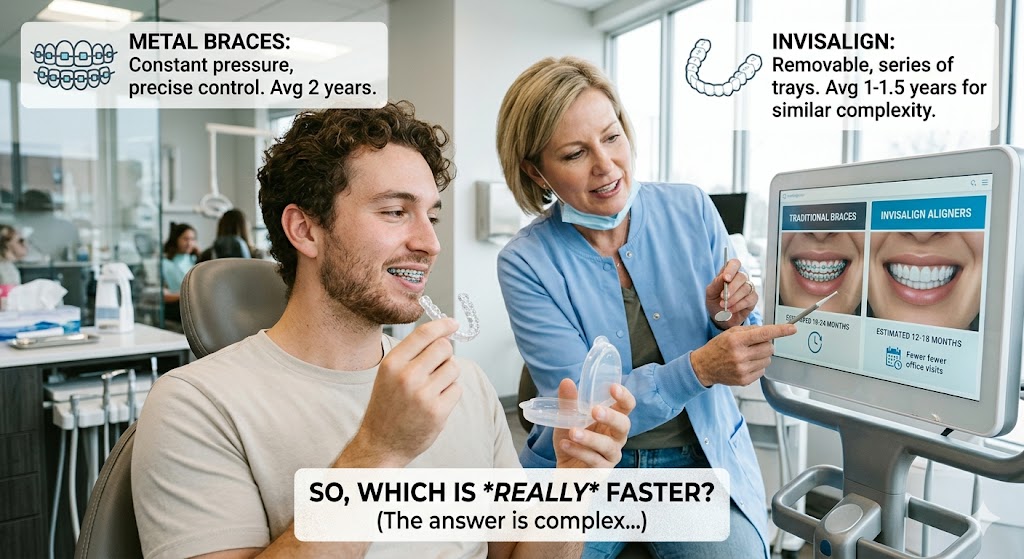
For mild to moderate orthodontic cases, Invisalign is often slightly faster.
For complex cases involving significant bite corrections, traditional braces are frequently faster and more predictable.
Here is a quick comparison:
| Factor | Invisalign | Braces |
|---|---|---|
| Mild crowding | Often faster | Effective |
| Moderate crowding | Similar speed | Similar speed |
| Severe crowding | May take longer | Often faster |
| Major bite issues | Usually slower | Often faster |
| Compliance required | Very high | Low |
| Average treatment time | 6–18 months | 18–36 months |
| Ability to treat complex cases | Good | Excellent |
The key takeaway is that treatment complexity often matters more than the appliance itself.
Average Invisalign Treatment Time
Invisalign has become increasingly popular because many patients can complete treatment relatively quickly.
Typical treatment durations include:
| Case Type | Average Invisalign Duration |
| Minor corrections | 6–12 months |
| Moderate alignment issues | 12–18 months |
| Complex cases | 18–24 months |
| Severe orthodontic problems | 24+ months |
Some patients see noticeable improvements within a few weeks.
Because Invisalign uses a series of custom-made aligners, tooth movement is planned digitally before treatment begins. This allows for highly organized and efficient movement sequences.
Many orthodontists report that properly selected Invisalign patients can complete treatment faster than patients using braces for similar issues.
However, there is an important condition.
Patients must wear aligners as instructed.
Average Braces Treatment Time
Traditional braces remain one of the most effective orthodontic treatments available.
Average treatment times include:
| Case Type | Average Braces Duration |
| Mild crowding | 12–18 months |
| Moderate cases | 18–24 months |
| Complex cases | 24–36 months |
| Severe bite corrections | 30–36+ months |
Braces may appear slower at first glance. However, they can handle difficult tooth movements that Invisalign sometimes struggles to achieve efficiently.
Because braces are fixed to the teeth, they work continuously.
Patients do not need to remember to wear them.
This consistency often helps orthodontists maintain steady progress throughout treatment.
Why Invisalign Can Be Faster in Some Cases
Many patients are surprised to learn that Invisalign can sometimes outperform braces in treatment speed.
Several factors contribute to this advantage.
Digital Treatment Planning
One of Invisalign’s biggest strengths is advanced digital planning.
Before treatment starts, orthodontists create a detailed 3D model of the patient’s teeth.
The entire treatment sequence is mapped out in advance.
Benefits include:
- Precise movement planning
- Reduced trial-and-error adjustments
- Better predictability
- Fewer emergency appointments
Because every aligner is designed to accomplish a specific movement, treatment can proceed efficiently.
Fewer Office Visits
Braces typically require adjustment appointments every four to eight weeks.
Invisalign often requires fewer in-office modifications.
Patients may receive several aligners at once and continue treatment with less interruption.
Reduced Friction
Traditional braces involve wires sliding through brackets.
This creates friction that can sometimes slow certain tooth movements.
Invisalign aligners apply force differently, which may allow more efficient movement in selected situations.
Better Oral Hygiene
Clean teeth and healthy gums support efficient orthodontic treatment.
Because aligners are removable, patients can brush and floss normally.
Healthier gums often contribute to smoother treatment progression.
Why Braces Can Be Faster in Complex Cases
Despite Invisalign’s advantages, braces continue to dominate many complex orthodontic situations.
Greater Force Control
Braces give orthodontists direct control over tooth movement.
This allows:
- Precise rotations
- Vertical tooth movement
- Major bite correction
- Significant crowding resolution
Some movements remain easier with braces.
No Compliance Issues
One of Invisalign’s biggest challenges is patient cooperation.
Aligners must usually be worn:
- 20–22 hours daily
- Every day
- Throughout treatment
Missing even a few hours regularly can delay progress.
Braces eliminate this problem.
Because they stay attached to the teeth, treatment continues around the clock.
Better for Severe Cases
Severe orthodontic issues often require:
- Complex force systems
- Elastics
- Additional appliances
- Significant tooth movement
Braces typically manage these situations more efficiently.
The Biggest Factor: Patient Compliance
Many orthodontists agree that compliance is often the deciding factor in treatment speed.
Consider this example:
Patient A chooses Invisalign but wears aligners only 15 hours daily.
Patient B chooses braces and follows all instructions.
Although Invisalign may have been theoretically faster, Patient B may finish treatment months earlier.
Common Invisalign Compliance Problems
Patients sometimes:
- Forget to reinsert aligners
- Remove aligners for long periods
- Skip aligner stages
- Lose trays
- Delay replacement aligners
Each issue can extend treatment.
How Much Wear Time Is Needed?
Most orthodontists recommend:
- 20–22 hours per day
- Removal only for meals
- Consistent daily use
Patients who meet these requirements often achieve excellent treatment efficiency.
“Invisalign can only work when it is being worn.”
Treatment Speed by Orthodontic Problem
Not every orthodontic issue responds equally to braces and Invisalign.
Crowded Teeth
| Severity | Faster Option |
| Mild | Invisalign |
| Moderate | Similar |
| Severe | Braces |
Gaps Between Teeth
| Severity | Faster Option |
| Small gaps | Invisalign |
| Moderate gaps | Similar |
| Large spacing issues | Braces |
Overbite
| Severity | Faster Option |
| Mild | Invisalign |
| Moderate | Similar |
| Severe | Braces |
Underbite
| Severity | Faster Option |
| Mild | Similar |
| Moderate | Braces |
| Severe | Braces |
Crossbite
| Severity | Faster Option |
| Minor | Invisalign |
| Moderate | Similar |
| Severe | Braces |
These comparisons are general guidelines. Individual treatment plans may differ significantly.
Which Option Produces Faster Visible Results?
Many patients care less about total treatment time and more about when they will notice improvement.
Visible changes often occur within:
| Treatment | First Visible Changes |
| Invisalign | 4–8 weeks |
| Braces | 6–10 weeks |
Because Invisalign treatment is digitally planned, some patients notice alignment improvements surprisingly early.
However, visible changes do not necessarily indicate that treatment will finish sooner.
The final stages often involve detailed bite refinement that takes additional time.
Does Age Affect Treatment Speed?
Yes.
Age plays a significant role in orthodontic treatment.
Children and Teenagers
Younger patients often experience:
- Faster bone remodeling
- Easier tooth movement
- Better orthodontic responsiveness
As a result, treatment can progress more quickly.
Adults
Adult treatment remains highly effective but may take slightly longer because bone metabolism changes with age.
Still, many adults complete Invisalign treatment in less than two years.
Age alone should not determine whether braces or Invisalign is selected.
The specific orthodontic problem remains the more important factor.
Important Note for Readers
The fastest treatment is not always the best treatment.
Orthodontic success depends on:
- Stable long-term results
- Proper bite alignment
- Healthy gums
- Functional chewing
- Attractive aesthetics
A treatment that takes a few extra months may ultimately provide a better and more durable outcome.
Patients should prioritize quality and stability rather than speed alone.