Small Bumps on Inside of Bottom Lip
Have you ever been casually brushing your teeth, eating a meal, or simply looking in the mirror, only to notice something new? There they are: small bumps on inside of bottom lip. Your first thought might be concern. What are they? Are they normal? Should you be worried?
Take a deep breath. You are not alone.
Millions of people notice these tiny bumps every single day. In the vast majority of cases, they are completely harmless. However, understanding what they are, why they appear, and when to take action can save you from unnecessary stress.
This guide is your all-in-one resource. We will explore every possible reason for these little bumps, from the most common and benign to the rarer situations that need a doctor’s attention. We will use simple, clear language, helpful lists, easy-to-read tables, and practical tips.
Let us get started and put your mind at ease.
Understanding the Landscape: What Is Normal on Your Lower Lip?
Before we dive into the bumps themselves, it helps to understand what a healthy inner lower lip looks like. The inside of your lip is covered by a type of tissue called oral mucosa. It is typically smooth, moist, and pink or reddish in color. It feels soft and flexible.
This tissue contains hundreds of tiny salivary glands, blood vessels, and nerve endings. Sometimes, the natural texture of this tissue includes very subtle, almost invisible ridges or tiny dots. These are often your normal glands at work.
So, when you see small bumps on inside of bottom lip, you are often just seeing a variation of normal anatomy. But not always. Let us separate the everyday from the unusual.
A Quick Note on Self-Examination
It is a good habit to look at your entire mouth once a month. Pull down your lower lip, look at the inner surface in good light, and note any changes. Most healthy mouths have a uniform appearance. Any new bump that appears suddenly, grows, or changes color deserves attention. But remember: attention does not mean panic. It means observation and, if needed, a professional opinion.
The Usual Suspects: Common Causes of Small Bumps on Inside of Bottom Lip
Let us talk about the most frequent reasons you might be noticing these little bumps. These are the causes that account for over 90% of cases.
Fordyce Spots: The Tiny Yellowish or White Dots
If you look closely at your inner lower lip, you might see clusters of very small, pale yellow or white dots. They look a bit like tiny grains of sand just under the surface. These are Fordyce spots, and they are incredibly common.
Fordyce spots are simply visible sebaceous glands. Sebaceous glands produce oil (sebum) to keep your skin lubricated. Normally, these glands are connected to hair follicles. However, on your lips, they exist on their own, free of hair follicles. When they become enlarged or just sit close to the surface, you can see them.
Key features of Fordyce spots:
- They are painless
- They never itch
- They do not grow or change over time
- They are often present for years without you noticing
- They affect up to 80% of adults
Do you need treatment? No. Fordyce spots are a normal variation. No treatment is ever required. Some people seek cosmetic removal, but this is rarely necessary and can cause scarring.
Mucoceles: The Fluid-Filled Bumps
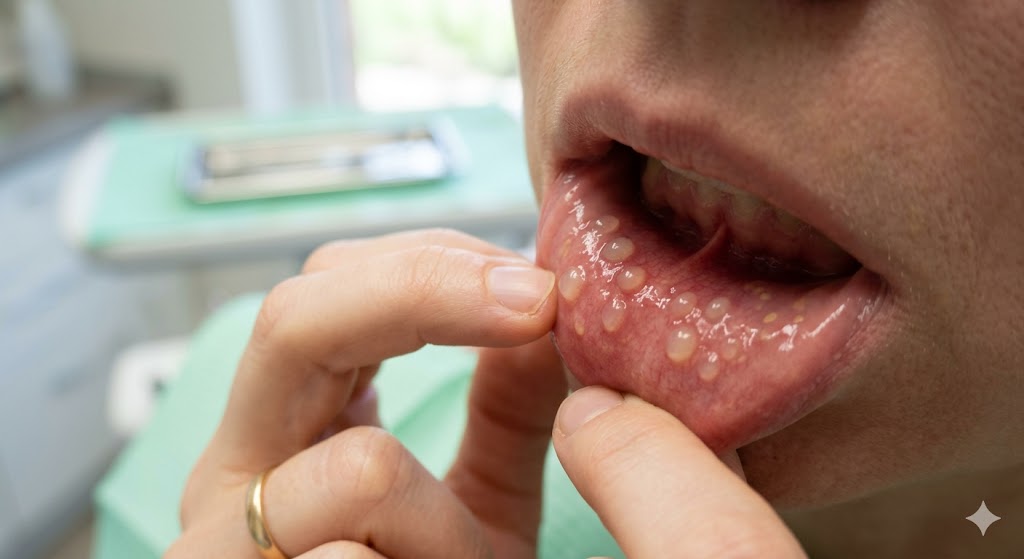
A mucocele (pronounced “myoo-ko-seel”) is another very common reason for small bumps on inside of bottom lip. Unlike Fordyce spots, a mucocele is a soft, fluid-filled lump. It looks like a small, round, translucent blister. It can be clear, bluish, or pink.
How does a mucocele form? Your lower lip is packed with tiny salivary glands (called minor salivary glands). These glands produce saliva continuously. If one of the tiny ducts (the tube that carries saliva from the gland to the surface of your lip) gets damaged or blocked, saliva leaks into the surrounding tissue. Your body walls off this leaked saliva, creating a bump.
The most common cause of a mucocele is accidental biting or sucking on your lower lip. You might not even remember doing it.
Key features of a mucocele:
- Usually soft and painless
- Can feel like a squishy bubble
- Often appears suddenly
- Can grow to about the size of a pea or small marble
- May pop, drain clear fluid, and then refill days later
Should you worry? Not usually. Mucoceles are benign (non-cancerous). Many resolve on their own within a few weeks. However, if a mucocele is large, painful, or does not go away after two months, a dentist or oral surgeon can remove it with a simple procedure.
Oral HPV (Human Papillomavirus) Papillomas
This sounds scarier than it often is. The human papillomavirus can cause small, wart-like growths in the mouth. These are called squamous papillomas.
How do they look? Unlike the smooth mucocele or the tiny Fordyce spot, an HPV-related bump often has a rough, cauliflower-like surface. It may be attached to the lip by a small stalk.
Key features:
- Usually single (just one bump)
- Can be white or pink
- Grows slowly over weeks or months
- Painless in most cases
Important note: Not every bump caused by HPV is dangerous. However, because HPV is transmissible and some strains are linked to oral cancer, any bump that looks wart-like should be examined by a dentist or doctor. They can remove it and send it for testing if needed.
Canker Sores (Aphthous Ulcers): The Painful Bumps That Become Sores
Canker sores often start as small, red bumps or raised spots before they break open into shallow ulcers. On the inside of the bottom lip, they are very common.
The typical progression:
- A tingling or burning sensation
- A small, red, raised bump appears
- Within hours or a day, the bump turns into a shallow, round or oval sore
- The sore has a white or yellow center with a red border
- Pain increases, especially when eating spicy, salty, or acidic foods
Key features:
- Very painful
- Usually heal in 7 to 14 days
- Can be triggered by stress, minor injury, acidic foods, or hormonal changes
- Are not contagious
What to do: Over-the-counter topical gels, saltwater rinses, and avoiding irritating foods can help. If you get very large or frequent canker sores, talk to your dentist.
Allergic Reactions: The Sudden Swelling Bumps
Your lower lip is sensitive to allergens. You can develop small bumps as part of an allergic reaction. This is often called contact stomatitis.
Common culprits:
- Toothpaste (especially those with sodium lauryl sulfate or strong flavors like cinnamon)
- Lip balms or lipsticks
- Mouthwash
- Foods (certain spices, preservatives, or acidic fruits)
How does it look? You might see multiple small, red bumps that feel irritated or itchy. Your lip might also feel swollen or dry. The bumps often appear within hours of contact with the allergen.
What to do: Stop using any new oral care products or lip products. Switch to a hypoallergenic, flavor-free toothpaste. If the bumps go away within a few days, you have likely found the cause.
Deeper Dive: Less Common but Important Causes
While the above causes handle most cases, there are other possibilities. These are rarer, but it is responsible to know about them.
Oral Lymphoepithelial Cysts
These are small, firm, yellow-white bumps that can appear on the inner lower lip. They are developmental cysts, meaning you were likely born with the microscopic structure that later became a bump. They are entirely benign.
Key features:
- Very slow-growing (months to years)
- Painless
- Usually smaller than a pencil eraser
- May feel firm to the touch
These rarely need treatment unless they become bothersome.
Minor Salivary Gland Tumors
Let us be direct: tumors on the inner lip are rare. When they occur, the vast majority are benign (not cancer). The most common benign salivary gland tumor is called a pleomorphic adenoma. Cancerous tumors on the inner lower lip are extremely uncommon.
Features that would raise concern (not panic):
- A bump that grows steadily over weeks or months
- A bump that feels hard or fixed (does not move when you press it)
- Numbness or tingling in the lip
- An overlying ulcer that bleeds easily and does not heal
The honest truth: Most people who worry they have a tumor have a mucocele or a Fordyce spot. But if any bump has these concerning features, see a professional for peace of mind.
Herpes Simplex (Cold Sores)
While cold sores are most common on the outside of the lips (the vermilion border), they can occasionally appear on the inside of the lower lip. However, this is less typical.
How to tell:
- They often start as one or more small, fluid-filled blisters
- The blisters cluster together
- There is a distinct tingling or burning sensation before the bumps appear
- They eventually crust over
Note: True herpes blisters on the inner lip are rare because the inside environment is not ideal for the virus. If you have bumps that look like blisters inside your lip, other causes are more likely.
Comparative Table: Quick Reference for Identification
Here is a simple table to help you distinguish between the most common small bumps on inside of bottom lip at a glance.
| Feature | Fordyce Spots | Mucocele | Canker Sore (early) | HPV Papilloma | Allergic Reaction |
|---|---|---|---|---|---|
| Appearance | Tiny yellow/white dots | Soft, round, bluish/clear bubble | Small red raised bump turning into white/yellow ulcer | Rough, cauliflower-like, often stalked | Multiple small red bumps |
| Pain level | None | None (unless traumatized) | Moderate to severe | None | Mild itching or burning |
| Speed of onset | Years | Hours to days | 1-2 days | Weeks to months | Hours |
| Common size | 1-2 mm | 2-10 mm | 2-8 mm | 3-10 mm | 1-3 mm each |
| Duration | Permanent (lifelong) | Days to weeks (may recur) | 7-14 days | Months to years (persistent) | Days after removing allergen |
| Needs treatment? | Never | Only if bothersome | Symptom relief only | Yes (removal often advised) | Identify and avoid trigger |
When to See a Dentist or Doctor: A Responsible Guide
Most bumps are harmless. But your health matters. Here is when you should absolutely make an appointment.
The “Two-Week Rule” : If any new bump on the inside of your lower lip has not completely healed or disappeared after two weeks, get it checked. This is a standard guideline used by oral health professionals worldwide.
Specific Signs That Warrant a Professional Look
- The bump grows steadily. Benign bumps like mucoceles can grow, but they usually plateau. If it gets bigger every week, see someone.
- It bleeds easily. If the bump bleeds when you brush your teeth or eat, that is not typical for most benign conditions.
- You have numbness. Any loss of feeling in your lip or chin area (not just the bump itself) is a sign to act.
- It changes color. A bump that becomes very dark, mottled, or develops a red and white patchy appearance needs evaluation.
- You have multiple bumps that spread. One or two bumps are common. A cluster that grows in number or size over time is different.
- You have other symptoms. Unexplained weight loss, fatigue, or swollen lymph nodes in your neck alongside a lip bump.
What to Expect at the Appointment
A dentist is your first and best resource for oral bumps. They are trained to spot the difference between harmless and harmful. Here is what they will likely do:
- Ask questions: When did it appear? Does it hurt? Have you had it before?
- Examine visually and by feel: They will look at the bump and gently feel it. The texture, mobility, and consistency tell them a lot.
- Shine a light: A bright light helps them see deep into the tissue.
- Biopsy if needed: If there is any doubt, they will take a tiny sample (a biopsy) and send it to a lab. This is a quick, painless procedure with local anesthetic.
Remember: A biopsy does not mean they think it is cancer. It means they are being thorough. Most biopsies come back as “benign mucocele” or “normal glandular tissue.”
Home Care and Self-Management: What Actually Works?
You do not need to rush to the doctor for every little bump. For many causes, simple home care is perfect.
For Mucoceles and Injury-Related Bumps
If you think you bit your lip or damaged a salivary gland:
- Leave it alone. Do not try to pop it. Popping a mucocele usually leads to infection or scarring, and it will almost always refill.
- Warm saltwater rinses. Mix half a teaspoon of salt in a cup of warm water. Swish gently for 30 seconds, three times a day. This reduces inflammation and keeps the area clean.
- Avoid irritating foods. Spicy, crunchy, or very acidic foods can aggravate the bump.
- Be mindful of biting. Try to notice if you are chewing on your lip. This habit is often unconscious.
For Canker Sores (Pain Relief)
- Topical gels: Look for benzocaine (Orajel, Anbesol) or lidocaine-based products.
- Milk of magnesia: Dab a small amount on the sore. It coats and soothes.
- Avoid triggers: For a week, avoid nuts, chocolate, coffee, strawberries, cheese, and tomatoes. These are common triggers.
- Vitamin B12 and lysine: Some studies suggest that taking these supplements can reduce recurrence.
For Allergic Reactions
- Switch to a very basic toothpaste. Look for “natural” or “hypoallergenic” brands without sodium lauryl sulfate (SLS) or flavoring.
- Stop using lip balm for a week. Many lip balms contain lanolin, fragrances, or preservatives that can cause reactions.
- Keep a diary. Note what you ate, drank, or used before the bumps appeared. Patterns will emerge.
For Fordyce Spots: Honest Advice
- Do nothing. Truly. They are normal. No home remedy will remove them, and trying to scrape or burn them at home is dangerous.
- Accept them as a variation of normal. You are unique, not flawed.
Preventive Strategies: How to Avoid Future Bumps
You cannot prevent every bump, but you can reduce your risk significantly.
1. Break the Lip-Biting Habit
Chronic lip biting is a major cause of recurrent mucoceles and scar tissue. Pay attention to when you do it (stress? boredom? concentration?). Chew sugar-free gum or hold a stress ball instead.
2. Stay Hydrated
A dry mouth can make your oral mucosa more fragile. Drink water throughout the day. A well-hydrated lip is more resilient and less prone to injury.
3. Eat a Balanced Diet
Deficiencies in iron, folate, and vitamin B12 are linked to an increase in canker sores and poor healing. Eat leafy greens, lean meats, and whole grains.
4. Practice Gentle Oral Hygiene
Use a soft-bristled toothbrush. Brush gently. Aggressive brushing can cause tiny, invisible injuries that turn into mucoceles or canker sores.
5. Manage Stress
Yes, stress is linked to canker sores and lip biting. Find what works for you: deep breathing, walking, listening to music, or talking to a friend.
The Emotional Side: Living with Visible Oral Bumps
Let us talk about something most articles ignore: how you feel about these bumps.
If you have Fordyce spots, you might feel self-conscious. You might wonder if other people see them. The truth? Almost no one will notice them unless you point them out. And if someone does notice, they will likely not care. We are our own harshest critics.
If you have a mucocele that keeps coming back, you might feel frustrated. That is understandable. But remember, it is benign. If it truly bothers you, a five-minute procedure can remove the gland permanently. You have options.
If you have canker sores frequently, you might dread eating. That is real pain. But you can learn your triggers. Many people who suffer monthly can get to just one or two per year by changing their diet and stress habits.
You are not alone. Millions of online searches every month prove that people everywhere are looking at their inner lips with curiosity and concern.
Procedure Spotlight: What Happens If a Bump Is Removed?
You might be told that a bump needs removal. Here is a realistic, non-scary look at what that involves.
Excision of a Mucocele or Minor Gland
This is the most common oral surgery procedure after wisdom teeth removal.
Step-by-step:
- Numbing: The dentist injects a local anesthetic (like at the dentist for a filling). You feel a quick pinch, then nothing.
- Isolation: They gently hold your lip out of the way.
- Removal: Using a scalpel or laser, they make a tiny elliptical cut around the bump and the associated salivary gland. This takes 2-5 minutes.
- Stitches (or not): They may place one or two dissolvable stitches, or if using a laser, no stitches are needed.
- Healing: You have a small sore for a few days. Soft foods, no spicy things, and gentle rinsing for a week.
Does it hurt? The numbing injection is the only pinch. Afterward, you might have mild soreness, like a pizza burn on your lip. Over-the-counter pain relievers handle it easily.
Success rate: Very high (over 95% for mucoceles). Recurrence is rare if the gland is completely removed.
Laser Ablation for Fordyce Spots (Cosmetic)
This is rarely done. But if you insist, a dermatologist or cosmetic dentist can use a laser or a specialized electric needle to destroy the visible glands.
What to know:
- It is purely cosmetic
- Insurance does not cover it (cost: $200-$800+ per session)
- Healing takes 1-2 weeks
- There is a risk of scarring or altered lip texture
- The spots can return over years
Our advice? Save your money and love your lips as they are.
Myths and Misinformation: Let Us Clear Things Up
There is a lot of wrong information online about small bumps on inside of bottom lip. Let us correct the most common myths.
Myth 1: “All white bumps are oral cancer.”
Fact: False. Oral cancer is rare. White bumps on the lower lip are almost always Fordyce spots or benign glands. Cancer is more likely to appear as a non-healing ulcer or a red/white patch on the floor of the mouth or side of the tongue, not as a tiny bump on the inner lip.
Myth 2: “You can pop a mucocele at home with a sterilized needle.”
Fact: Dangerous advice. Popping a mucocele often introduces bacteria, causing infection. The sac will almost always refill with fluid. And you will likely create scar tissue, making future removal harder.
Myth 3: “Fordyce spots are an STD.”
Fact: Absolutely false. Fordyce spots are not contagious. They are not an STD. They are normal oil glands. This myth causes unnecessary shame.
Myth 4: “Only smokers get oral bumps.”
Fact: Not true. Smoking increases the risk of oral cancer and other lesions, but the most common bumps (Fordyce spots, mucoceles, canker sores) affect non-smokers and smokers equally.
Myth 5: “If the bump goes away on its own, it was nothing.”
Fact: Partially true. Most bumps that heal quickly are benign. However, even some cancerous lesions can temporarily shrink or look better before growing again. The “goes away and comes back” pattern is classic for mucoceles, but if a bump goes away and returns in the exact spot multiple times, still mention it to your dentist.
When Bumps Are Part of a Bigger Picture: Systemic Conditions
Rarely, small bumps on the lower lip are a sign of something happening throughout your body. This is unusual, but a complete guide mentions them.
Crohn’s Disease
Crohn’s is an inflammatory bowel disease. One of its oral signs can include cobblestone-like bumps on the inside of the lips or cheeks. These are usually painless and come with other symptoms like abdominal pain, diarrhea, or weight loss.
Hand, Foot, and Mouth Disease
Common in children, but adults can get it too. Small, red, blister-like bumps appear on the inside of the lips, along with a sore throat, fever, and a rash on the hands and feet.
Lichen Planus
This inflammatory condition can cause white, lacy patches or small, raised bumps on the oral mucosa. On the lower lip, it is less common but possible. It is not dangerous but can cause discomfort.
Pemphigus Vulgaris
A rare autoimmune blistering disease. It causes painful, fragile blisters and bumps on the inside of the lips and elsewhere in the mouth. This requires specialist care.
The takeaway: If you have bumps and other unexplained symptoms elsewhere in your body, mention everything to your doctor. Do not assume the lip bumps are isolated.
Practical Daily Habits for a Healthy Inner Lip
Prevention and early detection go hand in hand.
The Monthly Mouth Self-Exam (10 minutes)
- Good light. Stand in front of a bright bathroom mirror.
- Lower lip. Pull your lower lip down and look at the entire inner surface from left to right.
- Feel. Use a clean finger to feel along the inner lip. Note any lumps, bumps, or rough spots.
- Compare. Does this look the same as last month? Use your phone to take a photo. Photos are objective; memory is not.
- Check other areas. While you are there, lift your tongue, look at your cheeks, and look at the roof of your mouth.
When to Photograph a Bump
Take a clear, well-lit photo if:
- You are going to monitor it for two weeks
- You plan to show it to a dentist (they appreciate photos of how it looked before your appointment)
- It is changing and you want a timeline
Lip Care Products That Actually Help
- Lanolin-free lip balm: Lanolin is a common allergen. Try beeswax or plant-based balms.
- SPF for your lips: Even the inner lip can get sun damage if you have very thin or translucent lip tissue. Use a lip balm with SPF 30.
- Avoid menthol and camphor. These ingredients can irritate the inner lip if they migrate from the outside edge.
Detailed Overview: Mucoceles vs. Salivary Stones
A related but different condition is a salivary stone (sialolith). It can form in the same minor salivary glands of the lower lip, but this is very rare.
| Feature | Mucocele (Lip) | Salivary Stone (Lip) |
|---|---|---|
| Composition | Fluid (saliva) | Hard, calcified mineral |
| Feel | Soft, squishy | Hard, like a tiny pebble |
| Pain | Usually none | Pain with eating (saliva cannot flow) |
| Treatment | Surgical removal | Massage, sour candies, or surgical removal |
If your bump feels hard as a rock, you might have a stone, not a mucocele. Your dentist can confirm with a simple exam.
The Natural History: What Happens If You Do Nothing?
Different bumps behave differently over time.
Fordyce spots: They will stay the same for decades. They do not become cancerous. They do not grow. They are stable.
Mucoceles: They may grow for a few weeks, then stop. They might pop on their own (if you bite them). The fluid drains, the bump flattens, then refills in days. This cycle can continue for months. Sometimes, they resolve permanently when the body absorbs the leaked saliva and the gland heals.
Canker sores: They always heal. Without treatment, they last 10-14 days. With treatment, you just reduce pain. You cannot speed healing dramatically.
HPV papillomas: They do not heal on their own. They persist. They may grow very slowly. Removal is the only way to get rid of them.
Allergic bumps: They disappear completely within 3-7 days of removing the trigger.
List: 7 Things Never to Do to a Bump on Your Inner Lip
- Do not cut it off yourself. You can cause severe bleeding, infection, and scarring.
- Do not apply apple cider vinegar, tea tree oil, or essential oils. These are caustic and will burn your oral mucosa.
- Do not use over-the-counter wart removers. These contain salicylic acid, which is not meant for inside the mouth.
- Do not ignore a bump that bleeds for no reason. Bleeding without injury is a red flag.
- Do not assume it is “just a pimple.” You cannot get acne pimples on the inside of your lip. It is something else.
- Do not stress to the point of losing sleep. Most bumps are nothing. Book an appointment for peace of mind.
- Do not use someone else’s prescription cream. Oral medications for cold sores or warts are specific. Do not share.
The Psychological Impact: Health Anxiety and Oral Bumps
Let us be real. You might be reading this because you are anxious. Maybe you googled “small bumps on inside of bottom lip” at 11 PM and spiraled. This is incredibly common. Health anxiety is real.
Here is a helpful script for your brain:
“I have noticed a bump. I have read this guide. I know that 90% of these bumps are harmless. I will give it two weeks. If it is still there, I will see my dentist. I am taking action, not panicking. My body is not out to get me; it is just being a body.”
If you cannot stop worrying: Call your dentist. Tell the receptionist, “I have a bump on my lip that I am worried about. Can I email a photo?” Many dentists now offer e-consults. They can often tell you over the phone or via email that it looks normal.
Building Your Oral Health Toolkit
Keep these items at home:
- Soft-bristled toothbrush (replace every 3 months)
- Non-alcoholic, SLS-free mouthwash
- Salt (for warm saltwater rinses)
- Over-the-counter topical oral gel (benzocaine)
- A small notepad or phone note for tracking triggers
- Photos of your normal inner lip (for comparison)
A Realistic Path Forward: Decision Tree
Use this simple decision flow.
Step 1: Does it hurt?
- No pain → Likely Fordyce spots, mucocele, or HPV. Monitor.
- Yes pain → Likely canker sore, trauma, or allergic reaction.
Step 2: How long has it been there?
- Less than 2 weeks → Observe. Use home care.
- More than 2 weeks → Schedule a dental exam.
Step 3: Does it look like a clear bubble?
- Yes → Probable mucocele. Leave it alone. See a dentist if it grows or bothers you.
- No → Move to next.
Step 4: Is it a cluster of tiny yellow/white dots?
- Yes → Fordyce spots. Celebrate being normal.
- No → See your dentist for an accurate diagnosis.
Summary Table: When to Act vs. When to Relax
| Scenario | Action |
|---|---|
| Tiny yellow dots, no pain, been there for years | Relax. These are Fordyce spots. |
| Soft, clear bubble that appeared after likely biting lip | Relax. Likely mucocele. Monitor 2 weeks. |
| Painful white/yellow sore with red border | Relax. Canker sore. Use home care. |
| Rough, cauliflower bump that grows slowly | Act. See dentist for evaluation and removal. |
| Multiple red bumps after new toothpaste | Relax. Allergic reaction. Change products. |
| Any bump that bleeds, causes numbness, or lasts >2 weeks | Act. See dentist. |
The Bottom Line: Your Lips Are Tough and Resilient
Here is the honest summary.
Your inner lower lip is a busy place. It houses hundreds of glands. It endures heat, cold, spicy foods, accidental bites, and constant movement. It is completely normal for it to develop small bumps from time to time.
The vast majority of these bumps are nothing to worry about.
Fordyce spots are just visible oil glands.
Mucoceles are just blocked salivary glands.
Canker sores are just annoying but harmless ulcers.
Even the less common causes like HPV papillomas are treatable and rarely dangerous when caught early.
Your job is not to diagnose yourself. Your job is to observe, practice good oral hygiene, and know when to seek help. That two-week rule is your best friend.
And if you are still worried after reading this entire guide? Book an appointment. A five-minute exam from a dentist will give you certainty. That is worth the time and small fee.
You have done the smart thing today: you educated yourself. Now, take a deep breath, look in the mirror, and smile. Your lips are doing exactly what they are supposed to do.
Conclusion: Three Lines to Remember
Most small bumps on the inside of your bottom lip are harmless Fordyce spots, mucoceles, or canker sores. Watch for bumps that last over two weeks, bleed, or grow steadily—these deserve a dentist’s look. Practice gentle oral care, avoid lip biting, and use this guide as your reliable reference for peace of mind.
Frequently Asked Questions (FAQ)
Q1: Can small bumps on inside of bottom lip be cancer?
A: Yes, but it is extremely rare. Oral cancer typically appears as a non-healing ulcer, a red or white patch, or a hard lump. Most bumps are benign. If a bump lasts more than two weeks, see a dentist for a professional exam.
Q2: Why do I have multiple small bumps on my lower lip?
A: Multiple bumps often indicate Fordyce spots (tiny yellow/white dots) or an allergic reaction (red, irritated bumps). Less commonly, viral infections like HPV can cause multiple bumps. A dentist can tell you with certainty.
Q3: Can I pop a mucocele on my lip myself?
A: No. Popping a mucocele at home risks infection, scarring, and recurrence. The fluid will almost always return. If a mucocele bothers you, see a dentist for proper, painless removal.
Q4: How long do canker sores last on the inner lip?
A: Most canker sores heal completely within 7 to 14 days. Pain is worst in the first 3-4 days. If a sore lasts longer than three weeks, see a dentist.
Q5: Are Fordyce spots contagious?
A: No. Fordyce spots are not contagious. They are normal, visible oil glands. You cannot give them to someone else, and you did not catch them from anyone.
Q6: What toothpaste is best if I keep getting bumps?
A: Look for a toothpaste without sodium lauryl sulfate (SLS), artificial flavors (especially cinnamon or strong mint), and without whitening agents. Brands like Sensodyne (certain versions), Verve, or Hello are often well-tolerated.
Q7: Can stress cause bumps on the inside of my bottom lip?
A: Indirectly, yes. Stress can trigger canker sores and worsen lip-biting habits, which lead to mucoceles. Stress itself does not directly create a bump, but it sets the stage.
Q8: Should I use mouthwash if I have a painful bump?
A: Use an alcohol-free, gentle mouthwash. Alcohol-based mouthwashes can sting and delay healing. Saltwater rinse (half teaspoon salt in warm water) is better and free.
Additional Resource
For more reliable, dentist-reviewed information on oral health conditions, visit the American Academy of Oral Medicine (AAOM) patient information page:
https://www.aaom.com/patient-information
The AAOM provides trustworthy, evidence-based patient handouts on Fordyce spots, mucoceles, canker sores, and oral HPV. No ads, no fear-mongering—just facts from oral medicine specialists.
Disclaimer (repeated for clarity): This article is for informational purposes only and does not constitute medical advice. Always consult a qualified healthcare professional for any health concerns or before starting any treatment. The author and publisher are not liable for any actions taken based on the content of this article. Your health is unique to you; professional guidance is irreplaceable.