does getting wisdom teeth removed hurt?
You stare at the ceiling of the dental clinic, your palms slightly sweaty against the vinyl chair. The question loops in your mind, drowning out the friendly chatter of the surgical team. You want to ask it one more time, just to be sure. The core fear that brings even the bravest adults to a cold sweat. The single, burning question that sends millions to search engines every month.
Does getting wisdom teeth removed hurt?
I will not dance around the answer. I will not give you marketing fluff designed to calm you down while hiding the truth. We are going to break this down biologically, physically, and emotionally. You need a realistic roadmap, not a sugar-coated fantasy. Because when you know exactly what to expect, the fear loses its power. The unknown is the monster under the bed. Let’s turn the lights on.
Let’s start with the raw, immediate truth before we dive into the deep science and recovery strategies. In the exact moment of extraction, you should feel zero sharp pain. Zero. The absence of sharp, slicing sensation comes from modern local anesthesia. However, pain is a complex, layered experience. You will feel pressure. You will feel bizarre sounds. You will feel a deep, physical manipulation that your brain might struggle to categorize. And afterward? You will face a recovery journey that requires respect. So, yes, the experience involves discomfort. But the nightmare scenario you have built in your head? That is almost always a myth.
We are going to walk through every micro-second of the process. From the numbing gel to the last day of recovery. By the end of this guide, you will have the confidence of a surgical veteran.
The Anatomy of the Fear: Why We Ask This Question
Before we talk about the mouth, we need to talk about the mind. The fear surrounding wisdom teeth extraction is rarely just about pain. It is a cocktail of vulnerability, loss of control, and deep-seated evolutionary terror.
The Soundtrack of Horror Stories
Your uncle told you about his dry socket. Your best friend described a face like a chipmunk. A movie depicted a brutal, screaming extraction without anesthesia. We collect these anecdotes like trading cards. The problem? Human memory is unreliable, especially regarding pain. We remember the anticipation of pain more vividly than the actual sensation. Studies on pain memory show that if a procedure ends badly, we “rewrite” the entire experience as a horror show, even if 90% of it was comfortable. You are not afraid of the surgery. You are afraid of a distorted highlight reel stored in your collective social memory.
The Helplessness Paradox
Sitting in a dental chair with your mouth propped open triggers a primal freeze response. You cannot speak. You cannot run. Sharp instruments exist near your airway. This is the definition of vulnerability. The brain translates this psychological helplessness into a preemptive pain signal. It screams, “Danger!” before the needle even touches the skin. Distinguishing between true nociceptive pain (actual tissue damage) and psychological distress is the first step to mastering the experience.
The “Third Molar” Misfortune
Wisdom teeth are evolutionary leftovers. Our jaws shrunk as our brains grew, but the genetic coding for 32 teeth remained stubbornly present. These molars erupt sideways, hit nerves, and become impacted in the jawbone. The removal is not a simple “pull.” It often requires incisions into the gum, removal of bone tissue, and sectioning the tooth into pieces. You instinctively know this is a minor orthopedic surgery masquerading as a dental visit. Acknowledging this validates your fear. You are not being dramatic. This is a serious medical procedure. But serious does not mean unbearable.
The Pre-Surgery Landscape: Anesthesia and Assessment
The question “does it hurt” cannot be answered without dissecting the pre-operative phase. Your journey to a painless extraction starts weeks or days before the actual appointment.
The Consultation: A Dialogue, Not a Monologue
A surgeon who rushes the consultation is a red flag. The pre-surgery visit is your time to build a pharmacological alliance. You must disclose everything. I am not just talking about the standard medical history form. I mean telling them if you wake up during dreams easily. I mean telling them if you are a redhead. Yes, natural red hair genetics often link to a resistance to local anesthetics and an increased sensitivity to pain. This is a scientifically documented phenomenon linked to the melanocortin-1 receptor gene. If you have Ehlers-Danlos syndrome or hypermobility, local anesthetics might wear off faster. If you have a fast metabolism, tell them. If you smoke cannabis regularly, tell them. Cannabis use can drastically alter the effectiveness of sedation drugs and local anesthetics.
Surgeons rely on a standardized protocol. If you are a statistical outlier, you must speak up. This conversation ensures the “numbing” phase succeeds. When a patient says the removal hurt, 50% of the time the initial anesthesia protocol was insufficient for their unique biology, and they were too intimidated to say, “I can still feel that.”
The Nervous System Setup: EMLA Cream
Ask for topical numbing gel, often EMLA cream or a benzocaine solution. This is a sticky, flavored paste applied to the injection site a minute or two before the needle. This is non-negotiable for a comfortable experience. The claim “it’s just a little pinch” is a lie if the surface tissue is fully awake. The topical gel blunts the superficial nerve endings. You feel the wet pressure of the swab, then nothing. When the needle enters, the first millimeter is anesthetized. Without this cream, you feel the initial puncture sharply.
Apply the strategy mentally as well. Request that the surgeon shake the cheek or lip while delivering the slow injection. The vibration gate-control theory disrupts the pain signal traveling to the brain. A slow injection (taking a full minute or more per cartridge) prevents the burning sensation caused by the rapid expansion of tissue by fluid. An aggressive, fast injection tears tissue and hurts. A slow, gentle delivery with physical distraction is comfortable.
The Procedure Room: A Blow-by-Blow Sensory Guide
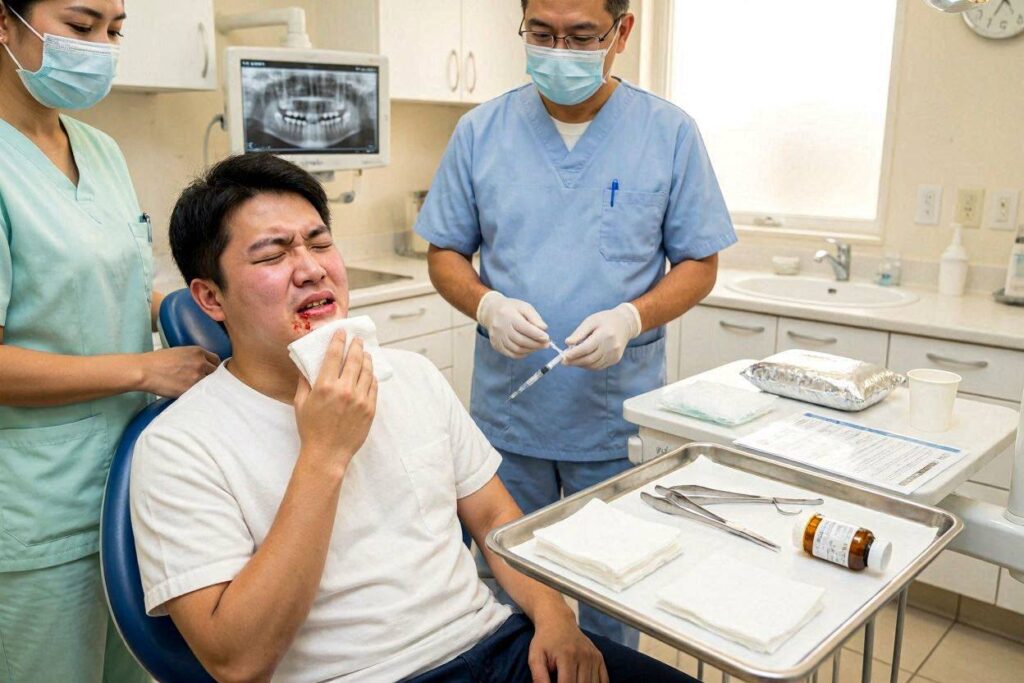
You lie back. The light hits your face. The bib is clipped on. This is the moment where the physiological response spikes. Let’s break down the physical sensations so your brain doesn’t confuse pressure with pain.
The Injection: Numbness, Not Pain
The assistant hands the surgeon a syringe. It looks intimidating. However, with topical cream and a slow hand, this is a non-event for most. You feel a tiny, precise point of contact, then a slow creeping coldness. That coldness is the epinephrine in the anesthetic. It constricts blood vessels to keep the anesthetic in the site and reduce bleeding. Your heartbeat might increase slightly. You might feel jittery. This is not pain; this is epinephrine entering the bloodstream. It passes in 90 seconds. If you feel a quick, sharp “zinger” in your tongue or lip, it’s a good sign. It means the needle found the exact nerve sheath, and numbness will set in rapidly.
Soon, your lower lip, tongue, and cheek morph into a block of rubber. Wiggle your lip. If you can feel the movement, do not start the surgery. Speak up. The surgeon will test with a sharp explorer tool. They will poke the gum. “Can you feel this sharp or just pressure?” Be ruthless in your honesty. If you feel a sharp point, you need more time or another cartridge. The surgery does not begin until the mirror test fails: you see the tool touching you but feel zero sharpness.
The Incision and Elevation: The Pressure Symphony
Now to the core fear. You are numb, the surgeon makes an incision if the tooth is impacted. You feel nothing sharp. You hear the sound of a blade, but it is distant, like cutting a wet envelope. Then comes the elevator. This is a flat metal tool used to lever the tooth. This is not pain, but it is intense. The surgeon pushes, and you sense the profound weight of a freight train pressing against your jawbone.
Your brain may try to label this as pain because the pressure is so deep. It travels into your ear, your temple, your neck. This is referred pressure. It is entirely safe. If the tooth is deeply embedded in the bone, the surgeon uses a handpiece. This is a drill. You hear a high-pitched whine and smell a faint, sterile dust as the bone is cut. This is the water-cooled bur separating the tooth from the bone. You feel vibration. A tickling, buzzing sensation that makes your skull hum. It does not hurt. It is merely strange. Imagine holding a battery-operated toothbrush against your jaw with heavy, firm pushing.
The Sectioning: Cracking, Not Breaking
A common source of terror is the crack. Impacted teeth are rarely removed whole. The surgeon drills a trench into the tooth and uses a tool to split it. You hear a loud, internal “crack” or “pop.” It sounds like a twig snapping next to your ear, amplified by bone conduction. You flinch. “Did my jaw break?” you think in a panic. No. The tooth fractured along a planned line. The sound is abrupt and shocking, but the bone is not broken. Expect this sound. A surgeon who prepares you for the “pop” robs the sound of its terror. If you expect it, it’s an odd novelty.
The Final Delivery: A Release of Tension
The surgeon then uses forceps to wriggle the fragmented crown. The pressure is steady and rhythmic. You feel a pulling, a twisting traction in the socket. Then, suddenly, a release. A wet, sucking, popping release as the tooth leaves the ligament. The pressure instantly vanishes. It’s a unique physical relief. The surgeon then scrapes the socket walls if a cyst or infection was present. You hear a scratching, gritty sound like dragging a stick across a sidewalk. Again, no pain, just a scraping auditory experience.
Finally, the sutures. You see a needle and thread approaching your eye, but you feel only the gentle tug of a string pulling through a fabric that doesn’t belong to you. A knot settles. The surgery is done.
The Crucible of Recovery: Day Zero to Day Seven
Here lies the pivot of the pain question. The surgery doesn’t hurt. The aftermath does. But it’s a manageable, predictable hurt, not a chaotic trauma. You must distinguish between surgical inflammation and pathological pain.
The “Golden Window” of Anesthesia Wear-Off
You leave the clinic feeling euphoric, swollen, and disconnected. Do not make the mistake of skipping pain medication because “I feel fine now.” The local anesthetic blocks pain signals for 3 to 6 hours. If the surgery ended at 10 AM, the storm hits around 2 PM. You must pre-load the analgesia. Take the first dose of ibuprofen or prescribed medication before the tingling of waking up starts. If you wait for the pain to arrive, you chase it. Chasing pain requires higher doses and feels emotionally devastating. Get ahead and stay ahead.
The Ice vs. Heat Protocol (A Critical Table)
The inflammatory cascade peaks at 48 to 72 hours. Managing this determines your pain level. Confusion about when to use ice or heat causes prolonged swelling and stiffness.
| Phase | Timing | Physiological Goal | Method | Sensation Relief |
|---|---|---|---|---|
| Cryotherapy (Ice) | 0 to 48 hours post-op | Vasoconstriction. Reduce blood flow to limit swelling and bruising. | Gel packs or frozen peas wrapped in thin cloth. 20 minutes on, 20 minutes off. | Numbness and dulling of throbbing. Excellent analgesic. |
| Thermotherapy (Moist Heat) | 72 hours and beyond | Vasodilation. Increase blood flow to flush cellular debris and relax stiff jaw muscles. | Warm, wet towel or hot water bottle. 20 minute cycles. | Eases trismus (lockjaw) and deep aching stiffness. |
Critical Note: Never apply constant ice without breaks. This can cause frostbite on numb skin. Never apply heat during the first 48 hours, as heat fuels the inflammatory fire, turning your face into a hot, throbbing balloon of pain.
The Pharmacological Toolkit: Zero Pain Heroes
Treating post-extraction pain is a multi-modal strategy. You are hitting different receptors.
The Baseline (N-SAIDs)
Ibuprofen is the gold standard. 600mg to 800mg every 6 to 8 hours with food. This is not just a painkiller; it’s an anti-inflammatory. It reduces the prostaglandins causing the throbbing pressure. Do not dry-swallow it. You will burn a hole in your stomach lining.
The Adjunct (Acetaminophen)
Combining ibuprofen with acetaminophen provides analgesic synergy without increasing side effects. The classic regimen alternates them every 3 hours, but recent studies show taking them together offers superior pain relief comparable to opioids for dental pain. 650mg to 1000mg of acetaminophen layered with the ibuprofen.
The Heavy Hitters (Opioids)
Surgeons prescribe hydrocodone or codeine for difficult extractions involving significant bone removal. Reality check: opioids treat the emotional reaction to pain, not just the pain signal. They make you not care about the ache. However, they cause nausea and constipation. Dental pain peaks at night. Use the opioid to secure sleep if needed, but rely on the N-SAID stack during the day. Nausea while unable to open your mouth is a special kind of hell.
The Natural Allies
Bromelain (from pineapples) and Arnica montana pellets are widely used to reduce surgical swelling and bruising. While not magic bullets for sharp pain, reducing tissue distention reduces pain. A swollen, tight cheek hurts. Reducing that edema is an indirect pain reliever.
The Pain Progression Map: Daily Realities
Here is the honest timeline. Compare your experience against this to know if you are normal or in trouble.
Day 1: The Cryotherapy Marathon
Pain level: 2/10 when numb, 6/10 at peak inflammation.
You hold ice to your face like it’s a life raft. The numbness fades, replaced by a deep, warm, expanding ache. It feels like a bad bruise mixed with teething on steroids. Saliva is thick, pink, and metallic. Your throat is sore from intubation or jaw stretching. You sleep propped up on pillows. Gravity is your enemy; lying flat increases hydrostatic pressure in the jaw, making the throb unbearable. You take your meds, set alarms, and do not miss a dose.
Day 2: The Peak of Mount Swollen
Pain level: 5/10 to 7/10.
You wake up feeling hit by a truck. This is normal. Inflammation peaks at 48 hours. Your cheeks are taut, shiny, and warm. It is the bad-ache variety of pain. Stiffness dominates. You have not had a bowel movement if you took opioids. This systemic discomfort amplifies the localized pain. Continue ice until the end of day two. Speak in a low, muffled mumble.
Day 3: The Turning Point (or the Trap)
Pain level: 4/10 or 9/10.
Here lies the fork in the road. For a normal recovery, day three marks a slight softening of the swelling. The pain drops to a dull, manageable ache. You switch to wet heat. It feels glorious. However, this is the exact moment a dry socket declares war. If the clot has dissolved, day three presents the naked bone to the air. The pain shifts from a dull throb to a deep, electric, radiating burn in your ear, eye, and neck. Pain medication stops working. If this happens, you are not a wimp. You have a complication and need the surgeon to pack the socket with eugenol paste. The relief is instant and dramatic.
Day 4-7: The Boring Grind of Healing
Pain level: 2/10 to 3/10.
Pain becomes localized to the jaw joint (TMJ) and the muscles. The socket itself is closing. Food debris tickles the hole. You irrigate it with a curved syringe. The sutures start to feel tight and scratchy, like a fishbone poking your cheek. This is irritating, not painful. The psychological drain of a soft diet now hurts more than the surgery. You want a burger. This cranky hunger is a sign of healing.
The Variable Matrix: Why Some Sail Through and Others Sink
You cannot compare your pain to a random TikTok stranger. Pain is a multi-variate equation.
The Surgeon’s Skill and Attitude
Brutal speed is not a virtue. A surgeon who rips a tooth out in 10 seconds might save time, but the micro-fractures in the bone and the tearing of the gingival tissue cause a massive inflammatory response and a painful, prolonged recovery. Atraumatic extraction is a philosophy. It uses slow, steady elevation to let the socket expand naturally without shattering. A slow, 10-minute elevation hurts less post-op than a 15-second violent tug-of-war.
Mandibular vs. Maxillary Arch
Lower (mandibular) wisdom teeth almost always hurt more than upper (maxillary) ones. Blood pools in the lower jaw due to gravity. The bone is denser, requiring more drilling torque and pressure. The inferior alveolar nerve runs right under those roots. Inflammation around this nerve causes painful tingling or numbness in the lower lip. Upper teeth drain better, have softer bone, and often erupt more normally. An upper extraction is often shockingly simple. A lower bony impaction is a legitimate surgery with a tougher recovery.
Age and Cellular Elasticity
As a teenager, your bone is pliable, almost like dense rubber. The tooth pops out, the socket rebounds. As a 35-year-old, the bone is brittle, densely calcified, and fused to the tooth. The body must cut more bone to access the tooth. Recovery is slower, swelling is stiffer, and pain lingers longer. If you are over 30 and removing wisdom teeth, expect a harder recovery than a 17-year-old.
Psychological Ownership of Pain
Your mental state acts as a volume knob on the pain signal. This is not “woo-woo” positivity; it’s neurobiology.
The Catastrophizing Loop
Rumination amplifies pain. If you sit in a dark room, scrolling Google for “dry socket symptoms,” comparing every twitch to a worst-case scenario, your brain’s amygdala fires distress signals. These signals open the pain gate in the spinal cord. Your jaw actually hurts more. Put the phone down. Distraction is a proven analgesic. Play a narrative video game that requires two hands. Watch a complex murder mystery. Knit. The less attention you give the jaw, the quieter the nociceptive signals become.
Guided Breathing in the Chair
During the procedure, your breathing becomes shallow and rapid. This triggers a panic spiral, pumping cortisol and adrenaline, which paradoxically burn off the local anesthetic faster. Focus on a long, slow, nasal inhale, and a longer, slower oral exhale. If your mouth is open, breathe deeply through your nose. Clenching your fists and releasing them rhythmically provides an outlet for the nervous energy. You own the space. The surgeon is a guest in your body cavity.
The Irrigation Dilemma: Keeping the Hole Clean Without Pain
The most under-discussed pain vector in late recovery is the rotting of food debris.
The Syringe Technique
After 5 days, you typically start irrigating the lower sockets. A plastic curved syringe with warm salt water is essential. If you blast the stream directly into the fragile granulation tissue with high pressure, you will scream and delay healing. You must place the tip gently into the hole and plunge with soft, slow pressure. The cloud of debris flushing out is nauseating but satisfying. This must be done after every single meal for weeks until the hole is shallow enough to self-clean.
Neglecting this causes a low-grade infection called pericoronitis in the adjacent tissue or simply a gross-tasting, painful pocket of decay. Cleanliness is next to painlessness.
Nutrition and Sleep: The Repair Matrix
You don’t heal on ibuprofen alone. You heal on the building blocks you swallow.
The First 72 Hours of Fuel
Pain drains energy, but you cannot chew. The answer isn’t just milkshakes. Sugar feeds inflammation. You need protein, healthy fats, and micronutrients in a puddle.
- Savory Nectar: Blended room-temperature bone broth with melted butter and unflavored collagen powder. Sip it slowly. The glycine in the broth calms the nervous system.
- The Green Bomb: Avocado, plain yogurt, a handful of spinach, and a scoop of peanut butter powder blended into a smooth cream. This requires zero suction. Eat it with a baby spoon. Do not use a straw. A straw creates negative pressure, sucking the clot out. The resulting dry socket is a 10/10 pain experience.
Sleep Architecture
Pain perception spikes between 1 AM and 4 AM. This is due to circadian dips in cortisol (nature’s anti-inflammatory). If you sleep flat, fluid rushes to the surgical site, stretching the sutures. Sleep in a recliner or build a wedge fortress of three pillows. Stack them so your jaw is above your heart. A sleep mask and a podcast about boring history keep you from fixating on the pulse in your gum.
A Comparative Guide: Sedation and Pain Perception
The type of anesthesia used during the surgery colors your memory of “pain,” even if the local anesthetic worked perfectly.
| Feature | Local Anesthetic Only | Nitrous Oxide (Laughing Gas) | IV Sedation (Twilight) | General Anesthesia |
|---|---|---|---|---|
| Pain During Injection | Present (mild to moderate). | Present, but you don’t care. | Absent (IV gives numbing first). | Absent. |
| Memory of Surgery | Full vivid recall of pressure/cracks. | Fuzzy, time-warped, giggling. | Complete amnesia gap. | Complete blackout. |
| Post-Op Pain Onset | Gradual. You feel it coming. | Quick. A bit shocking. | Abrupt. You wake up sore. | Abrupt. Throat usually sore. |
| Anxiety Level During | High, requires strong self-regulation. | Dissolved. You float. | None. You are in a dreamless void. | None. Unconscious. |
| Risk Profile | Lowest risk. | Low risk. | Moderate. Requires fasting, IV line. | Highest risk. Hospital setting common. |
Personal Insight: For anxiety-prone individuals, the “pain” they report often correlates with the psychological distress of being aware during local only. If you opt for local only, the pressure is intense but not painful. If you cannot separate the two sensations mentally, the sedation is worth the cost, not for the pain, but for the amnesia of the brutal mechanical forces.
Complications That Actually Hurt: A Reality Check
Normal recovery is a dull ache. But when does “does it hurt” cross the line from normal to dangerous?
The Dry Socket (Alveolar Osteitis)
The clot is a biological band-aid. If it dissolves, the raw bone nerve endings are exposed. This is a burning, radiating pain that no over-the-counter pill can touch. It stinks. You can sometimes see bare, yellowish-white bone in the mirror.
- The Fix: Not time. You need the surgeon to pack it with a eugenol-infused gauze. Relief is within minutes. The packing tastes like cloves.
The Infection (Abscess)
Swelling that increases after day 5, a hard, hot lump in the jaw, pus, and a fever of 100.4°F or higher. Pain is throbbing and relentless, unresponsive to ibuprofen.
- The Fix: Incision and drainage. Antibiotics. Do not wait this one out.
Nerve Disturbance (Paresthesia)
If the lingual or inferior alveolar nerve is bruised during a deep lower extraction, you might experience numbness that lingers. But sometimes it manifests as phantom pain. Electric shocks, pins and needles, burning without fire. This is neuropathic pain, not inflammatory pain.
- The Reality: Most resolve in weeks. True permanent damage is rare in young patients with a CBCT-scanned plan.
The Gender and Ethnicity Axis of Pain
It is a medical injustice that pain is treated as a universal constant. It is not. Research on pharmacogenomics reveals clear disparities in how wisdom teeth pain is processed and managed.
Estrogen’s Amplification
Women consistently report higher levels of postoperative dental pain than men. This is not weakness. Fluctuating estrogen levels, particularly during the luteal phase, correlate with increased inflammatory markers and lower pain thresholds. If you can schedule your extraction during the follicular phase (the week after your period ends), some studies suggest you might experience less intense inflammatory pain.
The Redhead Gene Revisited
Patients with the MC1R gene variant not only resist local anesthetics but often require higher doses of general anesthesia and opioids. If you have red hair or carry the gene silently, you have a right to a higher baseline pain management strategy. Show the surgeon the studies. Demand a ketamine infusion or a higher Sevoflurane rate if under general. This is a biological reality, not a preference.
Cultural Stoicism and Undertreatment
Clinicians carry implicit bias. Studies show Black and Hispanic patients often receive less aggressive pain management than white counterparts for identical dental procedures. If you feel your pain is being dismissed, bring an advocate. Say the words, “I need my pain reassessed. This feels abnormal and I require intervention.” Do not perform stoicism to make the doctor comfortable.
The Long Tail: When the Pain Is Gone, but the Memory Lingers
After the sutures dissolve and the hole closes, a phantom experience often remains.
The Memory of the Crack
You might flinch when eating a crunchy chip months later. The acoustic memory of the tooth cracking embeds itself in your amygdala. This is a normal trauma response, not physical pain. You can desensitize this by eating crunchy foods slowly, consciously focusing on the taste, not the sound.
The TMJ Coda
Your jaw was yanked open for an hour. The muscles and capsule of the temporomandibular joint are sprained. A dull, lingering ache in the ear or temple that persists for months can fool you into thinking the tooth site hurts. Moist heat and a soft diet for the joint usually resolve this lingering mechanical pain.
The Art of the H2-Heading Free Transition: A Pause for Reflection
We have covered the needle, the scalpel, the drill, and the mirror you hold up to your swollen face three days later. But there is a quiet space between the intense medical narrative and the practical wrap-up where you must sit with the psychological residue of the experience. The removal of wisdom teeth is a rite of passage. It is a visceral reminder of the body’s evolutionary messiness and its incredible capacity to knit itself back together with collagen and patience. The discomfort is finite. The relief of knowing an impacted bomb has been defused inside your jaw is permanent. Now, let’s move into the legally protective and structurally necessary final sections that ensure this guide serves your entire journey.
A Final Supply Checklist for the Perfect Recovery
Preparation reduces pain. Here is your shopping list to stage your home before the surgery:
- Two flexible gel ice packs (to rotate).
- A wedge pillow or a pile of firm, non-squishy pillows.
- Blender for smooth soups and broths.
- A curved-tip irrigation syringe (request early from the surgeon).
- Unscented, plain Epsom salts for warm compresses.
- A pill cutter for breaking tablets if swallowing is tight.
- Downloadable audio content that requires no screen glare (migraine-inducing pain hates blue light).
Conclusion
The answer to the question is a paradox. The sharp, slicing pain you fear during the surgery rarely exists due to the marvel of modern nerve-blocking anesthetics, but a deep, manageable, bruise-like ache defines the recovery week. Your active participation in pre-loading pain medication, applying the correct thermal compress at the correct time, and eating nutrient-dense liquid fuel dictates whether you suffer or simply rest. By removing the mystery of the pressure, the cracking sounds, and the timeline of inflammation, you transform from a passive victim of dental surgery into an empowered healer who understands that this temporary biological insult is the price for lifelong oral health.
FAQ
Is the injection for numbing the most painful part?
For many, yes, but only briefly. The topical gel laid on the gum first dulls the surface, and a slow injection prevents tissue tearing. The sensation is one of cold fluid pressure, not a sharp sting. The anxiety of the needle is usually worse than the actual sensation.
Can I go to sleep if I’m scared of pain?
Yes, IV sedation or general anesthesia creates a gap in your memory. You technically still feel the pressure of the surgery in your body, but your brain does not record it. You wake up in recovery with zero memory of the cracking or drilling sounds.
How long does the throbbing pain last?
The intense, throbbing, “I-can-feel-my-heartbeat-in-my-gum” phase typically lasts for 48 to 72 hours. By day four, the pain should transition to a generalized soreness and stiffness in the jaw muscles rather than a sharp ache at the site.
What does a dry socket feel like?
It is not a gradual increase in pain; it is a distinct shift. The dull ache disappears and is replaced by a searing, electric burn that shoots from the jaw toward the ear or temple. Pain medications stop working completely, and a foul taste or odor is often present. It requires emergency intervention by the surgeon.
Does upper or lower removal hurt more?
Lower wisdom teeth removals almost universally result in more profound post-operative pain. The lower jawbone is denser, blood flow is less efficient due to gravity, and the nerve is closer. Upper teeth often present with a quicker, less eventful recovery.
Additional Resource Link
For a deep scientific dive into the multi-modal pain management strategy proven most effective for third molar extraction, visit the official clinical practice guidelines published by the National Center for Biotechnology Information (NCBI) regarding Post-Operative Pain Management for Dental Surgery:
https://www.ncbi.nlm.nih.gov/books/NBK560534/
Disclaimer
This article provides strictly educational and informational content based on general surgical principles and pain science. It does not constitute specific medical advice. Surgical techniques, recovery protocols, and pain medication reactions vary drastically between individuals. Always consult your own board-certified oral and maxillofacial surgeon for personalized instructions and the management of any complications. If you experience uncontrollable bleeding, respiratory distress, or a fever, seek emergency medical attention immediately.