Can Invisalign Fix Jaw Alignment? The Realistic Guide to Clear Aligners and Your Bite
You look in the mirror and notice your chin sits a little too far back. Or maybe your jaw clicks when you chew. Perhaps you have lived with a lopsided smile your whole life. You want to fix it, but the thought of metal braces as an adult makes you cringe. Then you see an ad for Invisalign and think, “Could a piece of plastic really move my jaw?”
This question brings thousands of people to orthodontic offices every month. The answer matters because your jaw alignment affects how you eat, speak, sleep, and smile. A wrong choice could waste money and time.
Here is the honest, clear answer upfront: Yes, Invisalign can fix many types of jaw alignment problems, but not all of them. The treatment works best for mild to moderate issues driven by tooth position. For severe skeletal mismatches where the jawbone itself is the problem, surgery often remains the necessary path.
This article explores the full picture. We will examine what jaw alignment truly means, how Invisalign works on a mechanical level, which specific conditions respond well, and which require a surgeon. You will find detailed comparisons, real treatment timelines, cost breakdowns, and practical advice to help you make an informed decision.
Let us begin with the fundamentals.
Understanding Jaw Alignment: More Than Just Straight Teeth
Most people confuse straight teeth with a healthy jaw. They are not the same thing. You can have perfectly aligned teeth and still suffer from a severe jaw misalignment that damages your joints and muscles over time.
What Is Jaw Alignment?
Jaw alignment refers to how your upper jaw (maxilla) and lower jaw (mandible) fit together when your mouth closes. Dentists call this your “occlusion.” In a healthy bite, the upper teeth sit slightly outside the lower teeth. The points of your molars fit into the grooves of the opposing molars like gears in a machine. Your jaw muscles rest comfortably. Your temporomandibular joints slide smoothly in their sockets.
When this harmony breaks down, problems emerge.
Malocclusion: The Medical Term for a Bad Bite
Orthodontists classify jaw misalignments into three broad categories. Understanding these helps you see where Invisalign fits into the treatment puzzle.
Class I Malocclusion: The jaw relationship is normal, but the teeth crowd, space out, or rotate. This is the most common scenario. The skeleton looks fine. The teeth simply need guidance into better positions. Invisalign handles Class I problems exceptionally well.
Class II Malocclusion: The lower jaw sits too far back relative to the upper jaw. This creates an overbite, sometimes called “buck teeth” in severe cases. The chin recedes. The upper front teeth stick out. This alignment can result from a small lower jaw, an overgrown upper jaw, or a combination of both.
Class III Malocclusion: The lower jaw juts forward, creating an underbite. The lower front teeth sit ahead of the upper front teeth. The chin looks prominent. This can stem from an overgrown lower jaw or an underdeveloped upper jaw.
The distinction between dental and skeletal problems shapes everything about treatment.
The Critical Divide: Dental vs. Skeletal Misalignments
Imagine a house. The teeth are like the doors and windows. The jaws are the concrete foundation. You can replace doors and windows easily. Moving the foundation requires heavy machinery.
Dental misalignments involve teeth tilting, rotating, or shifting within an otherwise correctly positioned jawbone. The foundation sits square. The windows just hang crooked. Invisalign excels here because aligners primarily tip and rotate teeth.
Skeletal misalignments involve the actual size, shape, or position of the jawbones. The foundation itself tilts or sits unevenly. No amount of window adjustment can level a sinking concrete slab. For adults with skeletal problems, aligners alone rarely suffice.
“I see patients every week who believe Invisalign can reshape their jawline. Aligners move teeth through bone. They do not grow, shrink, or reposition jawbones. That requires surgery or, in growing children, functional appliances.” — Dr. Sarah Chen, Board-Certified Orthodontist
This distinction answers most questions about whether Invisalign works for a particular case. Now, let us address how the aligners actually move teeth and the innovations that expanded their capabilities.
How Invisalign Moves Teeth: The Mechanics Behind the Magic
To understand what Invisalign can do for your jaw, you need to grasp how it applies force to your body.
The Biology of Tooth Movement
Your teeth sit in sockets within the jawbone, held by a hammock of fibers called the periodontal ligament. When a gentle, sustained force pushes on a tooth, something remarkable happens. On the pressure side, specialized cells called osteoclasts dissolve bone. On the tension side, other cells called osteoblasts build new bone. The tooth essentially migrates through your jaw, carried by a slow wave of bone remodeling.
Invisalign trays exert this force. Each aligner is slightly different from the one before it. By wearing a sequence of these trays, you guide teeth along a predetermined path mapped by sophisticated software.
From Simple Tipping to Complex Bodily Movement
Early clear aligners mostly tipped teeth. Imagine pushing on a post in the ground. It leans one way, and the crown moves more than the root. Simple tipping corrects mild crowding but cannot fix bites reliably.
Modern Invisalign uses two game-changing innovations: attachments and SmartForce features.
Attachments are tiny tooth-colored bumps bonded to your teeth. They act as handles. An aligner grips these handles to apply force in specific directions — pushing a tooth down, pulling it up, or rotating it around its axis.
SmartForce refers to engineered cutouts, ridges, and pressure points built into the aligner plastic. These features allow complex movements like root torque (moving the root while keeping the crown still), extrusion (pulling a tooth further out of the gum), and intrusion (pushing a tooth deeper into the bone).
These capabilities matter enormously for bite correction. Fixing a deep overbite requires intruding the front teeth. Correcting an open bite often requires extruding them. Without attachments and precision force control, these movements remained unreliable with clear aligners.
The Role of Elastics and Mandibular Advancement
For jaw alignment specifically, Invisalign now incorporates two additional tools that mimic what braces do.
Elastics (Rubber Bands): Invisalign trays have precision cuts where you hook small rubber bands. One end hooks onto the upper aligner, the other onto the lower aligner. The bands pull your lower jaw into a better position. Class II elastics pull the lower jaw forward. Class III elastics pull it backward. Vertical elastics seat the teeth together more tightly.
Mandibular Advancement Features: For Class II patients, Invisalign offers aligners with precision wings. These wings, built into the aligner material near the back molars, guide the lower jaw forward when you bite down. This is Invisalign’s version of a functional appliance, traditionally a bulky, fixed device. The wings hold the lower jaw in a forward position, encouraging muscle and joint adaptation over time.
These additions transformed Invisalign from a simple tooth-straightening tool into a legitimate bite-correction system.
The Invisalign Journey: A Step-by-Step Timeline
Understanding the treatment process helps set realistic expectations. Jaw alignment with Invisalign is not a quick fix. It requires patience and compliance.
Phase 1: The Consultation and Digital Scan
Your journey begins in an orthodontist’s office, not a mail-order impression kit. The doctor examines your jaw clinically. They measure your overjet (how far your front teeth protrude), check for crossbites, and evaluate your profile. They palpate your jaw joints and listen for clicks or pops.
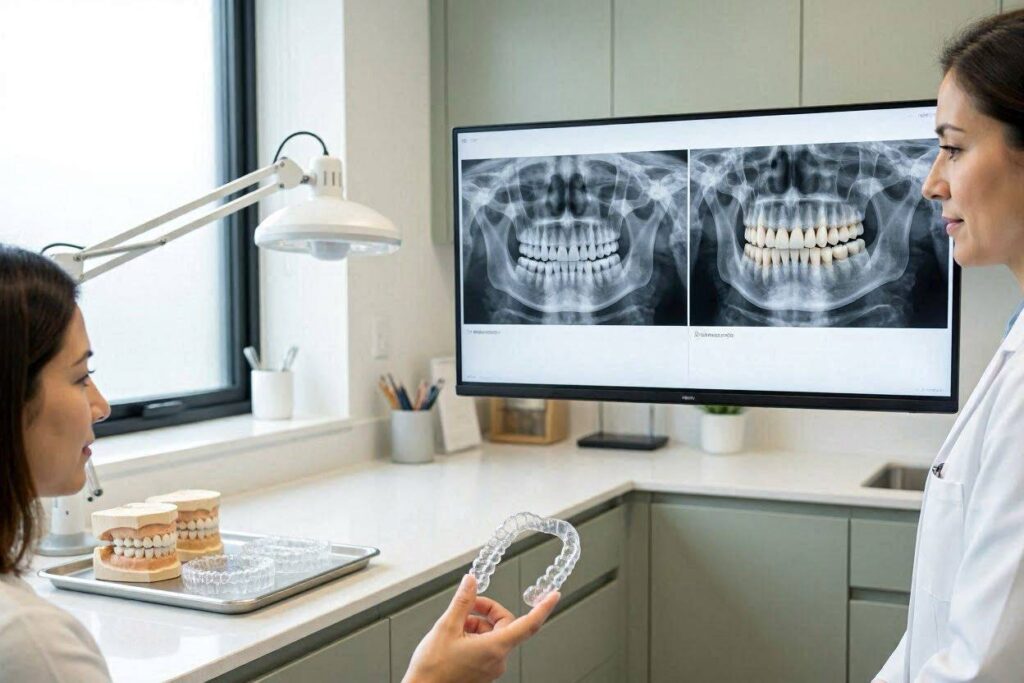
Next, they take digital records. A wand-shaped scanner captures thousands of images of your teeth and gums, stitching them into a precise 3D model. They also take a panoramic X-ray and a cephalometric X-ray (a side view of your skull). The cephalometric X-ray reveals the true skeletal relationship between your upper and lower jaws. This image often determines whether Invisalign alone can help you.
Phase 2: ClinCheck Treatment Planning
The orthodontist sends your scans and X-rays to Invisalign with a detailed prescription. A technician creates an initial digital treatment plan called ClinCheck. Your doctor then reviews, modifies, and approves every single tooth movement.
This step is critical. The software may propose movements that overstress roots or move teeth too quickly. An experienced orthodontist adjusts the plan, adding attachments in strategic locations, setting appropriate force levels, and programming the staging — the sequence in which teeth move. Jaw alignment cases require particularly careful staging.
Phase 3: Aligner Fabrication and Delivery
Once approved, Invisalign manufactures your custom aligner series. You receive several sets at a time. For jaw alignment cases, you will likely receive attachments bonded to your teeth at the first delivery appointment. The doctor will also show you how to wear elastics if your plan includes them.
Phase 4: Active Treatment and Progress Checks
You wear each aligner set for one to two weeks, at least 20 to 22 hours per day. You remove them only to eat, drink anything other than water, and brush and floss. You visit your orthodontist every 8 to 12 weeks for progress checks and to receive the next batch of aligners.
Typical treatment durations for jaw alignment cases:
| Type of Jaw Misalignment | Typical Treatment Time | Notes |
|---|---|---|
| Mild overbite (Class II, dental) | 12–18 months | Primarily tipping and elastics. |
| Moderate overbite (Class II, skeletal/dental mix) | 18–24 months | Requires elastics and possible mandibular advancement. |
| Mild underbite (Class III, dental) | 12–18 months | Often involves IPR and Class III elastics. |
| Moderate underbite (Class III, skeletal) | Often not suitable alone | Surgery likely needed; Invisalign may assist pre/post-surgery. |
| Open bite (anterior) | 15–24 months | Requires intrusion of back teeth or extrusion of front teeth. |
| Crossbite (unilateral or bilateral) | 12–20 months | Often involves elastics and maxillary expansion considerations. |
| Deep bite | 15–20 months | Requires intrusion of anterior teeth. |
Reader Note: These timelines represent averages. Your specific biological response, compliance, and case complexity significantly influence duration.
Phase 5: Refinement and Retention
Rarely does the initial series of aligners finish the job perfectly. Most cases require one or more rounds of “refinements.” You get rescanned, and a new set of aligners addresses remaining minor issues. After treatment, you must wear retainers. For jaw alignment cases, Vivera retainers (made by Invisalign) or bonded permanent retainers help hold teeth in their new positions. You typically wear retainers full-time for several months, then every night indefinitely.
Which Jaw Alignment Problems Can Invisalign Fix? A Detailed Breakdown
Now we arrive at the core of the article. Let us examine each major jaw alignment issue and assess Invisalign’s capability realistically.
Fixing Overbites (Class II Malocclusion) with Invisalign
An overbite refers to both vertical overlap (how much the upper teeth cover the lower teeth) and horizontal overjet (how far the upper teeth stick out). Invisalign addresses these through combined strategies.
For Deep Overbites (Excessive Vertical Overlap):
A deep bite means the upper front teeth cover too much of the lower front teeth when you close your mouth. In severe cases, the lower teeth bite into the roof of the mouth. This damages gum tissue and wears down tooth enamel.
Invisalign fixes deep bites by intruding the front teeth. Attachments placed on the upper and lower front teeth give the aligners grip. The aligner material pushes these teeth slightly upward into the bone. Simultaneously, the back teeth may be extruded slightly. This opens the bite.
For Increased Overjet (Protruding Upper Teeth):
This is the classic “buck teeth” appearance. The upper teeth stick out far ahead of the lowers. Invisalign addresses overjet through distalization (moving the upper teeth backward) or by advancing the lower jaw with elastics and mandibular advancement features. Often the treatment requires creating space — either through interproximal reduction (sanding tiny amounts between teeth) or through sequential distalization, where molars move back one by one, creating room for the front teeth to retract.
Realistic Expectation: Invisalign corrects mild to moderate overbites and overjets very well. If your lower jaw is significantly small (a skeletal Class II), Invisalign can improve your bite and camouflage the issue by tilting teeth, but it will not change your jaw’s actual position. For severe skeletal Class II, jaw surgery moves the lower jaw forward physically. Invisalign can serve as the presurgical and postsurgical orthodontic tool.
Correcting Underbites (Class III Malocclusion) with Invisalign
Underbites present a different challenge. The lower teeth sit in front of the upper teeth.
Dental Underbites: Sometimes the upper incisors simply tip backward, trapping the lower jaw forward. Invisalign can procline the upper incisors, bring them forward of the lower teeth, and use Class III elastics to pull the lower jaw back. This works when the jawbones themselves are in a normal position.
Skeletal Underbites: A true skeletal underbite means the lower jaw grew too long or the upper jaw grew too little. Camouflage with Invisalign may work for borderline cases by tilting the upper teeth forward and the lower teeth backward. However, significant skeletal mismatches require orthognathic surgery. An oral surgeon cuts the jawbones and repositions them. Invisalign can be used for the orthodontic phase around this surgery.
Realistic Expectation: For mild, primarily dental underbites, Invisalign works well. For moderate skeletal Class III cases, seek a surgical opinion. Attempting to camouflage a large skeletal underbite with aligners alone can compromise tooth roots and create an unstable result.
Resolving Crossbites with Invisalign
A crossbite occurs when the upper teeth sit inside the lower teeth instead of outside. This can happen in the front (anterior crossbite) or the back (posterior crossbite). Crossbites may affect one tooth or an entire segment of the mouth.
Posterior Crossbite and Palatal Expansion: A narrow upper jaw often causes a posterior crossbite. The upper arch needs widening. In children and adolescents, orthodontists use a palatal expander, which splits the midpalatal suture (the growth plate in the roof of the mouth) and actually widens the bone.
Can Invisalign expand the palate in adults? This is a common and nuanced question. Once the midpalatal suture fuses in the late teenage years, purely orthopedic expansion (skeletal widening) becomes impossible without a surgically assisted procedure. Invisalign can achieve significant dentoalveolar expansion — it tips the back teeth outward within the bone. This creates more space and resolves the crossbite by changing tooth position, not by widening the jawbone itself. For many adult patients with mild to moderate crossbites, this dentoalveolar expansion is perfectly sufficient.
| Patient Age | Crossbite Type | Invisalign Approach | Skeletal Change? |
|---|---|---|---|
| Child/Adolescent | Posterior, skeletal | May need palatal expander first; Invisalign for tooth alignment after. | Possible with separate expander. |
| Adult | Posterior, mild to moderate | Dentoalveolar expansion with Invisalign; attachments on posterior teeth. | No, tooth tipping only. |
| Adult | Posterior, severe skeletal | Surgically assisted rapid palatal expansion (SARPE) followed by Invisalign. | Yes, via surgery. |
| Any Age | Anterior (single tooth) | Invisalign with elastics or sequential aligner movements. | Dental correction. |
Important Distinction: “Expansion” in Invisalign marketing often means dentoalveolar expansion. Do not confuse this with true skeletal expansion. An honest orthodontist will clarify which type they can achieve for you.
Treating Open Bites with Invisalign
An open bite means the front teeth do not touch when the back teeth are clenched. You could pass a tongue through the gap. Open bites often combine habits like tongue thrusting or thumb sucking with a skeletal growth pattern where the back teeth over-erupt.
Invisalign treats open bites by intruding the back teeth. Attachments on the molars allow the aligners to push these teeth up into the bone. When the molars seat deeper, the jaw rotates slightly forward and upward, allowing the front teeth to close together. This mimics the effect of a bite block or high-pull headgear used with traditional braces.
Simultaneously, the patient may need myofunctional therapy — exercises to retrain the tongue to rest on the palate rather than pushing against the teeth. Without addressing the tongue habit, even a perfectly executed Invisalign case can relapse.
Realistic Expectation: Invisalign shows good success with anterior open bites caused by dental eruption patterns and mild skeletal patterns. Severe skeletal open bites, where the jaws themselves grow apart, usually require surgical impaction of the posterior maxilla.
The Critical Role of Patient Selection: Not Everyone Is a Candidate
If you take away one lesson from this article, let it be this: the orthodontist matters far more than the tool. Invisalign is a tool. In skilled hands, it performs remarkably. In inexperienced hands, it can fail to correct your jaw alignment, or worse, create new problems.
The Orthodontist’s Assessment Process
A thorough examination for jaw alignment includes several critical steps your provider must not skip.
The Clinical Jaw Exam: The doctor should watch you open and close your mouth. They measure your range of motion. They listen to your temporomandibular joints with a stethoscope. They feel the muscles of mastication for tenderness. They check for deviations — does your jaw swing to one side when you open?
The Cephalometric Analysis: This special X-ray provides a side silhouette of your skull. The doctor places tracing paper over it and measures angles between key landmarks. The ANB angle tells them the relationship between the upper and lower jaws. SNA locates the maxilla. SNB locates the mandible. These numbers definitively separate dental from skeletal problems.
The Intraoral Scan and Digital Models: The doctor evaluates your dental arches in three dimensions. They look at the curve of Spee (the natural curve of your teeth from front to back). A deep curve contributes to deep bites. They assess tooth size discrepancies that might prevent proper interdigitation.
Conditions That Make Invisalign Less Suitable
Certain factors reduce success with clear aligners for jaw correction.
Severe Skeletal Discrepancies: As stated repeatedly, large skeletal mismatches require surgery. No aligner can move cheekbones or chin bones.
Poor Compliance: Aligners require constant wear. If you cannot commit to 22 hours per day, your teeth will not move predictably. Jaw alignment cases demand even more compliance because elastics must be worn consistently.
Certain Tooth Shapes: Short, round teeth provide less grip for aligners. Teeth with large restorations or crowns may not bond attachments well.
Significant Vertical Problems: Extreme deep bites or open bites with severe skeletal components remain challenging even with modern Invisalign.
Active Temporomandibular Joint (TMJ) Disorders: While often manageable, unstable or painful jaw joints require careful management before or alongside orthodontic treatment.
The Importance of a Specialist, Not a General Dentist
Many general dentists offer Invisalign. Some take excellent continuing education and manage straightforward cases well. Jaw alignment is not a straightforward case. Orthodontists complete two to three years of full-time specialty training specifically focused on bite correction and facial growth. Their education covers the biological, biomechanical, and clinical aspects of moving teeth and managing jaw relationships.
If your concern involves jaw alignment, seek an orthodontist. Ask about their experience with complex Invisalign cases. Ask to see before-and-after photos of cases similar to yours.
Invisalign for Jaw Alignment: A Detailed Comparison with Traditional Braces
Patients often frame the choice as a battle: Invisalign versus braces. The reality is more nuanced. Each system has advantages and limitations for bite correction.
| Feature | Invisalign with Attachments & Elastics | Traditional Braces |
|---|---|---|
| Aesthetics | Nearly invisible. Major advantage for adults. | Visible metal or ceramic brackets. |
| Comfort | Smooth plastic; no wires to poke cheeks. Some pressure with each new tray. | Brackets can irritate; wires may poke. |
| Hygiene | Removable for eating and brushing. Easier to keep teeth and gums healthy. | Fixed; requires meticulous brushing around brackets and under wires. |
| Diet | No restrictions; aligners removed while eating. | Hard, sticky, and chewy foods must be avoided. |
| Force Mechanics for Jaw Movement | Relies heavily on patient compliance with elastics. Mandibular advancement wings available. | Elastics attached to fixed hooks. Forces are constant and not dependent on patient cooperation. Headgear possible for growth modification. |
| Control of Root Position | Good with attachments, but complex root movements (torque) can be less predictable. | Excellent three-dimensional control of each tooth, including root torque. |
| Vertical Control (Deep/Open Bites) | Good for intrusion of molars and incisors. May be slightly less predictable in severe cases. | Excellent vertical control, especially with bite plates or headgear. |
| Closure of Extraction Spaces | Possible, but requires careful staging. Bodily movement of teeth into extraction sites can be challenging. | Highly predictable method for closing spaces after extractions. |
| Emergency Visits | Rare; usually limited to lost attachments or non-tracking aligners. | More common; broken brackets, poking wires. |
| Duration | Often comparable, sometimes slightly faster for simple cases, but complex jaw movements may take similar time. | Proven track record for even the most complex jaw alignments. |
When Braces Remain the Superior Choice
Braces excel in cases requiring maximum control. If you need significant skeletal expansion in a growing child, a fixed expander attached to bands on molars works better than removable aligners. If you have a severe open bite requiring absolute intrusion of posterior teeth, braces with temporary anchorage devices (TADs — small screws placed in the bone) offer more force options. If you have multiple missing teeth and need complex space closure, braces often manage the biomechanics more predictably.
When Invisalign Offers Unique Advantages
For adult patients with mild to moderate dental bite problems, Invisalign provides a fantastic solution. The ability to remove aligners maintains periodontal health, which becomes increasingly important with age. The comfort and aesthetics drive higher patient satisfaction. The digital planning with ClinCheck allows you to visualize the final result before starting. Furthermore, Invisalign’s mandibular advancement features give orthodontists a tool to address Class II malocclusion in teenagers and adults that was previously only possible with bulky fixed functional appliances.
Adults vs. Teens vs. Children: Jaw Alignment Across Ages
Age changes what is possible. A nine-year-old’s jaws differ dramatically from a forty-year-old’s.
Growing Children (Ages 7–11): The Window of Opportunity
This age represents the golden window for skeletal correction. The upper and lower jaws still grow and can be guided. A child with a narrow upper jaw can undergo palatal expansion, actually widening the bone. A child with a retruded lower jaw may benefit from a functional appliance like a Herbst or a Twin Block. These devices encourage the lower jaw to grow forward.
Does Invisalign fit into this picture? Invisalign First, designed for young children with mixed baby and permanent teeth, exists. It can expand arches dentally, guide erupting teeth, and include mandibular advancement features. However, for significant skeletal issues, traditional appliances still hold advantages. A fixed expander cemented to the teeth works 24/7 and cannot be lost or forgotten in a lunchbox. The forces are continuous and reliable.
Teenagers: The Sweet Spot for Comprehensive Treatment
Teenagers have all or most of their permanent teeth. Their jaws retain some growth potential, though less than younger children. Invisalign Teen, with features like blue compliance indicators (dots that fade when worn) and mandibular advancement wings, is highly effective here.
The mandibular advancement feature in Invisalign Teen represents a major innovation. The aligners have wings that posture the lower jaw forward. This can improve a Class II profile significantly during the teenage growth spurt. It mimics what a fixed functional appliance does but with greater comfort and hygiene. Orthodontists widely consider it a good option for compliant teens with moderate Class II malocclusions.
Adults: Working Within Skeletal Limits
Adult jawbones are dense, fully formed, and immobile. The growth plates fused years ago. Orthodontic treatment in adults focuses on moving teeth within the existing bone. This means camouflage treatment for jaw discrepancies — tilting teeth to compensate for jaw position. It also means a longer treatment time because adult bone remodels more slowly.
For an adult with a borderline skeletal Class II malocclusion and good facial aesthetics, camouflage with Invisalign and elastics can produce a stunning smile and functional bite. For an adult with a significant skeletal Class III underbite, a recessed chin, and functional problems, jaw surgery combined with orthodontics provides the definitive correction. Invisalign can serve as the orthodontic component around that surgery, but the scalpel does the skeletal work.
The Role of Add-On Technologies and Procedures
Pure aligners alone sometimes need assistance. Orthodontists employ several adjunctive tools to make jaw alignment possible.
Interproximal Reduction (IPR)
IPR involves polishing tiny amounts of enamel from between teeth — typically 0.1 to 0.3 millimeters per surface. This creates space to resolve crowding and allows the orthodontist to retract teeth or correct a dental midline. IPR feels painless, like a nail file vibrating between teeth. Enamel removal, when done conservatively, does not harm teeth. IPR is often essential for Invisalign bite correction.
Elastics (Rubber Bands)
Never underestimate the power of a small rubber band. Elastics provide the inter-arch forces that shift jaw relationships. Class II elastics run from upper canine to lower molar, pulling the lower jaw forward. Class III elastics run from lower canine to upper molar, pulling the lower jaw back. Vertical elastics settle the teeth together. Triangle configurations address open bites. Consistent wear is non-negotiable. Sporadic elastic wear leads to treatment failure.
Temporary Anchorage Devices (TADs)
TADs are miniature titanium screws temporarily placed into the jawbone between tooth roots. They provide absolute anchorage — a fixed point that does not move. Orthodontists use TADs with Invisalign to intrude molars in open bite cases or to retract entire arches without unwanted side effects. The aligner hooks onto the TAD via a cutout or an elastic. TAD placement is a minor, local-anesthetic procedure. Combining TADs with Invisalign expands the range of treatable bite problems.
Mandibular Advancement Wings
These are precision-molded protrusions on the aligners near the back teeth. When you close your mouth, the wings on the upper and lower trays engage, sliding the lower jaw forward into a Class I position. The treatment progresses in stages, gradually advancing the jaw further. This works similarly to a fixed Herbst appliance but in a removable form. Compliance drives success; you must keep the aligners in to keep the jaw forward.
Potential Risks and Complications of Jaw Alignment with Invisalign
No medical treatment is without risk. Realistic expectations include understanding what can go wrong.
Posterior Open Bite
A well-documented side effect of Invisalign is the development of a posterior open bite — the back teeth stop touching. This happens because the thickness of the aligner plastic between the molars acts as a bite block, subtly intruding those teeth over months. Often this resolves after treatment when the aligners are removed and the teeth re-erupt. Sometimes it requires refinement aligners with vertical elastics to pull the molars back into contact.
Root Resorption
All orthodontic tooth movement involves a balance of bone removal and bone building. Sometimes the body’s cells also eat away at the tooth roots themselves. Mild, microscopic root blunting is normal and inconsequential. More significant root shortening, though rare, can compromise tooth longevity. Careful treatment planning with appropriate forces and adequate rest periods minimizes this risk.
Temporomandibular Joint (TMJ) Issues
Some patients worry that orthodontic treatment will cause TMJ problems. Research does not support a causal link. In fact, correcting a malocclusion often improves joint function by distributing forces evenly. However, if you have pre-existing joint clicking or pain, inform your orthodontist. Treatment may need modifications. Occasionally, joint symptoms flare during treatment and require management.
Non-Compliance and Treatment Failure
This is the most common reason for poor outcomes. Aligners left in a case, elastics forgotten, appointments missed. The teeth stop tracking. The bite fails to correct. The treatment extends by months or requires conversion to braces. If you know yourself to be forgetful or unmotivated, traditional fixed braces may serve you better.
Relapse
Teeth have memory. They want to return to their original positions. Without diligent retainer wear, even a perfectly corrected jaw alignment can relapse. Nighttime retainer wear is a lifelong commitment.
Finding the Right Provider: Red Flags and Green Flags
Your outcome depends overwhelmingly on the human treating you, not the plastic in your mouth. Choose wisely.
Green Flags: Signs of a Quality Provider
They perform a comprehensive examination. The doctor spends significant time assessing your face, jaw joints, muscles, and teeth. They take a cephalometric X-ray and trace it. They do not just scan your teeth and leave.
They discuss treatment options honestly. An excellent orthodontist presents multiple approaches: no treatment, braces, Invisalign, or surgery if appropriate. They clearly state the limitations of each.
They manage your expectations. They explain what can be achieved and what cannot. They show you cases similar to yours.
They are an orthodontic specialist. An additional two to three years of training after dental school, focused entirely on bite correction and dentofacial orthopedics, makes a difference.
Red Flags: Warning Signals to Heed
They promise a “quick fix.” Jaw alignment takes time. Promises of six-month comprehensive bite correction should raise skepticism.
They do not take X-rays. A cephalometric analysis is non-negotiable for bite evaluation.
They say “Invisalign can do everything braces can.” This statement is false. An ethical provider acknowledges that some cases remain better suited to braces or surgery.
They are a corporate “aligner mill” with minimal doctor involvement. Some large chains use remote monitoring and minimal in-person visits. Complex jaw cases need direct doctor supervision.
They never mention surgery or alternatives. If your jaw discrepancy is significant but surgery is never mentioned, you may be getting a camouflage treatment you were not fully informed about.
Cost of Invisalign for Jaw Alignment: What to Expect
Complexity drives cost. A simple, short Invisalign Express case costs less than a comprehensive jaw alignment case with elastics, attachments, and mandibular advancement.
In the United States, comprehensive Invisalign treatment for jaw alignment typically ranges from $5,000 to $9,000. The price varies by region, provider experience, and case complexity. Severe cases requiring multiple refinements cost more. If your treatment involves surgical orthodontics, the orthodontic fee alone (before surgery) often falls in the $7,000 to $10,000 range.
Factors influencing cost:
- Geographic location (urban specialist costs more than rural).
- Provider specialty and reputation.
- Complexity of the malocclusion and estimated treatment length.
- Inclusion of all refinement aligners.
- Inclusion of retainers (Vivera, in-house, or bonded).
Insurance and Financing: Many dental insurance plans cover orthodontics up to a lifetime maximum, typically $1,000 to $3,000. Check if your plan covers adults, as some limit benefits to patients under 19. Flexible spending accounts (FSAs) and health savings accounts (HSAs) can cover orthodontic payments with pre-tax dollars. Most orthodontic offices offer in-house, interest-free payment plans spreading the cost over the treatment duration.
Can Invisalign Fix Jaw Alignment? A Summary of Scenarios
Let us consolidate the critical information into a quick reference guide.
| If You Have… | And It Is Primarily… | Invisalign Alone? | Alternative/Adjunct |
|---|---|---|---|
| Overbite / Deep Bite | Dental (teeth over-erupted) | Yes, excellent candidate. | None. |
| Overbite / Deep Bite | Skeletal (small lower jaw) | Camouflage possible if mild; no if severe. | Orthognathic surgery. |
| Overjet (Protruding teeth) | Dental (teeth flared) | Yes, excellent candidate. | IPR or extractions for space. |
| Overjet | Skeletal (lower jaw retruded) | Camouflage possible if mild; Invisalign with mandibular advancement for teens. | Jaw surgery for adults with severe discrepancy. |
| Underbite | Dental (incisors tipped) | Yes, good candidate. | Class III elastics. |
| Underbite | Skeletal (large lower jaw) | Rarely, only in borderline cases. | Orthognathic surgery. |
| Crossbite | Dental (tooth position) | Yes, good candidate. | Elastics; IPR. |
| Crossbite | Skeletal (narrow maxilla) | Adult: dentoalveolar expansion only. Child: fixed expander first. | SARPE for adults with severe narrowing. |
| Open Bite | Dental (habit/eruption) | Yes, good candidate with habit management. | Myofunctional therapy. |
| Open Bite | Skeletal (jaw growth pattern) | Limited; may need TADs. | Orthognathic surgery. |
Living with Invisalign During Jaw Correction
Treatment impacts your daily life. Knowing what to expect helps you prepare.
Eating and Drinking
You remove your aligners for all meals and snacks. This means you must brush your teeth before reinserting them. Eating out requires a trip to the restroom. You cannot sip coffee or wine with aligners in; the liquid seeps inside and bathes your teeth in sugar or acid. Water is the only safe beverage with trays in place.
Speech and Socializing
You will likely lisp for the first few days. Your tongue needs time to adapt to the plastic covering your teeth and the attachment bumps. Practice speaking out loud. Read a book to yourself. The lisp fades quickly. Mandibular advancement wings add more bulk in the back, potentially affecting speech slightly more.
Discomfort and Pain
Each new aligner tray exerts pressure. The first day or two of a new tray bring a tight, achy sensation. This means the teeth are moving. Over-the-counter pain relievers manage it. Attachments can rub against cheeks until your soft tissues toughen. Dental wax provides relief. Elastics create a constant, dull tension on your jaw muscles and teeth.
The Relationship with Elastics
Your orthodontist gives you a bag of rubber bands and a strict prescription: wear them 22 hours a day, replace them every meal, specific configuration. The bands feel tight. Your teeth may ache. Your jaw muscles may feel tired. This discomfort is a sign that the elastics are working, remodeling the neuromuscular patterns and dental positions. Changing bands frequently maintains consistent force. Old, stretched-out bands do nothing.
The Psychological Aspect: Looking Different While Getting Better
Correcting jaw alignment changes your face. For many, this is a positive experience — their profile improves, their smile widens, their lips support each other differently. For some, the transitional phase feels awkward.
You may notice your bite shifting week to week. One day your teeth hit in one spot; the next day, another. This temporary instability is normal as teeth move. Your brain’s proprioceptive map of your bite takes time to update. Trust the process, but communicate concerns to your orthodontist.
The Technology Behind the Treatment: Itero Scanners and ClinCheck
Modern Invisalign relies on digital tools that did not exist twenty years ago.
The Itero Element Scanner captures a 3D model of your mouth in minutes. It replaces the messy, uncomfortable goop impressions of the past. The scanner also uses a simulated outcome tool. The provider can show you a rough projection of your final smile on the screen immediately.
ClinCheck Pro is the software where your doctor plans treatment. They see a digital model of your teeth moving through each stage. They can rotate the model in three dimensions. They measure overjet, overbite, and arch width at any stage. The software flags potential collisions between teeth. It also allows precise staging — moving one group of teeth first, then another. Staging is critical for jaw alignment. A poorly staged plan can stall progress or create bite issues.
Frequently Asked Questions
Can Invisalign fix my asymmetrical jaw?
If the asymmetry stems from tooth positions (a dental midline shift or a cant of the teeth), Invisalign can correct it beautifully using elastics and strategic tooth movements. True skeletal asymmetry, where one side of the mandible grew longer than the other, requires surgical correction. Invisalign cannot change the length of a jawbone.
I have clicking and popping in my jaw. Will Invisalign help or make it worse?
This depends on the cause. Some clicking comes from a displaced disc in the temporomandibular joint. Aligning the teeth to a stable bite often reduces muscle tension and allows the joint to function more smoothly, potentially reducing clicking. However, no orthodontic treatment can “cure” a damaged joint structure. Inform your orthodontist about any jaw joint noises or pain so they can factor this into your treatment plan.
How long do I need to wear retainers after jaw alignment with Invisalign?
For life. This may sound daunting, but it means wearing retainers at night while you sleep. Teeth are not set in concrete; they are suspended in a living, dynamic system of bone and fibers. The forces of your lips, tongue, and chewing constantly press on them. Your retainer holds them in place. Skipping retainer wear allows teeth to shift back toward their old positions, undoing years of work.
Is Invisalign cheaper than braces for jaw alignment?
The cost is often comparable. In many practices, comprehensive Invisalign costs the same as comprehensive braces. Some offices charge a lab fee supplement for Invisalign, making it slightly more expensive due to the external manufacturing cost. Discuss the exact fees with your provider. Do not let a few hundred dollars difference drive your decision; choose the tool best suited to your specific problem.
Can I use the cheap mail-order aligners for bite problems?
Absolutely not. Dangers of DIY aligners include tooth loss, bone damage, and permanent bite disruption. These companies do not take X-rays. They do not assess your jaw joints or your bone health. They move teeth based on a simple impression or scan without any consideration for your occlusion. A report by the American Association of Orthodontists documented cases of severe, irreversible damage from such treatments. Correcting jaw alignment requires professional diagnosis, radiographs, and continuous in-person monitoring.
Conclusion
Invisalign can fix many jaw alignment problems, particularly when the root cause lies in tooth position rather than skeletal structure. Modern aligners, combined with attachments, elastics, and mandibular advancement features, effectively treat mild to moderate overbites, underbites, crossbites, and open bites. For severe skeletal discrepancies, surgery remains the gold standard, with Invisalign serving as an excellent adjunct tool. Your outcome depends fundamentally on the skill of your orthodontist and your own commitment to wearing the aligners and elastics as directed. Seek a board-certified orthodontist for a comprehensive evaluation to determine which path leads to a healthy, functional, and confident smile.
Additional Resource
For further information on orthodontic treatment and jaw alignment, the American Association of Orthodontists offers a reliable patient resource library. You can access it here: American Association of Orthodontists – Patient Information
Disclaimer: This article provides general educational information and does not constitute medical or dental advice. Every case is unique. Consult a qualified orthodontist for a thorough examination, diagnosis, and personalized treatment plan. Never delay seeking professional advice based on information read online.