What Is Better: Dental Implant or Bridge?
You stand at a crossroads. One path leads to a dental implant, a titanium post surgically placed into your jaw. The other leads to a fixed bridge, a row of connected crowns that spans the gap. Both will replace your missing tooth. Both will restore your smile and your ability to chew. But which path is truly better?
The answer is not one-size-fits-all. For most single-tooth replacement scenarios, modern dentistry strongly favors the implant. It preserves bone, leaves adjacent teeth untouched, and can last a lifetime. However, bridges still have a valuable place. They are faster, require no surgery, and are often more affordable upfront. The “better” choice depends on your specific anatomy, health, finances, and priorities.
This comprehensive guide will dissect the dental implant versus bridge debate from every angle. We will compare the procedures, longevity, costs, aesthetics, and biological impact. By the end, you will have the clarity to make the right decision for your mouth.
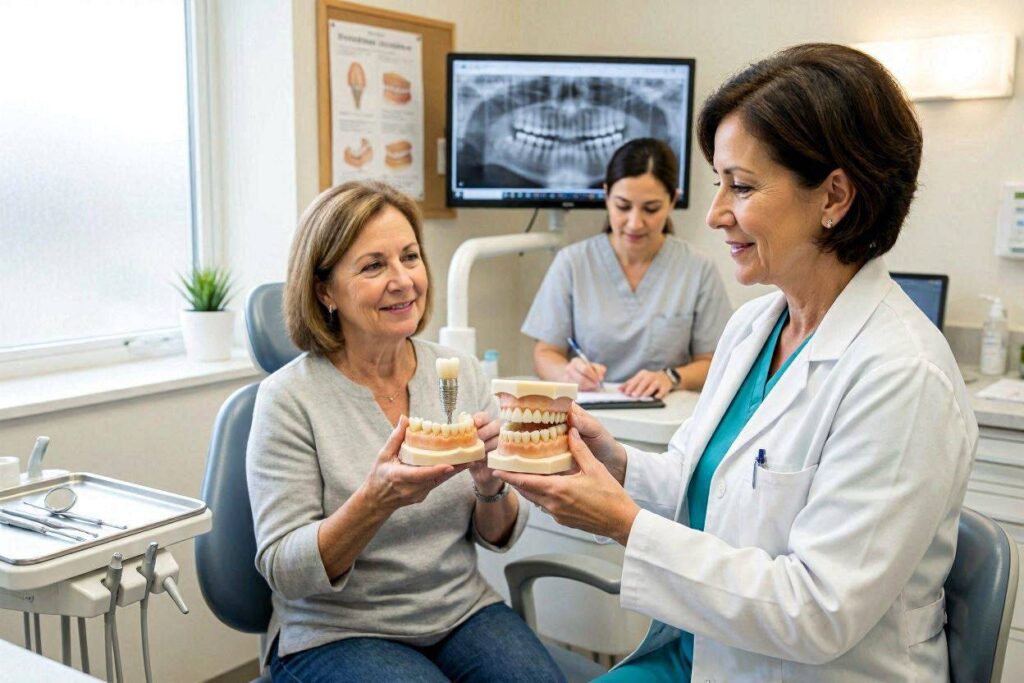
The Fundamental Difference: How They Work
Before we compare, we must understand what each option actually is. They solve the same problem in completely different ways.
The Dental Implant Approach
A dental implant is a surgical tooth root replacement. A titanium or zirconia post is placed into the jawbone where the root of the missing tooth once was. Over several months, the bone fuses to the post (osseointegration). A custom abutment and crown are then attached to this post. The implant is a stand-alone unit. It touches no other teeth. It is the closest thing to growing a new tooth.
The Fixed Bridge Approach
A traditional fixed bridge is a prosthetic tooth suspended between two crowns. The adjacent teeth on either side of the gap are shaved down significantly, removing healthy enamel. These reduced teeth act as abutment pillars. A single piece, consisting of the two crowns plus the false tooth (pontic) in the middle, is cemented over the prepared teeth. The bridge is not a separate entity; it splints the healthy teeth together.
This fundamental difference drives every other comparison. An implant is independent. A bridge depends on the neighboring teeth.
Comparison Table: Implant vs. Bridge at a Glance
| Feature | Dental Implant | Traditional Fixed Bridge |
|---|---|---|
| Impact on Adjacent Teeth | None. Teeth remain untouched. | Significant. Enamel is permanently removed from both adjacent teeth. |
| Bone Preservation | Yes. Stimulates bone, prevents resorption. | No. Bone under the missing tooth continues to resorb. |
| Longevity | 25+ years to lifetime with care. | 10 to 15 years average. |
| Surgical Requirement | Yes. Requires bone surgery. | No surgery. Requires tooth preparation. |
| Treatment Time | 4 to 8 months from start to finish. | 2 to 3 weeks. |
| Upfront Cost | Higher initial investment. | Lower initial investment. |
| Long-Term Cost | Often lower, as it rarely needs replacement. | Often higher, due to replacement and decay under crowns. |
| Aesthetics | Excellent. Emerges from gum like a natural tooth. | Good. Can have a metal margin at the gumline or look opaque. |
| Hygiene | Floss like a single tooth. Easy access. | Must thread floss under the false tooth. Difficult. |
| Failure Mode | Peri-implantitis or mechanical issues. | Decay on abutment teeth, requiring root canals or extraction. |
Let us now explore the most important categories in greater depth.
Biological Cost: What Each Option Does to Your Mouth
This is the most critical consideration and the one often overlooked in the rush to fill a gap.
The Biological Price of a Bridge
To make a bridge, the dentist must prepare two perfectly healthy teeth. This involves removing a millimeter or more of enamel circumferentially, carving the teeth down to small pegs. You are sacrificing healthy tooth structure permanently.
What happens next? These crowned abutment teeth become more vulnerable. The margin where the crown meets the tooth is a plaque trap. Over time, decay can sneak under the crown. Because the teeth are now splinted together, flossing becomes a threading operation under the pontic. Many patients struggle with this, and the abutment teeth develop decay and gum disease.
If one abutment tooth develops a problem, the entire three-unit bridge is often compromised. A cavity that reaches the nerve means the tooth needs a root canal, which requires drilling through the perfectly good crown. If an abutment tooth fails and must be extracted, the entire bridge is lost. You now have a three-tooth gap instead of one.
The Biological Preservation of an Implant
An implant does not touch adjacent teeth. They remain pristine, untouched, and separately cleanable. Moreover, the implant transmits chewing forces into the bone, stimulating the bone to maintain its density. This prevents the sunken, caved-in appearance that develops over time under a bridge pontic. You preserve not only the neighbor teeth but also the entire alveolar ridge.
“When you choose an implant, you are investing in the preservation of your entire mouth. A bridge solves the immediate space problem but borrows against the future health of the adjacent teeth.”
Longevity and Long-Term Value: The 20-Year Perspective
Patients often fixate on the initial price tag. Let us look at the 20-year cost.
A well-made traditional bridge has an average lifespan of 10 to 15 years. Many fail sooner. The reason is almost always biological: decay on the abutment teeth. The bridge itself does not fail; the tooth underneath it does. When this happens, the bridge must be cut off, the tooth treated (or extracted), and a new, larger bridge fabricated. Each replacement cycle adds cost and consumes more tooth structure.
A dental implant, specifically the implant fixture, can last a lifetime. The crown on top may eventually need replacement due to wear or chipping, just like a crown on a natural tooth, after 15 to 20 years. But the implant post in the bone remains. The long-term maintenance cost is lower.
A Hypothetical 20-Year Cost Projection:
- Bridge Path: Initial bridge ($3,500). Year 12: one abutment tooth fails, requires extraction and implant, or a new bridge spanning three teeth now becomes a four-unit bridge ($5,000). Total 20-year cost: $8,500 plus the loss of a tooth.
- Implant Path: Implant and crown ($4,500). Year 18: crown replacement due to porcelain wear ($1,500). Total 20-year cost: $6,000. Adjacent teeth remain intact.
In the long run, the implant is often the more economical choice despite the higher upfront fee.
Aesthetics and Feel: The Natural Look
A single implant crown, particularly one that is screw-retained or custom-cemented with a zirconia abutment, can be indistinguishable from a natural tooth. It emerges from the gum with a natural contour, and the gums can be sculpted to look perfectly natural. There is no metal collar showing at the gumline if designed correctly.
A traditional bridge has some aesthetic limitations. The pontic (false tooth) rests on the gum ridge. Over time, as the underlying bone resorbs, a gap can develop under the pontic. Food collects here. The bridge can appear to hang, or the false tooth can look unnaturally long. If the bridge has a metal substructure, a dark gray line may eventually become visible at the gumline as gums recede slightly with age.
The Surgical Factor: Fear of the Knife
For some patients, the deciding factor is surgery. A bridge requires no surgery. You sit in the chair, the teeth are prepared, and a temporary bridge is glued in. Two weeks later, the permanent bridge is cemented. It is fast, familiar, and non-invasive in a surgical sense.
An implant requires a surgical procedure. The dentist makes an incision, drills into the bone, and places the implant. Stitches are placed. There is a recovery period. For a patient with severe dental anxiety, a bleeding disorder, a compromised immune system, or a condition that makes surgery risky, this may be a genuine barrier. However, modern implant surgery is remarkably gentle, with minimal post-operative pain for most patients. Sedation dentistry can also manage the anxiety.
When a Bridge is Actually the Better Choice
Dental implants are not always the winner. There are specific scenarios where a bridge is the clearly superior option.
1. Adjacent Teeth Need Crowns Anyway
If the teeth on either side of the gap already have large old fillings, cracks, or need crowns for their own reasons, then a bridge makes elegant sense. You are not sacrificing virgin teeth; you are restoring already-compromised teeth and filling the gap simultaneously. This is the classic ideal indication for a bridge.
2. Insufficient Bone Without Grafting Option
If the bone ridge is severely atrophied and the patient is unwilling or medically unable to undergo a bone graft, an implant may be impossible. A bridge can be a reliable alternative.
3. Medical Contraindications to Surgery
Patients on high-dose intravenous bisphosphonates, with severe uncontrolled diabetes, or with certain bleeding disorders may not be candidates for elective implant surgery. A bridge provides a fixed solution without surgical risk.
4. Time Constraints
If you need a tooth replaced immediately for a wedding, a major event, or personal preference, a bridge can be completed in two or three weeks. An implant takes months.
5. Younger Patients with Still-Growing Jaws
As discussed in the candidacy article, placing an implant before the jaw stops growing (around 18-20) can lead to it submerging as adjacent teeth continue to erupt. A resin-bonded bridge (Maryland bridge) can be a conservative temporary solution.
The Adjacent Teeth: The Deciding Factor for Most Dentists
If you walk into a modern dental office with a single missing tooth and two completely healthy, virgin teeth on either side, almost every dentist will strongly recommend an implant. The ethical principle of “do no harm” directs them to preserve healthy tooth structure. Grinding down two perfect teeth to replace one missing tooth is increasingly viewed as an outdated approach.
However, if those adjacent teeth are heavily filled, structurally compromised, or endodontically treated, the calculus changes. Now, crowning them provides a protective benefit. A bridge becomes a restorative solution for three teeth, not a sacrifice of two healthy ones.
The Decision Matrix: A Tool for You
Use this matrix to weigh your own situation.
| Your Situation | The Leaning Recommendation |
|---|---|
| Single missing tooth, adjacent teeth are healthy. | Strongly consider implant. |
| Adjacent teeth have large fillings or need crowns. | Bridge may be more practical. |
| You have a strong aversion to surgery. | Bridge or explore sedation for implant. |
| You want the longest-lasting solution. | Implant. |
| You have inadequate bone and refuse grafting. | Bridge. |
| You have a high smile line and want peak esthetics. | Implant, for superior gum contour. |
| You are a younger patient (under 18-20). | Temporary bridge until growth is complete. |
| Cost is the primary constraint right now. | Bridge is lower upfront; discuss payment plans for implants. |
Conclusion
For the replacement of a single missing tooth with healthy neighboring teeth, the dental implant is the superior long-term solution. It preserves bone, protects adjacent teeth, and offers a lifetime of service with proper care. However, the traditional fixed bridge remains a valid, excellent option when the adjacent teeth are already compromised, when surgery is contraindicated, or when patient preference and anatomy favor it. The best choice is the one that aligns with your biological reality, your health status, and your long-term goals for your oral health.
FAQ
1. Can a bridge be replaced with an implant later?
Yes. If a bridge fails, the abutment teeth can often be restored with individual crowns or may need extraction. At that point, the missing teeth can be replaced with individual implants. It is a common progression in restorative dentistry.
2. Is it painful to have a tooth prepared for a bridge?
No. The teeth are prepared under local anesthesia, so you feel no pain during the procedure. There may be some mild post-operative sensitivity as the teeth adjust, but this is usually temporary.
3. How do I clean under a dental bridge?
You must use a floss threader or super floss to pass floss under the false tooth (pontic). You use a shoeshine motion to scrub the underside of the pontic. A water flosser with a special tip is also an excellent adjunct to keep the area clean.
4. Which option is less likely to fail in the first five years?
Dental implants have a survival rate of over 95% at five years. Traditional bridges also have a high five-year survival rate, around 90-95%, but the failure is usually due to biological issues (decay) on the supporting teeth, not the bridge itself breaking. Implant failures are usually early and due to failure to integrate.
Additional Resource
For a deeper comparison of tooth replacement options, visit the American College of Prosthodontists: https://www.gotoapro.org/