Do Teeth Move After Braces Are Off?
The day the braces come off feels like liberation. You run your tongue over smooth, naked enamel for the first time in years. The mirror reflects a perfect, aligned smile. You take a hundred selfies. You eat an apple without cutting it into slices. Life is beautiful. Then, a few months later, you notice something horrifying: a tiny gap has opened between your front teeth. Or that one lower incisor that used to be crowded is starting to twist again. The panic sets in. Was the treatment a failure? Did you waste years of pain and thousands of dollars?
The short, biologically honest answer to “Do teeth move after braces are off?” is yes. They will move. They are programmed to move. Every orthodontist on the planet knows this, and every patient who has been warned about retainers and then “forgot” to wear them has learned it the hard way. Teeth are not set in concrete; they are suspended in a living, dynamic tissue that retains a powerful molecular memory of their original position. This article is not just a warning about retainer compliance. It is a deep exploration of the periodontal ligament’s elastic recoil, the role of the gingival fibers, the relentless pressure of the tongue and lips, and the lifelong physiological drift that means your orthodontic result is not a destination—it is a maintenance subscription you will pay, in retainer wear, for the rest of your life.
The Periodontal Ligament: Nature’s Rubber Band
To understand why teeth move after braces, you must understand the microscopic architecture that holds them in place. The tooth root does not touch the bone directly. It is suspended by a sling of collagen fibers called the periodontal ligament (PDL). This ligament is roughly 0.2 to 0.4 millimeters wide, but it is the most biologically active tissue in the tooth-supporting complex. It contains fibroblasts, blood vessels, and nerve endings, all swimming in a gel-like ground substance.
When braces apply force, the PDL is compressed on one side and stretched on the other. Osteoclasts eat bone on the pressure side; osteoblasts lay new bone on the tension side. This is how teeth move. But here is the critical insight: the PDL fibers themselves are not permanently remodeled by the brief orthodontic treatment window. They are stretched, wrenched, and twisted into a new position, but they retain a structural “memory” of their original, pre-treatment conformation. The collagenous network has been deformed under load, and when the braces—the active force—are removed, those elastic fibers immediately begin to pull the tooth back toward its starting coordinates. Think of it as a rubber band that has been held in a stretched position for two years. The moment you release it, it snaps back. The PDL does not snap instantly; it creeps, but the vector of that creep is relentless and points toward the original malocclusion.
The Supracrestal Gingival Fibers: The Unseen Culprits
Even if you could perfectly remodel the PDL, another anatomical villain awaits: the gingival connective tissue fibers that run above the bone crest, encircling the tooth neck. These fibers, particularly the transseptal fibers that connect adjacent teeth across the interdental space, are among the most stubborn collagen networks in the body. They are not remodeled by orthodontic tooth movement because they are not compressed or stretched in the same way the PDL is. They are simply dragged along, rotated, and deformed.
When braces come off, these transseptal fibers act like tiny springs. If a tooth was rotated during treatment—a lower incisor twisted 30 degrees into alignment—the transseptal fibers that encircled that tooth in its twisted state are now under torsional stress. Over weeks and months, they relax back toward their original untwisted configuration, rotating the tooth right back to where it started. This is why severely rotated teeth, especially lower incisors, are notorious relapsers. The standard surgical countermeasure is a fiberotomy—a minor procedure where the dentist or periodontist severs these transseptal fibers with a scalpel blade inserted into the gum sulcus after braces are removed. This simple, underutilized procedure dramatically reduces rotational relapse because it cuts the rubber bands that memory lives in. Without a fiberotomy, even a glued retainer is fighting a biological recoil force 24 hours a day.
The Tongue-Lip-Cheek Equilibrium: The Muscular Envelope
Orthodontic alignment is not just a battle against ligament fibers. It is a battle against the soft tissue pressures of the oral cavity. The teeth sit in a neutral zone—a corridor of balance between the inward pressure of the lips and cheeks and the outward pressure of the tongue. A perfect orthodontic result places the teeth precisely in this balance point.
But the neuromuscular system is not passive. A patient with a tongue thrust habit (swallowing by pushing the tongue forward against the incisors) generates constant, repetitive outward force that will splay the upper front teeth over time, even if the braces achieved a perfect class I occlusion. A patient with a strong lower lip habit (a mentalis muscle that fires excessively during swallowing) will push the lower incisors backward. The orthodontic finish line was a snapshot of alignment against a dynamic muscular background that never stopped pushing. The teeth move after braces because the muscles never stopped working, and their vector of force was incompatible with the aligned position. Myofunctional therapy, which retrains the tongue and lip posture, is the missing piece in many relapse cases. You cannot straighten teeth against a dyskinetic tongue and expect them to stay straight without changing the tongue’s behavior.
Growth and Aging: The Lifelong Drift
Even if you wear your retainers religiously, even if your PDL is perfectly remodeled, your teeth will still move over your lifetime. This is a hard biological truth that orthodontic marketing often glosses over. The human face changes with age. The mandible continues to grow, often slightly forward and downward, throughout life—a phenomenon known as late mandibular growth. The dental arches naturally narrow over time, particularly the lower arch, as the inter-canine width decreases with age.
This means the teeth are sitting on a shifting bony foundation. The arch form that was perfect at age 16 is not the same arch form at age 45. The teeth drift mesially (toward the midline) over decades, a process called “physiological mesial drift.” The lower incisors, in particular, are squeezed by the narrowing arch and the forward pressure of the mesial drift, and they are the first to show crowding. This is not orthodontic failure; it is biological aging. The question is not whether teeth move after braces, but how much movement is acceptable over a lifetime, and what intervention will keep it within a cosmetic tolerance. Retainers are not just preventing orthodontic relapse; they are fighting the normal aging process of the human dentition. That is a permanent job.
The Critical First Year: The “Hot” Phase of Relapse
The highest risk period for catastrophic relapse is the first 6 to 12 months after debonding. During this window, the PDL has not yet fully reorganized into a mature, stable network. The bone around the newly positioned roots is still immature woven bone, which will eventually remodel into dense lamellar bone. The gingival fibers are still screaming with torsional stress. The patient is fatigued from years of active treatment and may be resentful of yet another appliance.
This is the period where the orthodontist typically prescribes full-time retainer wear—often 22 hours a day, removing only for eating and brushing. The purpose is to splint the teeth during the biological consolidation phase, allowing the bone to mineralize and the PDL to reorganize under neutral load. If a patient skips this critical year, the teeth can shift visibly within weeks. A gap that took 18 months to close can re-open in a month. The speed of relapse in this early window is shocking to patients who thought the hard work was done. The retention phase is not an afterthought. It is the final, passive phase of active treatment, and it demands the same discipline as wearing elastic bands.
Retainer Types and Their Failure Modes
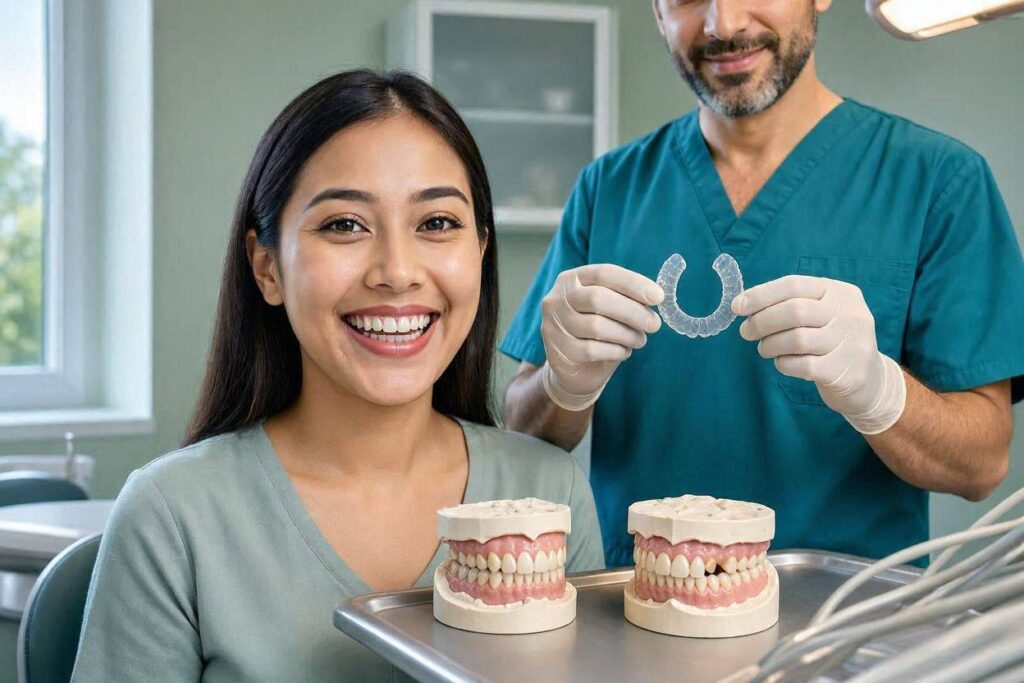
Understanding why teeth move after braces requires understanding the hardware designed to stop them. The two primary retainer types are removable appliances (Hawley retainers with acrylic and wire, or clear vacuum-formed trays like Vivera or Essix) and fixed lingual retainers (a thin wire bonded to the back of the anterior teeth).
The removable retainer is only effective if it is in the mouth. The most common failure mode is simply not wearing it. The patient starts skipping nights, then entire weeks, then the retainer doesn’t fit because the teeth have already shifted. The second failure mode is not replacing a lost or broken retainer immediately. A patient loses a clear tray on vacation, delays ordering a replacement for three weeks, and the teeth shift. The retainer, when finally received, is now an active tooth-moving device, not a passive retention device.
The fixed lingual retainer has a different failure profile. It is bonded with composite resin and is therefore “invisible” and continuous. However, it can debond from one tooth—often the canine—without the patient noticing. The wire is still intact, but it is no longer anchored to that specific tooth, which then drifts out of alignment while the wire holds the rest. This “silent debond” is a devastating relapse mechanism because the patient believes they are protected. Regular professional checks of the fixed retainer bond integrity are essential. A bonded retainer also makes flossing difficult, and plaque accumulation around the wire can cause interproximal decay and gingival inflammation, compromising the periodontal health of the aligned teeth. It is a trade-off.
The “No Retainer, No Problem” Delusion
A pervasive myth in orthodontic patient forums is that after a certain number of years of retainer wear, the teeth “settle” and the retainer can be discarded. This is a dangerous half-truth. Some minor settling of the occlusion—the posterior teeth finding a more comfortable intercuspal position—is normal and often desirable after braces. This settling is not relapse; it is the neuromuscular system optimizing the bite.
But the anterior alignment—the cosmetic smile that was the point of the whole endeavor—does not “settle” into stability. It degrades without retention. The myth persists because a small percentage of patients do discard their retainers after a decade and seem to have stable teeth. These lucky individuals likely had a very mild initial malocclusion, a perfectly balanced soft tissue envelope, and a favorable growth pattern. They are the exception, not the rule. Basing your retention strategy on the luckiest 5% of patients is a gamble with your smile. The standard of care among orthodontists has shifted toward recommending lifetime retention—some form of retainer wear indefinitely, even if it is reduced to a few nights per week after the first several years. The PDL never stops trying to move teeth back. The retainer is not a cure; it is a splint.
Comparative Table: Relapse Risk Factors
To help patients understand their personal relapse risk profile, the following table maps common pre-treatment conditions to their post-treatment stability prognosis.
| Pre-Treatment Condition | Relapse Risk | Stability Strategy |
|---|---|---|
| Mild Crowding (Class I) | Low to Moderate. | Removable retainer at night; taper slowly. |
| Severe Crowding (Class I) | High. | Fixed lingual retainer + removable at night. |
| Rotated Incisors (>30°) | Very High. | Fiberotomy + fixed lingual retainer. |
| Midline Diastema (Gap) | Very High. | Fiberotomy + fixed lingual retainer; frenectomy if tongue-tie. |
| Deep Overbite (Class II) | High (bite tends to deepen). | Hawley retainer with anterior bite plane to control vertical relapse. |
| Open Bite | Very High (tongue posture). | Myofunctional therapy + fixed retainers + careful monitoring. |
| Expansion of Arches (adult) | High (facial musculature resists). | Permanent fixed retention; accept some relapse as inevitable. |
The Frenum Factor: The Lip Pull
A specific relapse mechanism that deserves focused attention is the maxillary labial frenum—that fleshy band of tissue connecting the upper lip to the gum between the central incisors. In some patients, this frenum is thick, fibrous, and extends into the interdental papilla. When braces close a gap between the front teeth, this frenum is compressed. The fibrous tissue resists the closure and exerts a constant, vector-specific pull that can re-open the gap within months of braces removal.
A simple “blanch test” performed by the orthodontist—pulling the upper lip outward and watching for blanching of the incisive papilla—can diagnose a high-risk frenum. If the frenum is the primary driver of the original gap, a frenectomy (surgical removal or revision of the frenum) may be indicated, typically performed after the gap is closed but before the braces are removed, or immediately after debonding. Without addressing the frenum, even a bonded retainer can be overwhelmed. The fiberotic pull of a thick frenum is stronger than a thin wire.
The Impact of Wisdom Teeth: Fact vs. Fiction
For decades, patients were told that erupting wisdom teeth push the anterior teeth forward, causing crowding. This theory was used to justify prophylactic third molar extraction. The modern orthodontic consensus has largely debunked this. Multiple longitudinal studies tracking patients with and without wisdom teeth have found that late mandibular incisor crowding occurs regardless of third molar presence. The forces generated by erupting wisdom teeth are minimal, and the anterior crowding is better explained by natural mesial drift and arch narrowing.
Extracting wisdom teeth to prevent orthodontic relapse is not supported by evidence. The crowding will happen with or without the wisdom teeth. This does not mean wisdom teeth are irrelevant—they can cause other problems like pericoronitis and distal caries—but they are not the driving force behind anterior relapse. The patient who sees their lower teeth crowding in their 30s should blame biology, not their wisdom teeth.
The “Retainer for Life” Reality
The most honest answer an orthodontist can give to the question “How long do I need to wear my retainer?” is: for as long as you want your teeth to stay straight. There is no finish line. There is a taper. After the first year of full-time wear, patients typically transition to nighttime wear—every night while sleeping. After several years of stable nighttime wear, some patients may be able to drop to 3-4 nights per week. But if the teeth start shifting at that reduced frequency, the patient must immediately return to a higher frequency.
Think of retainers like contact lenses or eyeglasses. You do not wear glasses for two years to “fix” your vision and then throw them away. You wear them continuously, or your vision blurs. Teeth are not different. The genetic and environmental forces that caused the malocclusion are still present. The retainer holds the result. It is a maintenance therapy. The psychological shift from “I am done with braces” to “I am now in the retainer phase, which lasts decades” is the key to long-term orthodontic satisfaction.
Important Note: The “Lost Retainer” Protocol
If you lose or break your removable retainer, do not wait for your next six-month checkup. Call the orthodontist immediately. Some offices can pull your digital scan from the cloud and mill a new clear retainer within 48 hours. The window before teeth begin shifting is measured in days to weeks, not months. Paying $200-$400 for a replacement retainer immediately is far cheaper than needing re-treatment for relapse. If your original orthodontist has retired or the records are gone, a new scan and retainer can be made from your current tooth positions, freezing the existing alignment before it degrades further.
Conclusion
Teeth move relentlessly after braces are removed due to the elastic memory of the periodontal ligament, the torsional recoil of unremodeled gingival fibers, the constant pressure of the tongue and lips, and the lifelong biological drift of the dental arches. Retention is not an optional afterthought but a permanent, indefinite maintenance therapy requiring either nightly removable retainer wear or a fixed bonded wire combined with routine professional surveillance. Patients who understand that orthodontic treatment is a two-phase process—active movement followed by lifelong passive retention—are the ones who keep their beautiful smiles into old age.
FAQ
Q: If I wear my retainer perfectly for 10 years, can I stop wearing it?
A: You can try reducing the frequency to a few nights a week, but you cannot stop completely and assume the teeth will remain perfectly straight. The biological forces that caused your original malocclusion are still active, and age-related arch narrowing continues throughout life. Monitor your teeth closely. If the retainer feels tight after a few nights off, your teeth have already shifted microscopically, and you need to increase wear frequency. The retainer is a lifelong appliance for most patients.
Q: Can a retainer push teeth back if they have already shifted slightly?
A: Yes, if the shift is very mild and recent, forcing the retainer to fit will orthodontically move the teeth back into alignment. This will be uncomfortable, and the retainer will feel extremely tight. However, if the shift is more than 0.5 millimeters or has involved significant rotation, forcing the retainer can cause root resorption, pulpal damage, or simply not work. You need a professional evaluation. The orthodontist may take a new scan and fabricate an active clear aligner to re-align the teeth, which is a short re-treatment, not a simple retention fix.
Q: Do permanent bonded retainers last forever?
A: No. The composite bonding that anchors the wire to the teeth can chip, debond, or fail over time. The wire itself can fatigue and fracture, especially if the patient chews hard foods. Bonded retainers typically last 5-10 years before requiring repair or replacement. They are “permanent” only in the sense that they are fixed in place, not that they never need maintenance. Regular checkups to verify bond integrity are essential, and a removable backup retainer should also be worn at night in case the fixed retainer fails silently between visits.
Additional Resource
For detailed, research-based patient education on retention protocols and the management of orthodontic relapse, visit the British Orthodontic Society’s public information library at www.bos.org.uk.