Are Dental Exams Necessary For Covid-19?
The image of a dentist swabbing a patient’s throat for a respiratory virus would have seemed absurd in 2019. Dentistry lived in its own silo—teeth and gums, cleanings and crowns, a universe physically adjacent to the airway but professionally walled off from systemic infectious disease. Then a novel coronavirus ripped through the globe, and the dental operatory, with its aerosol-generating drills, high-volume suction, and intimate access to the oral cavity, suddenly became one of the most dangerous places in healthcare. But it also became one of the most diagnostically valuable.
The question “Are dental exams necessary for Covid-19?” has a dual meaning, and both demand answers. First: is a routine dental checkup medically necessary during an active pandemic, given the risk of viral transmission in the dental setting? Second: can a dentist, through examination of the oral cavity, detect signs of Covid-19 infection and contribute meaningfully to the diagnostic pathway? The answer to both is a qualified, nuanced yes. This article explores the oral manifestations of SARS-CoV-2 infection, the aerosol risk calculus that transformed infection control protocols, the surprising role of saliva as a diagnostic fluid, and the long-term consequences of skipping dental exams during public health emergencies.
The Mouth as a Viral Factory: ACE2 Receptors and Saliva
To understand why the dental exam intersects with Covid-19, we must begin with the molecular biology of the oral cavity. The SARS-CoV-2 virus gains entry to human cells via the ACE2 receptor—a protein that studs the surface of cells in the lungs, nasal passages, and critically, the oral mucosa. The tongue, the gingival sulcus, and the salivary glands are richly supplied with ACE2 receptors. The minor salivary glands of the lower lip, in particular, express ACE2 at high levels, making them a potential early replication site for the virus.
This biology means the mouth is not just a passive conduit for virus swallowed from the nasopharynx; it is an active site of infection and viral shedding. A 2020 study published in Nature Medicine demonstrated that SARS-CoV-2 infects salivary gland cells, and the saliva of infected patients contains replication-competent virus. The dental exam, which involves direct visualization and manipulation of the very tissues that harbor the virus, sits at the intersection of diagnostic opportunity and transmission risk. The dentist sees the oral mucosa in high magnification and bright light—a view no other medical professional routinely obtains. This vantage point became unexpectedly relevant when patients began presenting with oral lesions, taste disturbances, and gingival inflammation as early or sole signs of Covid-19 infection.
Oral Manifestations of Covid-19: What the Dentist Sees
During the acute phase of the pandemic, case reports and observational studies began cataloging a constellation of oral findings associated with Covid-19. These are not incidental; they are direct manifestations of viral infection, secondary opportunistic infections, or immune-mediated responses triggered by the cytokine storm. The dentist performing a routine exam might encounter:
- Dysgeusia and Ageusia: The sudden loss or distortion of taste is a hallmark neurological symptom of Covid-19, often preceding respiratory symptoms by days. A patient presenting with “my food tastes like cardboard” and no other explanation may be an undiagnosed Covid-19 case.
- Oral Ulcerations: Painful aphthous-like ulcers, sometimes large and necrotic, appearing on the tongue, palate, or buccal mucosa. These are likely multifactorial—direct viral cytopathic effect, immune dysregulation, or secondary herpesvirus reactivation.
- Petechiae and Purpura: Pinpoint red spots or larger bruised patches on the hard and soft palate, reflecting microvascular inflammation and thrombotic microangiopathy. This is a visual correlate of the endothelial damage that drives severe Covid-19 pathology elsewhere in the body.
- Candidiasis: Opportunistic oral thrush, particularly in patients who have received corticosteroids as part of Covid-19 treatment or who have prolonged illness with compromised immunity.
- “Covid Tongue”: A transient lingual papillitis, with the tongue appearing swollen, red, or exhibiting a geographic pattern with patchy depapillation. This finding gained significant public attention through the ZOE Covid Symptom Study app, where patients uploaded images of their tongues.
None of these findings is pathognomonic for Covid-19. An oral ulcer could be trauma, a herpes outbreak, or an autoimmune lesion. But the constellation of oral symptoms, particularly in the context of taste loss and no prior history of recurrent oral disease, should prompt the dentist to recommend a Covid-19 test and defer elective care. The dental exam, in this sense, functions as a screening gateway, identifying patients who should be in medical isolation, not a dental waiting room.
The Aerosol Problem: Why Routine Exams Became Controversial
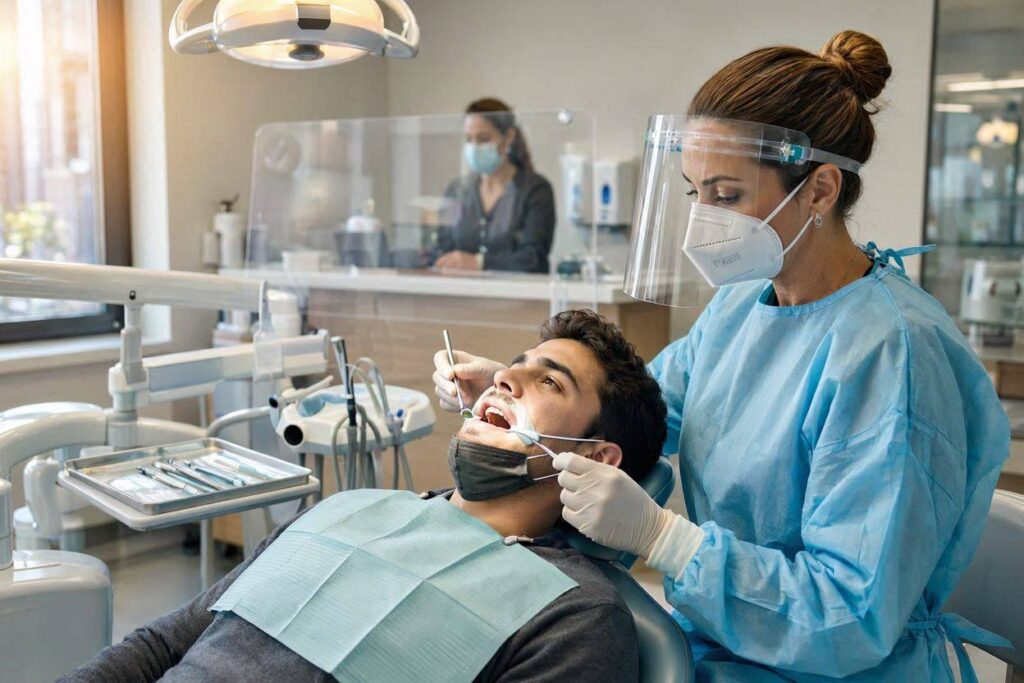
The necessity of dental exams during Covid-19 must be weighed against the transmission risk inherent in the dental environment. Dentistry is an aerosol-generating procedure (AGP) specialty. High-speed handpieces, ultrasonic scalers, and air-water syringes create a fine mist of saliva, blood, and biofilm that hangs in the air for hours. If the patient is presymptomatic or asymptomatic with active oral viral replication, that aerosol is infectious.
Early in the pandemic, the World Health Organization and national dental associations recommended postponing all routine, non-urgent dental care. This was not because cleanings and exams are medically worthless—they are essential for prevention—but because the risk of creating a super-spreader event in a dental office outweighed the benefit of a six-month recall for a patient with a healthy mouth. The calculus shifted over time. Enhanced infection control protocols—N95 respirators, pre-procedural mouth rinses with oxidative agents like 1% hydrogen peroxide or 0.2% povidone-iodine to reduce salivary viral load, high-volume evacuation systems, air filtration with HEPA purifiers, and extended operatory turnover time—reduced the risk to an acceptable level. The dental exam became “necessary” again, but under a new safety architecture that remains largely in place.
The Triage Role: Screening for Systemic Disease at the Dental Chair
Beyond directly spotting oral signs of Covid-19, the dental exam plays a broader screening role during a pandemic. Dentists are often the only healthcare providers a patient sees annually. A significant portion of the population does not visit a primary care physician regularly but does visit a dentist. The dental recall appointment is the de facto health screening for millions of adults.
During the pandemic, dental screening questionnaires were expanded to include temperature checks, pulse oximetry readings (in some practices), and detailed inquiries about cough, shortness of breath, and loss of taste or smell. Patients who had been avoiding medical settings for fear of exposure sometimes revealed concerning systemic symptoms during these dental screenings—a persistent dry cough, unexplained fatigue, a subtle change in taste—that they had not connected to Covid-19. The dental team became an informal public health surveillance network, redirecting symptomatic patients to medical testing. The necessity of the dental exam, in this context, extends beyond the teeth. It serves as a population-level disease surveillance touchpoint, catching patients who have otherwise slipped through the cracks of a strained medical system.
Saliva Diagnostics: The Dental Office as a Testing Site
A fascinating convergence occurred during the pandemic: the dental operatory, with its pre-existing expertise in collecting and managing saliva, became a logical site for Covid-19 testing. Saliva-based PCR and antigen tests emerged as non-invasive, patient-acceptable alternatives to deep nasopharyngeal swabs. The dentist, who suctions saliva by the liter every day, was suddenly positioned to administer diagnostic tests.
Some dental practices, particularly those affiliated with large DSOs or academic institutions, integrated on-site salivary Covid-19 testing into their pre-appointment protocols. Patients would self-collect a saliva sample in the parking lot, the sample would be processed in a rapid point-of-care device, and the result would clear the patient for aerosol-generating care or flag them for medical referral. In this model, the “dental exam” is not necessary for Covid-19 diagnosis per se, but the dental practice infrastructure—the physical space, the PPE-trained staff, the regulatory familiarity with biohazardous samples—is repurposed for pandemic response. The necessity of dental exams during a respiratory pandemic is partly a question of resource allocation: can the dental infrastructure be mobilized to augment overrun medical testing capacity? The answer, demonstrably, was yes.
The Consequences of Skipping Dental Exams: The “Deferred Care” Crisis
The most compelling argument for the necessity of dental exams during a pandemic is not about Covid-19 directly—it is about the silent progression of oral disease when preventive care is deferred. When dental offices shut down for routine care in March and April 2020, millions of patients missed their recall exams. Small carious lesions that would have been detected and treated with a simple filling progressed to deep lesions requiring root canals or extractions. Incipient periodontal disease, which would have been arrested with a scaling and root planing, advanced to bone loss and tooth mobility.
Oral disease is time-dependent. A six-month delay is not neutral; it is a clinically meaningful acceleration of pathology. The dental community saw a surge in odontogenic infections—abscesses, cellulitis, Ludwig’s angina—in the months following the shutdown, requiring emergency surgical intervention and hospital admission. Some of these infections became life-threatening sepsis. The patient who skipped two recall exams during the pandemic to avoid Covid-19 exposure ended up in an emergency room with a swollen airway, surrounded by Covid-19-positive patients—a far higher-risk scenario than a masked, HEPA-filtered dental cleaning. The dental exam is “necessary” in the sense that it prevents downstream medical emergencies that strain the hospital system during a crisis. Preventive dentistry is a load-bearing pillar of public health infrastructure; removing it causes structural collapse elsewhere.
The Immunocompromised Patient: When the Dental Exam is More Necessary, Not Less
For a subset of patients, the dental exam is not just necessary; it is medically urgent, even during a pandemic. Patients undergoing chemotherapy, organ transplant recipients on immunosuppressants, patients with poorly controlled diabetes, and those with autoimmune diseases on biologic medications are at elevated risk for oral infections. These oral infections, if left undetected, can become systemic sources of sepsis in an already immunocompromised host.
For these patients, the risk calculus is inverted. The risk of contracting Covid-19 from a controlled, PPE-protected dental visit is low. The risk of an undetected dental abscess progressing to septicemia is high. The dental exam, in this population, is a medical necessity, not a cosmetic luxury. Dentists managing these high-risk patients during the pandemic implemented “sterile cockpit” protocols—first appointment of the day, no other patients in the office, full enhanced PPE—to minimize exposure risk while providing essential surveillance. The necessity of the exam is stratified by patient risk profile. For a healthy 25-year-old with pristine home care and no dental disease, deferring a cleaning for six months was a reasonable decision. For a 60-year-old diabetic with a history of periodontal abscesses, deferring the exam was a dangerous gamble.
Comparative Table: Pre-Pandemic vs. Pandemic vs. Post-Pandemic Dental Exam Necessity
| Context | Risk of Exam Deferral | Transmission Risk During Exam | Exam Necessity |
|---|---|---|---|
| Healthy Patient, No Active Disease | Low: minor caries risk progression. | Present: aerosol exposure. | Elective; deferrable for months. |
| Moderate Caries/Periodontal Risk | Moderate: lesions progress, bone loss advances. | Present. | Semi-urgent; should not be deferred >6 months. |
| High-Risk Medical History (Diabetic, Immunocompromised) | High: risk of odontogenic sepsis. | Present, but controlled with enhanced PPE. | Medically necessary; prioritize first available slot. |
| Active Oral Symptoms (Pain, Swelling) | Critical: infection will escalate. | Present; cannot defer. | Urgent; treatment necessary regardless of pandemic. |
| Patient with Confirmed Covid-19 | N/A; patient is actively infectious. | Severe: active viral shedding in saliva. | Contraindicated; defer all non-emergent care until recovery and negative test. |
The table clarifies that “necessary” is a sliding scale, not a binary. The pandemic forced an explicit articulation of what was always true: not every six-month recall is a medical emergency. But for patients with active disease or elevated risk, the exam is a critical medical intervention that should not be postponed indefinitely.
The Emergence of Teledentistry: A Triage and Triage-Only Tool
One of the significant adaptations during the pandemic was the rapid expansion of teledentistry—virtual consultations via video call. A patient with a chipped tooth but no pain could send a photo, have a brief video chat with the dentist, and receive a risk assessment: “This is a minor cosmetic chip. We can monitor it. If you develop pain, call us immediately.” Or, alternatively: “The photo suggests deep decay near the pulp. You need an in-person exam and likely a root canal. Let’s schedule you.”
Teledentistry is not a replacement for the physical exam. A video camera cannot detect proximal caries between teeth, cannot probe periodontal pockets, cannot assess the depth of an occlusal fissure stain. But it serves as a powerful risk-stratification tool, reducing unnecessary in-person visits during a viral surge while flagging high-risk patients who need urgent care. The dental exam, in the age of Covid-19, has been supplemented, not replaced, by virtual screening. Patients should understand that a “teledentistry clearance” is a provisional opinion, not a comprehensive exam. The physical exam, with radiographs and tactile probing, remains the gold standard.
Long Covid and the Oral Cavity: The Persistent Role of the Dentist
As the pandemic transitioned to an endemic phase, a new patient population emerged: those suffering from Long Covid, the persistent post-viral syndrome characterized by fatigue, brain fog, dysautonomia, and a constellation of neurological symptoms. Among these patients, oral complaints are common: persistent dry mouth (xerostomia), burning mouth syndrome, altered taste, and temporomandibular joint (TMJ) pain exacerbated by prolonged clenching and stress.
The dental exam becomes a necessary component of the multidisciplinary Long Covid workup. Xerostomia increases caries risk exponentially; a patient with Long Covid and persistent dry mouth needs more frequent exams and aggressive fluoride therapy, not less. Burning mouth syndrome, while poorly understood, can be managed with topical agents and reassurance once other pathology is excluded via oral examination. The TMJ pain may require occlusal splint therapy. The dentist is not treating the Long Covid; they are managing the oral consequences of a systemic post-viral syndrome. The necessity of the exam persists into the long tail of the pandemic.
Important Note: Pre-Procedural Mouth Rinses and Viral Load Reduction
Research has consistently shown that pre-procedural rinsing with 0.2% povidone-iodine, 1% hydrogen peroxide, or certain cetylpyridinium chloride mouthwashes reduces salivary SARS-CoV-2 viral load significantly, at least transiently. This does not eliminate transmission risk, but it is a low-cost, low-risk adjunct that dentists continue to employ before aerosol-generating procedures. Patients should expect to rinse before any dental exam that may involve a cleaning or drilling, not just during Covid-19 but as a permanent infection control standard going forward. This is one legacy of the pandemic that improves safety against all respiratory pathogens, not just SARS-CoV-2.
Conclusion
Dental exams are indirectly necessary for Covid-19 care because the oral cavity is an active site of viral replication with distinct clinical manifestations—taste loss, oral ulcers, and petechiae—that can flag undiagnosed infection, while the deferral of routine exams during surges led to a preventable wave of odontogenic emergencies. The necessity is stratified: a healthy patient with no active disease can safely defer a cleaning for months, but for immunocompromised patients or those with active oral pathology, the dental exam remains a medically urgent intervention that prevents life-threatening systemic infection.
FAQ
Q: Can a dentist diagnose Covid-19 from looking at my mouth?
A: No. A dentist cannot definitively diagnose Covid-19 from an oral exam alone. However, certain oral findings—particularly sudden-onset taste loss, a “Covid tongue” appearance, and palate petechiae—can be highly suggestive, especially when combined with systemic symptom screening. A dentist who sees these findings will recommend a confirmatory PCR or antigen test and defer elective dental care. The dental exam is a screening tool, not a diagnostic test.
Q: Is it safe to go to the dentist for a cleaning during a Covid-19 surge?
A: With modern enhanced infection control protocols—N95 masks, HEPA filtration, pre-procedural mouth rinses, and extended operatory turnover—the risk of contracting Covid-19 in a dental office is low. Dental settings have not been identified as major transmission sites. However, if you are personally high-risk for severe Covid-19 outcomes (elderly, immunocompromised, multiple comorbidities), you may choose to defer a routine cleaning during a local surge and schedule it for a lower-transmission period, in consultation with your dentist.
Q: What should I tell my dentist if I have had Covid-19 recently?
A: Disclose the date of your positive test or symptom onset. Most dental offices will defer elective care for at least 10-14 days from symptom resolution or a positive test, and some may require a negative test before aerosol-generating procedures. You may also want to mention any persistent oral symptoms—dry mouth, altered taste, TMJ pain—that have lingered after recovery. These are relevant to the dental exam and may influence treatment planning.
Additional Resource
For current guidelines on infection control in dental settings, including Covid-19 protocols and aerosol management, visit the Centers for Disease Control and Prevention (CDC) Division of Oral Health at www.cdc.gov/oralhealth.