What Is Gum Contouring And Reshaping?
Gum contouring and reshaping, clinically known as gingivoplasty or gingival sculpting, is a cosmetic and sometimes therapeutic dental procedure that removes or repositions excess gum tissue to create a more balanced, symmetrical, and aesthetically pleasing gum line. The procedure transforms a “gummy smile,” where the teeth appear short and the gums are excessively prominent, into a smile that displays the correct, harmonious proportions of tooth to gum. It is a form of periodontal plastic surgery that addresses the soft tissue frame around the teeth, recognizing that a beautiful smile depends as much on the health and shape of the gums as it does on the whiteness and alignment of the teeth.
The Aesthetic Principles Governing the Ideal Gum Line
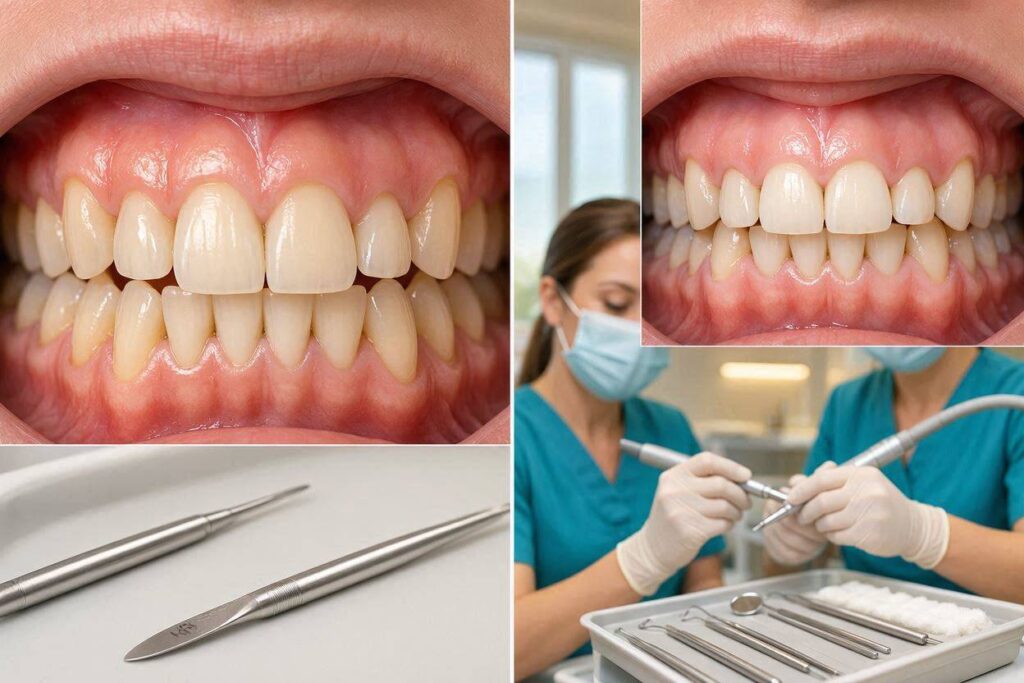
Gum contouring is not a random freehand carving. It is governed by well-defined aesthetic parameters that define a beautiful and healthy smile. The most critical rule is that the gum line over the central incisors, the two front upper teeth, must be perfectly symmetrical and at the exact same height. This midline symmetry is the single most important determinant of a smile’s aesthetic appeal. The gum line over the lateral incisors, the teeth next to the central incisors, is ideally positioned slightly lower than the centrals, creating a gentle, upward step. The gum over the canines, or eyeteeth, should match the height of the centrals or be very slightly higher.
Another foundational principle is the tooth-to-gum proportion. When a person smiles, only a small triangle of pink gum, known as the interdental papilla, should be visible between the teeth. The visible tooth crown should display a width-to-length ratio of approximately 75 to 85 percent. A short, square tooth with a low, bulky gum line is an aesthetic problem. Excessive gingival display, defined as showing more than 3 to 4 millimeters of gum tissue when smiling fully, is the clinical definition of a gummy smile that gum contouring is designed to correct.
The Diagnostic Process: Identifying the Cause of a Gummy Smile
Before any gum tissue is removed, the dentist must diagnose the exact cause of the excessive gingival display. Not every gummy smile is treated by simply cutting away gum tissue, and misdiagnosing the cause leads to a devastating aesthetic and functional result. The three primary causes are gingival overgrowth, altered passive eruption, and a skeletal vertical maxillary excess.
Gingival Overgrowth and Altered Passive Eruption
Gingival overgrowth is a true excess of gum tissue, often caused by certain medications like phenytoin, cyclosporine, or calcium channel blockers, or by chronic mouth breathing and poor hygiene. The teeth are of a normal anatomical length, but they are buried under a thick, bulbous layer of hyperplastic gum tissue. Removing this excess tissue to expose the normal crowns is the straightforward goal of the contouring procedure.
Altered passive eruption is a more common and more subtle condition. During normal tooth development, the tooth erupts into the mouth, and the gum tissue naturally migrates down the root surface to its final position at the cementoenamel junction, the anatomical neck of the tooth. In altered passive eruption, this migration does not occur completely. The gum tissue remains positioned high on the crown, covering a significant portion of the healthy, anatomical enamel. The patient’s teeth are actually of a normal length, but they appear short because they are hidden by a curtain of gum and the underlying bone that is positioned too high on the root. A simple gum trim in this case, without addressing the bone level, will result in the tissue growing right back.
Skeletal and Muscular Causes
A gummy smile caused by a skeletal vertical maxillary excess is a fundamentally different diagnosis. In this case, the upper jaw itself is excessively long in the vertical dimension. The gums and the teeth are proportionally normal in their relationship, but the entire upper jaw sits too far down. Gum contouring alone in this patient would lead to an unnatural lengthening of the teeth and a disastrous aesthetic outcome. The correct treatment is orthognathic surgery to superiorly reposition the maxilla. A hypermobile upper lip, where the lip rises too high when smiling, is another non-gum cause. This is treated with lip repositioning surgery or Botox to limit the excessive elevation, not by removing gum tissue.
The Surgical Techniques: Laser vs. Scalpel
Once the correct diagnosis of a soft tissue and bone excess is made, the dentist or periodontist will select a surgical technique. The two primary modern methods are the traditional scalpel and electrosurgery approach, and the soft tissue diode laser.
A scalpel gingivectomy provides tactile feedback and is excellent for precisely sculpting the fibrous, attached gingiva. The incision is made with a fine periodontal knife at a 45-degree angle to the tooth surface, creating a thin, beveled, natural-looking margin. The tissue is then carefully removed with a curette. An electrosurgery unit uses a high-frequency electrical current to vaporize the tissue. It provides excellent hemostasis, controlling bleeding instantly. However, the heat can cause collateral thermal damage to the underlying bone and the periodontal ligament if not used with extreme skill and precision.
The Soft Tissue Diode Laser: The Modern Standard
The soft tissue diode laser has become the instrument of choice for aesthetic gum contouring. The laser fiber tip emits a concentrated beam of light energy that is selectively absorbed by the melanin and hemoglobin in the gum tissue. It vaporizes the tissue with a single, smooth, sweeping motion, creating an almost bloodless surgical field. The laser energy simultaneously seals the capillary endings and the lymphatic vessels, resulting in dramatically less post-operative swelling and pain compared to a scalpel.
The laser sterilizes the tissue as it cuts. There is no need for sutures. The precision is exceptional, allowing the dentist to re-contour the gum line with a micro-sculpting control that mimics a fine artist’s brush. The healing response after laser gingivoplasty is generally faster and more comfortable. The diode laser is not suitable for hard tissue. If the underlying bone needs to be recontoured as part of the procedure, a piezoelectric surgical unit or a hand bur is used to precisely reshape the alveolar bone crest, and the laser finishes the soft tissue sculpting.
The Periodontal Flap Approach: Reshaping Bone and Gum
For cases of altered passive eruption, a simple gum trim is insufficient. The dentist must perform a periodontal flap procedure, known as esthetic crown lengthening. Local anesthetic is administered, and a meticulous, full-thickness mucoperiosteal flap is elevated to expose the crest of the underlying alveolar bone. The true biological width, the minimum healthy distance between the bone crest and the future gum margin, must be established. This typically requires a minimum of 3 millimeters of space.
The exposed bone is recontoured with fine diamond burs or piezoelectric tips to lower the bone crest to the correct, physiologic position relative to the enamel. The gum tissue flap is then repositioned and sutured at its new, stable, and biologically sound level, exposing the correct length of the tooth crown. The sutures are removed after one to two weeks, and the final, mature gum contour is established over several months. This is an advanced periodontal procedure requiring a deep understanding of the biologic width and the surgical anatomy.
Post-Operative Care and Healing
The first 48 hours after gum contouring are critical. The patient will experience mild to moderate discomfort, controlled with over-the-counter analgesics and the application of ice packs to the face to minimize swelling. The diet must be soft, cool, and bland, avoiding any spicy, acidic, or crunchy foods that can irritate the healing surgical site. The patient must not brush the surgical area directly but will be instructed to gently rinse with a prescribed chlorhexidine mouthwash to keep the wound chemically clean.
The gum tissue heals rapidly. The initial epithelial covering occurs within the first week, and the tissue appears red and slightly swollen as the healing blood vessels proliferate. Over the next four to six weeks, the tissue matures, the color returns to a healthy coral pink, and the final, sculpted shape begins to emerge. The final aesthetic result of a laser gingivectomy is usually stable and visible by the three-month mark. The final result of a flap crown lengthening procedure continues to mature over six months as the soft tissue fully stabilizes at its new, bone-dictated level.
Conclusion
Gum contouring and reshaping is a precise periodontal plastic surgery procedure that sculpts the gum line to correct a gummy smile, restore ideal tooth-to-gum proportions, and create a symmetrical aesthetic frame for the teeth. An accurate pre-operative diagnosis is critical to distinguish between true gingival overgrowth, altered passive eruption requiring bone recontouring, and non-gum skeletal causes that require orthognathic surgery. Modern techniques using a soft tissue diode laser provide a minimally invasive, nearly bloodless approach for the soft tissue sculpting, while esthetic crown lengthening with a flap procedure is the definitive treatment when the underlying bone position must be corrected to achieve a stable, beautiful, and biologically sound result.
Frequently Asked Questions
Q: Is gum contouring painful?
A: The procedure itself is performed under local anesthesia and is pain-free. Post-operative discomfort is typically mild to moderate, lasting a few days, and is well-managed with over-the-counter pain medication and a soft diet. Laser treatments tend to be less painful post-operatively than scalpel procedures.
Q: Will my gums grow back after contouring?
A: For a simple gingivectomy where the bone is not reduced, there is a risk of some tissue rebound. For a properly diagnosed and executed crown lengthening procedure that corrects the bone level to the biological width, the tissue will stabilize at its new, surgically determined position and should not regrow.
Q: How long does it take to see the final cosmetic result?
A: The initial healing is rapid, within a week. However, the final, stable gum margin, the complete color normalization, and the full maturation of the sculpted papilla can take three to six months. The dentist will not consider any minor cosmetic touch-ups until this full healing period has elapsed.
Additional Resource
For authoritative patient information on the standards and procedures of periodontal plastic surgery and the management of aesthetic gum conditions, the national specialty academy is the definitive source.
- American Academy of Periodontology Cosmetic Procedures: perio.org/for-patients/cosmetic-periodontal-procedures