Why Dental Implants Over a Partial? Comparing Tooth Replacement Options
A patient with several missing teeth faces a decision that will affect their oral health, comfort, and confidence for decades. The dentist presents two primary options: a removable partial denture or dental implants. The partial denture is familiar, less expensive upfront, and covered more generously by insurance. The implant route requires surgery, costs more initially, and takes longer to complete. Why would anyone choose implants over a partial?
The answer lies in a constellation of advantages that implants offer over removable partial dentures. These advantages span bone preservation, impact on adjacent teeth, functional performance, comfort, longevity, and quality of life. This guide provides a thorough, balanced comparison to help patients understand why implants are often the superior choice and under what circumstances a partial might still be appropriate.
The Fundamental Difference in Design Philosophy
The two approaches represent fundamentally different philosophies of tooth replacement.
How a Removable Partial Denture Works
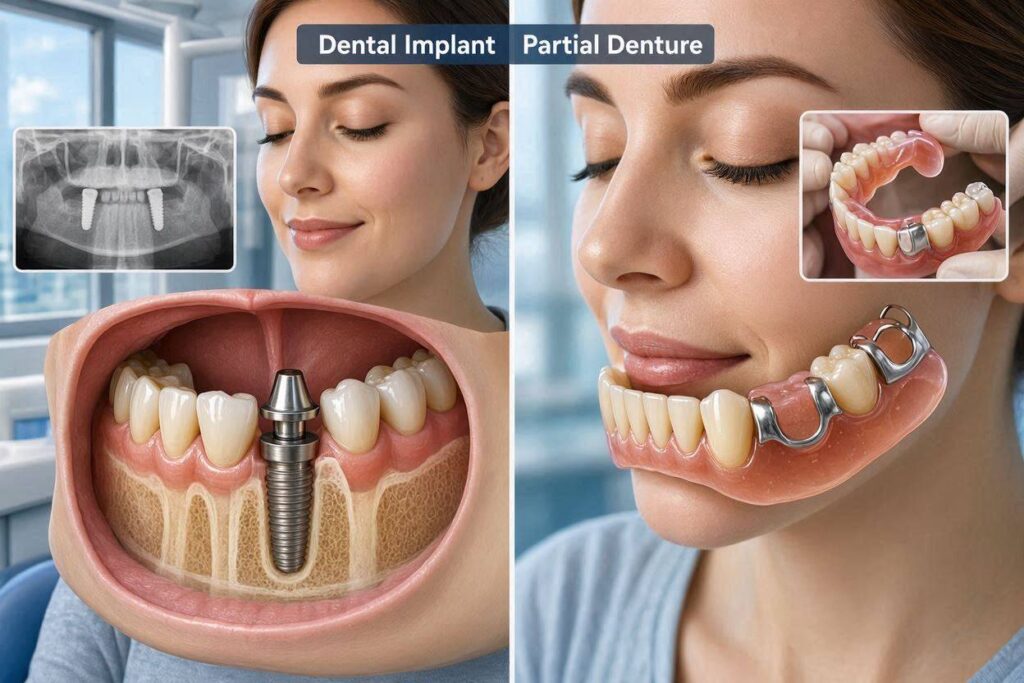
A removable partial denture is an appliance that rests on the gum and is supported by the remaining natural teeth through clasps, rests, or precision attachments. The patient removes it for cleaning and at night. It does not replace the tooth root. It does not stimulate the underlying bone. It does not prevent the adjacent teeth from moving. It is a removable device that compensates for missing teeth but does not restore the biological integrity of the dentition.
How Dental Implants Work
Dental implants are titanium fixtures surgically placed into the jawbone. They integrate with the bone through osseointegration, becoming a structural part of the body. They support individual crowns, fixed bridges, or removable overdentures. They replace the missing tooth root. They stimulate the bone. They are fixed in place and do not rely on adjacent teeth for support.
The Impact on Adjacent Teeth
This is one of the most significant differences between the two options.
Implants Preserve Adjacent Teeth
An implant is an independent structure. It does not touch the adjacent teeth. It does not require any preparation or modification of the neighboring teeth. The adjacent teeth remain intact and unaltered.
Partials Can Damage Adjacent Teeth
A removable partial denture uses clasps that wrap around adjacent teeth to retain the appliance. These clasps create plaque traps that increase the risk of decay on the abutment teeth. The forces transmitted through the clasps and rests can traumatize the supporting teeth over time, leading to mobility, fracture, or loss. Studies consistently show that abutment teeth for partial dentures have a higher rate of decay, periodontal disease, and eventual extraction than teeth in the same mouth that are not used as abutments.
The partial denture, intended to replace missing teeth, can inadvertently contribute to the loss of the remaining teeth over the long term.
The Long-Term Cost of Tooth Damage
The loss of an abutment tooth that has been damaged by a partial denture extends the edentulous area. The partial must then be modified or remade to include the new missing tooth. The cycle continues. The apparent savings of the partial denture can be erased by the cost of treating complications and eventually converting to a more extensive tooth replacement.
Bone Preservation
The biological consequence of the missing tooth root is central to the implant advantage.
The Alveolar Bone Resorption Problem
When a tooth is extracted, the alveolar bone that supported it begins to resorb. The process is most rapid in the first year but continues throughout life. The bone loss is irreversible. It alters the contour of the jaw, reduces support for the lips and cheeks, and can make future implant placement more difficult or impossible without grafting.
Implants Stimulate and Preserve Bone
An implant transmits chewing forces through the bone, providing the mechanical stimulus that maintains bone density. The bone around the implant is preserved. This is a biological benefit that no other tooth replacement option provides.
Partials Do Not Preserve Bone
A partial denture rests on the gum. It transmits forces to the surface of the ridge, which can actually accelerate bone resorption. The edentulous ridge under a partial denture continues to resorb, progressively changing the fit of the appliance and requiring relines or remakes. The partial denture does nothing to address the underlying biological process of bone loss.
Functional Performance
How well does the replacement allow the patient to eat?
Implant Function Approaches Natural Teeth
An implant-supported crown or bridge provides chewing efficiency approaching that of natural teeth. The implant is rigidly fixed in bone. There is no movement during function. The patient can bite and chew with confidence on foods that would be problematic with a partial denture. Patients with implants typically report that they eat what they want without restriction.
Partial Denture Function Is Compromised
A removable partial denture moves during function. The clasps may flex. The denture base may lift or rock. Chewing efficiency is reduced compared to natural teeth or implants. Patients with partial dentures often avoid certain foods: sticky foods that dislodge the appliance, hard foods that cause discomfort on the underlying gum, or fibrous foods that wrap around the denture components.
The psychological impact of eating in public with a partial denture that might move or dislodge is significant. Many partial denture wearers develop habits of eating carefully, avoiding certain foods, or positioning the denture with their tongue during meals.
Comfort and Convenience
The daily experience of living with the replacement matters.
Implants: Forget They Are There
A well-integrated implant becomes psychologically invisible. The patient does not think about it. It does not move. It does not need to be removed. It is brushed like a natural tooth. There is no acrylic covering the palate. There is no altered taste sensation from a large palatal coverage. The implant is simply a tooth.
Partials: Constant Awareness
A removable partial denture is a foreign object in the mouth. The patient is aware of it. The metal framework and acrylic base occupy space. The palate may be partially covered, affecting taste. The appliance must be removed for cleaning and at night, a routine that some patients find burdensome and embarrassing. Over time, the fit deteriorates as the ridge resorbs, leading to movement, discomfort, and the need for adjustment or relining.
Esthetics
How natural does the replacement look?
Implant Esthetics
A well-executed implant crown can be indistinguishable from a natural tooth. The crown emerges from the gum with a natural contour. There are no visible metal clasps. The esthetic result, particularly with all-ceramic restorations, can be excellent.
Partial Denture Esthetics
Partial dentures can be esthetically acceptable, but they have limitations. The metal clasps on anterior teeth are often visible, which is a significant concern for many patients. Precision attachments or esthetic clasps can mitigate this but add cost and complexity. The acrylic base may not match the gum color perfectly. The junction between the denture base and the natural teeth can trap food and stain.
Longevity and Maintenance
How long does the replacement last, and what does it cost to maintain?
Implant Longevity
A well-placed, well-maintained dental implant can last decades or a lifetime. The crown may need replacement after 15 to 20 years, but the implant fixture remains. Maintenance involves regular professional cleanings and daily home care. The long-term maintenance costs are relatively low.
Partial Denture Longevity
A removable partial denture has a finite lifespan. The average partial denture lasts five to ten years before needing replacement. Relines are needed as the ridge resorbs. Clasps may fracture or lose retention. The abutment teeth may develop problems requiring restoration or extraction. The cumulative lifetime cost of partial denture wear, including replacements, relines, and treatment of abutment tooth complications, can approach or exceed the cost of implant treatment.
Table: Implants Versus Removable Partial Denture
| Feature | Dental Implants | Removable Partial Denture |
|---|---|---|
| Impact on adjacent teeth | None | Clasps increase risk of decay and periodontal disease |
| Bone preservation | Yes, stimulates bone | No, may accelerate resorption |
| Chewing efficiency | Approaches natural teeth | Significantly reduced |
| Comfort | Feels like natural tooth | Foreign body sensation, movement |
| Esthetics | Excellent, no visible metal | Clasps may be visible |
| Palatal coverage | None | Often partial coverage affecting taste |
| Removal for cleaning | No | Yes, nightly removal |
| Longevity | 20+ years to lifetime | 5-10 years average |
| Initial cost | Higher | Lower |
| Lifetime cost | Often lower due to durability | May be higher due to replacements and complications |
The Psychological Dimension
The emotional and social aspects of the choice are powerful.
The Stigma of Removable Appliances
Many patients associate removable partial dentures with aging, decline, and poor health. They do not want to take their teeth out at night. They do not want their partner to see them without their teeth. They do not want to worry about their teeth moving during social interactions. This psychological burden is significant and real.
The Confidence of Fixed Teeth
Implant patients report a restoration of confidence. They smile without reservation. They eat in public without anxiety. They speak without fear of their teeth clicking or moving. The implant becomes integrated into their self-image as a permanent part of their body.
When a Partial Denture Might Be the Better Choice
Implants are not always the right answer. Partial dentures have legitimate indications.
Insufficient Bone for Implants Without Major Grafting
If the bone deficiency is so severe that extensive grafting is required, and the patient cannot or will not undergo those procedures, a partial denture may be the practical choice.
Medical Contraindications to Implant Surgery
Patients with certain medical conditions, such as recent radiation to the jaws, active IV bisphosphonate therapy, or severe uncontrolled systemic disease, may not be candidates for implant surgery. A partial denture provides tooth replacement without surgery.
Financial Constraints
The upfront cost of implants is higher. If the patient cannot afford implant treatment and cannot access financing, a partial denture provides functional tooth replacement at a lower initial cost.
Need for Rapid Tooth Replacement
A partial denture can be fabricated in a few weeks. Implant treatment takes months. If the patient needs teeth immediately for an event or professional obligation, a partial may be the interim or even permanent solution.
Multiple Missing Teeth in Different Areas
A single partial denture can replace multiple missing teeth in different areas of the mouth. Implants would require multiple individual fixtures. The cost and surgical burden of replacing many scattered teeth with implants may favor a partial denture.
Conclusion
Dental implants are the superior choice over removable partial dentures for most patients because they preserve adjacent teeth, stimulate and maintain jawbone, provide near-natural chewing function, offer greater comfort and esthetics, and last longer with proper care. The removable partial denture, while less expensive initially, carries hidden long-term costs in the form of damage to abutment teeth, ongoing maintenance, and eventual replacement. Implants are not appropriate for every patient. Those with medical contraindications, insufficient bone without the option of grafting, or severe financial constraints may find partial dentures an acceptable alternative. The decision should be made collaboratively between the patient and the dental team, with full understanding of the trade-offs.
Frequently Asked Questions
Why are implants better than a partial denture?
Implants preserve adjacent teeth, prevent bone loss, provide superior function and comfort, and last longer. Partials can damage the teeth they clasp onto and do not prevent bone resorption.
Do partial dentures damage your other teeth?
Yes, over time. The clasps create plaque traps that increase decay risk, and the forces transmitted can traumatize the abutment teeth, leading to mobility and eventual loss.
Are implants cheaper than partials in the long run?
Often yes. While the initial cost of implants is higher, the cumulative cost of partial denture replacements, relines, and treatment of abutment tooth complications can exceed the cost of implants over a lifetime.
Can a partial denture be converted to implants later?
Yes. Patients who start with a partial can transition to implants later as finances permit. However, the bone resorption that occurs under the partial may necessitate grafting.
Is there a situation where a partial is better than implants?
Yes. When implants are medically contraindicated, when bone is severely deficient and grafting is not feasible, or when the patient needs a rapid, low-cost solution, a partial denture is a reasonable choice.
Additional Resources
American College of Prosthodontists – Tooth Replacement Options
https://www.gotoapro.org
Comprehensive information from prosthodontic specialists on the full range of tooth replacement options, including implants and removable partial dentures.