How Old Are Dental Implants?
Dental implants feel like modern technology. The titanium posts, digital planning software, and immediate-load protocols seem like products of the twenty-first century. Yet the concept of replacing missing teeth with implanted materials stretches back thousands of years. Understanding the history of dental implants provides perspective on how far this technology has come and appreciation for the scientific foundations supporting today’s remarkably successful treatment.
The question of how old dental implants are has multiple answers. Modern osseointegrated implants date to the 1960s. Earlier experimental implants appeared in the early twentieth century. Ancient civilizations attempted tooth replacement with various implanted materials thousands of years ago. This article traces the fascinating journey from ancient attempts to modern predictable implant dentistry.
I wrote this article because understanding implant history enriches appreciation for the treatment you may be considering. The implant your dentist places today represents the culmination of centuries of human ingenuity, scientific discovery, and clinical refinement.
Ancient Attempts at Tooth Replacement
The desire to replace missing teeth is not modern. Archaeological evidence reveals that ancient civilizations attempted dental implantation with remarkable creativity.
Ancient China: The Oldest Known Implants
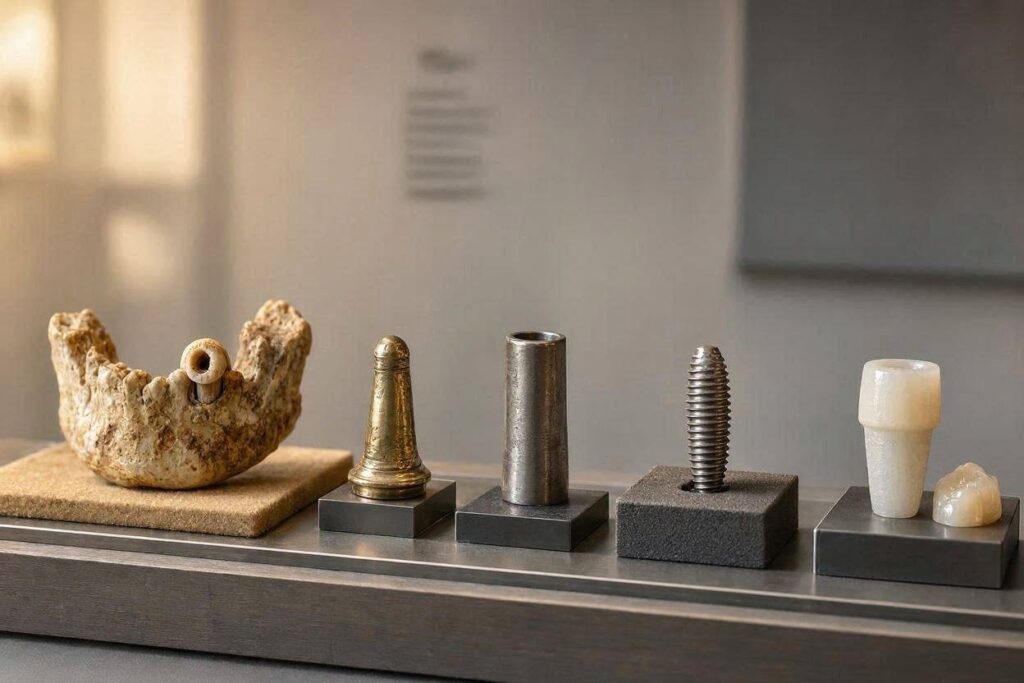
The oldest discovered dental implants date to approximately 4,000 years ago in ancient China. Archaeologists found bamboo pegs driven into the jawbone to replace missing teeth. These bamboo implants represent humanity’s earliest known attempts at dental implantation.
Bamboo would not have integrated with bone in any biological sense. These implants likely served as temporary placeholders or cosmetic replacements that eventually failed. Yet they demonstrate that the concept of implanting a foreign material to replace teeth occurred to humans millennia ago.
Ancient Egypt: Precious Metals and Shell
Egyptian mummies have been discovered with teeth replaced by various materials. Gold wire was used to stabilize loose teeth, an early form of splinting. Some mummies show evidence of transplanted teeth, possibly from donors or from other positions in the same mouth.
Seashells carved to resemble teeth were placed in tooth sockets in some Egyptian remains. Like bamboo, these materials could not integrate with bone. They represent early attempts at cosmetic replacement rather than functional restoration.
Mayan Civilization: The First Evidence of Osseointegration
The most remarkable ancient implant discovery comes from Mayan civilization. In 1931, archaeologists excavating in Honduras found a mandible dating to approximately 600 AD. This jawbone contained three tooth-shaped pieces of shell placed into sockets of missing lower incisors.
Radiographic examination revealed something extraordinary. Bone had grown around the shell implants, creating a tight fit reminiscent of what we now call osseointegration. The shell pieces were not merely sitting in the sockets. They had become integrated with the surrounding bone.
Whether the Mayans understood what they had achieved remains unknown. The implants may have been placed post-mortem for ceremonial purposes. Regardless, this archaeological find represents the first evidence that bone could integrate with implanted materials, anticipating Brånemark’s discovery by over a millennium.
Early Modern Experimentation
The eighteenth and nineteenth centuries saw renewed interest in tooth replacement, including experimental implantation.
Tooth Transplantation
In the eighteenth century, tooth transplantation became fashionable among the wealthy. Healthy teeth were extracted from donors, often impoverished individuals who sold their teeth for money, and transplanted into the sockets of the recipients.
These transplants sometimes succeeded temporarily. However, infection, rejection, and disease transmission were common. The practice declined as its risks became apparent and as dentistry developed more predictable replacement options.
Early Metal Implants
The nineteenth century brought experimentation with various metals for dental implantation. Gold, platinum, silver, and various alloys were tried as implant materials. These attempts generally failed because the metals did not integrate with bone and often caused infection or were rejected.
Some practitioners developed elaborate implant designs. Gold baskets, iridium tubes, and platinum posts were placed into extraction sockets or surgically prepared bone sites. These implants might remain stable for varying periods but eventually failed due to lack of true integration with bone.
The Vitallium Era
In the 1930s, the cobalt-chromium-molybdenum alloy Vitallium was developed for orthopedic applications. Its biocompatibility and corrosion resistance made it attractive for dental implantation as well.
Several implant systems using Vitallium were developed in the 1940s and 1950s. The subperiosteal implant, which rested on top of the jawbone under the gum tissue, was fabricated from Vitallium. The blade implant, a flat metal blade placed into a groove cut in bone, also used this material.
These early modern implants achieved some clinical success but lacked predictability. They did not achieve true osseointegration. Instead, they relied on mechanical retention and fibrous encapsulation. Success rates were inconsistent, and complications were common.
The Accidental Discovery That Changed Everything
Modern implant dentistry began with an accident in a Swedish laboratory.
Per-Ingvar Brånemark’s Observation
In 1952, orthopedic surgeon Per-Ingvar Brånemark was studying blood flow in rabbit bone using titanium optical chambers inserted into the bone. When he attempted to remove these chambers at the conclusion of his experiments, he made a startling observation.
The titanium had fused so completely with the surrounding bone that the chambers could not be removed without cutting away bone. Brånemark recognized the potential significance of this phenomenon. Titanium could bond with living bone in a way that no other material had demonstrated.
He named this process osseointegration, defining it as the direct structural and functional connection between living bone and the surface of a load-bearing implant. This biological phenomenon would become the foundation of modern implant dentistry.
The First Dental Implant Patient
After years of additional research, Brånemark placed the first titanium dental implants in a human patient in 1965. The patient, Gösta Larsson, had been unable to wear conventional dentures due to severe bone loss. Brånemark placed four titanium implants in Larsson’s lower jaw, which supported a fixed prosthesis.
Those implants functioned successfully for the remainder of Larsson’s life, more than four decades. This first patient demonstrated the long-term viability of osseointegrated dental implants and provided the clinical foundation for implant dentistry’s development.
Resistance and Acceptance
The dental establishment initially resisted Brånemark’s work. Conventional wisdom held that the body would eventually reject any foreign material implanted in bone. The concept of a metal implant that could function reliably for decades seemed implausible to many practitioners.
Brånemark faced skepticism, criticism, and difficulty publishing his research. He persisted, accumulating clinical evidence and refining his techniques. By the 1980s, the weight of evidence supporting osseointegrated implants became undeniable. Implant dentistry entered the mainstream.
The Evolution of Modern Implant Systems
Once osseointegration was established as a clinical reality, implant systems evolved rapidly.
The Brånemark System
The original Brånemark implant was a machined titanium screw with a relatively smooth surface. It required a submerged healing period of several months before loading. The original protocol called for placing implants, closing the gum tissue over them, and waiting three to six months before uncovering them and beginning restoration.
This cautious approach produced excellent results and established the predictability of implant treatment. The Brånemark system’s documentation of long-term success built the evidence base supporting implant dentistry.
Surface Technology Advances
Early implants had machined surfaces that were relatively smooth by modern standards. Researchers discovered that roughening the implant surface enhanced bone integration. Various surface modification techniques were developed.
Titanium plasma spray created a rough surface by spraying molten titanium onto the implant. Sandblasting with various media followed by acid etching created micro-roughness that accelerated osseointegration. Anodization produced controlled oxide layers with specific surface characteristics. These surface modifications reduced healing times and improved success rates, particularly in compromised bone.
Design Evolution
Implant design evolved based on biomechanical research and clinical experience. Thread designs were refined to optimize load distribution. Implant body shapes transitioned from exclusively parallel-walled designs to include tapered options matching extraction socket anatomy.
The implant-abutment connection evolved from external hex designs to internal conical connections that create bacterial seals and resist micromovement. Platform switching, where the abutment is narrower than the implant platform, was introduced to help preserve crestal bone.
The Timeline of Modern Implant Milestones
Key developments mark implant dentistry’s progression from experimental procedure to standard of care.
1960s: Scientific Foundation
Brånemark’s discovery of osseointegration and the first human implant placement established the scientific basis for implant dentistry. The 1960s represented the transition from empirical attempts to scientifically grounded implant treatment.
1970s: Refinement and Documentation
Brånemark and colleagues refined surgical and prosthetic protocols. Long-term documentation of implant success began accumulating. The concept of the implant team, with surgical and restorative providers collaborating, developed during this period.
1980s: Acceptance and Growth
The 1982 Toronto Conference on Osseointegration in Clinical Dentistry represented a watershed moment. Brånemark presented his long-term results, and the dental community largely accepted osseointegrated implants as a predictable treatment modality.
Other implant systems entered the market. The Core-Vent system, later evolving into the Zimmer and then Zimmer Biomet systems, was introduced. Straumann began developing its implant system. Competition accelerated innovation.
1990s: Mainstream Adoption
Implant dentistry entered mainstream practice during the 1990s. Single tooth replacement with implants became common. Implant-supported overdentures for edentulous patients gained acceptance. Surface technology advanced with the introduction of sandblasted and acid-etched surfaces.
2000s: Digital Revolution
Cone beam computed tomography brought three-dimensional imaging to implant planning. Computer-guided surgery using 3D-printed guides improved placement accuracy. Immediate loading protocols gained acceptance for appropriate cases.
2010s and Beyond: Refinement and Access
Zirconia implants emerged as metal-free alternatives. Digital workflows integrating intraoral scanning, computer-aided design, and 3D printing streamlined treatment. Mini implants and reduced-diameter designs expanded treatment options. The focus shifted from whether implants could succeed to optimizing esthetics, efficiency, and patient experience.
The Age of Dental Implants Today
Modern dental implants represent mature technology with extensive scientific support.
Current Success Rates
Modern dental implants achieve success rates exceeding 95 percent in appropriate patients. Single implants in healthy bone are among the most predictable procedures in all of medicine. Even in compromised situations, success rates remain high with appropriate techniques and patient selection.
Long-term studies document implants functioning successfully for decades. Many patients have maintained implants for thirty years or longer. The original Brånemark patient’s implants functioned for over forty years until his death.
Ongoing Evolution
Implant dentistry continues evolving. Biologics and growth factors may further enhance healing. Ceramic materials continue improving. Digital technology increases precision and efficiency. The basic principle of osseointegration remains the foundation, while techniques and technologies built upon it continue advancing.
Frequently Asked Questions About Implant History
When were dental implants invented?
Modern osseointegrated dental implants were discovered in 1952 and first placed in a human patient in 1965 by Per-Ingvar Brånemark. Ancient civilizations attempted tooth replacement with implanted materials thousands of years earlier.
How long have titanium dental implants been used?
Titanium dental implants have been used since 1965, when Brånemark placed the first titanium implants in a human patient. Titanium remains the most widely used implant material today.
Did ancient implants actually work?
Ancient implants made from bamboo, shell, and precious metals could not achieve true osseointegration. They may have served temporary cosmetic purposes but would not have provided long-term functional replacement. The Mayan shell implants show evidence of bone integration, though whether this was intentional or incidental remains unknown.
When did implants become common?
Dental implants entered mainstream practice in the 1990s, though they gained acceptance during the 1980s following the landmark Toronto Conference. Widespread adoption accelerated through the 1990s and 2000s as evidence accumulated and techniques improved.
How have implant success rates changed over time?
Early Brånemark implants achieved success rates around 85 to 90 percent. Modern implants with advanced surface technology and refined protocols achieve success rates exceeding 95 percent. Improvements in patient selection, surgical technique, and prosthetic design have all contributed to improved outcomes.
Additional Resources
The Academy of Osseointegration provides historical and current information about implant dentistry. The International Congress of Oral Implantologists offers educational resources including historical perspectives. The American Academy of Implant Dentistry provides information about implant treatment evolution. Dental history museums and collections preserve early implant artifacts and documentation.
Conclusion
Dental implants have a dual history spanning thousands of years. Ancient civilizations attempted tooth replacement with implanted bamboo, shell, and precious metals, demonstrating that the desire for tooth replacement is as old as civilization itself. Modern implant dentistry began with Per-Ingvar Brånemark’s accidental discovery of osseointegration in 1952 and the first human implant placement in 1965. From those beginnings, implant dentistry has evolved through surface technology advances, design refinements, digital integration, and expanding applications to become one of the most predictable and transformative procedures in modern healthcare.