Which Dental Implants Have The Longest Lifespan?
The decision to get a dental implant is a long-term commitment, and the question of lifespan is at the forefront of every patient’s mind. You are not buying a disposable product; you are investing in a medical device that you expect to last for decades. The truthful answer to which dental implants have the longest lifespan is that it is not about a single magic brand. The lifespan of a dental implant is the product of four interlocking factors: the implant design and surface technology, the surgical precision of placement, the quality of the final crown and its fit, and the lifelong maintenance protocol followed by the patient. A premium implant placed poorly will fail. A budget implant placed perfectly can last a lifetime, though it lacks the same long-term data. However, when all other factors are optimized, the implant systems with the most extensive, published, multi-decade clinical data demonstrating survival rates of 95% or higher at 20 years and beyond are the ones manufactured by the leading Swiss and Swedish companies that pioneered the field. This guide will dissect the specific features, brands, and biological principles that produce the longest-lasting dental implants.
The Core Determinant of Lifespan: The Implant Surface and Osseointegration
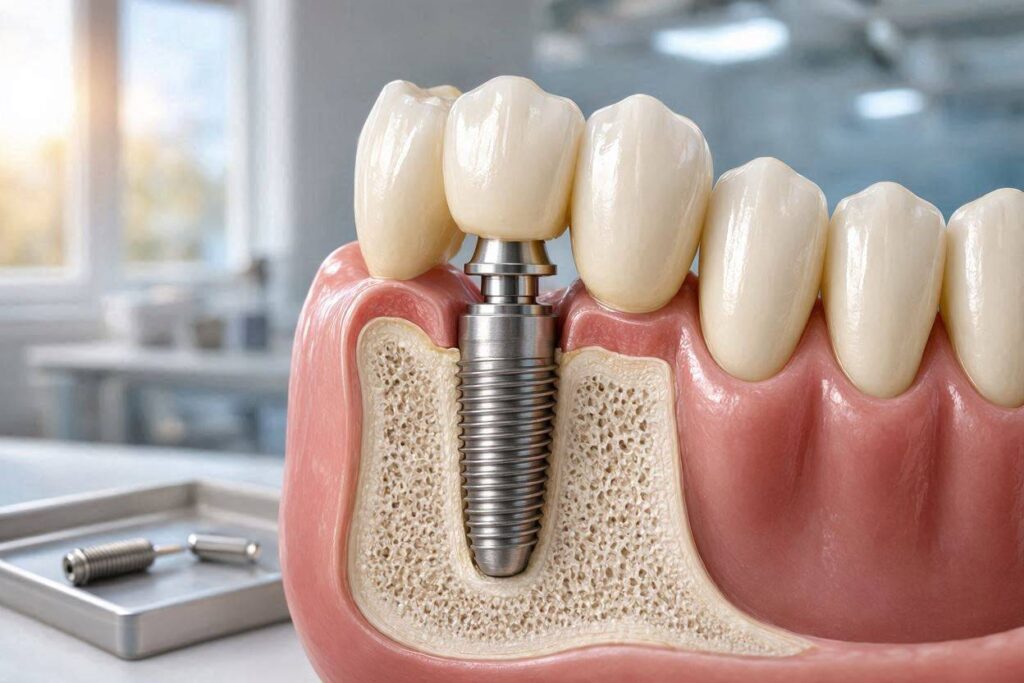
The lifespan of an implant begins at the microscopic level, at the interface between the titanium and the living bone. Osseointegration, the direct structural and functional connection between ordered, living bone and the surface of a load-bearing implant, is the biological phenomenon that makes dental implants possible. The quality and durability of this bond is the single most important predictor of how long an implant will last. The implant surface is not a passive piece of metal; it is an active biologic scaffold.
The earliest dental implants, developed by Dr. Per-Ingvar Brånemark in the 1960s, had a machined, relatively smooth surface. These implants achieved osseointegration, but the process was slower and the bone-to-implant contact was lower. The modern standard is a moderately rough, micro-roughened surface, created through a process of sandblasting with a biocompatible grit (such as alumina or titanium oxide) followed by acid etching. This surface, often referred to as an SLA (Sandblasted, Large grit, Acid-etched) surface, dramatically increases the surface area for bone cell attachment. The most advanced evolution of this technology is the hydrophilic SLA surface. A traditional titanium surface is hydrophobic, meaning it repels water and blood. A hydrophilic surface, achieved through proprietary chemical treatments, instantly attracts blood and bone-forming proteins. This accelerates the healing cascade and results in a denser, more rapid bone formation. Implants with a well-researched, hydrophilic, moderately rough surface have the highest documented long-term bone stability. When you ask which implant lasts the longest, you are fundamentally asking which surface technology has the most robust, long-term evidence for maintaining crestal bone height.
The Prosthetic Connection: The Hidden Engine of Longevity
If the implant surface is the biological engine, the prosthetic connection—the interface where the implant meets the abutment—is the mechanical heart that determines long-term prosthetic stability. A loose screw, a fractured abutment, or a crown that repeatedly dislodges is a prosthetic failure, and these failures, while not always causing implant loss, can significantly degrade the patient’s quality of life and require costly interventions.
The historical standard was the external hex connection. It was simple and effective, but it had an inherent vulnerability to micromovement and screw loosening. The modern gold standard connection, and a major driver of long-term implant success, is the conical connection, often termed the Morse taper. In this design, the internal walls of the implant and the abutment are precision-machined with a slight taper. When the abutment is inserted and tightened, the two conical surfaces wedge together with a friction lock that is so tight it is often called a “cold weld.” This connection eliminates virtually all micromovement between the implant and the abutment. The clinical benefit is profound. Zero micromovement means no pumping of bacteria at the interface, which preserves the marginal bone level. It also means a dramatically reduced rate of abutment screw loosening. The platform-switched conical connection, where the abutment is narrower than the implant platform, further enhances bone preservation by moving the inflammatory microgap inward, away from the vulnerable crestal bone. The implant systems that have invested the most research into these conical, platform-switched connections are the ones with the highest published long-term prosthetic success rates.
“When I look at a 20-year follow-up radiograph of a single implant, I am looking for one thing above all else: the crestal bone level. An implant that has a stable, flat bone level hugging the first thread after two decades is a successful implant. The conical connection with platform switching is the design feature that gives me that radiograph. It is an engineering solution to a biologic problem.” — A Prosthodontist and Implant Researcher
The Brands with the Longest Clinical Track Record
Scientific evidence in implant dentistry is measured in decades, not years. The implant brands that can legitimately claim to have the longest proven lifespan are those that have been on the market the longest and have meticulously tracked their patients in prospective clinical studies. These companies have published 10, 15, and 20-year data showing survival rates consistently above 95%.
Straumann (Switzerland): The Straumann Dental Implant System is arguably the most extensively studied implant system in the world. Its signature feature is the Roxolid alloy, a high-strength titanium-zirconium alloy that allows for smaller-diameter implants without sacrificing strength, and the SLActive hydrophilic surface, which has been shown in numerous studies to accelerate osseointegration and maintain high bone stability over a decade. The Straumann Bone Level implant with its conical CrossFit connection is a benchmark for long-term bone preservation. Published 10-year data shows a 97-99% survival rate. The company offers a lifetime warranty, a tangible reflection of its confidence in the product’s longevity.
Nobel Biocare (Sweden): As the company founded by Professor Brånemark, the inventor of osseointegration, Nobel Biocare has the longest-running longitudinal implant study in history, tracking patients for over 40 years. The NobelParallel and NobelActive implants feature TiUnite, a moderately rough, porous anodized surface that has extensive long-term documentation. The internal conical connection of the NobelActive provides high primary stability, making it a preferred choice for immediate loading protocols.
Astra Tech (Dentsply Sirona, Sweden): The Astra Tech Implant System is renowned for its OsseoSpeed surface, a fluoride-modified titanium surface that stimulates bone formation, and its unique conical seal design with platform switching. The conical connection in the Astra Tech system has a long taper that creates an exceptionally strong seal. This system has some of the most impressive marginal bone level preservation data in the literature, with studies showing less than 0.3mm of bone loss over five years.
The table below compares these longevity leaders.
| Implant Brand | Key Surface Technology | Key Connection Feature | Documented Long-Term Survival |
|---|---|---|---|
| Straumann | SLActive (hydrophilic, chemically active SLA) | CrossFit conical connection; Roxolid alloy | 97-99% at 10 years; lifetime warranty |
| Nobel Biocare | TiUnite (porous, anodized) | Internal conical connection; immediate loading protocols | 95%+ at 20 years; 40+ year patient studies |
| Astra Tech (Dentsply Sirona) | OsseoSpeed (fluoride-modified) | Conical seal design with platform switching | <0.3mm marginal bone loss at 5 years; excellent bone preservation data |
The Critical Role of the Surgeon: Why Placement Trumps Brand
A fundamental truth of implant longevity is that the surgeon’s skill is more important than the implant brand. An implant placed with traumatic surgical technique, in poor-quality bone without adequate primary stability, or in a position that creates a restorative compromise will fail, regardless of how advanced its surface technology is.
Surgical factors that directly influence lifespan include the atraumatic preparation of the osteotomy, which means drilling the implant site with sharp, cooled drills to avoid thermal necrosis of the bone. If the bone is overheated during drilling, the osteocytes die, and the implant is surrounded by necrotic, non-viable bone that cannot osseointegrate. The surgeon’s judgment in assessing the bone density and selecting the correct drilling protocol is critical. Under-preparation of the site in soft bone, creating a tighter fit for the implant, is a manual skill that enhances primary stability. The use of a 3D-printed surgical guide based on a CBCT scan ensures the implant is placed in the exact prosthetically-driven position, avoiding fenestration of the facial bone plate. A facial plate that is thinner than 1.5mm is at high risk of resorption over time, leading to gum recession and an aesthetic failure. The surgeon, not the implant brand, is the guarantor of this precision.
The Patient’s Role: The Lifelong Hygiene Contract
The most important variable in the long-term lifespan of a dental implant, and the one that the patient fully controls, is the daily disruption of bacterial biofilm. An implant is not susceptible to decay, but it is absolutely susceptible to peri-implantitis, a destructive inflammatory process that causes progressive bone loss around the implant.
Peri-implantitis is a disease of neglect. It is caused by the accumulation of plaque and calculus on the implant surface and the rough abutment, leading to a chronic bacterial infection in the peri-implant gum cuff. The body’s inflammatory response to this biofilm destroys the supporting bone, crater by crater. This process is slow and often painless, like gum disease on natural teeth, but on an implant, the progression can be faster and more destructive because the implant lacks the periodontal ligament’s defensive barrier. The patient who meticulously cleans around their implant crown with a water flosser, superfloss, and interdental brushes, and who attends a three-to-six-month professional maintenance appointment with a hygienist who uses specialized non-metal instruments, is the patient whose implant will last a lifetime. The patient who treats their implant like a “tooth that doesn’t need to be flossed” is the patient who will lose their implant to peri-implantitis. The implant brand and the surgeon’s skill can only deliver a successful integration; the patient’s hygiene delivers the decades of survival that follow.
Important Note: Smoking is a catastrophic risk factor for implant longevity. Nicotine is a potent vasoconstrictor that starves the peri-implant tissues of oxygen and blood flow. Smokers have a significantly higher rate of both early implant failure and late bone loss from peri-implantitis. If you are a smoker, the single most powerful action you can take to extend the lifespan of your implant is to stop smoking. No implant surface technology can fully overcome the biologic damage of inhaled tobacco products.
Material Lifespan: Titanium vs. Zirconia
The material from which the implant body is made is another factor in lifespan. Commercially pure titanium and titanium alloy (Ti-6Al-4V) are the gold standard materials with over 50 years of documented clinical use. Titanium is non-corrosive, biocompatible, and has a modulus of elasticity that is favorable for bone loading. A well-osseointegrated titanium implant has no inherent material fatigue lifespan; it is a lifetime device.
Zirconia implants, made of yttria-stabilized tetragonal zirconia polycrystal (Y-TZP), are a metal-free ceramic alternative. Modern one-piece zirconia implants have excellent biocompatibility and soft tissue adhesion. However, their long-term data is less extensive than titanium’s. The primary material risk with zirconia is not corrosion, but brittle fracture. Early generations of zirconia implants had issues with material flaws. Modern, highly polished, HIPed (Hot Isostatic Pressed) zirconia has largely solved this problem, but the fact remains that titanium is a ductile material that can flex slightly, while ceramic is rigid and, under extreme overload, can fracture. For a patient with no metal allergy, a titanium implant with a proven surface technology remains the choice with the longest and most predictable material lifespan.
Conclusion
The dental implants with the longest documented lifespan are the premium titanium systems from Straumann, Nobel Biocare, and Astra Tech (Dentsply Sirona), which combine a highly researched hydrophilic, micro-roughened surface for dense osseointegration, a conical internal connection with platform switching to preserve crestal bone, and published 10-to-40-year survival data exceeding 95%. However, the brand is only a platform; the true longevity is a three-legged stool where the surgeon’s atraumatic, prosthetically-driven, 3D-guided placement and the patient’s uncompromising, life-long daily hygiene and professional maintenance are equally critical legs. A Straumann implant in a smoker with poor hygiene will fail faster than a budget implant in a fastidious non-smoker, but when all controllable factors are optimized, the premium, research-backed systems provide the highest probability of a truly permanent tooth replacement.
Frequently Asked Questions (FAQ)
Q: Can a dental implant last a lifetime?
A: Yes, absolutely. There are patients alive today who have had the same Brånemark titanium implants functioning for over 40 years. A lifetime of service is the expected outcome, not the exception, when the implant is placed well and maintained meticulously.
Q: What is the single biggest threat to a dental implant’s lifespan?
A: Peri-implantitis, a bacterially driven bone infection around the implant, caused by inadequate oral hygiene. It is a silent, progressive disease that is entirely preventable with proper daily cleaning and professional maintenance.
Q: Do I need to replace the crown on an implant after a certain number of years?
A: Not necessarily. A well-made, properly fitting implant crown that is not under excessive occlusal force can last for decades. The crown may need replacement if it fractures, if the porcelain chips, or if the gum recedes and exposes an unaesthetic margin, but there is no predetermined lifespan that requires prophylactic replacement.
Q: Are “value” or “budget” dental implants a false economy for lifespan?
A: Often, yes. The lower initial cost of a budget implant clone may be offset by a lack of long-term clinical data, a potential absence of a manufacturer warranty, and a less validated surface technology and connection design. The implant is not the place to minimize cost; the laboratory work, crown, and surgeon’s time constitute the majority of the total fee.
Additional Resource:
For an independent, academic review of long-term implant outcomes, the Cochrane Oral Health Group publishes systematic reviews of implant survival rates: Cochrane Oral Health – Dental Implants.