What Is The Term For Dental Implants?
The world of dental implants has its own precise, technical language. When you enter a consultation, you are confronted with terms like endosteal implant, osseointegration, abutment, and All-on-4. These are not interchangeable buzzwords; each term refers to a specific component, concept, or procedure within the broader field of implant dentistry. The question “What is the term for dental implants?” can be answered at multiple levels, from the simple, common name to the precise medical nomenclature that distinguishes one type of implant from another. Understanding this terminology is not a trivial exercise; it is the key to informed consent. When you know the correct term for a subperiosteal implant versus an endosteal implant, or a custom abutment versus a stock abutment, you can communicate clearly with your dental team, understand your treatment plan, and research your options effectively. This guide is a comprehensive glossary of the essential terms for dental implants, explaining each one in clear, clinical language.
The Fundamental Term: Endosteal Implant (The Root-Form Implant)
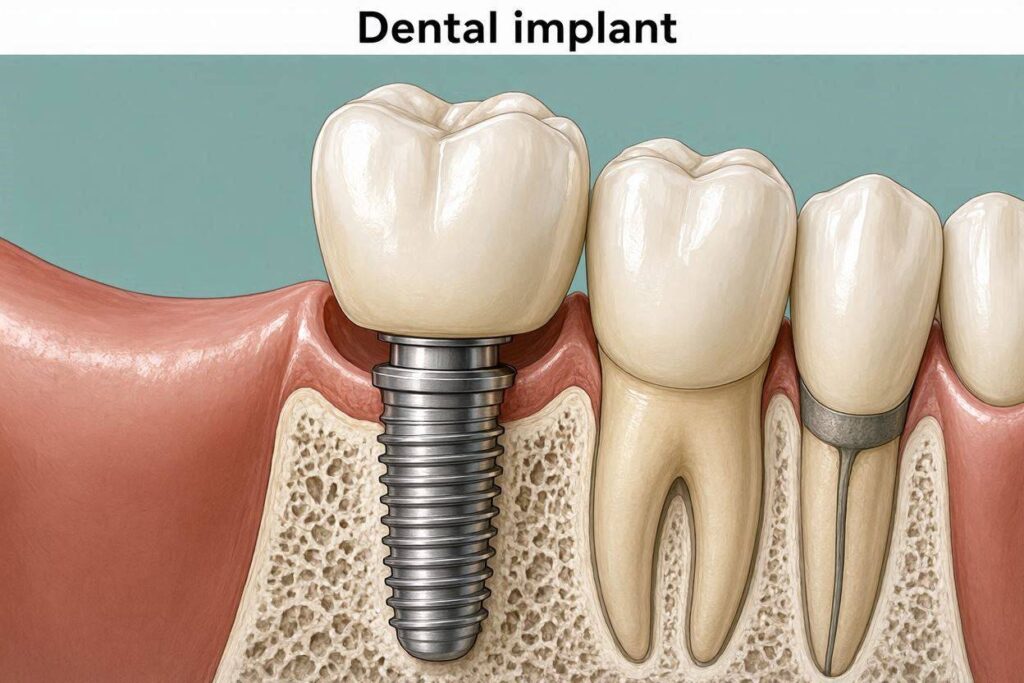
When a patient or a dentist uses the generic term “dental implant,” they are almost always referring to an endosteal implant. The word “endosteal” comes from the Greek “endo” meaning within, and “osteon” meaning bone. An endosteal implant is a medical device that is surgically placed inside the jawbone. It is the classic, modern dental implant: a screw, cylinder, or blade-shaped post that is inserted into a precisely drilled channel in the bone.
The endosteal implant acts as an artificial tooth root. Its purpose is to replace the root of the missing natural tooth and to provide a solid, stable anchor for a prosthetic tooth, a crown, a bridge, or a full-arch denture. The overwhelming majority of the millions of dental implants placed worldwide each year are endosteal root-form implants. The term “root-form” further specifies the shape: it mimics the tapered or cylindrical shape of a natural tooth root. Endosteal implants are made of biocompatible materials, primarily commercially pure titanium or a titanium alloy, although zirconia, a high-strength ceramic, is an emerging metal-free alternative. The entire science of modern implantology, the process of osseointegration, and the long-term success data exceeding 95% at 10 years are all based on the endosteal implant. When you are discussing a dental implant, this is the starting term.
The Defining Biological Term: Osseointegration
No discussion of the terminology of dental implants is complete without the most important biological term in the field: osseointegration. This term, coined by the Swedish researcher Dr. Per-Ingvar Brånemark, describes the direct structural and functional connection between living, ordered bone and the surface of a load-bearing artificial implant. It is the biological process that makes endosteal implants work.
Osseointegration is not a simple mechanical interlock of the implant threads in the bone. It is a cellular-level bond. When the titanium implant is placed, blood coats the surface. Osteoblasts, the bone-building cells, migrate to the implant surface and begin laying down new bone matrix directly onto the microscopic layer of titanium oxide. Over a period of three to six months, this bone matures and remodels, creating a rigid, intimate, and permanent fusion. The implant is not just held by friction; it is biologically welded to the skeleton. The term “failed osseointegration” describes the clinical situation where this bone-implant bond does not form, and a fibrous scar tissue capsule encases the implant instead. A mobile implant is a sign of failed osseointegration. This term is the conceptual cornerstone of implant dentistry, and understanding it is essential to understanding why a dental implant is a permanent, not a temporary, solution.
“Osseointegration is the word I want every patient to understand before they leave the consultation. It’s the miracle of the whole process. The body doesn’t just tolerate the titanium; it actively incorporates it into the living skeleton. That’s why an implant doesn’t slip or click like a denture. It’s a part of you.” — An Implant Dentist and Educator
The Prosthetic Terms: The Parts That Form the Tooth
The implant body in the bone is only one part of the system. The visible tooth and the connector that attaches it to the implant have their own specific terminology. These are the prosthetic components, and they are just as important to the final result as the implant itself.
Abutment: The abutment is the connector piece that screws directly into the implant body and protrudes through the gum tissue. It is the interface between the surgical world (the implant in the bone) and the prosthetic world (the crown). The abutment serves multiple critical functions. It supports the crown, shapes the gum tissue into a natural emergence profile, and, in screw-retained restorations, provides the seat for the crown. Abutments can be stock, meaning a prefabricated, off-the-shelf shape, or custom, meaning a patient-specific abutment milled from a block of titanium or zirconia to perfectly match the individual’s gum contour and implant angle. A custom abutment is the gold standard for aesthetic implant restorations. The term “healing abutment” refers to a temporary, wide, dome-shaped cap placed during healing to shape the gum before the final abutment is fabricated.
Implant Crown: The crown is the visible, tooth-shaped restoration that is attached to the abutment. It is the part of the implant that you see, brush, and chew with. Implant crowns are fabricated from high-strength dental ceramics, most commonly porcelain fused to a metal substructure or solid monolithic zirconia. The crown can be cement-retained, meaning it is glued onto the abutment, or screw-retained, meaning it has a small channel through the biting surface that allows a screw to pass through it and thread directly into the implant or abutment. Screw retention is generally favored by many restorative dentists because it is fully retrievable and avoids the risk of residual cement under the gum causing peri-implantitis.
The Alternative Implant Types: Subperiosteal and Transosteal
While the endosteal implant is the standard of care, there are two other historically significant and niche implant types that you may encounter in the literature or in specific, complex clinical situations.
Subperiosteal Implant: A subperiosteal implant is a custom-fabricated metal framework that sits on top of the jawbone, under the gum tissue. The term “subperiosteal” means beneath the periosteum, which is the connective tissue covering of the bone. This implant does not penetrate the bone for its primary stability; it rests on the bone like a saddle. Posts protrude from this framework through the gum to hold a fixed or removable denture. The subperiosteal implant was developed for patients with severe jawbone atrophy who could not tolerate conventional endosteal implants or bone grafting. In the modern era, digital technology and 3D printing have given this old concept a new lease on life. A CBCT scan is used to create a digital model of the bone, and a custom titanium framework is 3D-printed. The surgical placement is now a single-stage procedure. The subperiosteal implant is the correct term for an implant located beneath the gum but on top of the bone.
Transosteal Implant (Transmandibular Implant): A transosteal implant is a plate-and-post device that passes completely through the jawbone. The term “transosteal” means through the bone. The most well-known example is the transmandibular implant, which involves a titanium base plate that is secured to the inferior border of the mandible, under the chin, with vertical posts that pass through the full height of the bone and emerge into the mouth. This is a highly specialized, rarely used, and aggressively engineered solution for the most severely atrophic lower jaws. The surgery requires an extraoral incision under the chin. This term represents an extreme endpoint on the spectrum of implant solutions.
The Prosthesis Terminology: Full-Arch Restorations
When all the teeth in an arch are being replaced, a different set of terms describes the implant-supported prosthesis.
Hybrid Prosthesis (Fixed-Detachable): This is a full-arch, horseshoe-shaped bridge that is screwed into four to eight dental implants. It is called a “hybrid” because it is a hybrid of a denture and a fixed bridge. It has a pink acrylic base that replaces the lost gum tissue and bone, and white acrylic or porcelain teeth. The patient cannot remove it; only the dentist can remove it at maintenance visits. This is the classic “All-on-4” or “All-on-6” restoration. The correct term for this prosthesis in a treatment plan is a fixed, implant-supported, screw-retained hybrid prosthesis.
Implant-Retained Overdenture: An overdenture is a removable, full denture that snaps onto locator abutments on two to four implants. It is retained by the implants, providing vastly superior stability compared to a conventional denture, but the patient removes it daily for cleaning. The term “overdenture” specifically means a denture that fits over and is supported by retained tooth roots or implants. The term “locator” refers to the specific attachment system, a low-profile abutment with a resilient nylon insert in the denture that provides a snap-fit retention.
The table below provides a quick reference guide to these key terms.
| Term | Definition | Clinical Significance |
|---|---|---|
| Endosteal Implant | An implant placed within the jawbone | The standard, modern dental implant; 95%+ of all implants |
| Osseointegration | The direct, living bone-to-implant bond | The biological basis for implant success and permanence |
| Abutment | The connector between the implant and the crown | Supports the crown and shapes the gum tissue |
| Implant Crown | The visible, tooth-shaped restoration | The prosthetic tooth; made of porcelain or zirconia |
| Subperiosteal Implant | A framework resting on the bone, under the gum | A niche solution for severe jawbone atrophy without grafting |
| Hybrid Prosthesis | A full-arch, fixed, screw-retained bridge on multiple implants | The All-on-4/All-on-6 concept; not removable by the patient |
The Surgical Guide Terminology: Precision in Placement
Modern implant placement is often guided by a surgical guide, a 3D-printed template that dictates the exact position of the implant. The terms used in this digital workflow are important for understanding how precision is achieved.
Cone Beam Computed Tomography (CBCT): This is the 3D X-ray scan that provides the diagnostic data. It shows the bone volume, the nerve position, and the sinus anatomy. It is the foundational image for all guided implant surgery.
Surgical Guide (Surgical Stent): This is the physical, 3D-printed appliance that fits over the teeth or the gum and contains metal sleeves. The surgeon passes the precision drills and the implant through these sleeves, constraining the position to the pre-planned digital design.
Fully Guided Surgery: This term describes the protocol where every step of the osteotomy preparation and the implant placement is constrained by the surgical guide. This is the most accurate method of implant placement, achieving deviations of less than one millimeter from the plan.
Important Note: When discussing your treatment plan, ask your dentist to define any term you do not understand. A professional who uses precise terminology and is willing to explain it is demonstrating the depth of their knowledge. Be wary of vague, non-specific language.
Conclusion
The primary and most accurate term for a modern dental implant is an endosteal root-form implant, a biocompatible post surgically placed within the jawbone to act as an artificial tooth root. The critical biological process that anchors it permanently is osseointegration, the direct structural and functional bond between living bone and the titanium implant surface. The visible prosthetic parts are the abutment, the connector, and the implant crown, the tooth-shaped restoration, with alternative implant types including the subperiosteal implant, which rests on the bone, and the transosteal implant, which passes through the bone, reserved for severe atrophy cases.
Frequently Asked Questions (FAQ)
Q: What is the difference between a dental implant and a dental post?
A: A dental post is a small rod cemented into the root canal of a natural tooth to retain a core buildup for a crown. It is used inside an existing, endodontically treated tooth. A dental implant is a completely independent artificial root surgically placed into the jawbone to replace a missing tooth. They are entirely different procedures.
Q: What is a “mini dental implant”?
A: A mini dental implant is an endosteal implant with a very narrow diameter, typically less than 3.0 millimeters. It is often used to stabilize a lower denture in situations where there is insufficient bone width for a standard-diameter implant without grafting. It is a one-piece design where the implant and abutment are a single unit.
Q: What does “immediate load” mean?
A: Immediate loading refers to the placement of a temporary crown, bridge, or denture onto the implant at the same surgical appointment as the implant placement. This provides the patient with a fixed tooth on the day of surgery, but it requires the implant to achieve very high primary stability.
Q: What is a “sinus lift” and why is it related to dental implants?
A: A sinus lift, or sinus augmentation, is a surgical bone grafting procedure that adds bone to the floor of the maxillary sinus in the upper jaw. It is often required before placing an implant in the posterior upper jaw when the natural bone has resorbed and the sinus floor is too close, leaving insufficient bone height for an implant.
Additional Resource:
For a complete glossary of dental implant terms, the American Academy of Implant Dentistry provides an extensive patient education section: AAID Glossary.