How A Dental Implant Works: The Science and Stages of Tooth Replacement
A dental implant is often described as an artificial tooth root, but this simple definition fails to capture the profound biological and mechanical sophistication of the process. A dental implant is not merely a piece of inert hardware; it is a carefully orchestrated biological event. The titanium post placed in the jawbone does not just sit there; it actively engages with the living bone cells, triggering a cellular-level welding process that fuses the implant to the skeleton. The question “How does a dental implant work?” is a journey from a missing tooth to a fully restored, functional, and aesthetically indistinguishable replacement, a journey that integrates surgery, bone biology, and precision engineering. This guide will walk you through every stage of how a dental implant works, from the initial placement of the titanium fixture to the final delivery of the crown, explaining the scientific principles that make it one of the most successful procedures in modern medicine.
The Core Principle: Osseointegration, the Biologic Weld
The entire function of a dental implant rests on a single biological phenomenon: osseointegration. This term, coined by the Swedish orthopedic surgeon and researcher Dr. Per-Ingvar Brånemark, describes the direct structural and functional connection between ordered, living bone and the surface of a load-bearing artificial implant, without any intervening soft tissue. In the 1950s, Brånemark made a serendipitous discovery. He placed optical chambers encased in titanium into the leg bones of rabbits to study blood flow. When he went to remove these titanium chambers, he found that the bone had fused so tightly to the metal that the chambers could not be retrieved without fracturing the bone. The body had not rejected the titanium. It had embraced it. The bone cells had grown directly onto the titanium oxide layer on the surface of the metal, forming a molecular-level bond.
This discovery became the foundation of modern implant dentistry. A dental implant works because commercially pure titanium or a titanium alloy is a biocompatible material that the body’s immune system does not recognize as a foreign invader. When a precisely machined titanium implant is placed into a surgically prepared, accurately sized channel in the jawbone, a cascade of cellular events is initiated. Blood from the prepared bone coats the implant surface. Platelets release growth factors that attract osteoblasts, the bone-building cells. These osteoblasts migrate to the implant surface and begin laying down new bone matrix directly onto the titanium oxide layer. Over a period of three to six months, this immature woven bone remodels into mature, dense lamellar bone, creating a rigid, permanent, and intimate union. The implant is not a screw in a piece of wood; it is a biologic weld that transforms the implant into a functional part of the skeleton.
The Implant Surface: Engineering the Cellular Response
The surface of a modern dental implant is not smooth. Under a scanning electron microscope, it is a complex, three-dimensional landscape of microscopic peaks, valleys, and pores. This surface topography is the primary interface for osseointegration, and its design is the subject of decades of research and development.
A smooth, machined implant surface has a lower bone-to-implant contact ratio. The gold standard modern surface is a moderately rough, micro-roughened topography, created through a process called sandblasting with a biocompatible grit (like alumina or titanium oxide), followed by acid etching. This SLA (Sandblasted, Large grit, Acid-etched) surface dramatically increases the surface area available for bone cell attachment. It also creates a surface energy that attracts blood and osteogenic proteins. The most advanced evolution of this technology is the hydrophilic SLA surface. A traditional titanium surface is hydrophobic, meaning it repels water and blood. A hydrophilic surface is chemically treated to be instantly wettable, meaning blood and the proteins within it are drawn into the microscopic surface texture immediately upon contact. This accelerates the healing cascade, reducing the osseointegration period from a traditional three to four months to a potential six to eight weeks in healthy, dense bone. The implant surface is the engine of how an implant works biologically. The better the surface, the faster and more predictable the bond.
“Osseointegration is not just a mechanical interlock. It is an active, living bond. The titanium oxide layer on the implant is a biologically inert ceramic. The bone cells do not see it as a foreign object. They see it as a scaffold and begin to lay down bone matrix directly onto it. When I place an implant, I am not just putting in a screw. I am initiating a healing cascade that will result in the patient’s own bone cells holding the implant in place. It is, in my opinion, one of the most elegant phenomena in all of medicine.” — A Board-Certified Implant Surgeon
The Surgical Phase: Creating the Osteotomy and Achieving Primary Stability
The biological process of osseointegration cannot begin without the surgical phase, which creates the precise channel in the bone for the implant and establishes primary stability. Primary stability is the mechanical friction-lock of the implant in the bone at the time of placement. It is the clinical prerequisite for osseointegration. An implant that is loose in the bone will not integrate. The body will form a fibrous capsule around the mobile object, a scar tissue interface that is a biological failure.
The surgical procedure for a dental implant is performed under profound local anesthesia, often with the assistance of sedation for anxious patients. The surgeon begins by making a small incision in the gum to reflect the gum tissue and expose the underlying bone. Using a series of progressively wider, precision drills, the surgeon creates the osteotomy, the channel in the bone that will receive the implant. The drilling is performed at a controlled, slow speed under copious irrigation with sterile saline to prevent thermal necrosis, the overheating of the bone that can kill the osteocytes and destroy the bone’s ability to heal. A skilled surgeon feels the density of the bone through the drill and adjusts the protocol accordingly. The implant is then threaded into the prepared osteotomy. Because the implant is slightly wider than the final drill, it is compressed into the bone, creating a tight, frictional engagement known as primary stability. The surgeon verifies this stability with a torque wrench; an insertion torque of at least 30 to 35 Ncm is generally considered indicative of good primary stability.
With the implant placed, a cover screw or a healing abutment is attached to the top of the implant. If a cover screw is used, the gum is sutured closed over the implant, burying it completely during the healing period. If a healing abutment is used, it protrudes through the gum, eliminating the need for a second uncovering surgery. The choice depends on the surgeon’s protocol and the clinical situation. The surgical phase is now complete. The implant is in the bone. The biological phase, osseointegration, now begins.
The Restorative Phase: From Implant to Functional Tooth
After the osseointegration period, typically three to six months, the implant is ready to be restored with a tooth. The restorative phase is where the visible, functional crown is designed, fabricated, and attached to the implant.
If the implant was buried under the gum, a brief second-stage surgery is performed to expose the top of the implant and attach a healing abutment. This healing abutment is a small metal or plastic cap that shapes the gum tissue into a natural, rounded emergence profile. The gum is allowed to heal around this abutment for a few weeks. Once the gum is mature and healthy, the final restorative steps begin. The dentist takes an impression of the implant position using a transfer coping, or, in a modern digital workflow, scans the implant with an intraoral scanner and a scan body. This impression or scan captures the precise three-dimensional position and rotation of the implant platform. This data is sent to a dental laboratory.
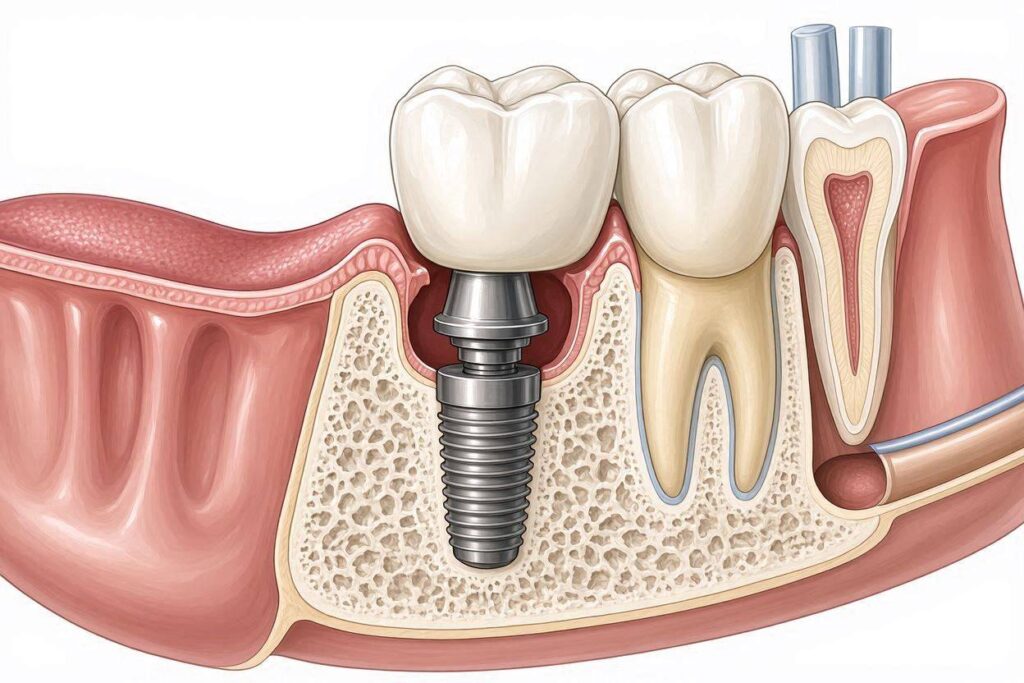
The laboratory uses the impression to fabricate a custom abutment and a crown. The custom abutment is a patient-specific connector, milled from titanium or zirconia, that screws into the implant and emerges through the gum with a contour that perfectly supports the final crown and the surrounding gum tissue. The crown is made of layered porcelain or a monolithic block of zirconia, shade-matched to the patient’s natural teeth. The abutment is torqued into the implant to the manufacturer’s specified force, and the crown is either cemented onto the abutment or screwed directly into the implant. The screw access hole is sealed with a small filling material. The implant is now a functioning tooth. It can be chewed on, flossed, and brushed. It has no decay risk. It is rigid, stable, and designed to last a lifetime with proper care.
The table below summarizes the components and their specific roles.
| Component | Material | Function | Placement Phase |
|---|---|---|---|
| Implant Fixture | Titanium or Zirconia | Artificial tooth root; integrates with bone | Surgical |
| Abutment | Titanium, Zirconia, or Gold | Connector between implant and crown; shapes gum tissue | Restorative |
| Crown | Porcelain fused to metal, Zirconia, or Acrylic | Visible, functional tooth; withstands chewing forces | Restorative |
| Healing Abutment | Titanium or Plastic | Temporary cap that shapes gum during healing | Surgical/Restorative transition |
The Biomechanics of Function: How the Implant Handles Chewing Forces
The final piece of understanding how a dental implant works is the biomechanics of function. A natural tooth is attached to the bone by the periodontal ligament, a fibrous, viscoelastic suspension system that allows the tooth to move slightly under load and provides sensory feedback to the brain about the hardness and texture of food. A dental implant has no periodontal ligament. It is ankylosed, rigidly fused to the bone.
This rigid connection changes the way force is transmitted. When you chew on a natural tooth, the ligament compresses, and the force is distributed along the entire root surface in a damped manner. When you chew on an implant crown, the force is transmitted directly and undamped through the rigid titanium post into the surrounding bone. The bone must be strong enough to absorb this force. This is why adequate bone volume and density are prerequisites for implant placement. The implant crown must be designed with a shallow occlusal anatomy that directs the force of chewing straight down the long axis of the implant, minimizing destructive lateral forces. A well-designed, well-placed implant handles these forces beautifully, stimulating the bone to maintain its density, a process known as Wolff’s Law, where bone remodels in response to the loads placed upon it. The implant, by transmitting force to the bone, prevents the resorption that occurs when a tooth is missing and the bone is no longer stimulated.
Conclusion
A dental implant works through the biological process of osseointegration, where living bone cells fuse directly and rigidly to the micro-roughened titanium surface of the implant, creating a permanent biologic weld that acts as an artificial tooth root. The surgical phase establishes a mechanically stable foundation, while the restorative phase attaches a custom-designed abutment and crown that replicates the function and aesthetics of a natural tooth, transmitting chewing forces directly to the bone to maintain its health. The entire system succeeds because titanium is biocompatible, the surgical protocol is precise and atraumatic, and the final restoration is engineered to direct forces axially, replacing not just the missing tooth crown, but the missing tooth root.
Frequently Asked Questions (FAQ)
Q: How is a dental implant different from a screw in the bone?
A: A screw is a passive mechanical fastener. A dental implant actively integrates with the bone at the cellular level. The bone does not just grip the threads; it bonds chemically and structurally to the titanium oxide surface. This biologic fusion is what makes an implant permanent and capable of supporting a tooth independently.
Q: Can the body reject a dental implant?
A: True immunologic rejection, like an organ transplant rejection, does not occur with titanium. However, an implant can fail if the bone does not osseointegrate, due to surgical trauma, infection, or patient risk factors. This is a failure of the healing process, not an allergic rejection.
Q: How long does it take for a dental implant to fully integrate with the bone?
A: For a standard implant in healthy bone, the process of osseointegration takes approximately three to four months in the lower jaw and four to six months in the upper jaw, where the bone is typically less dense. The use of a hydrophilic implant surface can accelerate this process.
Q: Is a dental implant noticeable as a foreign object in the mouth?
A: Once the final crown is placed and the patient has adapted to the new sensation, a properly placed dental implant should feel like a natural tooth. The patient should not be aware of the titanium post. The absence of the periodontal ligament’s proprioceptive feedback is a subtle difference, but the brain adapts quickly.
Additional Resource:
For a deeper understanding of the science of osseointegration, the Osseointegration Foundation provides educational resources: Osseointegration Foundation.