Does Prolia Affect Dental Implants?
You receive a Prolia injection twice a year. Your bones have become thinner with age, and this medication helps keep them strong. Now you need a dental implant, and a critical question surfaces: does Prolia affect your ability to receive dental implants safely? Could the medication that protects your bones from osteoporosis somehow interfere with the bone healing required for implant success?
The relationship between Prolia and dental implants is complex and clinically significant. Understanding this relationship is essential because serious complications, while uncommon, can be devastating when they occur. This guide explains exactly how Prolia affects dental implant treatment, what the risks are, how those risks can be managed, and what you should discuss with both your prescribing physician and your dental surgeon before proceeding.
What Is Prolia
Before exploring how Prolia affects dental implants, you need to understand what this medication is and how it works.
The Drug
Prolia is the brand name for denosumab, a medication manufactured by Amgen. It is administered as a subcutaneous injection, typically once every six months, in a healthcare setting.
How Prolia Works
Prolia is a monoclonal antibody that targets and inhibits RANKL (Receptor Activator of Nuclear factor Kappa-B Ligand). RANKL is a protein essential for the formation, function, and survival of osteoclasts, the cells that break down bone tissue.
By blocking RANKL, Prolia powerfully suppresses osteoclast activity. This reduces bone resorption (breakdown), leading to:
- Increased bone mineral density
- Reduced risk of fractures in patients with osteoporosis
- Slowed bone loss in certain cancer-related conditions
What Prolia Is Prescribed For
| Indication | Description |
|---|---|
| Postmenopausal osteoporosis | Women with high fracture risk |
| Osteoporosis in men | Men at high fracture risk |
| Glucocorticoid-induced osteoporosis | Bone loss from long-term steroid use |
| Bone loss from hormone therapy for cancer | Prostate or breast cancer treatment-related bone loss |
| Giant cell tumor of bone | Certain bone tumors |
| Hypercalcemia of malignancy | Cancer-related high calcium levels |
Prolia vs. Bisphosphonates
Prolia belongs to a different drug class than oral or intravenous bisphosphonates (Fosamax, Actonel, Boniva, Reclast, Zometa). However, both drug classes suppress bone resorption, and both have been associated with a rare but serious jaw complication.
The Critical Concern: Medication-Related Osteonecrosis of the Jaw
The primary concern linking Prolia to dental implants is a condition called medication-related osteonecrosis of the jaw (MRONJ).
What Is MRONJ
MRONJ is a condition in which bone in the jaw fails to heal after even minor trauma, leading to exposed, dead bone that can persist for months or years. It is defined clinically by:
- Exposed bone in the maxillofacial region that persists for more than 8 weeks
- History of treatment with antiresorptive or antiangiogenic medications
- No history of radiation therapy to the jaws
Why the Jaw Is Vulnerable
The jawbones are uniquely susceptible to antiresorptive medication effects for several reasons:
- High bone turnover rate: The jaw remodels bone faster than most other skeletal sites, making it more dependent on the balanced activity of osteoblasts (building) and osteoclasts (breaking down). Suppressing osteoclasts affects the jaw disproportionately.
- Thin mucosal covering: The bone in the mouth is covered by only a thin layer of gum tissue, making it vulnerable to exposure.
- Constant microbial challenge: The mouth contains billions of bacteria. Any breach in the gum tissue can introduce bacteria directly to bone.
- Frequent microtrauma: Chewing, brushing, and dental procedures create ongoing minor stress to jawbones.
MRONJ Risk with Prolia
| Factor | Detail |
|---|---|
| Incidence in osteoporosis patients | Approximately 0.01–0.03% per year (1–3 per 10,000) |
| Incidence in cancer patients (higher dose) | Approximately 1–2% per year |
| Risk after dental surgery | Higher than spontaneous risk |
| Risk increases with | Duration of therapy, concurrent medications, comorbidities |
The absolute risk for osteoporosis patients on Prolia is low. However, when MRONJ occurs, it can be extremely difficult to treat, and the consequences can be devastating.
How Prolia Specifically Affects Dental Implant Healing
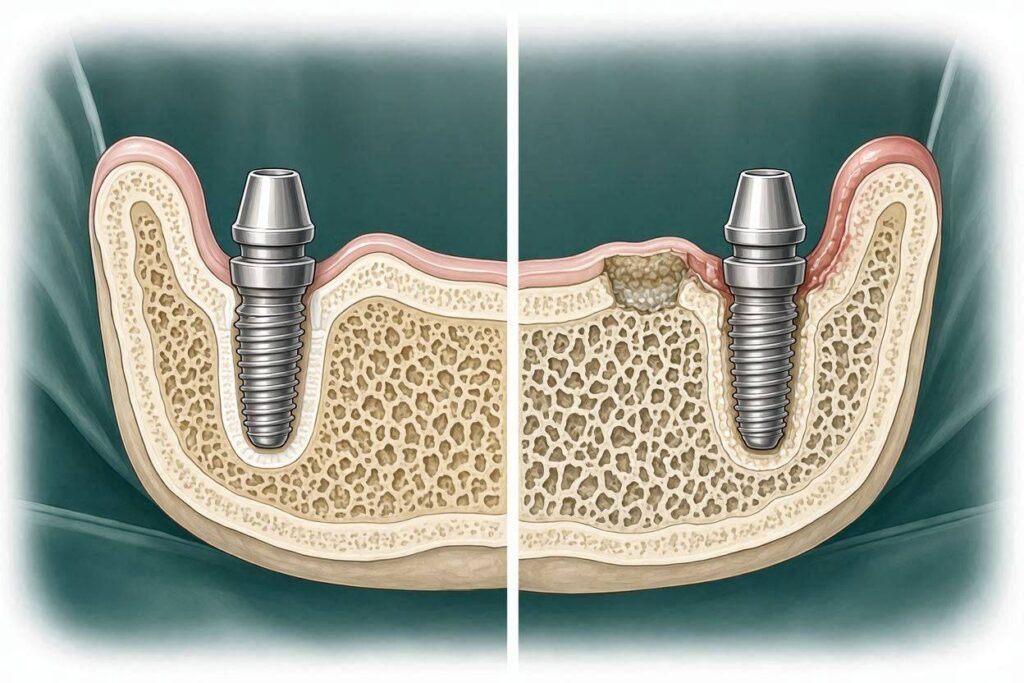
Dental implant placement creates a surgical wound in the jawbone. The healing of this wound requires a coordinated biological response that Prolia may interfere with.
The Normal Bone Healing Sequence After Implant Placement
| Phase | Key Processes | Cells Involved |
|---|---|---|
| Inflammatory phase | Blood clot formation; release of growth factors | Platelets, inflammatory cells |
| Resorptive phase | Removal of bone debris; preparation of the site | Osteoclasts |
| Formative phase | New bone deposition on implant surface | Osteoblasts |
| Remodeling phase | Maturation and strengthening of bone | Osteoclasts and osteoblasts |
Where Prolia Interferes
Prolia suppresses osteoclast activity. The resorptive and remodeling phases, which depend on osteoclast function, may be impaired. Specifically:
- Debridement of the surgical site: Osteoclasts normally remove bone debris and create a clean surface for new bone formation. Suppressed osteoclasts may leave debris that interferes with osseointegration.
- Bone remodeling: The initial woven bone that forms around the implant must be remodeled into stronger lamellar bone. This remodeling requires osteoclast activity.
- Response to microdamage: Normal function creates microscopic damage in bone that is continually repaired. Suppressed remodeling may allow microdamage to accumulate.
- Mucosal healing: Prolia may also affect the cells involved in soft tissue healing, though this effect is less well understood.
The Clinical Implications
| Implication | What It Means |
|---|---|
| Potentially slower osseointegration | The implant may take longer to integrate |
| Uncertain long-term stability | Bone remodeling around the implant may be impaired |
| Impaired healing if complications occur | Infection or wound dehiscence may be harder to resolve |
| Risk of MRONJ triggered by the surgery | The implant surgery itself could trigger osteonecrosis |
What the Research Shows
The scientific literature on Prolia and dental implants is evolving but provides important guidance.
Key Research Findings
Osteoporosis Patients on Denosumab (Prolia):
- Several case series have reported successful implant outcomes in patients on Prolia, with short-term success rates comparable to patients not on the medication
- However, case reports of MRONJ following implant placement in Prolia patients exist and serve as cautionary examples
- The overall body of literature is limited compared to bisphosphonates, reflecting Prolia’s more recent introduction
Higher-Dose Denosumab (Cancer Patients):
- The risk of MRONJ is significantly higher in cancer patients receiving the higher 120 mg monthly dose
- Implant placement in this population is generally considered high-risk
- Many guidelines recommend against elective implant placement in patients on oncologic-dose denosumab
Bone Turnover Markers:
- Prolia suppresses bone turnover markers (CTX, P1NP) significantly
- The clinical significance of suppressed bone turnover markers for implant outcomes is not fully established
- Unlike bisphosphonates, the suppressive effect of Prolia on bone turnover is largely reversible after discontinuation, typically within 6–9 months
Clinical Recommendations and Guidelines
Professional organizations have issued guidance on antiresorptive medications and dental implant surgery.
Risk Stratification
| Risk Category | Description | Implant Recommendation |
|---|---|---|
| Low risk | Prolia for osteoporosis, less than 2 years duration, no other risk factors | May be candidate with informed consent and careful management |
| Moderate risk | Prolia for osteoporosis, more than 2 years duration, or with additional risk factors | Caution; consider drug holiday if medically appropriate; enhanced informed consent |
| High risk | Prolia at oncologic dose, or osteoporosis dose with multiple risk factors | Generally avoid elective implant placement |
Additional Risk Factors
The presence of these factors increases MRONJ risk:
- Concomitant corticosteroid use
- Diabetes mellitus
- Smoking
- Periodontal disease
- Poor oral hygiene
- Advanced age
- Concurrent chemotherapy or other immunosuppression
- Previous MRONJ history
The Drug Holiday Concept
Unlike bisphosphonates, which accumulate in bone and have effects lasting years after discontinuation, Prolia’s effects are more rapidly reversible.
Prolia Pharmacokinetics
| Feature | Detail |
|---|---|
| Half-life | Approximately 25–30 days |
| Duration of effect | RANKL inhibition resolves over several months after the last dose |
| Reversibility | Bone turnover markers begin to recover approximately 6 months after the last dose is due |
| Dosing interval | Every 6 months |
The Drug Holiday Strategy
For patients on Prolia who need dental implant surgery, a temporary interruption of therapy (drug holiday) may be considered.
Potential approach:
- Patient receives their scheduled Prolia injection
- Dental implant surgery is planned for approximately 5–6 months after the last injection, when the medication’s effect is waning but before the next dose is due
- Surgery is performed during this window of relatively lower drug effect
- The next Prolia injection is administered after the surgical site has healed (typically 4–8 weeks after surgery)
Critical caution: Prolia discontinuation carries a risk of rapid bone loss and increased vertebral fracture risk. This is sometimes called the “rebound effect.” A drug holiday from Prolia should never be undertaken without the explicit approval and management of the prescribing physician. The decision involves balancing the risk of MRONJ from surgery against the risk of fracture from interrupting osteoporosis treatment.
Transitioning to Alternative Medications
In some cases, the prescribing physician may consider transitioning the patient to an alternative osteoporosis medication with a different mechanism of action, such as teriparatide (Forteo), which stimulates bone formation rather than suppressing resorption. This is a complex medical decision made by the physician, not the dentist.
Management Protocol for Patients on Prolia Needing Implants
A structured approach maximizes safety.
Pre-Treatment Evaluation
| Step | Action |
|---|---|
| 1 | Confirm Prolia indication, dose, frequency, and duration of therapy |
| 2 | Contact the prescribing physician to discuss planned implant surgery |
| 3 | Discuss the possibility of a drug holiday if medically appropriate |
| 4 | Assess additional MRONJ risk factors |
| 5 | Obtain cone beam CT imaging to evaluate bone quality and anatomy |
| 6 | Complete any necessary non-surgical dental treatment before implant surgery |
| 7 | Achieve optimal oral hygiene and periodontal health |
| 8 | Obtain comprehensive informed consent including MRONJ risk discussion |
Intra-Operative Management
- Atraumatic surgical technique
- Minimize periosteal stripping
- Achieve primary wound closure when possible
- Consider two-stage implant protocol (submerged healing)
- Prophylactic antibiotics may be considered (controversial; discuss with surgeon)
Post-Operative Management
| Time | Action |
|---|---|
| Immediate | Chlorhexidine mouth rinse as directed |
| Weeks 1–2 | Soft diet; meticulous oral hygiene; avoid trauma to surgical site |
| Weeks 2–4 | Monitor wound healing closely |
| Months 1–6 | Regular follow-up to monitor for signs of MRONJ |
| Ongoing | Regular professional maintenance; prompt evaluation of any concerns |
| Prolia coordination | Resume Prolia only after adequate healing, per physician guidance |
Signs of MRONJ to Watch For
- Exposed bone at the surgical site that persists beyond 8 weeks
- Non-healing wound despite adequate time
- Pain, swelling, or purulent discharge at the surgical site
- Numbness or altered sensation
- Loose teeth or implants
- Radiographic changes (persistent extraction socket, bone destruction)
Any of these signs warrant immediate evaluation by the dental surgeon.
Communicating with Your Healthcare Team
Effective communication between all providers is essential.
Information the Oral Surgeon or Implant Dentist Needs
- Exact medication name (denosumab/Prolia)
- Dose and frequency (60 mg every 6 months vs. 120 mg monthly)
- Duration of therapy
- Indication for the medication (osteoporosis vs. cancer)
- Prescribing physician contact information
- Any history of previous MRONJ or dental complications
Information the Prescribing Physician Needs
- Planned surgical procedure details
- Number of implants planned
- Anticipated surgical trauma extent
- Whether bone grafting is planned
- Timing of surgery relative to Prolia dosing schedule
- Request for guidance on drug holiday if being considered
The Informed Consent Discussion
Patients on Prolia considering dental implants should understand:
- The baseline risk of MRONJ with Prolia is low for osteoporosis patients (approximately 1–3 per 10,000 per year) but increases with dental surgery
- MRONJ can be difficult or impossible to treat
- The consequences of MRONJ can include chronic pain, infection, jaw fracture, and significant loss of jawbone
- Implant success rates in Prolia patients are not as well-documented as in patients not on the medication
- Alternatives to implants exist and should be discussed (bridges, removable prostheses)
- The decision to proceed involves accepting a small but real risk of a serious complication
Alternatives to Dental Implants for Prolia Patients
For patients who decide the risks of implant surgery outweigh the benefits, or for whom the prescribing physician advises against elective implant surgery, alternative tooth replacement options exist.
Conventional Fixed Bridge
| Advantage | Disadvantage |
|---|---|
| No surgical risk to jawbone | Requires reduction of adjacent healthy teeth |
| No MRONJ risk | Adjacent teeth may develop problems later |
| Predictable outcome | Does not preserve bone in extraction site |
| Lower cost | May need replacement every 10–15 years |
Removable Partial Denture
| Advantage | Disadvantage |
|---|---|
| No surgery | Less stable and comfortable |
| No MRONJ risk | May accelerate bone loss under the denture |
| Lower cost | Visible clasps may be aesthetic concern |
| Easily modified | Requires removal and special cleaning |
Removable Complete Denture
| Advantage | Disadvantage |
|---|---|
| No surgery | Least stable option |
| No MRONJ risk | Significant bone loss over time |
| Lowest cost | Reduced chewing efficiency |
| Psychological impact of tooth loss |
Resin-Bonded Bridge (Maryland Bridge)
| Advantage | Disadvantage |
|---|---|
| Minimal tooth preparation | Less durable than conventional bridge |
| No surgery | Limited to specific clinical situations |
| Lower cost | May debond over time |
Special Circumstances
Existing Implants and Starting Prolia
Patients who already have successfully integrated dental implants and are subsequently prescribed Prolia face different considerations:
- Existing, integrated implants are not a contraindication to Prolia therapy
- The primary concern with Prolia is surgical wound healing, not maintenance of existing osseointegration
- However, peri-implantitis (inflammation and bone loss around existing implants) may progress differently in patients on antiresorptive medications
- Excellent oral hygiene and regular professional maintenance become even more critical
- Any future dental surgery, including treatment of peri-implantitis, carries MRONJ risk
Prolia and Bone Grafting
Bone grafting procedures may carry higher risk than implant placement alone because:
- The surgical site is typically larger
- The grafted bone must be revascularized and remodeled, processes that depend on osteoclast activity
- Wound closure may be more challenging
- Healing is more complex than simple implant osteotomy
Patients on Prolia who need significant bone grafting should have an especially careful risk-benefit discussion.
Conclusion
Prolia (denosumab) affects dental implant treatment by suppressing osteoclast activity essential for normal bone healing and remodeling, and by carrying a risk of medication-related osteonecrosis of the jaw (MRONJ). While the absolute risk of MRONJ is low for osteoporosis patients on Prolia (approximately 1–3 per 10,000 per year), dental implant surgery increases that risk, and the consequences of MRONJ can be severe and difficult to treat. Successful implant outcomes are possible with careful risk assessment, coordination between the dental surgeon and prescribing physician, consideration of a medically supervised drug holiday, meticulous surgical technique, and close post-operative monitoring. Patients on oncologic-dose denosumab are at substantially higher risk and are generally not candidates for elective implant placement. The decision to proceed with implants should involve comprehensive informed consent and a thorough discussion of alternatives.
Frequently Asked Questions
Can I get dental implants while on Prolia?
It depends on your specific situation. Patients on Prolia for osteoporosis may be candidates for implants with careful management, informed consent, and coordination between providers. Patients on higher-dose denosumab for cancer are generally not candidates for elective implants. A thorough risk assessment is essential.
Does Prolia cause dental implant failure?
Prolia does not directly cause implant failure in the traditional sense, but it impairs bone healing and remodeling, which can interfere with osseointegration, and it carries a risk of MRONJ triggered by the surgical procedure.
Should I stop Prolia before dental implant surgery?
This decision must be made by your prescribing physician, not your dentist. Prolia discontinuation carries a risk of rapid bone loss and increased fracture risk. If a drug holiday is deemed appropriate, the timing of surgery relative to Prolia dosing must be carefully coordinated.
What are the signs of jaw problems with Prolia?
Signs include exposed bone in the mouth that does not heal within 8 weeks, persistent pain or swelling in the jaw, non-healing wounds after dental procedures, loose teeth, numbness or altered sensation in the jaw, and drainage or infection.
Are there alternatives to implants if I am on Prolia?
Yes. Fixed bridges, removable partial or complete dentures, and resin-bonded bridges are alternatives that do not involve jawbone surgery and therefore carry no MRONJ risk. Discuss these options with your dentist.
Additional Resources
- American Association of Oral and Maxillofacial Surgeons – MRONJ Position Paper: www.aaoms.org
- American Dental Association – Osteoporosis Medications and Oral Health: www.ada.org
- National Osteoporosis Foundation: www.nof.org