Who Is The Leader In Dental Implants?
You type “best dental implant brand” into a search engine and receive millions of results. Forums buzz with conflicting opinions. One dentist swears by a particular brand. Another uses something completely different. Marketing materials from every company claim superiority. You need an honest, evidence-based answer: who actually leads the dental implant industry, and does it matter for your treatment?
Leadership in dental implants is not about a single company dominating all others. It is about understanding which manufacturers have the strongest research foundation, the longest track records, the most innovative technologies, and the most extensive global presence. This guide provides a balanced, factual overview of the dental implant industry landscape.
Defining Leadership in Dental Implants
“Leader” means different things depending on the criteria applied.
Possible Definitions
| Criterion | What It Measures |
|---|---|
| Market share | Total revenue or units sold globally |
| Research and development | Investment in innovation and clinical studies |
| Clinical documentation | Volume and quality of published research |
| Longevity and track record | How long the company’s implants have been in clinical use |
| Innovation | Introduction of new technologies and surface treatments |
| Global reach | Availability in countries worldwide |
| Educational commitment | Training programs and professional development |
| Warranty and support | Product guarantees and replacement policies |
No single company leads in every category. Different manufacturers excel in different areas.
The Two Titans: Straumann and Nobel Biocare
Two companies stand above the rest in terms of research documentation, global presence, and historical significance.
Straumann
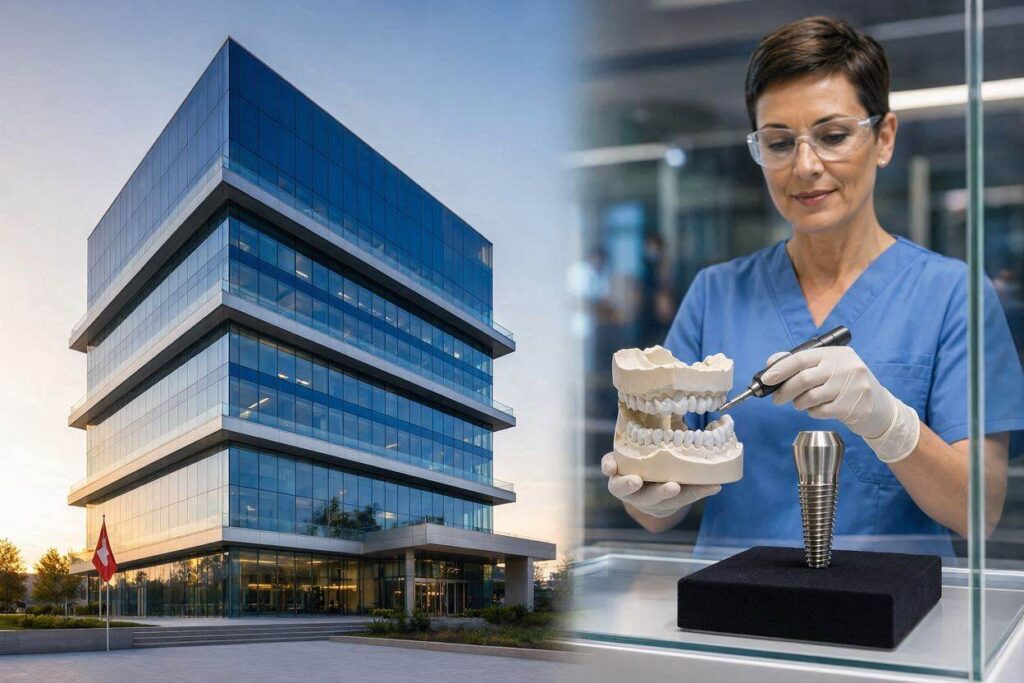
Headquarters: Basel, Switzerland
Straumann is widely considered a premium leader in implant dentistry. The company’s implants have extensive scientific documentation, and its surface technology is among the most studied in the field.
| Strength | Detail |
|---|---|
| Research foundation | Vast body of published clinical studies |
| Signature technology | SLActive hydrophilic surface; Roxolid titanium-zirconium alloy |
| Market position | Premium segment; strong global presence |
| Founded | 1954 (implant division developed later) |
| Key innovations | Tissue-level implant design; SLA and SLActive surfaces; Roxolid material |
The SLActive Surface: Straumann’s hydrophilic chemically modified surface accelerates early healing by attracting blood and proteins to the implant surface. This technology is backed by extensive research demonstrating faster osseointegration.
Roxolid: A titanium-zirconium alloy that is stronger than pure titanium, allowing for smaller-diameter implants without compromising strength. This expands treatment options for patients with limited bone.
Nobel Biocare
Headquarters: Kloten, Switzerland (part of Danaher Corporation)
Nobel Biocare holds a unique historical position as the company founded by Per-Ingvar Brånemark, the discoverer of osseointegration. The first modern dental implants were Nobel Biocare implants.
| Strength | Detail |
|---|---|
| Historical significance | Pioneer of osseointegration; first commercial dental implant |
| Research foundation | Decades of clinical documentation |
| Signature technology | TiUnite surface; All-on-4 treatment concept |
| Market position | Premium segment; strong global presence |
| Founded | 1981 (roots in Brånemark’s 1960s research) |
| Key innovations | All-on-4 protocol; TiUnite anodized surface; zygomatic implants |
The All-on-4 Concept: Nobel Biocare popularized and documented the All-on-4 treatment approach, which uses four implants to support a full arch of teeth. This protocol has transformed treatment for edentulous patients.
TiUnite Surface: A moderately rough anodized surface with a thickened oxide layer that supports osseointegration. This surface has extensive long-term clinical data.
The Established Competitors
Several other companies hold significant market positions and have substantial research backing.
Dentsply Sirona
Headquarters: Charlotte, North Carolina, USA
Dentsply Sirona is one of the largest dental companies globally, with an implant division that includes well-known brands.
| Brand Under Dentsply Sirona | Known For |
|---|---|
| Astra Tech Implant System | OsseoSpeed surface; conical connection |
| Xive | Established implant system |
| Ankylos | Tissue care connection; platform switching |
Astra Tech: Known for the OsseoSpeed fluoride-modified surface and a conical connection design that provides excellent stability and bacterial seal.
Zimmer Biomet
Headquarters: Warsaw, Indiana, USA
Zimmer Biomet combines orthopedic and dental implant expertise, with a substantial presence in the dental implant market.
| Strength | Detail |
|---|---|
| Known brands | Tapered Screw-Vent; Trabecular Metal |
| Key technology | Trabecular Metal material (porous tantalum) |
| Connection design | Internal hex with friction-fit |
Trabecular Metal: A unique porous metal material that mimics the structure of cancellous bone, potentially enhancing bone ingrowth. This technology differentiates Zimmer Biomet from competitors.
BioHorizons
Headquarters: Birmingham, Alabama, USA
BioHorizons is a well-regarded implant manufacturer known for specific technologies.
| Strength | Detail |
|---|---|
| Key technology | Laser-Lok surface |
| Design philosophy | Tissue preservation and aesthetics |
| Market position | Mid-to-premium range |
Laser-Lok: A laser-ablated surface that creates microchannels on the implant collar, which has been shown to support connective tissue attachment, potentially preserving crestal bone and soft tissue.
The Value Segment
Several companies offer implants at lower price points while maintaining acceptable quality.
Value Manufacturers
| Company | Characteristics |
|---|---|
| Hiossen (Osstem) | Large South Korean manufacturer; growing global presence |
| MegaGen | South Korean; known for internal connection design |
| Implant Direct | Founded by a former Nobel Biocare executive; offers competitive pricing |
| Neodent | Brazilian company now part of Straumann Group; value segment |
| MIS Implants | Israeli company; offers competitive products |
Value implants can offer adequate clinical results when placed properly. However, they typically have less extensive research documentation, shorter track records, and may offer less robust warranties than premium manufacturers.
Innovation Leaders
Some companies lead in specific technological areas.
Surface Technology Innovation
| Company | Technology |
|---|---|
| Straumann | SLActive (hydrophilic); Roxolid alloy |
| Nobel Biocare | TiUnite (anodized) |
| Dentsply Sirona (Astra Tech) | OsseoSpeed (fluoride-modified) |
| BioHorizons | Laser-Lok (laser-ablated microchannels) |
| Zimmer Biomet | Trabecular Metal (porous tantalum) |
Digital Workflow Innovation
| Company | Digital Solution |
|---|---|
| Straumann | Straumann CARES digital workflow |
| Nobel Biocare | NobelProcera; DTX Studio |
| Dentsply Sirona | CEREC integration; Primescan |
| Zimmer Biomet | Zfx digital solutions |
Does the Implant Brand Matter for Patients
This is the question most patients care about. The answer is nuanced.
What the Research Shows
Systematic reviews comparing implant brands generally find:
- High survival rates across all major implant brands (typically 93–98% at 10 years)
- No single brand consistently outperforms all others in well-designed comparative studies
- Differences between brands are smaller than differences between clinicians
- Surgeon skill and experience matter more than implant brand for clinical outcomes
When Brand Matters More
| Situation | Brand Importance |
|---|---|
| Routine single implant in good bone | Lower; most major brands perform well |
| Complex case with poor bone | Higher; advanced surfaces may offer advantages |
| Immediate loading protocol | Higher; documented protocols important |
| Full arch restoration | Moderate; established systems with prosthetic flexibility preferred |
| Patient with risk factors | Higher; research-backed surfaces and designs may help |
| Aesthetic zone | Moderate; prosthetic options and abutment selection matter |
| Long-term warranty concerns | Higher; premium brands offer stronger warranties |
What Matters More Than Brand
| Factor | Why It Matters |
|---|---|
| Surgeon skill and experience | The most critical factor in implant success |
| Treatment planning | Proper case selection and planning prevent failures |
| Surgical technique | Atraumatic preparation preserves bone healing capacity |
| Restorative quality | The crown or prosthesis must fit precisely |
| Patient factors | Hygiene, smoking, systemic health affect outcomes |
| Maintenance | Regular professional care prevents peri-implantitis |
The Warranty Dimension
Implant warranties differ significantly between manufacturers and may influence brand choice.
Typical Warranty Structures
| Brand Tier | Typical Warranty |
|---|---|
| Premium (Straumann, Nobel Biocare) | Lifetime warranty on implant fixture; often includes replacement implant if failure occurs |
| Mid-range | 10–20 year warranty or limited lifetime |
| Value | Limited warranty; 5–10 years typical |
Warranties typically cover the implant fixture only, not surgical fees or the restoration. Some require the implant to be restored with compatible components.
Geographical Leadership
Market leadership varies by region.
| Region | Leading Manufacturers |
|---|---|
| North America | Nobel Biocare, Straumann, Zimmer Biomet, Dentsply Sirona |
| Europe | Straumann, Nobel Biocare, Dentsply Sirona |
| Asia-Pacific | Osstem (Hiossen), Straumann, Nobel Biocare |
| Latin America | Neodent (Straumann Group), SIN, Nobel Biocare |
| Middle East | Straumann, Nobel Biocare, MIS Implants |
The Educational Commitment
Premium manufacturers invest heavily in education and training.
| Company | Educational Programs |
|---|---|
| Straumann | International Team for Implantology (ITI) partnership; extensive course offerings |
| Nobel Biocare | Nobel Biocare Global Symposium; training centers worldwide |
| Dentsply Sirona | Astra Tech education programs; university partnerships |
| Zimmer Biomet | Zimmer Biomet Institute; hands-on training |
This educational commitment supports the profession and ensures that clinicians are trained in proper techniques using their systems.
Making Sense of Brand Choice as a Patient
Questions to Ask Your Surgeon
- What implant brand do you use, and why did you choose it?
- How long have you been using this system?
- What is the warranty on the implant?
- If I move or need treatment elsewhere, is this brand widely available?
- What is your personal success rate with this implant system?
- Are there clinical situations where you would choose a different brand?
Red Flags
- A surgeon who cannot articulate why they use a particular system
- Use of obscure brands with no research documentation
- Claims that one brand is dramatically superior to all others
- Refusal to discuss brand choice
Conclusion
The dental implant industry is led by two premium manufacturers with the most extensive research foundations and longest track records: Straumann and Nobel Biocare. Straumann is known for its SLActive surface and Roxolid alloy, while Nobel Biocare holds the historical legacy of osseointegration’s discovery and the All-on-4 treatment concept. Strong competitors including Dentsply Sirona (Astra Tech), Zimmer Biomet, and BioHorizons offer excellent implant systems with their own technological distinctions. Value manufacturers like Osstem, Implant Direct, and Neodent provide more affordable options with less extensive documentation. Research consistently shows that surgeon skill, treatment planning, and patient factors influence implant success more than brand choice alone, though premium brands offer advantages in research backing, warranties, and global availability.
Frequently Asked Questions
Which dental implant brand is the best?
There is no single “best” brand. Premium manufacturers like Straumann and Nobel Biocare have the most extensive research and longest track records. Mid-range manufacturers like Astra Tech and Zimmer Biomet produce excellent implants. The skill of the surgeon matters more than the brand.
Does it matter which implant brand my dentist uses?
Yes, to an extent. A well-documented brand from an established manufacturer with a good warranty is preferable to an obscure brand with no research support. However, a skilled surgeon using a mid-range implant will achieve better results than a less skilled surgeon using a premium implant.
Are cheaper implant brands safe?
Many value implant brands meet regulatory standards and can produce acceptable results. However, they typically have less research documentation, shorter track records, and more limited warranties. Discuss brand choice with your surgeon.
Why do some implant brands cost more?
Premium brands invest heavily in research and development, clinical studies, surface technology innovation, quality control, surgeon education, and warranty programs. These investments are reflected in the implant cost.
Can I request a specific implant brand?
You can discuss brand preference with your surgeon, but the surgeon should use the system they are most experienced and comfortable with. A surgeon using their preferred system will achieve better results than using an unfamiliar system at a patient’s request.
Additional Resources
- International Team for Implantology: www.iti.org
- Academy of Osseointegration: www.osseo.org
- American Academy of Implant Dentistry: www.aaid.com